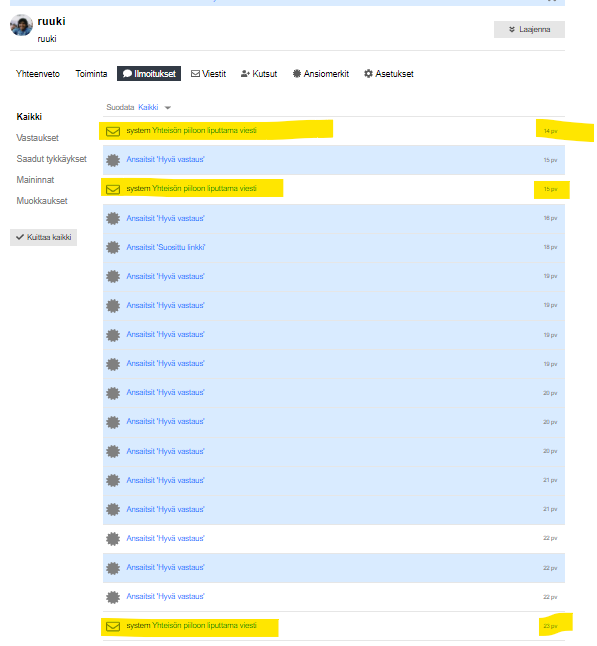
Indeed, that single message doesn’t bother me, and probably many others either, but if these kinds of messages start appearing more often in these company threads, there will be a lot of them, and other genuinely informative things might get lost, especially in active threads. Your message would be particularly good, for example, in the coffee room or a few other threads, and I didn’t mean to express any particular negativity towards your writing.
It would be desirable for feedback to be received appropriately if it has been attempted to be given appropriately. The intention here is not to deliberately upset people but to respect the general principles and rules of the forum. There’s no need to take these things too seriously and start sulking or similar because of this feedback, for example.
I wonder if the flags came on the same day or hour, or what the logic was behind flags and bans? Three flags and then a ban sounds pretty harsh for an automated action.
It’s quite annoying to write long replies to messages, only for them to be flagged and removed from the threads immediately after. The Spinnova thread is starting to look like I’m just talking to myself.
On a general note, I’d hope that flags would be reserved for genuinely pointless messages, and even slightly relevant messages would be left alone. Removing a slightly weaker message from the middle of a discussion degrades the quality of the discussion more than the message itself would.
Those messages have been moved to the correct thread, @JK-32, because they do not belong in the Spinnova thread at all. I considered that your message (even though it was only a reply to another message) was still highly relevant to Spinnova, and as such, it was good to keep it in the thread. Let’s not flood company threads with, for example, IPO technical questions or other unrelated messages—that does not serve the purpose of the Forum, nor the interest of investors, especially when there is a dedicated place for such discussions on the Forum (e.g., the general IPO thread and the coffee room for other chatter).
You’re at the heart of my point. I would never have written my highly relevant messages in the thread if slightly below-average comments hadn’t sparked them. In a good discussion, not every comment is excellent; there’s room for even below-average comments in between.
Excuse me, but flagging and deleting messages is not about the quality of comments (or rather, the reader’s experience of them) but about whether the message fits and belongs in the discussion. A message can also be offensive or inappropriate in its content. EDIT: Messages that are unreadable due to their language can and should also be flagged.
If one imagines that flags are “grades” for messages and that they are somehow rated and ranked, and the worst ones are then flagged, one is quite clueless about how internet discussion forums work. In addition, the forum rules have not been read during registration.
This is it (the consequences of flagging are not clear, probably not even to myself ), many “trolls” from, for example, the Kauppalehti forum have found their way to this forum, especially in the Nokia discussion, just to lower the level and rant that it has dropped 95% in 20 years :-D. Then they flagged posts and the poster got a ban, automatically? That’s not entirely sensible either.. I still don’t know why I got banned (3 flags in a week for similar tracking messages in the Nokia thread), apparently that’s the reason, and I won’t continue that tracking anymore, since it annoys someone (dozens still like it), isn’t that quite fair?
I haven’t noticed anything in Ruukki’s posts that violates the rules. As I understand it, Ruukki’s monitoring of bot trading in the Nokia thread interested quite a few people and probably annoyed some significantly.
I wish there was a feature here that would show who flagged a post, because some people surely do it just to be annoying. It would also be good to be able to talk to the flagger to at least get their reasons. It feels like flagging is done based on personal preference, for example, in this comment it’s okay to go to a store, whereas when I suggested something similar in the Puuilo chain, my posts were removed…
In my opinion, viljo’s and Average_Joe’s messages are not useless and should not be flagged or deleted. The fact that a few forum readers become customers of the company or at least visit the store can bring a little added value. A few examples:
If you know customers of Handelsbanken and Nordea, you might get a better picture of the differences in customer service and operating culture between the banks.
If you know someone who has been visiting Stockmann (Helsinki’s department store) since the 80s, you might have already gotten a slightly better idea of the gradual collapse of their customer service a few years ago.
Lynch himself was genuinely inspired to research companies by personal experiences; for example, one of his greatest successes, Dunkin’ Donuts, he began to research, if I recall correctly, after enjoying the taste of the chain’s coffee.
I believe those who flag posts should have the responsibility not to flag a post after just a few seconds of thought, but to consider for a while whether the message is truly useless. Okay, viljo’s message would have been a bit more effective if he had first visited the store, then shared his experiences, and finally encouraged others to do the same. But the idea has a right to be visible, as does Average_Joe’s case.
I completely disagree, organizing a lynching-type ground operation like that brings silent information that no one else has → extremely valuable for small investors who are looking for that edge in the market.
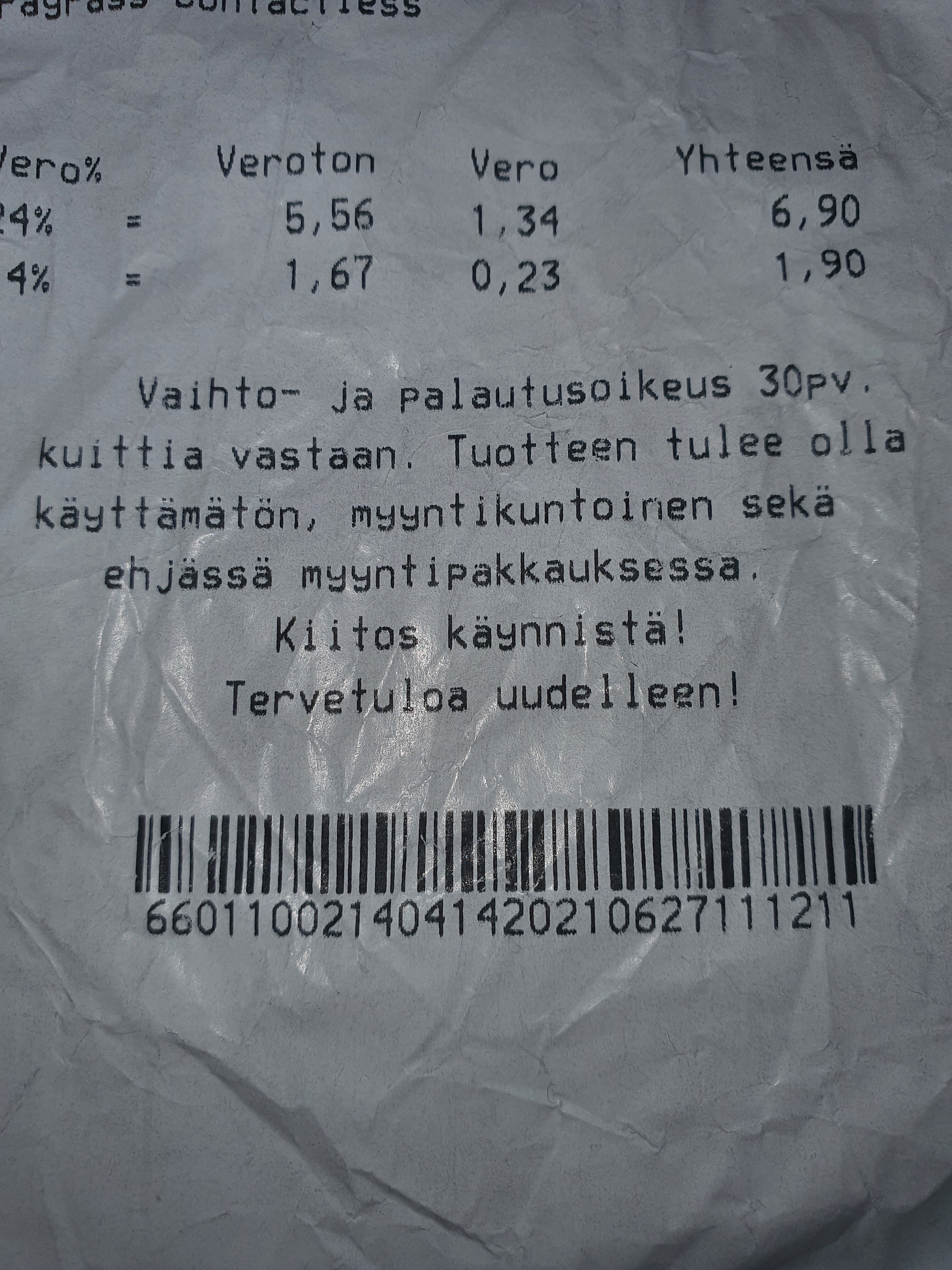
I think that, fundamentally, some people want to look at their investment from a macro level and believe that micro-level issues wouldn’t affect it. However, the following example might be interesting: below is a picture of a receipt from Puuilo.
I bought a washing machine and a dryer from Veikon Kone and wanted a laundry tower, so I bought an adapter. I noticed at home that the cabinet was too narrow, so the adapter didn’t fit between the machines, and I went to return it. The salesperson said that their return policy only applies to online purchases, so in this case, the customer is stuck with a 70e adapter that only works for a specific brand.
As a result of the previous shopping experience, I have favored Gigantti because I can return a product if I want to. The nuances might be minor, but they still affect customer loyalty.
On the other hand, I find “information” useless when someone reports that a shelf for a certain product is empty after visiting a store. The same kind of useless information applies to car sales… Sales figures will eventually come out with the correct numbers.
But in the end, the moderators decide whether to accept the flag or not, so my personal opinion doesn’t really matter.
In Puuilo’s case, it’s mostly a debate about whether the aisles are too narrow or not. One analyst, after visiting a store, noted the cramped space, but if a mortal says the same, it’s not a relevant observation. My own observation today, when visiting the said establishment, was the narrowness, as the shopping cart touched items on both sides (the aisle was narrower than the shopping cart in places). Some see this as a virtue, as more goods fit, while others are annoyed. The truth seems to be that some stores implement a different layout than others? Or perhaps store management has the freedom to implement shelf spacing as they please. I would have been interested in clarifying this matter, but my intentions were thwarted, and I accept my fate. One could ask these questions from the chain management, if an ordinary person has the means to do so.
Looks like there’s more important things to ponder during Midsummer than Viljo’s writings!
How about we agree that company-specific topics can only be written about in connection with the publication of interim reports and press/stock exchange releases. Everything else is just hearsay and speculation
That’s a very good point of view when considering a store’s success. Which represents a more typical customer for the shop, an analyst or a so-called “average Joe”? Which has a greater impact on the store’s success, and which on the stock’s valuation? In the short term, the analyst’s opinion has a greater impact; in the slightly longer term, the average customer’s.
 )
)