Here is the Sifter fund’s annual report for 2025 in video format
The year 2025 managed to show two very different sides. The year began strongly, as markets rose by about five percent in January, but after Liberation Day in April, the direction changed quickly. The volatile market environment reminded investors of how suddenly the mood can shift.
The return of the Sifter fund during 2025 was 6.6% for the PA class and 7.1% for the PI class. Remember that historical returns are no guarantee of future results.
Riku from Sifter wrote on LinkedIn about fund returns and the returns investors actually receive in reality.
Because fund investors trade in and out of funds, their returns are lower than the fund returns themselves.
Fund returns are calculated as if an investor had invested their money all at once and kept it invested the whole time. In real life, this does not happen. Money is added, withdrawn, switched, and moved, driven by market conditions and emotions.
In the recent Mind the Gap 2025 report, Morningstar examined the last ten years. During this period, funds returned an average of 8.2% per year, but the actual outcome for investors was 7.0%.
@Santeri_Korpinen has written an interesting piece that includes, among other things, the psychology of investing.
We know from experience that the markets reward patience and money works over time. However, the stock market constantly tests an investor’s nerves. The biggest investment mistakes often do not arise from a lack of information, but from the investor’s reaction.
When financial media headlines are screaming and prices are volatile, doing nothing feels like passivity, even though it is often the most active and productive decision.
Let’s look at this phenomenon through one of my favorite topics: the psychology of investing.
Good article on when to sell a stock. Investors are also proven to spend less time thinking about sales, even though their role is also important for returns!
The first quarter started strongly, but in March, the escalation of the situation in Iran wiped out a large part of the returns from the beginning of the year. The Sifter fund’s PB class returned +0.3% in the first quarter of the year. A modest but positive return in a fast-moving market.
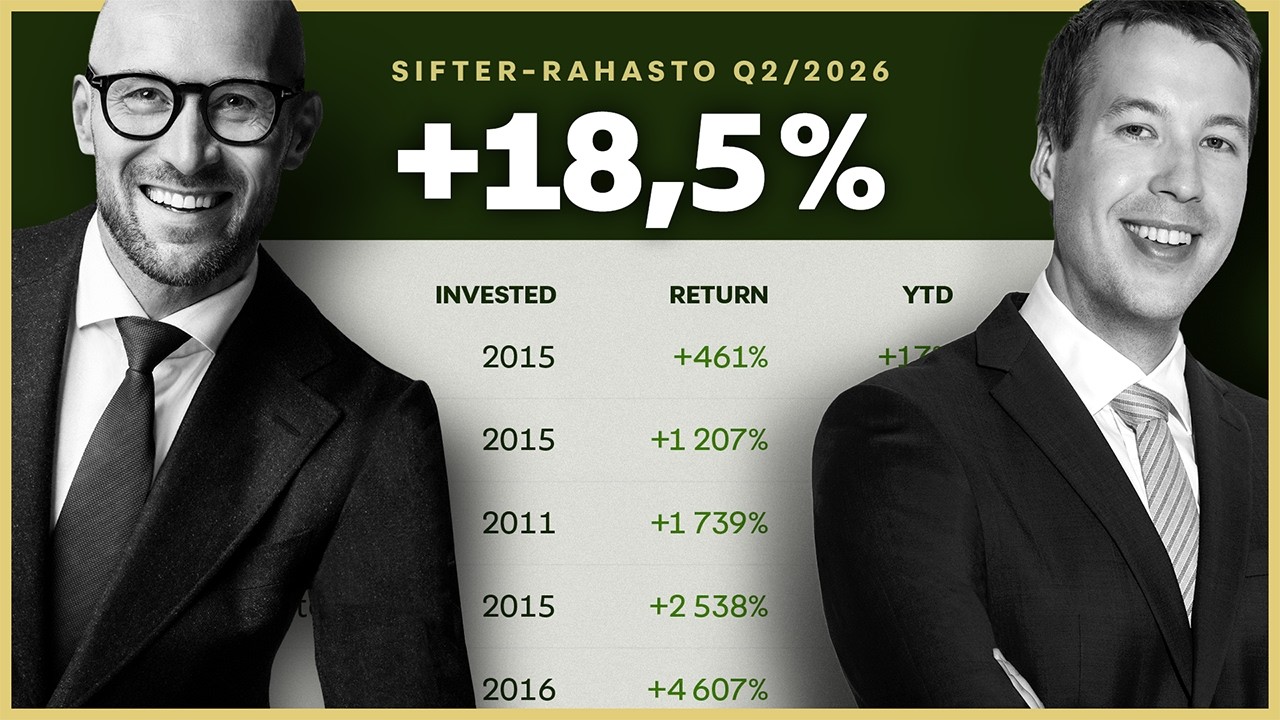
Another interesting discussion with Sifter’s @Santeri_Korpinen. Sifter has been trimming positions in semiconductor stocks that have risen. The second half of the interview covers the mental pressures faced by portfolio managers. Competition is fierce, and the pressure of managing other people’s money is commensurately high.
00:00 Disclaimer 00:05 Semiconductor companies have performed best YTD 00:40 Sifter fund returns 01:30 Sifter fund 23 years 02:31 Top gainers in Q2 04:00 Top losers in Q2 05:19 The portfolio’s 10 largest investments and returns 07:39 Portfolio changes and new investments 13:57 Allocations 15:20 Valuation