My memory of the early 2010s is different. I remember Pesonen saying directly that newsprint machines would not be converted or renewed, but rather run to their end, and the resulting cash flow would be used to develop new businesses. UPM thus made a different strategic choice than SE and MG.
At that time, the largest ongoing projects were the refining of biofuels in Lappeenranta as a completely new business, and the expansion/diversification of pulp production in the Uruguay project. In addition, Pesonen strongly emphasized UPM’s transformation from a bulk paper producer to a high-tech company. Previously, UPM registered only a few patents a year; in the early 2010s, the number rose, I don’t remember exactly, perhaps 20-fold?
Hindsight is, of course, always the best wisdom, and it is clear that innovations in the forest sector will largely continue to depend on political guidance – that is, in practice, whether producers of replaceable products (such as traditional cotton producers in the case of wood-based textile fibers) have to pay for the negative external effects they cause, or not. Politicians often decide for political reasons that they do not have to. In such cases, high-tech solutions from the forest industry cannot compete economically. This has also happened to a very large proportion of forest industry innovations since the early 2010s.
I don’t know which year in the early 2010s was referred to here, but in my memory, Pesonen’s view on the future of printing papers was no more optimistic than others’. Surely many expected some kind of recovery, but the depth and permanence of the decline came as a surprise.
On the other hand, at the societal level, we expected until about 2020 that the economy would soon enter strong growth after the 2008 crisis, as had always happened before. Now a huge number of people have appeared who, of course, immediately saw that economic growth like before was never going to happen. Hindsight is always easiest.
If one disregards those tonnes and cubic meters and instead looks at their relative figures, revenue has increased by 33% in ten years. However, inflation has eroded 26% of that (EUR Inflation Calculator - Euro (2014-2025)). Still, 7% better. Are the chosen years the best possible for comparison, as revenue and production vary? It would be nice to see a similar comparison for other companies as well.
As a forest owner, I wouldn’t be overly concerned about this UPM situation. Let’s hypothetically assume that the new JV would close the Kirkniemi paper mill, meaning a capacity reduction of 575,000 tons per year. This multiplied by 3, meaning a reduction in raw wood demand of 1,725,000 cubic meters of wood per year. However, that’s only about 5% of fiberwood consumption in Finland. Of course, it would affect the price of raw wood, but less than the imported wood brought from Russia back in the day.
UPM is launching UPM Circular Renewable Black™ pigment, a groundbreaking innovation that redefines the role of black color in sustainable packaging. UPM Circular Renewable Black is the world’s first bio-based and carbon-negative\[1\] pigment that can be identified by near-infrared (NIR) radiation. It enables premium packaging that combines top-tier design, full recyclability, and strong, responsible performance.
Black packaging has long been considered a challenge for recycling, as fossil-based carbon black prevents optical sorting in NIR systems, making packaging virtually invisible in recycling facilities. UPM Circular Renewable Black changes the situation. The pigment is made from renewable lignin and is certified according to independent certification systems (FSC\[2\], PEFC\[3\], ISCC Plus). The pigment offers an iconic deep black shade, full NIR detectability, and a carbon-negative footprint, enabling brands to adopt circular economy-supporting and climate-positive packaging solutions.
UPM Circular Renewable Black is part of UPM’s portfolio of carbon-negative solutions, which will be produced at the company’s 1.3 billion euro biochemicals plant in Leuna, Germany. The plant is Europe’s largest industrial-scale investment in biochemical production. It converts sustainably sourced hardwood into next-generation biochemicals and accelerates the transition from fossil-based solutions to renewable materials across various industries.
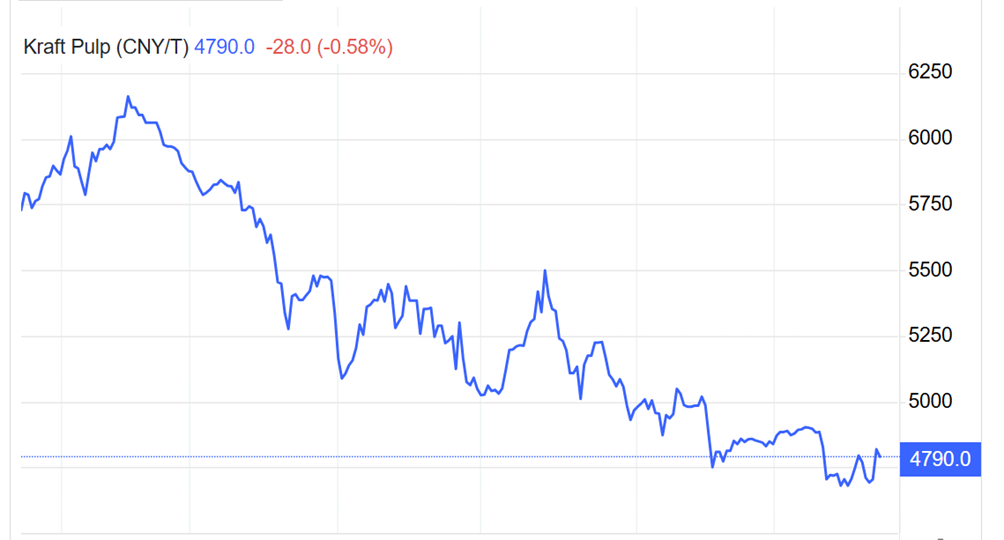
This 2025 pulp price curve doesn’t give much cause for celebration. Additionally, over the weekend, news came that the economy in the price-leading region, namely China, is struggling badly. Is the pulp producers’ elimination game truly beginning?
It certainly looks bad, but luckily the price of wood has already come down. Apparently, in addition, cardboard has started flowing into Europe from China in increasing amounts, which creates even more price pressure.
Next, will Joutseno, Uimaharju, Kaukas, or even Anjala permanently shut down?
This issue of raw wood prices in Finland will only be resolved if 1) a couple of medium-sized pulp mills and a few sawmills/plywood factories are closed domestically, or 2) wood starts coming from Russia again.
Otherwise, I agree with Jekkku, those are the endangered pulp mills.
It will be interesting to see how long the management of pulp companies believes in better times and runs factories at 70-80% utilization rates. It’s worth noting that the price of wood in Finland has decreased due to reduced demand from factory shutdowns. When pulp demand picks up, the price of pulpwood will skyrocket again. Solutions to the profitability crisis are still ahead.
UPM announced in March 2025 its plan to cease graphic paper production at Ettringen, Germany. Change negotiations have now been concluded, and the mill’s closure affects 189 employees.
With the closure of the Ettringen mill, UPM’s annual production capacity for uncoated graphic papers will decrease by 270,000 tonnes. The mill will cease operations by the end of December 2025. After the closure, a post-care team will be appointed to ensure the safety of the mill.
The process extended by 5 months. The original schedule was to close already in July 2025. Apparently, the negotiations according to German law did not proceed so smoothly, but momentum was sought through arbitration.