Saga Furs - A value company on the Helsinki Stock Exchange

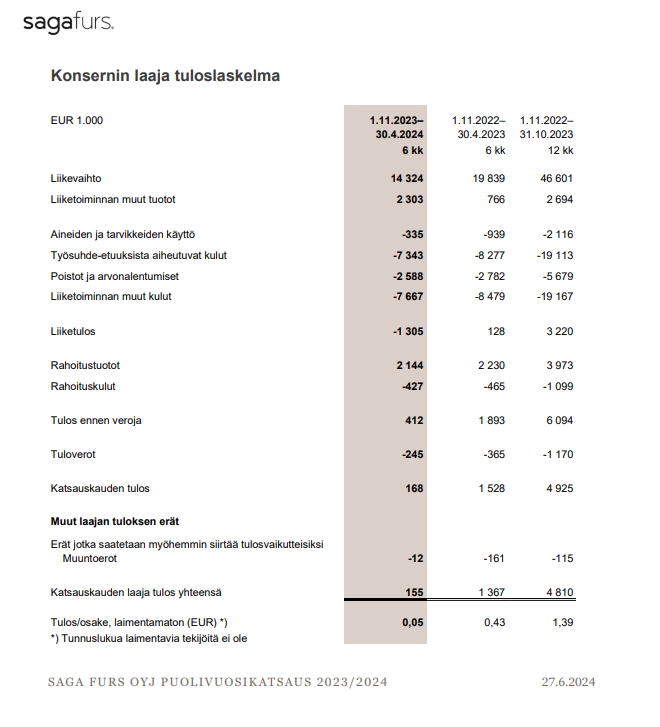
I thought I’d open a thread for a true value company on the Helsinki Stock Exchange, Saga Furs, which didn’t have a thread or any discussion yet. After years of languishing, Saga Furs might have an opportunity for significant profit growth following the closure of its largest competitor. Saga Furs issued a positive profit warning today. Saga Furs Oyj: Positive profit warning, inside information: Saga Furs Group’s result for the ended financial year clearly better than the previous year | Kauppalehti

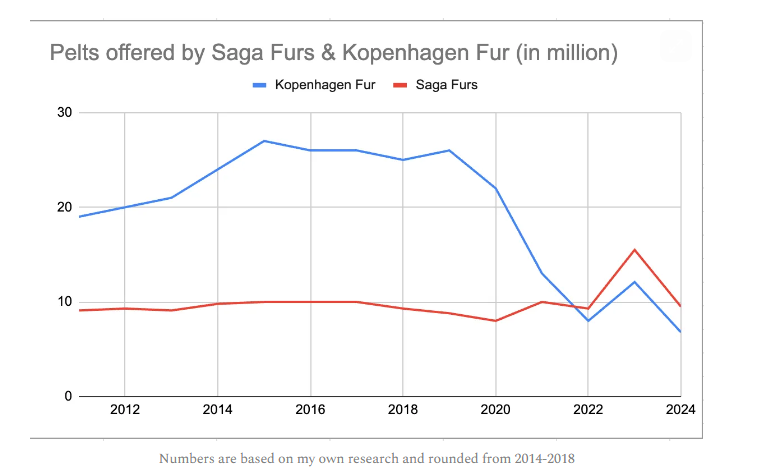
Saga Furs doesn’t necessarily operate in a glamorous industry, as the company organizes fur auctions. However, the company is in an interesting situation because the market leader in fur auctions, Kopenhagen Furs, is shutting down its business entirely, likely during this year, 2024. A few years ago, Kopenhagen Furs’ market share was around 60%. This could potentially provide Saga Furs with a significant amount of market share. The cost structure of auctions is quite fixed, and profitability could be pushed higher through additional sales (cf. 2021 revenue of €51M and EBIT of €11M). According to the just-issued positive profit warning, revenue in 2023 was €46M. Saga Furs has the opportunity to organically achieve a near-monopoly market position, as competitors have ceased operations and the industry isn’t the most attractive, so there will likely be very little new competition :smiley:

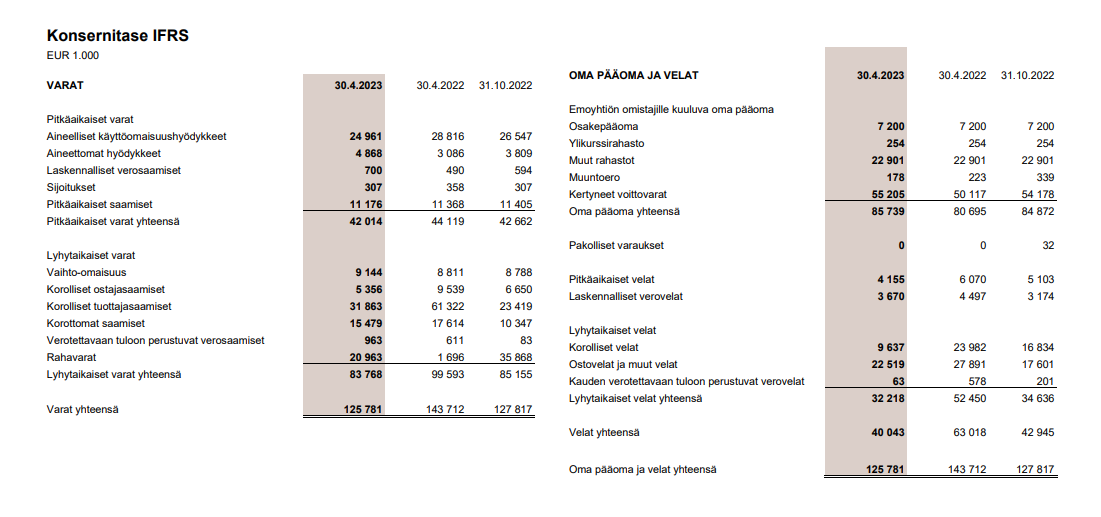
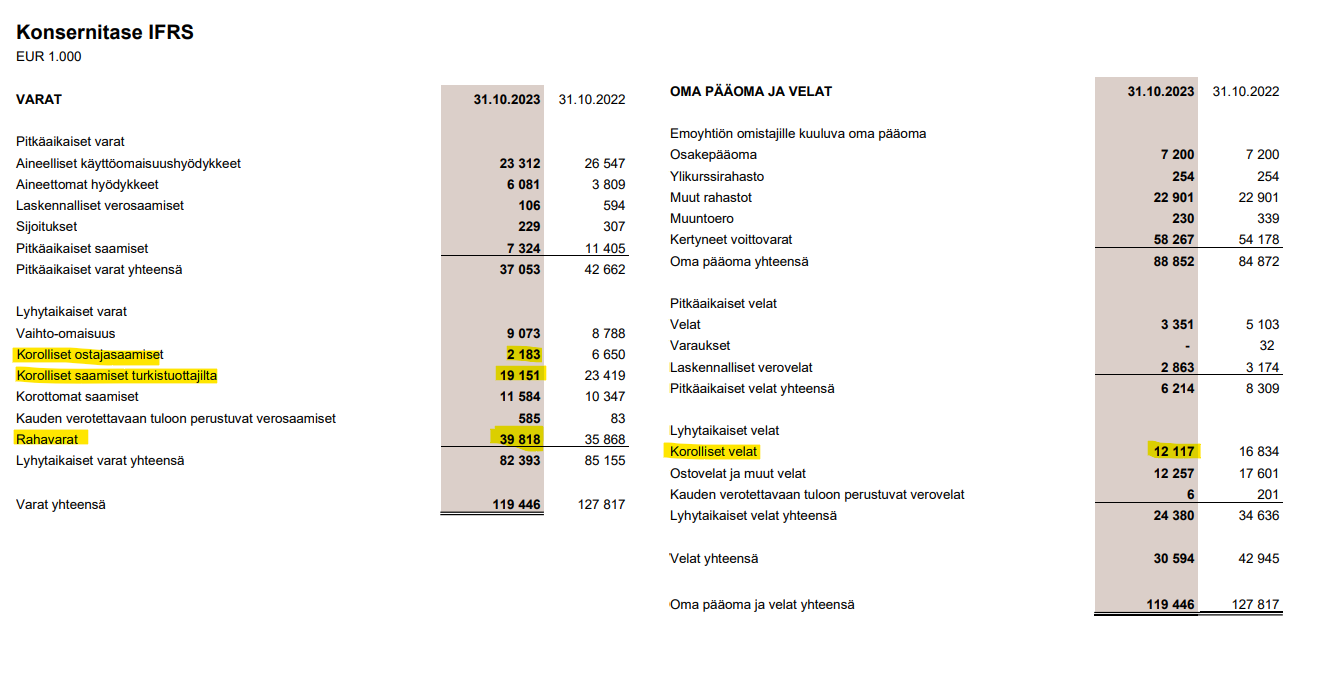
The company generates its income from auction commissions and by providing financing to buyers and sellers. In H1, the company had €37M in interest-bearing receivables from auctions. Cash stood at €21M and interest-bearing debt at €9.6M. In addition to gaining a significant potential market share, the company is very solvent, there is hidden value in the balance sheet, and the stock is priced at approximately P/B 0.4. If a larger amount of cash flow was released from interest-bearing receivables in H2 compared to last year, the company’s enterprise value (EV) could turn NEGATIVE. It sounds like a Chinese scam or a value investor’s dream stock.

The company’s cash flow fluctuates significantly due to the interest-bearing receivables it offers to auction buyers, from which it earns substantial financial income annually. This has kept the company’s results for financial years profitable, even when the operating result has been negative. The company’s market cap is €38M at a share price of €10.5. If the company were to make an operating profit of €2.6M in 2023 and financial income of €2.5M, the result for the period after taxes would be €4.1M, meaning the P/E ratio would be 9.2x. There is potential for significant profit growth in the coming years when Kopenhagen Furs’ final auctions conclude.
image

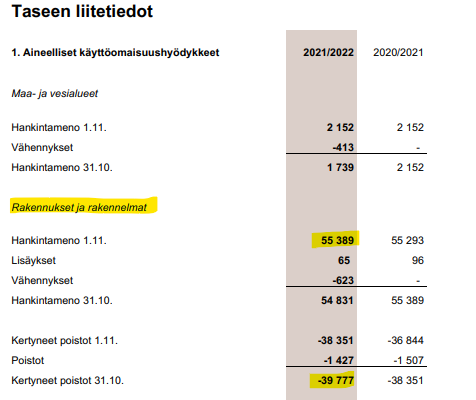
Speaking of hidden value, the company appears to have real estate on the balance sheet worth about €55M. I don’t know what these properties are or where they are located, but after annual depreciation, a significant amount of potential hidden value has been created on the balance sheet when proportioned to the company’s market cap (€38M).
image

I am no expert in fur farming, but as I understand it, even if fur farming were banned in Finland, it might not necessarily have a major impact on Saga Furs’ business, since according to the March 2023 auction, at least 18% of the pelts acquired were sourced from the Nordics. There are political risks in the industry, but I see Saga Furs as a low-risk investment due to its significant assets. If the real estate is liquid, the company’s liquidation value could be 3x the current share price.

image

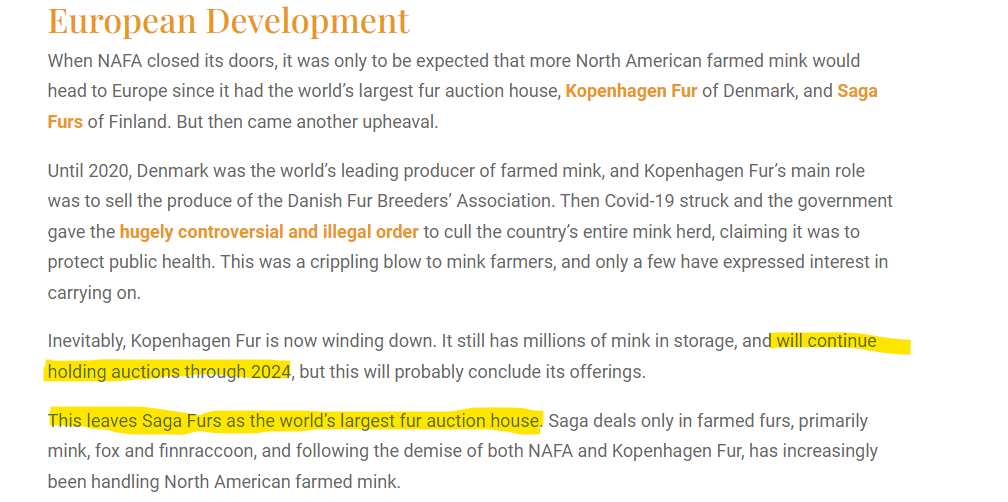
Here is a story from October 2023 regarding Kopenhagen Furs:
image
The Changing Fur Auction Landscape (truthaboutfur.com)

Are there any experts on this subject on the forum?

32 Likes

An interesting opening; Saga has at least previously sold real estate on a small scale and recorded good profits from it. Apparently, there is still quite a lot of hidden value on the balance sheet.

The company could split into two entities where the real estate would be placed in its own company, and this new company would be distributed to the current owners. The real estate company could make a long-term contract with the auction company, making its cash flows quite predictable. Some debt could be allocated to the real estate company. The higher-volatility trading company could then trade with a strong balance sheet as its own entity, which would also continue bank-like operations by financing customers.

A classic cigar butt company that is crying out for some kind of restructuring. We live in an ESG world where many things are polarized into good or bad, and that also opens up opportunities.

9 Likes

18% of the skins come from the Nordic countries, 71% from the Rest of Europe, and 10% from North America. Quote from the Board of Directors’ report:

”The Saga Furs Group consists of the parent company Saga Furs Oyj and its wholly-owned subsidiaries. The subsidiaries primarily include Furfix Oy, which sells pelting services to Finnish producers; Lumi Mink Oy, which handles breeding animal trade and related quarantine facilities; Saga Furs A/S in Denmark, a sales promotion and skin procurement company; Saga Furs Holland BV in the Netherlands, a skin procurement company; Saga Furs Polska Sp. z o.o. in Poland, a skin procurement company; and Saga Furs North America INC in the United States, a skin procurement and sorting company.”

Is there any information on where that 71% share of Saga’s skins from the Rest of Europe then comes from? From Poland? Surely not from Russia or Belarus? The Netherlands has already banned fur farming, as have 18 other European countries. Why doesn’t the company openly state (or at least I can’t find the information) the countries of origin for its skins when there are only a handful of countries in Europe where fur farming is permitted? They do say, however, that the vast majority of the skins are sold to China.

3 Likes

That article mentions that in addition to Finland, fur farming is allowed in Poland, Lithuania, Greece, Cyprus, Portugal, and Romania among EU countries. However, Lithuania banned fur farming in the autumn. The company discloses the country of origin of the skins at auctions and has categorized them at the Nordic / other Europe level in its investor communications.

Some of those properties were acquired during the Finnish markka era, so their real values could be significantly higher than the €55M acquisition cost. The sale of one property in 2022 and the resulting capital gain would support this.

image

The value of net financial assets is €48.4M. The company’s market cap is €38M. It’s hard to be very bearish here when the value of the assets is 3x the market value, even if the entire industry were banned. The next couple of years will also be very interesting from a competitive perspective, as the market leader exits the game.

6 Likes

They speak vaguely to investors about Europe rather than the EU. Based on that article, among non-EU European countries, fur farming is permitted at least in Belarus, Ukraine, Moldova, Albania, Montenegro, and Macedonia. Buyers likely have to be told the origin of the pelts by law; while Chinese buyers probably aren’t very interested, potential investors might be.

6 Likes

Good opening :+1: . There is some good discussion in the Kauppalehti forums. Saga Furs’ properties are located in Petikko, Vantaa, if I remember correctly, right next to Ring III. That’s where the auctions are held. The properties are in good condition and the location is excellent; they certainly hold a lot of value.
One big problem for investors is that the largest owners are the fur farmers’ associations PSTK and SÖP; they are unlikely to look out for the best interests of the shareholders in every situation, but rather those of the farmers.

5 Likes

Thanks for the info :+1:

I also completely agree that producer-owners are rarely the best partners for other speculators.

Edit: I’m repeating myself, but I don’t see political risks as an issue at the current share price, as the company has €48.4M in financial assets plus €55M in real estate, which could have upside or downside potential, and the company’s market cap is €37M. Many might say the entire industry should be banned, which, somewhat paradoxically, would unlock the hidden value in the company. Political risks are therefore an option for all minority shareholders except for the producers.

4 Likes

Amer once produced tobacco but swapped Boston cigarettes for sporting goods. I’ve been wondering if Saga Furs might face a similar radical transformation if fur farming meets the same fate as tobacco production. Since the company’s largest shareholder holds over 60% of the votes, it is simultaneously a threat and an opportunity. Because it’s an association—meaning, as I understand it, a “faceless” owner where management plays with other people’s money but benefits from good results—it might be “not so innovative” as an owner.

4 Likes

Will the interim results be released only in the afternoon, or what has been Saga Furs’ usual practice?

The previous financial statement was published a year ago at 13:15. H1’23 was published at 11:15. To my knowledge, the exact time has not been disclosed.

4 Likes

Financial statement out:

  • Operating profit for the full year €3.2M
  • Financial income €2.9M
  • EPS €1.39
  • Dividend €0.66

Based on this result, the stock is trading at a P/E of 7.87x. If only cash and interest-bearing debt are considered, the EV/EBIT would be 3.66x at a share price of €10.95.

Net financial assets are €48.9M vs. Saga’s market cap of €39.4M.

image

Saga Furs Oyj’s FINANCIAL STATEMENT RELEASE 1.11.2022-31.10.20 | Kauppalehti

15 Likes

An article about Saga.

4 Likes

Excellent analysis on Saga:

Update on Saga Furs after 2023 earnings - by Sebastian (substack.com)

7 Likes

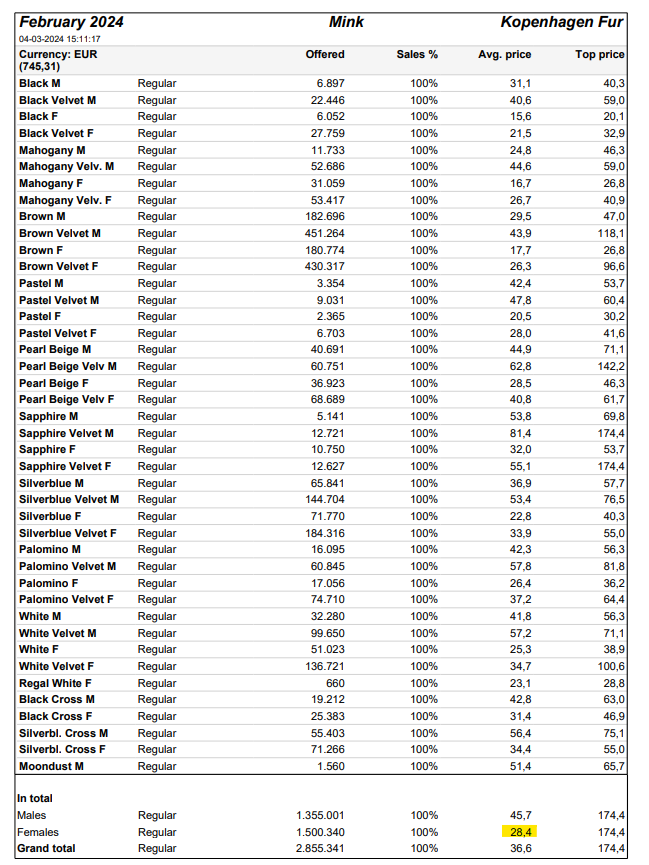
Saga’s competitor Kopenhagen Fur held its first auction of the year, where mink prices increased by 23%.

All 2.8 million pelts were sold, which bodes well for Saga’s auction starting on Saturday. Saga has 3 million mink on offer in the March auction. A year ago in the corresponding auction, Saga had 5 million pelts on offer, of which 4.25 million were sold.

Kopenhagen Fur will hold its final auction in June, after which Saga Furs will be in a monopoly position. It’s hard to say how this will ultimately affect Saga’s sales volumes, because the number of mink farms has collapsed over the last 10 years.

Kopenhagen Fur’s February-March auction:
image

Here are some more statistics on sales from previous years:
image

9 Likes

The stock has dropped 15% in a week and 8% today; attached are reports from the auctions currently underway.

6 Likes

An inevitable trend:

And a good thing, too.

“According to the Fur Free Alliance, under the new policy of the family-owned Italian luxury fashion house Max Mara, it will no longer use fur in its future collections. The brand has also been a customer of the Finnish company Saga Furs.”

15 Likes

I have often overlooked this stock, certainly for the same reasons why not many are interested in it – the fur business is a dying industry. At a quick glance, its value is obvious. But…

Based on Iikka’s visit to Inderes, I took it upon myself to check the claims. They held up quite well.

It’s an interesting case, though. Net current assets of €20 per share, net real assets of €30 per share. And if the talks about potential undervaluation of real estate hold true – even more. And you can get the stock for €9 per share. As a Graham disciple, I’m certainly interested.

Even the business itself still seems quite relevant. Of course, it will decline gradually, and at some point, even a monopoly position might not be enough. However, using the average of the last five, ten, and twenty years with 0% nominal growth expectations, the business value, on average across all time periods, is even higher than the assets. Of course, I would never dare to buy this with the expectation that the business value would materialize, but it’s a nice option nonetheless.

It’s hard not to get excited about this case. For ethical reasons, I wouldn’t necessarily want to own it, but on the other hand, the expected value of the investment is highest the faster the entire industry can be brought down by political means (the company will not liquidate without compulsion, due to its ownership structure). And even if that option stretches out, the business is still in a monopoly position and viable, and it likes to pay generous dividends.

Additionally, there are catalysts for the coming years. The company’s most important market by far, China, has initiated significant stimulus measures, especially to boost domestic consumer demand. A fresh monopoly position, how will that reflect in the numbers in the coming years?

I’ve been buying the stock for the past couple of days. A small 12% position in the portfolio (I never own more than five stocks). We’ll see how this case develops in two to three years, or I’ll sell it earlier if the stock price corrects closer to reality.

Thanks @Iikka!

15 Likes

Thanks @raisinglines for liking the podcast!

In H2 auctions (May and September), the value of brokerage sales grew by 15% year-on-year, while the number of skins sold decreased. So, in theory, this would be a good basis for profit improvement, as revenue would be growing and at the same time the cost level should be lower compared to last year’s H2.

However, this year’s figures are not as interesting as what will happen next year. Saga’s competitor Kopenhagen Fur brokered 6.5 million pieces of furs this year, while Saga brokered 10.4 million pieces. It will be interesting to see what happens to prices and Saga’s volumes when such a large amount of supply disappears. Fur prices have risen by 30% from autumn 2023 prices, and current prices are already profitable for producers.

The fur business has historically been very cyclical, and a moderate price increase directly benefits the bottom line. For example, in 2021, Saga made an operating profit of 11 M€ when fur prices rose.
image

19 Likes

Results out

Brokerage sales grew in the second half of the year, operating profit on par with the comparison period

  • The 19 percent decrease in the number of skins brokered reduced Saga Furs’ brokerage sales value to 343 million euros (financial year 2022/2023: 352 million euros).
  • The Group’s turnover decreased by 12 percent and was 41 million euros (47 million euros).
  • Operating expenses decreased from the comparison period and were 43 million euros (46 million euros).
  • Operating profit weakened to 1.7 million euros (3.2 million euros).
  • Net financial income decreased to 1.7 million euros (2.9 million euros).
  • Profit before taxes was 3.5 million euros (6.1 million euros).
  • Earnings per share were 0.73 (1.39) euros.
    The Board proposes to the Annual General Meeting that a dividend of 0.71 euros per A-share and 0.71 euros per C-share be paid.

Half-year period 1.5.-31.10.2024

  • The company’s brokerage sales value grew from the comparison period and was 232 million euros (203 million euros).
  • The Group’s turnover was on par with the comparison period at 27 million euros (27 million euros).
  • Operating expenses decreased to 25 million euros (26 million euros).
  • Operating profit was on par with the comparison period at 3.1 million euros (3.1 million euros).
  • Profit before taxes decreased to 3.0 million euros (4.2 million euros).

Business outlook

In the current financial year, the company will organize auctions in March, June, and September 2025. The company estimates that it will offer 9.25 million mink skins and a total of approximately 700,000 fox and Finnish raccoon dog skins at the auctions during the financial year. In addition to the anticipated decrease in sales volume, changes in skin price levels will affect the development of the company’s brokerage sales and turnover. The decrease in skin volumes will reduce the Group’s personnel expenses, despite the fact that personnel expenses allocated from the sale of previously sorted skins would be recognized during the financial year. The completion of the enterprise resource planning (ERP) system at the end of the previous financial year will increase depreciation, which weakens operating profit in the financial statements. Other operating expenses are expected to reflect the decrease in sales volume. The volume of financing is expected to remain low. The result for the financial year 2024/2025 depends on the sales results of the season’s auctions, which cannot be estimated before the actual selling season begins.

6 Likes

An interesting point from the report is the company’s net cash, which is 45 million euros, while the company’s market value is 33 million euros.

The market clearly lacks faith in the future of the fur trade. :smile:

In the current financial year, the company will organize auctions in March, June, and September 2025.
The company estimates it will offer 9.25 million mink pelts in the financial year’s auctions, as well as
a total of approximately 700,000 fox and Finnish raccoon dog pelts.

In the now reported financial year, a total of 10 million pelts were sold, thus sales volume is expected to decrease, even though the volume of the entire market is significantly declining, as the Danes are no longer selling any pelts, even though last year they sold 6.5 million pieces.

7 Likes