REIT - dividend income from real estate

Medical Properties Trust Announces Pricing of $1.5 Billion 8.500% Senior Secured Notes Due 2032 and €1.0 Billion 7.000% Senior Secured Notes Due 2032

$1.5 billion USD and €1 billion EUR secured notes due 2032 priced at 8.5% and 7% interest rates. Financing costs will rise, which was expected. However, this will resolve loans maturing within two years and provide an estimated $0.8 billion in working capital.

Perhaps a slightly higher % than I expected, but tolerable relative to the current interest rate level. The pricing changed the original allocation more towards the Euro, from €0.5 billion to €1.0 billion. Could it have been due to the pricing of that bond? :thinking:

The SEC filing published for the bond pricing contains a good overview of what has happened during the year.
There haven’t been few events from a real estate perspective :rofl:
https://medicalpropertiestrust.gcs-web.com/static-files/2ae4406c-0c4e-4996-b76a-139b5b7abfc1


MPW’s tenant, Prospect, filed for Chapter 11 proceedings in January, which is equivalent to corporate restructuring in our system. The outcome of this is uncertain and will result in some write-downs. These were mentioned in the previous SEC filing.

At least in Steward’s case, operators were found relatively quickly, so I guess we’ll get through this unscathed now that the financing is in order.

In any case, through Chapter 11, the overall situation remains better contained, hospitals stay open, and creditors recover at least some of their receivables.


Secured notes, by the way, apparently also mean that the loosened covenant terms can be lifted, and thus various operational restrictions regarding financing will return to their previous state.

Dividends are one of these, which have now been reduced a couple of times, and the restriction has been $0.08/quarter. Hopefully, this won’t be significantly raised back to its previous level, but rather gradually increased as the financial situation clarifies.


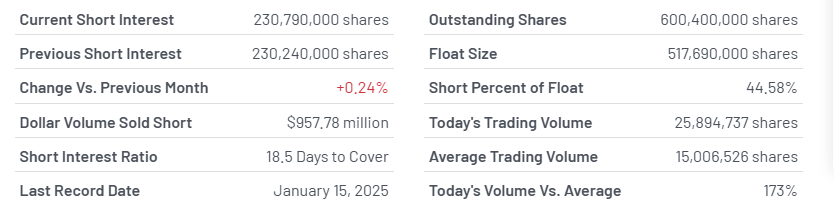
And lest we forget the truth, the short interest % is quite substantial :grin:

The main reasons were primarily the potential junk bond rating and the financial uncertainty caused by a couple of large tenants, which have now more or less disappeared.

image
source: https://www.marketbeat.com/stocks/NYSE/MPW/short-interest/

13 Likes

Moody’s Ratings upgrades MPT’s CFR to B3 and assigns B2 rating to new secured notes; outlook changed to stable

Moody’s yesterday raised its credit rating and outlook.

7 Likes

This is indeed getting interesting, as 44% of the entire float is shorted. Somewhere I saw a discussion about what the estimated current free float would be, when institutional, insider, Yeti’s and Hu’s, and estimated private investor shares are removed from the picture. This calculation resulted in well under 100 million.

At that point, things will start to happen if a squeeze begins, because 230 million shares are a bit difficult to find from a float of less than 100 million. In a proper squeeze, some things would then be rigged with institutions etc., so that it doesn’t turn into a Gamestop situation, but even in a good scenario here, we could reach, for example, 20-40 dollars. That 40 wouldn’t even be x2 from the 2022 peak.

image

Hen’s and Yeti’s almost identical positions of about 6% from last September/October are also interesting. As far as I understand, they are activist investors who know each other, so they also have some idea of the situation, because 6% is not a small position, and neither of them has sold anything since then.

8 Likes

Jussi Askola’s tweet thread below might be of interest in this thread. :slight_smile:

https://x.com/askjussi/status/1886073731652485229
image
image
image
image

10 Likes

ARE: I myself have been accumulating shares, alongside VICI, for quite some time now (though with little success so far). In my eyes, it’s such a good-looking company that it just has to rise from there at some point.
.
.
.
Right?

1 Like

I’m a little worried about that part, as with all government-dependent companies, that Musk’s cost-cutting measures might hit them badly.

Oh, was it that little? My memory had a completely different number. I must be confusing it with another one. My fears are back.

1 Like

I also don’t understand the market’s bearishness around ARE? The US Government accounts for 1.4% of revenue, and on average, that contract still has over 5 years left.

It also feels like a good time to consider adding [to the position].

3 Likes

I too went back on my “don’t buy anything early in the year” decision and grabbed ARE for my portfolio. In the short term, it might be very volatile and the prospects dim, but if I look at today’s purchase with the help of a time machine(*) in five (or so) years, I will be satisfied - good cash flow (dividends) and share price appreciation have enabled a clearly over 10% annualized return.

(*) A time machine does not actually exist, nor can one use it to go into the future to see the profitability of past investment decisions.

3 Likes

Tässä on Askolan video, joka sopii meikäläisen kaltaisille. :slight_smile:

I have lost a lot of money investing in real estate investment trusts. REIT investing is complicated and not all REITs are worth buying. I discuss 5 lessons that I wish I knew before I started investing in REITs. This REIT education should help you select the best REITs to buy and avoid painful losses.

3 Likes

I’ll briefly throw in a few thoughts here:

  • With COVID, there was a historically massive shift and a technological leap to remote work. Office buildings became empty. Office routes collapsed. For example, W.P. Carey completely divested from offices in its portfolio.

  • For many companies, however, the costs of empty office properties continued to run (long contracts, etc.). In addition, many (large) companies have ties to properties through ownership. This means they benefit in the short term if people return to offices. I haven’t researched how much, for example, MAG7 companies own in real estate, but especially headquarters, which serve as status symbols, cannot simply be left empty. And employees of headquarters alone cannot be forced into the office in the name of equality.

  • Then there are corporate leaders who feel the need to control and supervise employees. They believe this can only be achieved in the office. Behind this is an atmosphere of distrust and an old-fashioned management style based on authority and measuring working hours instead of results. HS wrote an excellent article on the subject, centered on a toxic, surveillance-based corporate culture.

  • The Trump administration has its own reasons for forcing government employees back to the office. HS also just wrote an excellent article on this topic. Trump has sought to get people to resign voluntarily.

  • Let’s look to the future for a moment: The most cost-effective way to work ALWAYS wins. And that way is remote work without real estate costs. Examples: 1) IF P&C Insurance abolished all its offices a long time ago. 2) Online banks like Revolut are gaining millions of new customers in Europe every month (Revolut alone 1M/month). They have no offices or even premises, and staff often sit across Europe (at home). They can offer superior benefits to their customers with a lean cost structure. Young adults no longer have an emotional connection to traditional banks, so what will happen in 10-20 years?

  • Technological development will likely advance so far this decade that a team can gather in the same space without being physically present. Apple’s Vision Pro is laughed at, but it’s just a prototype and a glimpse of what the future holds. In the near future, Teams headsets will be replaced by Teams virtual glasses. > The benefits of gathering in the office will decrease.

  • For a long time, there has been a trend in working life where people don’t want to spend their free time with colleagues. It’s hard to attract people to company Christmas parties, and they leave as soon as they can. A natural continuation of this trend is that people no longer gather in offices. At most, they meet live once a quarter in a rented space. MOW was ahead of its time.

  • In summary: I believe that by the 2040s, very few companies will still have offices. The 2030s will be a transition period when, especially in SMEs, it will be realized that offices are an extra cost item, they reduce work efficiency (according to one study, the noise in an open-plan office wastes 1 month a year), and employees ultimately don’t even want to go there. It may be that the change still requires the next generation of leaders to take the helm of companies, whose mindset is completely different, but I personally do not see a very bright future for office routes.

9 Likes

New to this channel and asking silly questions, so apologies if this has been discussed before. REITs are otherwise familiar products in themselves. But there’s one thing I couldn’t find a clear answer to. Can they be bought into a share savings account?

Technically, they are normal companies, but on the other hand, they are funds (Trusts), and for this reason, I’m a bit doubtful? So, does anyone have any information?

No, you can’t. REITs have a tax advantage in their home country, so they no longer receive a tax advantage in Finland. Initially, it was possible with some brokers, but then the interpretation tightened, and they had to be sold off from the Share Savings Account.

1 Like

I have a REIT on an OST. :thinking: I haven’t received any message from Nordnet that it shouldn’t be allowed.

Yes, I suppose you can buy them for an OST (Share Savings Account), but it might not be worth it because, for example, a 15% withholding tax is levied on US stocks, but nothing is credited here when you eventually sell from an OST. With an AOT (Securities Account), the withholding tax is levied but credited against dividend tax.

Is this really the case? So, buying Realty Income for an OST is not possible? (I don’t have an OST so I can’t test. But I haven’t heard of such a restriction.)

2 Likes

On the NN side, one can buy routes for the bid, excluding certain limited ones, such as Canadian routes.

Could it have been that at least Osuuspankki (and perhaps Nordea) and Mandatum would have blocked all purchases of routes for the bid? I might remember this incorrectly.

I see, perhaps it’s then a broker-specific interpretation. Mandatum then forced a sale.

Which REITs were involved, do you remember? Not those Canadian ones that had restrictions that weren’t related to the OST (Share Savings Account) per se?

It’s strange if different brokers have different interpretations of the law. It certainly speaks of failed legislation.

It wasn’t Canadian, I’ve never owned those anyway. At that time, the message was that all REITs had to be sold from OST and it wasn’t related to any specific country.

1 Like

I remembered correctly and it seems I had even posted a message about it here. Quite a large list, if I recall correctly, was banned by Mandatum, and there were LP, MLP, REIT companies there at the time.

Brokers, after all, have their own interpretations of things. For example, on the NN side, Canadian REITs were just banned, and some time ago they put half of the BDC companies on a blacklist, seemingly by flipping a coin. However, these can still be bought from other brokers.

3 Likes

What’s the classification when some are prohibited? At Mandatum, I have EPR, SPG, DOC, O, and SILA.