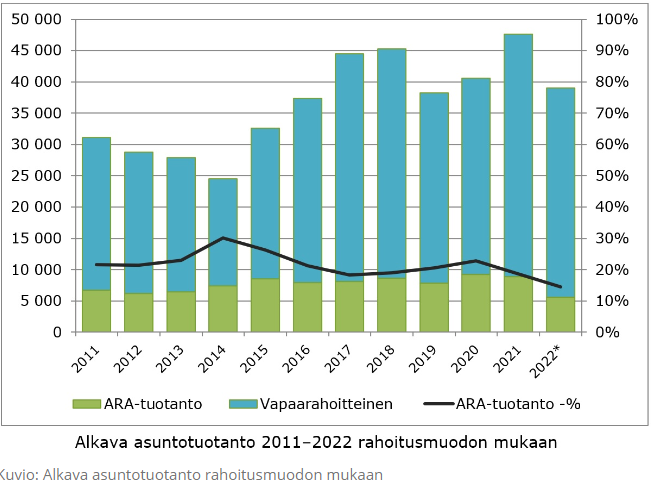
That certainly will support the construction sector if 50% more ARA projects start next year than this year. Typically, ARA production has smoothed out the cycle at the stage when market-rate production hits a wall.
15 Likes
But those companies that are currently fighting for survival with empty coffers probably won’t get any help from this, will they?
Of course, the strongest in the sector will get a boost for the coming years.
1 Like
The possible abolition of the transfer tax was mentioned last, which would indeed be a smart move. It would just be replaced by something – an increase in property tax?
2 Likes
For current crisis companies whose projects have already run out, that’s likely the case. Some of those whose work would run out next year, and consequently their cash reserves too, might survive. At the very least, this keeps construction workers etc. in that value chain—those under threat of layoffs or unemployment—somewhat attached to the payroll.
5 Likes
Once again, taxpayer money is being transferred in the form of subsidies to a few large developers who build these ARA housing units targeted at low-income earners and immigrants, who in turn need subsidies for rent. Naturally, nothing truly significant is being done to make it possible for young people to have, for example, their own home and a plot of land..
20 Likes
The construction sector support package left a strange aftertaste — Was there no shared situational awareness after all? Rakennusalan tukipaketista jäi outo sivumaku — Yhteistä tilannekuvaa ei ollutkaan? | Kauppalehti
I’d almost ask, what does it matter if construction firms go bankrupt, thinking more broadly. The workers could probably move to those still standing and we investors lose our money (I’m not personally involved as an investor in the sector yet, but the company is).
I just talked to a construction firm in Northern Ostrobothnia that has had steady apartment building production. One is ongoing, but no word on the next ones… So there won’t be any business for me then either…
It’s a bit depressing in the industry. I guess the Helsinki metropolitan area and Pirkanmaa are doing okay?
5 Likes
Here are some comments regarding construction and the budget. Generally, political decisions do not significantly sway anyone’s course in either direction, but naturally, in the midst of the industry crisis, even quick solutions are more in focus.
17 Likes
It isn’t the role of the state or any other public administration to save companies; rather, according to Keynesian economic theory, it’s to balance business cycles. However, it seems that in Finland, the public sector steps on the gas during upturns and booms, and then when help is needed, it’s not available. Thus, the public sector’s actions have only served to accelerate economic fluctuations.
A major problem in selling apartments that are already completed or nearing completion is the high level of housing company loans and plots owned by land funds. This is because potential buyers are finally understanding the risks this operating model brings to the buyer. The only solution would be to reduce these, but that requires a lot of money, which is likely impossible to find.
The financial crisis did not cause a major drop in the prices of new apartments because financiers chose to be patient, judging that forced liquidations would cause even greater problems. Now the situation may be different, especially in those housing companies where a significant portion of the units have been successfully sold and the financial risk has been shifted to the new owners.
9 Likes
On an individual level, it causes problems because there is no longer a company to hold accountable for construction defects. Guarantees for RS projects (RS-kohteet) help a bit, but they have limitations and do not cover real estate properties (detached houses and some semi-detached and terraced houses). These are the issues with completed projects. In unfinished ones, it can cause major challenges and bitter outcomes. At a systemic level, it likely has little significance.
3 Likes
Indeed, these bankruptcies cause serious problems even in completed buildings where there are unsold units. The bankruptcy estate might not pay the maintenance and capital charges, meaning the other shareholders have to cover them—though the housing company can likely recover at least part of that when the apartments are sold. The bankruptcy estate may not sell the units on a particularly fast schedule, so they could potentially bankrupt the completed housing company as well. On a systemic level, the impact would be that selling new apartments becomes significantly more difficult unless some “magic trick” can be found to better protect homebuyers from the risks associated with unsold units.
6 Likes
The automotive industry was used in a previous message as an example of where quality is more consistent than in construction. If I have the right understanding, car manufacturers build the cars they sell on their own production lines. Of course, components and systems are purchased from sub-suppliers. In construction, there are many options for the “assembly” phase, and often the lowest bid wins. That’s why “you don’t always get quality on the cheap.”
The biggest problem in the construction industry is cyclicality. Currently, building is cost-effective and skilled labor is plentiful, but nobody is buying the product. When the cycle turns, business picks up, labor availability tightens, and material prices rise.
The construction industry is much more than just new residential production, which accounts for about a quarter of the industry’s turnover. New construction projects are being started all the time, even in this cycle. It’s not true that nobody is buying construction services or end products.
2 Likes
Exactly so, even though my own work weeks for this year can be counted on the fingers of one hand.
There are also foreign construction workers in this low-income group who need rent subsidies.
Most of them live in large groups in shared housing, but some live on their own as a couple.
In general, when looking at the personnel level, those who continue working and benefit from the subsidies are mostly, for example, my foreign colleagues. I know my job too, but I don’t make the kind of savings required in tight times.
I work in new construction, which in my opinion doesn’t need subsidies from public funds, but rather the support of the general public who are ready to invest, buy, and rent again.
5 Likes
If construction as a whole were to slow down significantly and for an extended period, it would be reflected in the order backlogs of engineering firms in advance. Order books have been high; for example, Sitowise saw record levels in Q2 and, if I remember correctly, the backlog represents nearly a year’s worth of revenue. It is good to monitor how the order books and outlook comments of engineering firms develop.
9 Likes
I know of a larger architecture firm specializing in new construction, apartment buildings etc.; they’ve had layoffs ongoing for some time now. Another firm, which has more public sector and commercial real estate on their drawing boards, is still in a relatively good position. It varies quite a bit within the industry.
5 Likes
Yes @Jesse7, that’s how it is on the new-build side, but in infrastructure and renovation, they are working away just as they were a year ago. And these are not small sectors within the construction industry. In the media, the focus is mainly on housing. The housing production situation makes for good clickbait headlines. I’m not saying other sectors can’t decline (I don’t have a crystal ball), but this is the focus right now. The construction industry has already collapsed, if you follow the media discussions. Of course, if you happen to work in the housing sector, it might feel like it’s probably the same across the whole industry.
6 Likes
Is it? This is often thrown around, but I haven’t really found any good research on the matter.
In my opinion, that’s somewhat similar to using familiar subcontractors/suppliers. There’s a fair amount of players, but at least in this region, it’s very rare to pick a completely unknown contractor out of the blue just because they are the cheapest. Often the choice falls on a familiar contractor who handles their business and you know what you’re getting. But yeah, there are plenty of differences compared to the automotive industry, so it might not be the most fruitful comparative discussion.
Certainly so! Even some new residential builds have been started this year.
1 Like
What has had the biggest impact on the industry is specifically the change in the buying behavior of private individuals and investors, driven by the zero-interest-rate environment. This affects housing production in particular. Companies are investing moderately, and if interest rates stabilize now, there will be more confidence to move forward with more construction projects. We are seeing contract bids even for smaller construction projects from firms that used to focus on housing production, which increases competition and lowers prices. There is certainly caution; I know of companies in the industrial sector where even small planned renovations or improvements are being postponed due to these uncertain times.
4 Likes
It’s not even meaningful to study this. The operations are on a completely different planet. A car has about 30,000 parts, which are assembled on a line with a takt time so short that the line might not even stop. To make this possible, parts must be compatible with an extremely high probability throughout the entire line. This is achieved by requiring a sufficiently small standard deviation from both self-manufactured and supplied parts relative to the part’s specifications. Compliance with this safety margin is then monitored through regular measurements, control charts, and control limits that are significantly tighter than the actual specifications. There is no chance of becoming a supplier unless the supplier can prove they are capable of a sufficient quality level.
On the construction side, Pena (the average joe) measures, saws, sands, and carves, and finally gets the parts to fit together.
13 Likes
Even if the order backlog is at a good level, the issue might be that projects aren’t getting started. At least I’ve heard things to that effect from my own circle of acquaintances. Of course, the sample size is small.
4 Likes