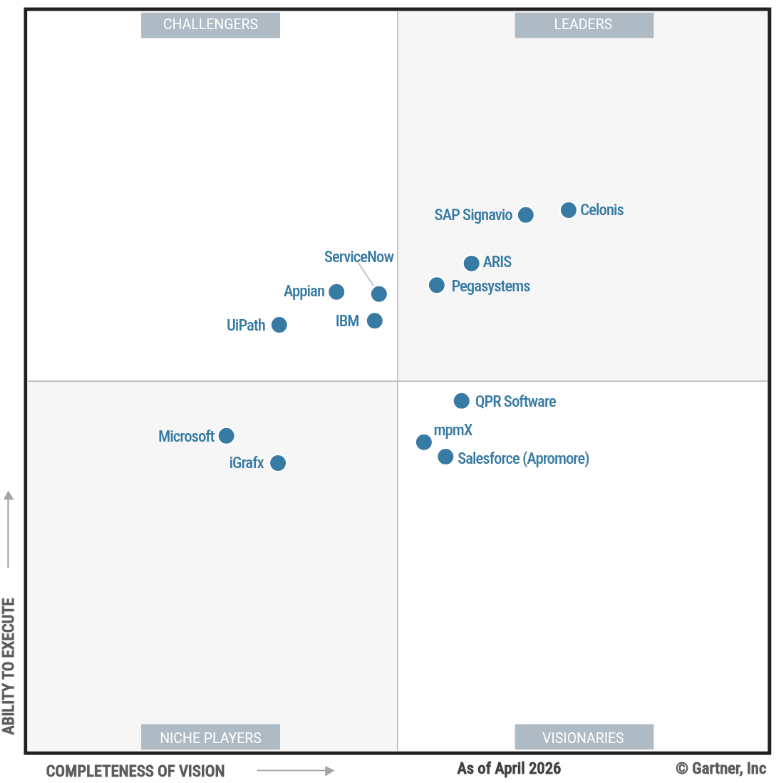
QPR for the fourth year in a row in Gartner’s Magic Quadrant in the Visionary category:
Here is the latest Quadrant from April:
And the corresponding chart from December 2024:
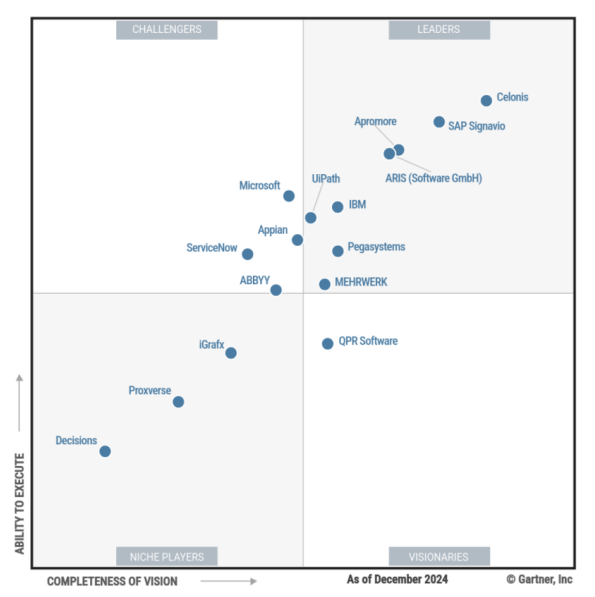
One could note that the field of companies has tightened compared to before and the number of “Leaders” has shrunk. QPR has taken a step upwards in the chart, which can be interpreted as a positive shift. Here is the section on QPR quoted from the report:
QPR Software
QPR Software is a Visionary in this Magic Quadrant.
Its QPR ProcessAnalyzer and QPR EnterpriseArchitect products offer process mining and process modeling and analysis natively, while relying on third-party partners for task mining.
Operations are mostly focused in EMEA, serving midmarket to large enterprises, concentrated in manufacturing and consumer packaged goods, BFSI, and pharmaceuticals and life sciences.
QPR’s roadmap prioritizes enabling agentic AI operations by launching an MCP interface to securely expose process insights to autonomous AI agents, unifying case-centric and OCPM models, and automating process modeling from unstructured data.
Strengths
Native Snowflake architecture: QPR’s platform is built natively on Snowflake, enabling zero-copy analytics that keep data securely within the customer’s environment. This integration enables process analysis without manual data replication or ETL pipelines. However, the platform is not limited to Snowflake customers, and organizations can also access the solution through QPR’s managed service, AWS-hosted offerings, and on-premises configurations.
OCPM: QPR was an early innovator in OCPM. The platform automatically generates object-centric data models from relational schemas by identifying object-to-object relationships, eliminating tedious manual mapping. A native OCPM flowchart visualizes multiple interacting processes such as orders, items, and deliveries in a single view.
Unified process mining and modeling: QPR tightly integrates its process mining and enterprise architecture modeling tools. Users can discover as-is flows from event logs, export them into the enterprise architect repository in BPMN 2.0 format, edit or optimize them, and send them back to the process analyzer for automated conformance checking.
Cautions
Process modeling and analysis: QPR’s modeling environment and simulation reports have an outdated appearance and lack modern design. Setting up simulations requires significant technical expertise and lacks guided or AI-assisted setup, making onboarding challenging for new users.
Geographic concentration and partner-dependent reach: QPR focuses direct sales and growth on Europe. In other regions, such as Latin America, Asia/Pacific, and the Middle East, the company relies on partners for implementation and support. Organizations outside Europe should confirm that local partners have the expertise needed for deployment and ongoing success.
No native task mining: QPR has retired its proprietary task recording technology and now relies on third-party partners for granular, task-level data capture. Organizations that require integrated process and task mining must procure and manage a separate tool, increasing procurement friction and deployment complexity compared with unified competitor solutions.