This year, I’ve come across several articles discussing China’s investments in EUV lithography. It strongly appears that the biggest player in China will be Huawei. Their technology would be based on another alternative that ASML researched decades ago, LDP plasma. LPP technology, which ASML currently uses, is the option that achieves higher power and thus faster throughput for a single wafer. China is unlikely to run out of budget when investing in EUV lithography, so it will be interesting to see where LPD technology goes in the coming years.
In itself, ASML’s owners don’t need to be worried, but it’s good to be aware that Huawei has taken significant next steps to develop EUV technology.
Broadcom reported a strong quarter, with revenue and earnings exceeding expectations. Growth was primarily driven by AI accelerators, networking, and the VMware business. The company’s AI revenue grew significantly, and according to the CEO, growth will continue in the next quarter as well.
For the fourth quarter, Broadcom continues to forecast clear growth, especially in semiconductors and software solutions. The company also achieved record cash flow, strengthened profit margins, and paid out substantial dividends.
As a result, ASML will own 11 percent of Mistral. The market seems to have reacted to this with a shrug. This is interesting and telling: there is no belief in European AI development. Although ASML is known to have a competitive and moat advantage, its valuation doesn’t move in any hype spheres either. And based on recent funding rounds, Mistral’s valuation is only 1/36 of OpenAI’s valuation.
The European Commission is expected to present an AI strategy and plan by the end of the year. The French will surely know how to play their cards right and push Mistral as the primary European and, above all, geopolitically suitable alternative.
The market isn’t reacting because it doesn’t understand the logic here. Why would a company developing chip manufacturing equipment invest in an AI company? Yes, applications where AI models are a good idea can certainly be found for the software of these devices, but investing in an external company… why?
The press release, of course, paints a picture that this is a win-win and both will benefit by moving beyond a normal customer-supplier relationship into strategic cooperation, but…
There’s no belief in European AI endeavors because it’s seen that our regulation ensures they have to compete with one hand tied behind their back. The fact that European customers might want European AI doesn’t directly convert into sacks of money, especially if the product is weaker due to regulation or general lack of resources. Thus, this deal primarily raises the question of whether ASML might commit to developing AI features for their equipment with a C-tier also-ran company, potentially resulting in a product that is ultimately worse than if ASML had simply bought expertise from industry firms without any “getting engaged” with a large investment.
Well, maybe there’s some logic to it, but I personally suspect there might be political reasons behind it, which is usually not a good reason to make bad business decisions.
Does anyone want to try to explain in simple terms how the value chain of such a Nebius-Microsoft deal actually works? Who bears the biggest and who the smallest risk?
In my opinion, this aligns with the trend that has been observed from equipment manufacturers for a long time. Different equipment manufacturers want to acquire simulation and technology companies that facilitate wafer manufacturing for the end customer. From experience, I can say that a DUV lithography tool outputs an enormous amount of data, and it’s quite an adventure to get that data into a state where it’s useful to the customer. The same applies to LAM (Lam Research); even though they have excellent expertise, for example, in etch simulation, they have still acquired external expertise.
One can always debate what could be done in-house and what to acquire externally, but I wouldn’t see anything unusual in this if it brings added value to the customer.
Today’s “AMD dips, NVIDIA rises, Intel goes on a moon trip” catalyst.
Interesting to see what this means in practice. Intel has been completely uncompetitive in the datacenter CPU segment for several years, so it’s a bit puzzling why they went shopping for semicustom processors there for future servers when they have their own ARM-based GB200 series and even future versions.
It even makes me wonder a bit if this is some political horse-trading…
Additionally, this mention:
\u003e For personal computing, Intel will build and offer to the market x86 system-on-chips (SOCs) that integrate NVIDIA RTX GPU chiplets. These new x86 RTX SOCs will power a wide range of PCs that demand integration of world-class CPUs and GPUs.
Raises the question of what will happen to Intel’s Arc GPU product line. Will it be flushed down the toilet?
It also raises the question of whether this is some kind of warning shot towards Arm, which has started developing its own circuits in addition to architecture licensing. It will be interesting to see what the long-term plan is for Arm-based servers and Arm+NVIDIA SoC products that were planned for WinArm laptops next year…
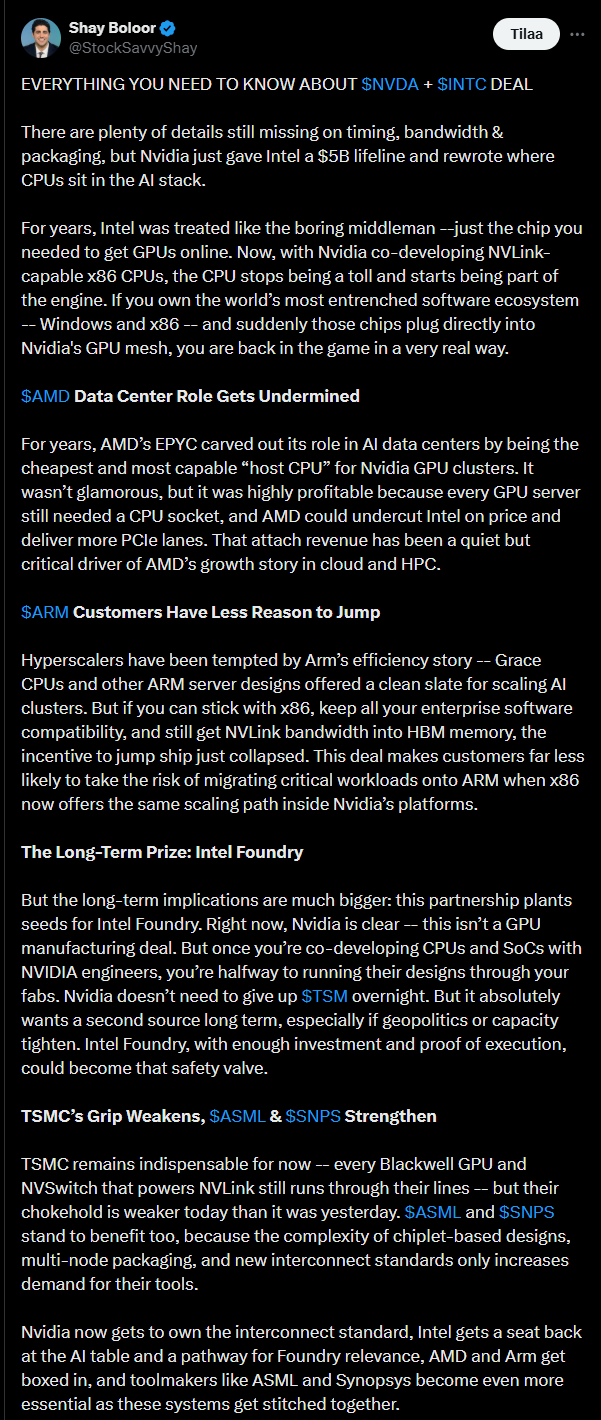
I did some background digging, and this Intel - NVIDIA setup currently looks practically like this:
The primary urgency is on the datacenter side, to build a direct NVLink-based connection between the CPU and GPUs and to build future NVIDIA server hardware that includes an Intel semicustom-processor together with NVIDIA’s future GPU accelerators. This will also take years before finished products. Perhaps we’ll see something in 2027? An open question is whether this is intended to completely replace Arm-based solutions, or merely to offer customers both Arm and x86 options. Another open question is performance. AMD is so strong in processors on the datacenter side that if the situation doesn’t improve in the coming years, no matter what miracle concoctions are made with NVIDIA’s GPUs, the end result may still be so uncompetitive that customers won’t accept it. I don’t yet fully buy the idea that this would directly be the majority of future NVIDIA datacenter hardware, but rather that it is currently a technology development project and the outcome is still uncertain.
Intel ARC is practically a walking corpse. Yes, they will still come as iGPUs in Intel processor models at least until 2026 and 2027, and it is also possible that one more generation of discrete cards (the “Celestial” generation) will come out because development is already so far along, but this is uncertain. Intel officially says that yes, this doesn’t affect roadmaps, but what they apparently aren’t willing to say yet is that once the current known roadmap has been traversed, that’s it for Intel ARC, and NVIDIA will in the future design all graphics chiplets into Intel’s chips at some point. As for discrete cards, the saga is over, “Buy NVIDIA”
These NVIDIA graphics parts will only come to integrated graphics cards for laptops and desktops years from now. 2028 - 2029 is probably realistic. So nothing will change quickly, Intel’s problems will continue in the coming years, and AMD will gain more market share, especially in laptops.
My own feeling about this is that the market got absolutely carried away with Intel’s stock. The stock has certainly been kicked so low that mere enthusiasm that perhaps something bigger will change carried it far, and with NVIDIA’s money-making machine involved, the hype is understandable. But practically, this won’t show up in Intel’s bottom line for at least two years because lead times are so long and the goods for the next few years are already in the pipeline and locked in.
A 5 billion dollar investment is completely insignificant coffee money for NVIDIA, and this currently strongly suggests that Intel is practically tying future desktop and laptop product generations (starting in about three years) to NVIDIA’s expertise in graphics and compute acceleration. In practice, this means that Intel will in the future largely depend on NVIDIA’s mercy, because, for example, in laptops you cannot make SoCs without a graphics processor, and if Intel practically discontinues its own development in this regard, it will be completely dependent on an external operator. I don’t really know how this could be twisted into a win for Intel. Perhaps this will lead to more competitive products to try to stop the slide in market share, but at the same time, serious questions arise about Intel’s ability to develop hardware if the graphics side is “outsourced” in this way.
In the end, it didn’t rise much, considering that credibility regarding the future has been the biggest question mark, and now it strongly seems that some kind of outlook for a brighter future is clarifying. I bet that Intel’s stock will continue to slowly climb upwards as the realization of the cooperation progresses.
I think this is mostly NVIDIA’s (for a small amount of money) defense against AMD. Currently, NVIDIA’s GPUs, but for some reason, someone who wants an x86 processor can easily buy EPYCs, and the money flowing to a quite viable competitor on the GPU side is naturally not pleasing. I don’t believe NVIDIA is abandoning ARM. I don’t really understand what is meant by a warning shot towards ARM, as NVIDIA’s Grace also directly uses ARM’s Neoverse v2 cores (and not cores designed for an ISA licensed from ARM).
Intel’s graphics card future does look dim. It’s hard to see a market for discrete ARC cards, but will the Xe architecture continue solely for integrated graphics? On the other hand, relying solely on NVIDIA also feels like quite a risk. Will NVIDIA have enough interest in developing low-power integrated graphics cards, which, as the AI craze continues, is quite small fry compared to the over-kilowatt-drawing AI chips craved by hyperscalers?
The open question here is whether the intention is to replace Arm chips instead of relying on future Arm developments alongside this new x86 semi-custom initiative. If the intention is to replace, it would be a big blow to Arm’s dreams of being a major player in the datacenter sector, due to software support alone.
Xe and Arc share the same underlying architecture, featuring Alchemist or Battlemage era GPU cores depending on the generation, with the next ones bringing the first Celestial-generation models. If discrete cards are killed off, the open question is what happens to ‘slow’ iGPUs. NVIDIA everywhere, or only as an alternative and Xe somehow continues? If all graphics development is stopped, then we will be completely dependent on NVIDIA in about 3-5 years.
CNBC’s news also mentions: “OpenAI is also in talks with Broadcom to build custom chips for its next generation of models.” Companies are trying to diversify away from CUDA and break Nvidia’s dominance. It’s perfectly understandable that they don’t want to pay ransom to Nvidia for this forever. It remains to be seen how they succeed. With these amounts of money, I would bet that in the near future (a couple of years), there will be viable alternatives to Nvidia, and CUDA will no longer be the only option.
It has long been clear that CUDA is not an insurmountable moat. Software is just software. If other hardware requires a bit more work on the software side, it can very well be worth it if hardware is bought in large quantities and the price difference is significant.
AMD has also invested heavily in its own ROCm software stack and has been catching up to NVIDIA’s lead in this regard.
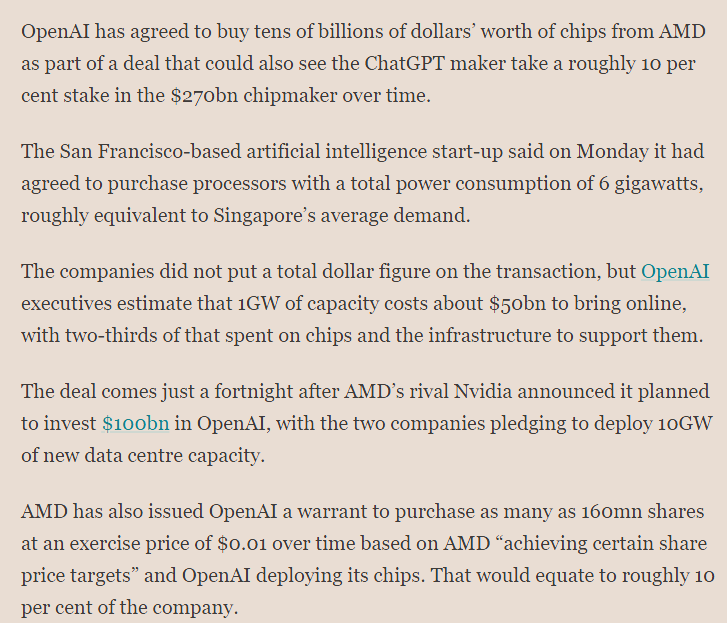
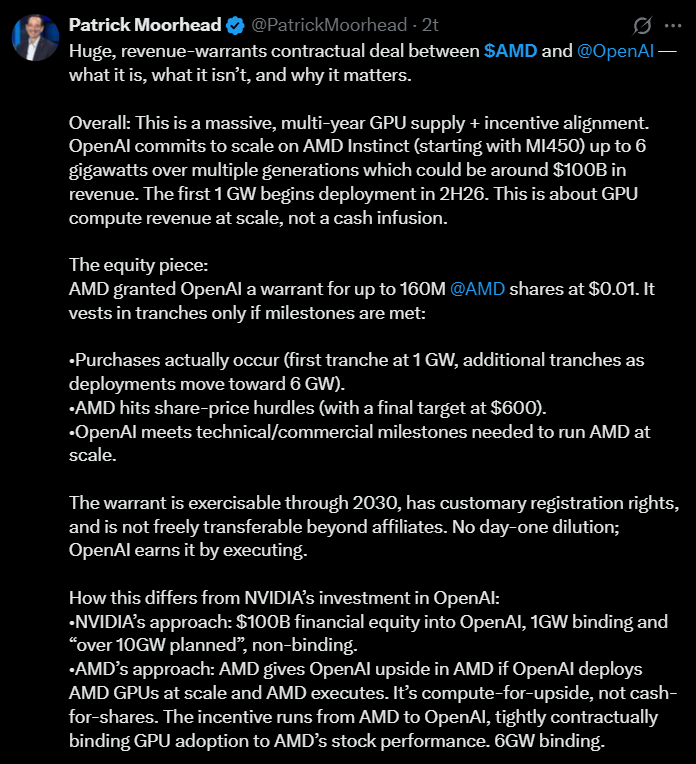
Strange situation. Cash-strapped OpenAI buys AMD hardware and receives warrants entitling it to subscribe for AMD shares at a nominal price of one cent per share, an amount that would correspond to 9% of the entire company –
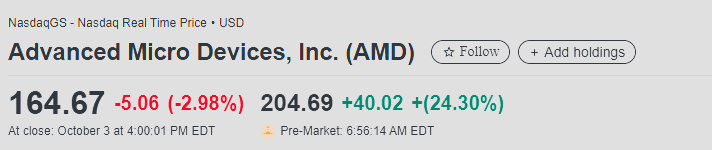
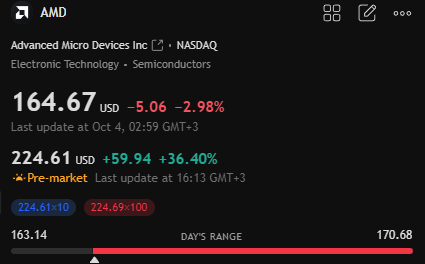
AMD’s rise has strengthened further in premarket after the news, and ATH (All-Time High) levels ($227.30) from 2024 are now being approached. The company’s performance is also in a different league than it was then.
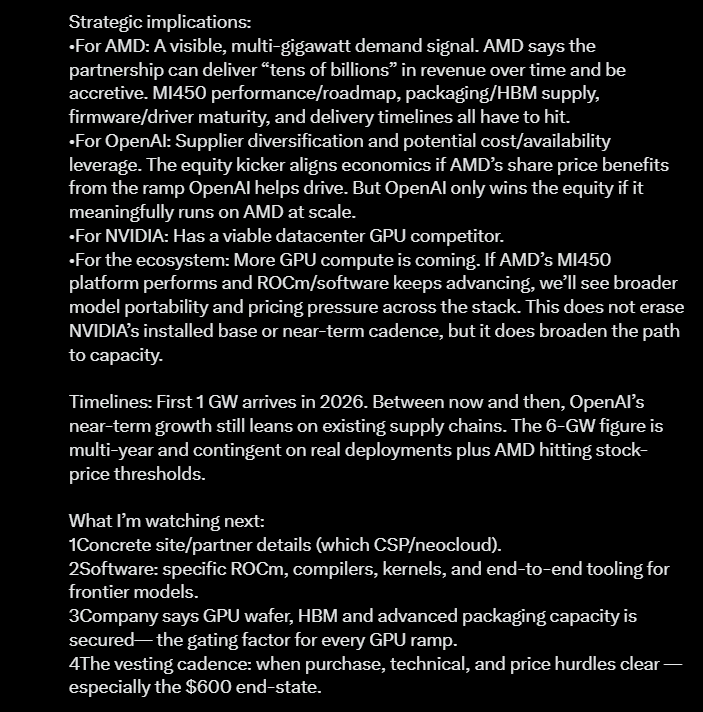
The post below thoroughly explains the deal’s structure and how different parties benefit from it. Shareholders have not been forgotten either, and Lisa emphasized this after today’s news. The deal is significant and, above all, an excellent reference for the future. Furthermore, the golden age of inference is just beginning.
Purchase rights vest only under certain conditions, meaning OpenAI must purchase sufficient quantities of goods, and additionally, AMD’s stock price must rise; apparently, the last ones vest at a share price of 600 USD.