Proprius Partners Funds

Basic information about the fund:

” The fund invests its assets in securities, primarily shares, of small and medium-sized Finnish companies where the companies’ business prospects appear promising in relation to the pricing and risk level of the company’s share.

The Special Investment Fund Proprius Partners Micro Finland is an actively managed equity fund, the investment objective of which is to achieve the highest possible appreciation for the fund unit in the long term by diversifying assets in accordance with the investment fund law and the fund’s rules.

Furthermore, in accordance with Article 8 of the SFDR, the fund aims to promote combinations of environmental and social characteristics, and the companies in which investments are made must adhere to good governance practices. To promote and monitor these objectives, the fund uses sustainability assessments maintained by external parties to evaluate the sustainability risks and factors of its investments. The fund clearly aims for higher returns than funds that diversify their investments more broadly.

The minimum subscription for the fund is €50,000.

Investment Strategy

The fund invests its assets in securities, primarily shares, of small and medium-sized Finnish companies where the companies’ business prospects appear promising in relation to the pricing and risk level of the company’s share. We use numerous different quantitative and qualitative criteria as part of our investment process. However, we believe that even the best company can be a poor investment, which means that in addition to the qualitative criteria of the business, we always pay attention to the price paid for the share or security. The fund’s investment activities are based on a so-called bottom-up approach, meaning we make our selections based on company-level analysis.

Finnish stocks have performed well in various historical return comparisons, and numerous highly successful companies have also been found in the small-cap sector, which have generated high returns for their owners historically. The size of the Finnish stock market is limited both in terms of market capitalization and the number of companies, which often leads to international large investors, for example, focusing their interest on the largest and most liquid stocks by market capitalization, while small and medium-sized companies may receive less attention. It is also difficult for a large fund to operate in the illiquid small-cap sector, and there is no ETF product (index fund) for the Finnish small-cap market.

Academic studies have shown that small-cap stocks tend to perform better than average (the so-called small-cap anomaly). In return for high return potential, small-cap companies often entail higher company-specific risk than, for example, large-cap companies. Therefore, our portfolio managers strive to avoid major failures while seeking potential multi-bagger stocks. As part of risk management, efforts are made to consider risks related to stock liquidity and the fund’s sector weightings, in addition to company-specific risks. Investments are generally made with a long-term horizon, but sometimes shorter-term opportunities may arise in the markets where an attractive risk/reward ratio justifies making an investment.

The fund only partially follows the company and sector weightings of the Helsinki Stock Exchange. Investment decisions are made without the limitations set by general indices. As a result, the fund’s performance may differ significantly from the general market development. This, in turn, is due to our fund presumably having a very high active share, meaning the fund’s composition clearly differs from that of comparable general indices. Proprius Partners Micro Finland prioritizes maximizing long-term returns rather than minimizing volatility. The fluctuation in the value of the fund unit can be very strong at times, and we also advise our clients to be patient with their fund investments.
To ensure agile investment operations, Proprius Partners intends to limit the size of the Special Investment Fund Proprius Partners Micro Finland, i.e., implement a so-called soft closing measure when the fund reaches the target size defined by the Proprius Partners board. The aim of this measure is to avoid the “elephant in a china shop” effect.”

The fund has not started its operations yet. More updates will be provided when available.

It will be truly interesting to follow the journey of this fund. Hopefully, communication will be transparent :slightly_smiling_face:

30 Likes

Proprius Partners / Viitikko has written out their selling process:

"
At Proprius Partners, we have prepared over 100 pages of PowerPoint material regarding our investment philosophy and investment process. Mind you, one could prepare even a 600-page document and still be completely clueless. However, we have tried to develop our thinking and processes also regarding selling during the planning phase of Proprius Partners, and this learning will continue in the future.

In our investment process, we have divided the reasons leading to a sale into both numerical and qualitative factors. To some extent, the grounds for selling can relate to both categories. Here, however, is an eleven-point list, where points 1-4 are numerical reasons and points 5-11 are qualitative.

Numerical reasons:

  1. The stock price has become too expensive. This varies considerably by investment strategy, but we always try to remain aware of the company’s valuation level. In value strategies, valuation is followed more religiously, and in small-cap strategies, slightly less so. However, it is not clear-cut which metric or what value triggers a sale. Nevertheless, for example, an industrial company with a relatively normal earnings trend and a moderate growth profile does not easily meet the criteria of a value investor with a P/E ratio of 70x and an EV/S ratio of 14x.
  2. Opportunity cost. We simply have a better idea that we want to invest in and therefore sell the weakest or one of the weakest horses in our portfolio. This is usually justifiable with numbers, even though it is not an exact science in this regard either. Company X’s expected return (whether it is pulled out of a hat or not) may be, in our estimation, for example 15% per year and Company B’s 10% per year, even if the companies’ risk profiles and outlooks were relatively identical.
  3. The company’s weight in the portfolio has become too large relative to the portfolio manager’s preferences or is becoming too large based on the fund’s rules. However, we remind you that our funds are special investment funds (erikoissijoitusrahasto), so an actual “obligation” to sell occurs very rarely. Portfolio concentration varies by fund, but for example, companies with a weighting of over 10% require continuous strong performance to justify their place.
  4. The fund receives redemptions, for which we need more cash. This is a typical reason where one might have to sell even favorite stocks quite reluctantly to keep portfolio weights sensible. In our case, special investment fund status helps portfolio managers by providing time for selling, which is helpful particularly in the sometimes illiquid small-cap field.

Qualitative reasons:

  1. Our trust in the company’s management and/or board (or sometimes the ownership base) has been lost. Trust can be lost slowly or quickly, but once it’s gone, we fundamentally sell. For example, we do not trust the company’s ability to allocate capital in a sensible way, or the (selfish) interests of some individual owners guide the decision-making of the entire company.
  2. The company’s attitude towards ESG risks does not improve despite our discussions. This can manifest as, for example, neglect or indifference toward environmental issues (E), weakness in governance (G), or poor treatment of employees (S). We aim to influence observed shortcomings by talking to the company’s management. We have made several sales at our previous employers for ESG reasons.
  3. The fundamentals of the company and potentially the entire industry have weakened, for example, through regulation or tightening competition. Fundamentals can weaken for a variety of reasons. Events of this kind typically reflect in the company’s numbers over some period of time.
  4. The company does not want to meet investors or even communicate with them. Particularly in German-speaking Europe, these are encountered. We do not want to be in the dark. ”We only devote our time to honorable work”, said the management of a German company once in connection with our meeting request. There are plenty of openly communicating companies in the world, so if a company shuts itself off from investors, our alarm bells start ringing.
  5. Special situations. Long-term thinking is one of our company’s values, and we practice this in our investment activities as well. Still, special situations can occasionally arise where short-termism can be rewarding or create an event with a clearly positive expected value (for example, particularly hot IPO situations or “avoiding” a likely very weak quarterly result by selling the stock before the result).
  6. Clean slate. We note separately that the fund is not tax-liable for its sales, so the portfolio manager does not need to consider the realization of gains and losses in the same way as private investors. Every day, the portfolio manager has a “clean slate” – would we invest in this today with the facts we have? If not, we may well begin replacement actions.
  7. Our investment thesis turned out to be wrong. In this case, it is not worth staying and hoping, but rather acting decisively. Good investors are constantly improving at admitting mistakes and reacting to them. Poor investors close their eyes to their mistakes and blame various external factors. Let us also remember that even successful investors are wrong a significant portion of the time.

"
The rest of the post can be read at: Kynäilymme ‣

This kind of reflection and transparency increases my own trust in the management of the fund. I can copy points from here directly into my own investment strategy; eternal holding is not sensible. If you intend to do that, I recommend investing in indices.

21 Likes

Received a message that the funds’ operations will begin on 31.3.23 and subscriptions can be made starting from mid-March. Minimum subscription amount €50k and additional subscriptions min. €10k.

4 Likes

A new blog post discusses the benefits of investing with Proprius.

I’ll highlight a few points:

” One of the cornerstones of Proprius’s investment philosophy is investing in small-cap companies. To put it simply: because there is less competition in the segment and information must be actively dug up.

True small-cap investing is difficult to implement with index funds. They are too large, and incoming cash must be invested immediately to avoid falling behind the index they track. In small-caps, and especially micro-caps, entering the bid and ask sides isn’t exactly easy. In these cases, index funds often experience the so-called ‘bull in a china shop’ phenomenon, which we at Proprius aim to avoid through our funds’ soft close logic. We do not intend to bloat the size of our funds.

Another cornerstone of Proprius’s investment philosophy is investing in value companies. A while back, Proprius’s staff supposedly had Finland’s last fund investing in Finnish value stocks. To our knowledge, there isn’t a single one currently. We have successfully practiced value investing across all our geographical areas of expertise.

Recent years haven’t been kind to value investors, and for this reason, a large portion of funds investing with a value style have been buried. As investors, we are long-term and have trusted value-style investing through cycles despite recent headwinds, and this time too, we continue to trust in value investing, especially now that competition has decreased in this regard as well. ”

Additionally:

” One of the most important but little-discussed roles of active portfolio management is to act as friction between people and their money. Our task is to manage our clients’ wealth well and professionally. We have the staff, processes, and expertise for investing in the stock markets. We act as gatekeepers to prevent hasty decisions from being made. We strive to create patience in situations where it might not necessarily exist. ”

Good points, and one has to appreciate that the core philosophy doesn’t change based on FOMO. And admittedly, an investor’s own mindset is the biggest obstacle to success in difficult situations (FOMO, panic selling), so if there is trust, an operator like Proprius serves as a good buffer against selling. There is also another side to this, which is why “impatient money” should not be invested through funds.

4 Likes

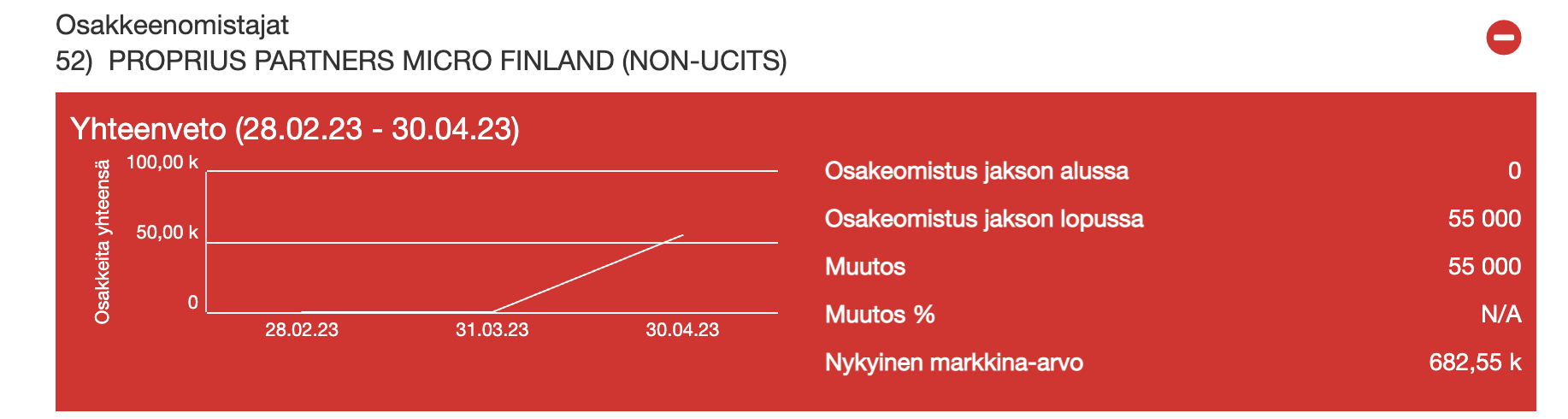
Proprius has bought Tokmanni:


Nalle2

2 d

Heikkilä & Viitikko have hopped on the red truck during the past month :tokmanni: :male_detective:

15 Likes

They also bought a sizeable stake in Remedy during April.
Currently, they are in 26th place on the shareholder list, so a pretty strong conviction :grin:

13 Likes

The fund has appeared on Marimekko’s shareholder list in 70th place. The portfolio managers’ previous fund has been a significant owner for a long time, so this was an expected development.

9 Likes

Proprius Partners is also found in the recent F-Secure shareholder list (rank 26), as well as the Terveystalo shareholder list (rank 40).

14 Likes

Also among Talenom’s owners

11 Likes

Here are the values of the previously mentioned holdings at today’s price. Interesting fund, but I don’t have enough chips for the minimum subscription.

Terveystalo: 1.141 million (140k shares)
Remedy: 1.057 million (43.7k shares)
F-secure: 1.032 million (350k shares)
Tokmanni: 0.670 million (55k shares)
Talenom: 0.608 million (80k shares)
Marimekko: 0.380 million (40k shares)

EDIT:
WithSecure 2.4 million euros (1.654m shares)
Enento 1.8 million euros (100k shares)

25 Likes

Additionally, WithSecure 2.4 million euros (Osake | WithSecure™)

13 Likes

Apparently, they don’t publish the funds’ holdings anywhere on their website, or is there no way to view them otherwise? How can a potential investor evaluate the fund before making a purchase decision?

They don’t disclose their purchases during the construction phase. Possibly later, at a more mature stage.

1 Like

The latest piece focuses on quality investing.

A few highlights from Viitikko’s writing:

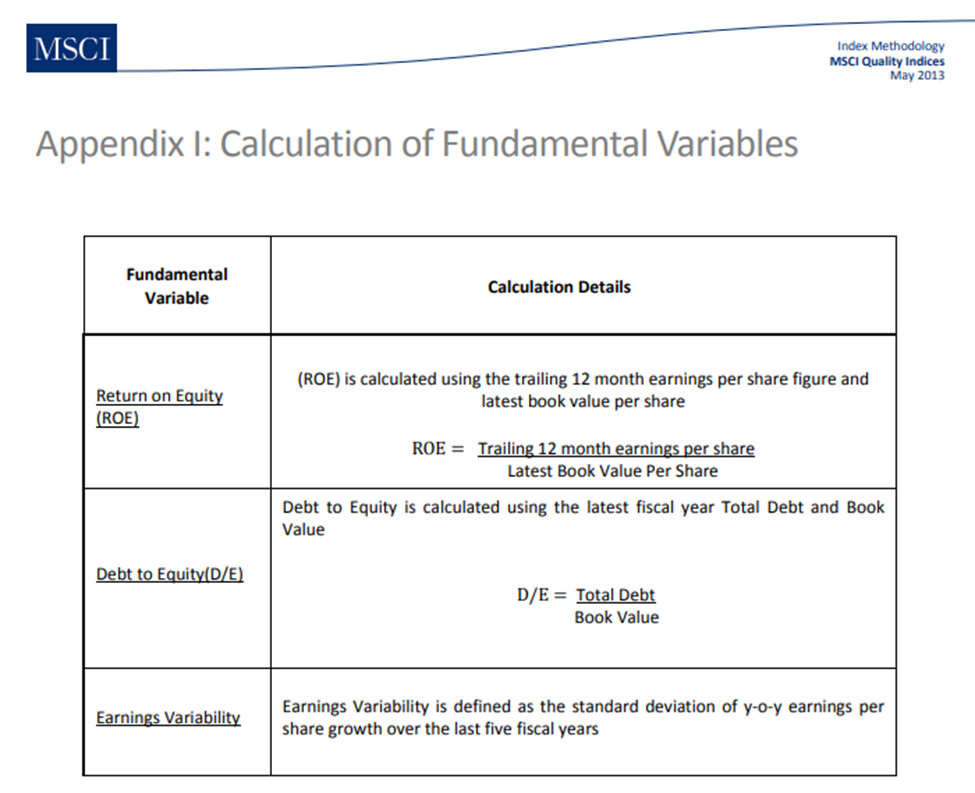
" There are several different criteria for company quality, as partially brought forward above. One widely used procedure is MSCI’s criteria, which are as follows:

In practice, quality according to MSCI consists of three fairly simple components:

  • Return on Equity
  • Strong balance sheet
  • Low earnings volatility.
    "

"
One significant problem for a quality investor is, predictably, whether the company is truly high-quality, whether it is as high-quality as the market generally understands and prices in, whether the company’s quality and competitive advantage will last through the coming decades, and how on earth an investor can assess that. This is certainly not easy, just as investing is not really easy in any style.

The best situation would be to buy a mediocre or even terrible company at low multiples before the company becomes high-quality in the eyes of investors and the multiples start running wild. Probably the best example of this from the Helsinki Stock Exchange over the last decades is Revenio Group, which transformed from a repulsive conglomerate mess into a sparkling health technology success story.
"
"
The highest-quality companies on the Helsinki Stock Exchange by MSCI criteria

I don’t consider it a sensible use of time for our clients to perform some semi-scientific modeling of the highest-quality companies on the Helsinki Stock Exchange. So, Mika Heikkilä and I discussed the matter for about 2 minutes to confirm each other’s quality delusions within the framework of the MSCI quality framework.

Here are the names that first came up, in random order, with minimal comments:

• Orion, meets all three criteria
• Kone, all three
• Elisa, all three, though considering the nature of the business, debt is used
• Neste, ok, but earnings are too volatile
• Olvi, ok, though the mood has soured due to Belarus
• Revenio, all three
• EQ, all three, but performance-linked fees, etc., can swing the results
• Titanium, same as above
• Sampo, within the company, especially If meets all criteria
• Kesko, some leverage in use, especially grocery (food) meets all criteria
• QT, meets all except earnings volatility may be high
• F-Secure, all three, but a recent acquisition increases indebtedness.

I should point out that this listing does not take any stance on valuation multiples or whether they are potentially good investment opportunities or not.

What criteria do we ourselves look at regarding quality?

After all this pouring out, I will briefly highlight what kind of criteria we ourselves use as builders of quality perception as part of our investment processes. The list is partially generic and certainly not exhaustive:

• High returns on capital (ROIC, ROE, ROA etc. as appropriate)
• High profitability margins, for example, EBIT, EBITDA, gross margin, net result…
• Balance sheet strength, for example, equity ratio, net debt, and gearing
• The business’s ability to generate free cash flow
• Long-term and convincing financial track records, including capital allocation
• Resilience of the business during weak times (e.g., consistency of margin levels, recurring revenue, etc.)
• Predictability and visibility in the business, low earnings volatility
• Strength of competitive advantage (e.g., economies of scale, network effects, barriers to entry, cost leadership, etc.)
• Pricing power of the company (typically seen as high margins)
• The company’s management and board as well as the ownership base
• Low business risk (the elevator business is more static than technology start-ups)
• The company’s market position
• If current performance is not great, there should be a credible plan to improve the situation

A Value Investor’s Concession

Since the roots of the portfolio managers at Proprius Partners are strongly based on value investing, here is our approach to company quality structured based on Buffett’s wisdom.

”It’s far better to buy a wonderful company at a fair price than a fair company at a wonderful price.“ (Buffett)
“Time is the friend of the wonderful company, the enemy of the mediocre.” (Buffett)

Points one and two are certainly familiar to many readers, but in our opinion, they must always be combined with point three.

“Price is what you pay. Value is what you get.” (Buffett)

So if one must choose, it’s better to pay a bit more than to force yourself to buy weak business, even if you are a value investor. Price is still always an important component!

"

12 Likes

@Sauli_Vilen, do Heikkilä or Viitikko have profiles on the forum? If not, they could create them and join the discussion once the portfolio accumulation is complete.

And Sauli, sell Proprius the same package that PYN Elite uses. There are definitely potential fund investors to be found here :slight_smile:

22 Likes

As far as I know, he doesn’t have an account on either forum, but Mika at least has mentioned that he occasionally stops by to read the discussions here :slight_smile:

P.S. and it would be quite strange not to follow the conversation about one’s own fund (I personally wouldn’t be able to resist the temptation :smiley:)

38 Likes

I’ve often wondered why the initial subscription in these kinds of funds is always so high that it inevitably weeds out a lot of interested people. I’d be interested too, but 50% of my total investment assets is just too much to put on one horse.

I’m sure there’s a reason for this and not everything is possible for the broke, but still. One would hope that moving the money etc. doesn’t cause manual work, but maybe a small investor’s money is more prone to all kinds of back-and-forth shuffling, which causes unnecessary hassle.

4 Likes

My guess as well is a reduction in frequent trading. If someone has €50k to invest, they likely have other investments and assets to use for unexpected expenses.

4 Likes

I can’t comment on the Proprius case in more detail, but generally in asset management, processing customers is quite expensive, and because of this, many smaller firms have quite high minimum tickets. For example, Titanium has 20k, PYN 10k, and I recall Taaleri being in a similar range at one time. To be able to accept subscriptions in the hundreds profitably, you need really good processes and large scale (it’s no coincidence that banks are essentially the only ones who can do this profitably). In practice, you protect customer-specific profitability by limiting the buyer base with a high minimum ticket.

I’d argue that in a situation with 100 customers with 1m tickets vs. 10,000 customers with 10k tickets, the 100-customer portfolio will definitely experience larger waves in redemptions (even a couple of redemptions are enough to cause a significant redemption on the portfolio scale) :slight_smile:

32 Likes

That didn’t take very long.

30 Likes