The mountains of government debt are certainly a big factor in delaying interest rate hikes for as long as possible, so that inflation can at least melt away some of it.
This ties in quite well with the scenario where the Fed has repeatedly indicated that employment must first be brought up, and in the meantime, soaring inflation would just be transient. And employment inevitably rises slowly.
I wonder if this is an explicit statement of the true motive.
I once again warmly recommend everyone to delve into this LT3000 blog post about stocks in inflation.
In short: inflation erodes real returns, so the required rate of return for stocks theoretically increases :o
“The history of financial markets makes it abundantly clear that empirically, P/E multiples have sharply compressed during periods of high inflation. This has confounded many observers, who argue that stocks are real assets, and therefore that P/E multiples ought not change during periods of high inflation. Indeed, seemingly confirming the theory, nominal EPS growth has been significantly higher during periods of high inflation. US Market EPS growth, for instance, was much higher in the inflationary 1970s than the relatively low-inflation 1980-90s, despite much poorer economic and financial market performance. The latter occurred because multiples sharply compressed. Is this a major inefficiency?”
Of course, this is especially true if/when interest rates rise with inflation. If interest rates didn’t rise, stocks could (note that this is pure speculation, hence the cautious wording) float along with inflation. This has happened, for example, during wars when interest rates have been forced down but inflation is rampant.
Yeah, exactly like Lyall’s other blog posts. Mainly, I was perhaps looking for what would be a better investment than stocks in a scenario with inflation and low interest rates. Of course, companies’ profits suffer, especially those with weaker pricing power, but in the same way, or even worse, inflation erodes property rental yields and, especially, bond yields, in my opinion.
So, in my opinion, since money always has to be somewhere, it’s mainly about comparing different asset classes with each other in different situations, rather than absolutely.
Again, it’s also good to consider why inflation is rising. For example, now it’s largely energy/raw material-driven (fortunately @Marianne_Palmu came to the office today so I have “macro support” next to me :D). It could be a temporary spike.
As Adrian stated above:
Then, when the labor market is super tight, the real worrying begins.
For example, even Italy could withstand higher interest rates if inflation is due to strong economic growth (tax revenues swell, etc.). Perhaps interest rates don’t need to be forced to stay low, as many now assume? Remains to be seen… The debt-to-GDP ratio could even start to decline, or should decline, in many countries as the economy expands.
If interest rates were not an option (central banks force them down by buying bonds indefinitely?), money could flow into cryptocurrencies, commodities, real assets, infrastructure projects, private equity funds, etc., but some of these are very small asset classes compared to stocks and bonds, so not everything can fit there without an enormous bubble. In that sense, stocks would be the “place to be” anyway.
But as stated above, interest rates can indeed rise quite a bit. Especially corporate bond yields.
Verneri, have you come across data where stock market valuation levels over different periods (i.e., P/E as a function of time) are depicted as inflation-adjusted, or specifically, with real P/E ratios?
And you might have had these in your presentations, but I don’t remember them anymore. It would be nice to save something like that in my own files.
Here’s a short summary for those who don’t feel like reading:
Once 801 enters effect, all hedgefunds holding short positions will be monitored Every. Single. Minute. They will have to report EVERY SINGLE MINUTE their value in short positions versus their actual money on hand. If they fail to report or their short position value crosses the threshold where it is higher than their money on hand, it is an immediate warning to deposit the funds needed to cover within ONE HOUR. Failure to do so leads to the NSCC immediately overriding operations and liquidating the hedge funds entirely, one after another until all that is left is the trillions in insurance.
So, in practice, 801 brings more transparency to hedge fund operations, which, at least in my understanding, can sometimes be almost purely criminal activity So if that holds true, hedge funds must constantly have money to cover shorts within an hour or their assets will be liquidated.
801 passed on Wednesday, and apparently, 002 is being processed today.
Could this week’s super shorting in the US be related to these, meaning they’re pulling retail money once more for good measure?
I crunched some numbers yesterday, you can find them above.
Below is S&P 500 data from the 2000s. These are not P/E ratios but earnings yield, which is the same thing, just inverted.
For inflation, I’ve used both 5-year breakeven inflation and CPI*. For comparison, I’ve used the real 10-year bond yield.
Perhaps Verneri has better data sources. I didn’t have any data stored beyond that for now. Maybe I’ll collect some someday.
*April and May 2021 data is not out yet, but I used 3.6%—which has been indicated.
CPI, in my opinion, is not the best fit for this. The 5-year breakeven is more stable and forward-looking, just like the stock markets always are.
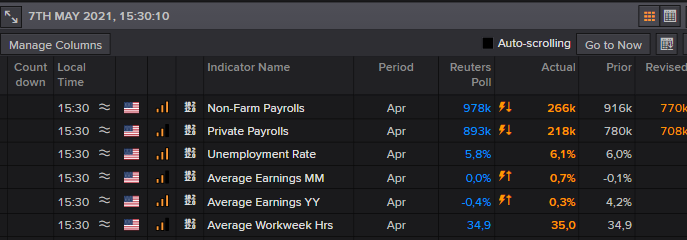
Good afternoon! The official US employment figures for April were just released, and they were disappointingly low compared to expectations. I haven’t seen such a large discrepancy in a while. Talks of stimulus will likely continue at the Federal Reserve.
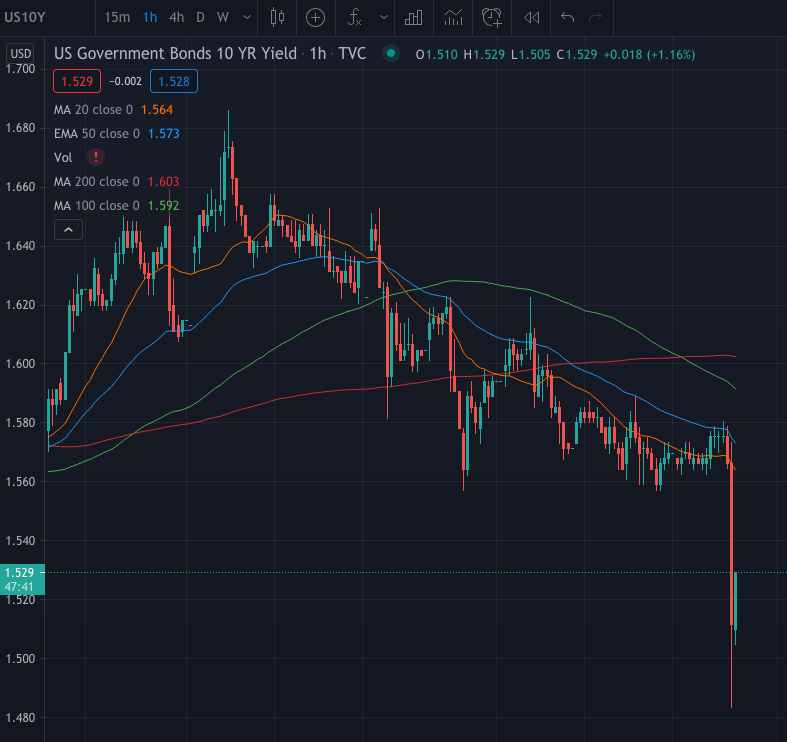
Market reactions in the short term are not always so rational. I would personally see that with the employment figures, it is expected that the FED will not raise interest rates and that stimulus will continue strongly. Supporting employment is the FED’s primary task. 10-year bonds went on sale because in the short term you get better returns from stocks or other assets. This situation can change again with the next news.
Admittedly, one is almost always surprised; everyone probably expected a big dip as the next move in the stock market.
Yeah, it’s pretty unusual when significantly worse-than-expected employment figures push the S&P 500 to an ATH (All-Time High). The Nasdaq saw an even bigger jump, which clearly indicates, in my opinion, that the most significant factor in the markets right now is inflation expectations and when the FED will start tightening its stimulus. These bad news provide a little pick-me-up, suggesting that the party might continue a bit longer, especially since there had already been speculation that tightening could come sooner than expected.
What do you think, @Verneri_Pulkkinen, which one will perform better over the next 5-10 years:
A) ESG/sustainable/SRI companies, from which polluting/unethical/other similar companies have been excluded, or
B) A broad market index without filtering, meaning it also includes polluting exploitative companies?
Ethics, of course, is a rather broadly defined characteristic, the unambiguous definition of which is difficult.
The market is taking a view on future guidelines, but this talk of rising inflation somehow feels like a strange reversal. There are already clear signs of inflation in the air. Perhaps the reason is that there hasn’t been proper inflation and/or a high-interest rate environment for years, so many have forgotten about it + all those involved who haven’t experienced it before. In just over half a year, it will be 2022, and by then, the situation should be quite different.
That report will surely allay fears of inflation overshooting, and given the weakness in growth stocks in recent weeks, it’s an understandable reaction.
You’ve all probably noticed, by the way, how the market narrative changes every couple of weeks. In the autumn, there was rotation panic, which lasted a couple of weeks in the media and investor discussions and then completely faded (even though the rotation itself actually happened with force). In the summer, there was the dead cat bounce narrative (“the stock market will crash further as infection numbers rise again…”). At the beginning of the year, GME and WSB. Then the inflation bogeyman, etc.
I don’t know for that period, it depends on how companies are defined in the indices.
I have not. P/E itself is not “inflation-adjusted.” However, if E is calculated as an average of several years, as in Shiller’s P/E, then yes, so that E is not unfairly large.
It might allay them for now.
Weakness in growth stocks? These also span such a wide range. Maybe it’s good that not all the garbage floats
With sector rotation, overvaluation also buzzes around. Everyone gets what they want in their portfolio when the enthusiasts disappear elsewhere.
Well, one can’t really “know” it. Let’s consider these options:
“Good Guys’ Group” (option A1) filters out the worst polluters (e.g., coal use for energy production, oil sands, tobacco industry, weapons, etc.).
Or a broader group of good guys (let’s call it A2): also invests in all the aforementioned, but tries to choose the “least bad” companies from each sector.
Or then option B, which invests market-value-weighted in everything? @Verneri_Pulkkinen
In the latest Traders Club, Lepikkö discussed the increased unemployment benefits in the US, which are valid until September. He also mentioned that due to this, low-wage sectors, for example, have had difficulty getting employees back to work, as the increased unemployment benefits can provide a better “salary.” It’s somewhat ironic that the Fed is so strongly focused on improving the employment situation while the increased unemployment benefits undoubtedly affect people’s willingness to return to work, at least for now. I can’t say what impact the removal of these increased unemployment benefits will have on the overall picture or if it will cause a jump in employment figures. Apparently, there is already quite good demand for employees in the US generally.
This $600/week unemployment benefit will certainly make it harder to find labor for low-wage jobs. It is likely that an even larger portion of those jobs will be done by undeclared labor (pimeä työvoima), which may be even easier to find among those collecting unemployment benefits and looking for “extra income.”
As I understand it, even in normal circumstances, there is more undeclared labor (pimeä työvoima) in the US than, for example, in Finland. The rise of earning models based on light entrepreneurship (kevytyrittäjyys) will also distort statistics and make it possible to simultaneously collect benefits and work.
If we are in a bubble anywhere, it’s a bond bubble.
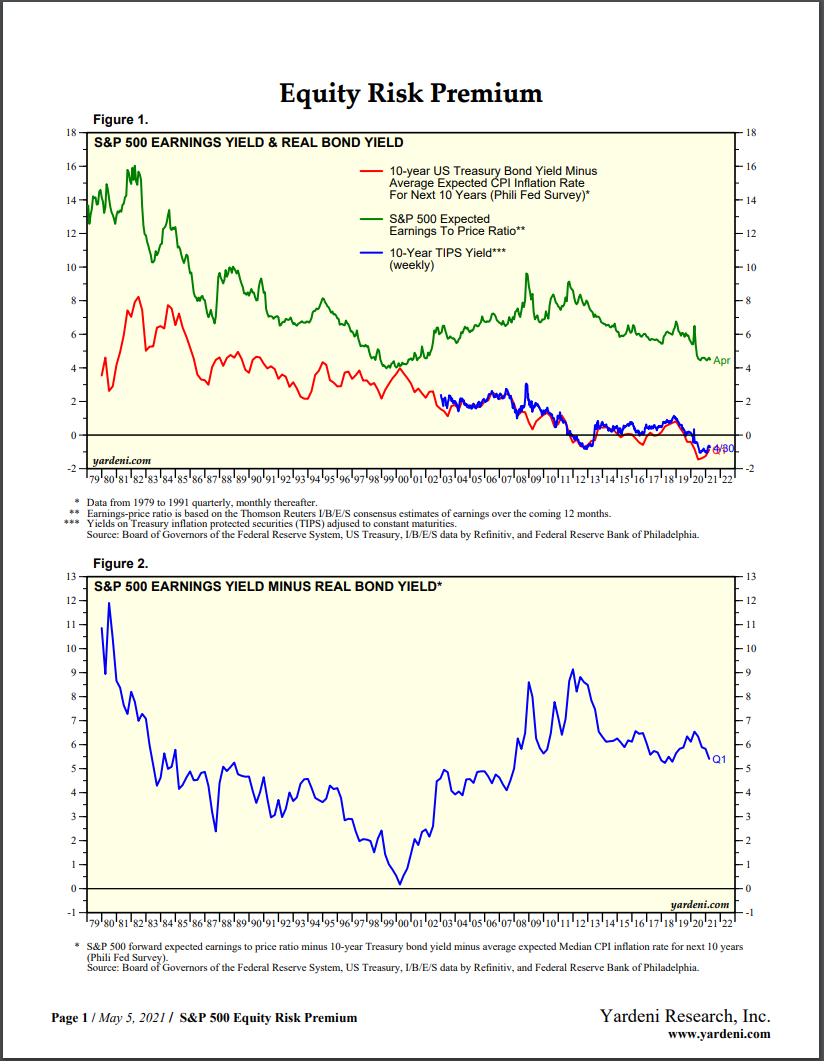
It’s an interesting situation that the equity risk premium has remained relatively constant, despite passive funds and such being marketed nowadays as a “guaranteed 7% return.” Of course, in absolute terms, the premium is only 4%. That’s quite a bit short of the promised seven percent. Earnings growth (or decline ) would, of course, be added to that 4%.
The figure is in millions and also includes the public sector, pension funds, etc. So, listed shares in Q4 2020 national wealth balance sheet amounted to 146 billion. A small sum compared to the entire balance sheet, which probably contains large amounts of buildings and other assets. I haven’t looked into the statistical methods in detail.
When the public sector is also included, the equity weighting is not comparable to the corresponding figure in the US indicator. The Bank of Finland’s figures are better in that sense, as they provide relatively detailed insight into private investors’ figures and, through that, investor sentiment.


 So if that holds true, hedge funds must constantly have money to cover shorts within an hour or their assets will be liquidated.





 ) would, of course, be added to that 4%.