“I think this is a bit of a bad forum to start analyzing this short case. But I will comment that Melvin didn’t close their shorts (and I don’t believe they were puts; it hasn’t been documented anywhere, nor have I seen it myself), but another company financed Melvin so they could keep the shorts alive.”
10 Likes
Noksu has a much smaller amount of shorted shares than, for example, Gamestop, which removes the possibility of a proper short squeeze, which is the biggest reason for GMS’s sharp rise. Those wsb pumps don’t have much to do with the company’s actual situation, but the rises are mainly based on short burning and calls, when brokers have to buy shares from the market before they expire.
Edit: It remains to be seen how many similar cases will emerge before some party starts interfering with wsb’s operations. Will people then withdraw to some dark web to maintain the torch of resistance 
6 Likes
In short, in the case of Nokia, the situation practically started in WSB, where one guy had analyzed Nokia’s fundamentals and stated that this is a great rocket and “technical analysis” also supports the rise. From there, they just got excited. Of course, there can be many opinions about how profound the analysis was.
- edit: @Vodel1 In that case, wouldn’t the Inderes forum also be shut down?
20 Likes
{“content”:“In my opinion, it was a good analysis, and there were many others as well.\n\nThe informational value was completely different from, for example, the Nordea report published on Friday.”,“target_locale”:“en”}
3 Likes
Could this Nokia vs Gamestop vs r/wsb discussion be moved to the respective company threads? It doesn’t belong in this thread, IMHO.
15 Likes
This is a bit off-topic, but… the actions of these hedge funds and activists aren’t transparent or ‘fair’.
There are dark pools, HFT tools, and stocks have been pumped up/down by leveraging the media. In the Neles case, there were already plans in the back pocket, and at the same time, they were acting as a grey eminence on Metso’s board.
However, I reckon the patience and pockets of the aforementioned actors are sufficient, compared to ADHD Robinhooders.
How all this affects the direction of the stock markets, I don’t know, but I’ve lightened my own hype stocks (Appian, Magnite, Unity) by about half. One has to set limits for one’s own greed…
4 Likes
I was under the impression that trading algorithms already utilize social media data. This also confirms the effect of social media buzz on stock prices.
7 Likes
What could have been the effect of the algorithm’s fault when Elon said ‘signal’?
This is certainly an interesting lab, swarm intelligence vs. artificial intelligence. It will lead to absurdities..
One must remember that the big boys have the market’s best IT-nerds coding AI-automation-etc algorithms, capable of processing billions of data points per second. Fast learning curve.
And it could even happen that the hedges start tripping each other, with China and North Korea joining in just to mess things up. 
4 Likes
Almost a minute-long -video stretched to almost ten minutes, but at least there’s even more content. 
A few charts to borrow here.
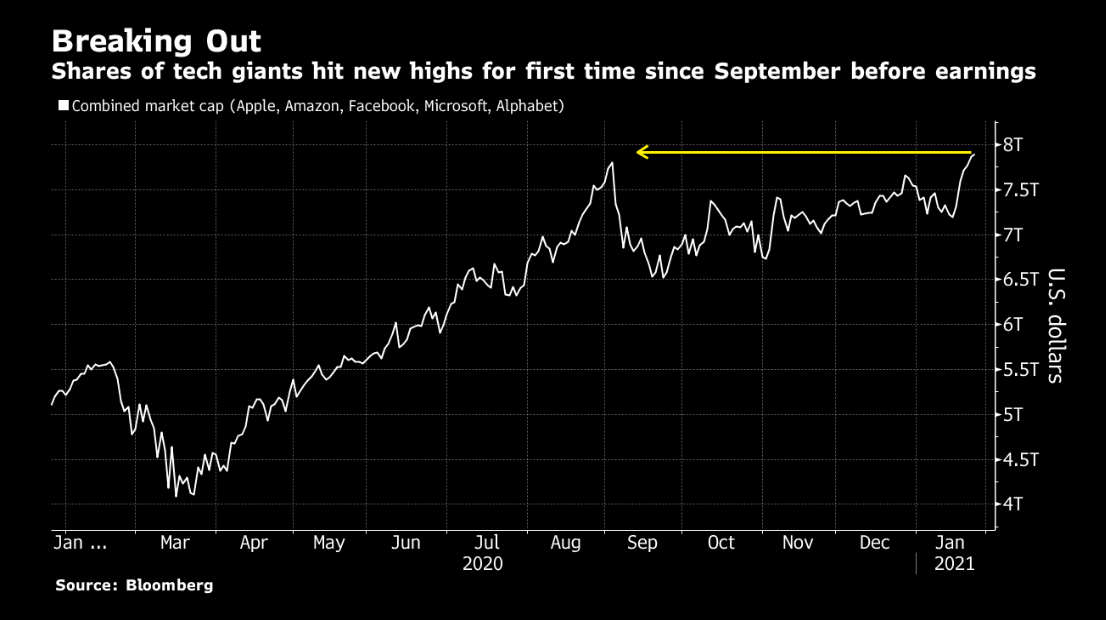
As investors’ attention shifted to hype sectors and Reddit, tech giants languished for the past six months. Now, finally, as a group, they have once again made new highs on the eve of earnings season.
Anything is possible when over 100% of the stocks are shorted..

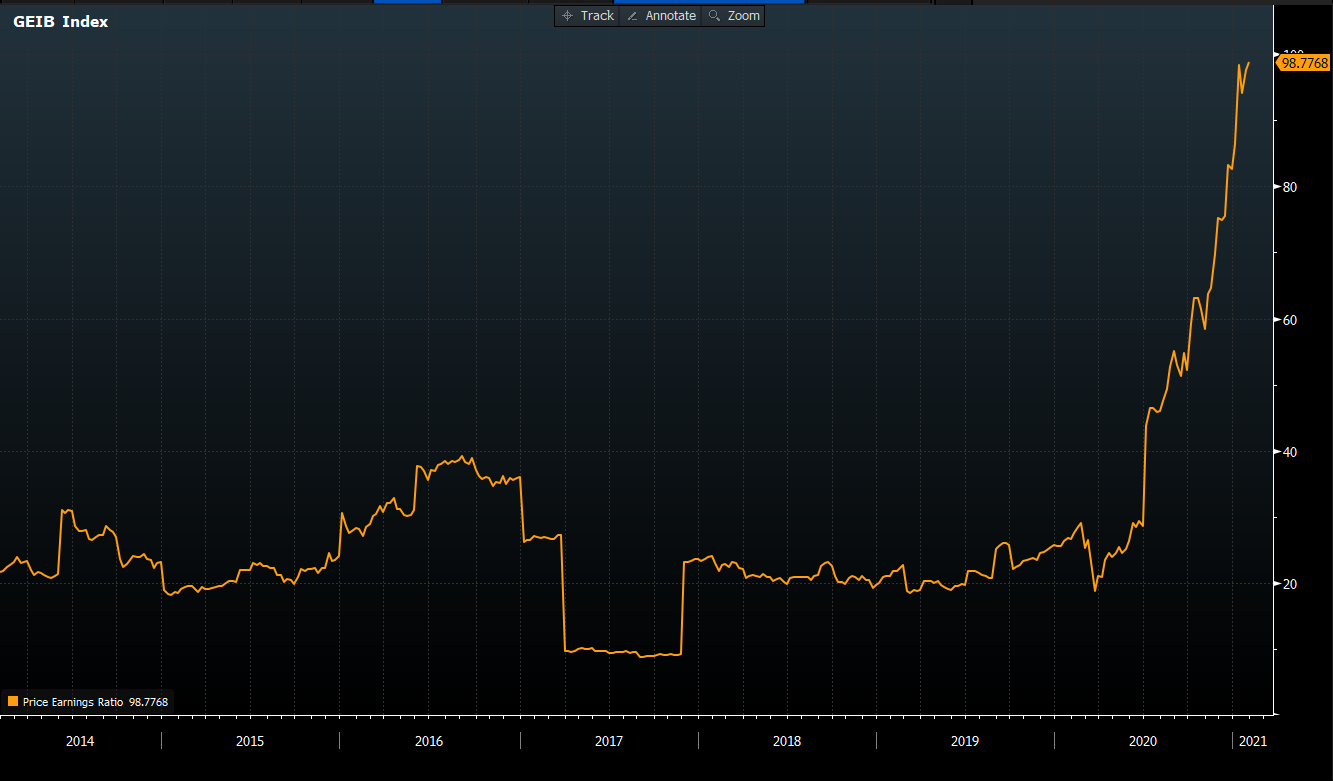
On this forum too, many investors have made a lot of money in renewable energy stocks. They are not alone. The MSCI Global Environment index clearly illustrates how the entire sector has risen parabolically over the past year.

This is also reflected in valuations: P/E has risen from 20 to 100!
Behind this are massive capital flows that have flooded into the sector’s stocks, ETFs, and funds. Here is an example of the capital flows of one ETF. Basically, everything is floating when ETFs buy stocks with blinders on.
The ETF’s largest holdings are familiar names to forum members…
The main point of the video is how much investors’ infatuation with certain narratives drives capital flows, which in turn fuels rises, which again generates more attention and fuels further rises.
The key question, of course, is how long this can continue as these sectors deliver massive returns day after day…
44 Likes
Nordea: Nordea Economic Outlook: An Invigorating Shot
We forecast the Finnish economy to grow by 3.0 percent this year and 2.0 percent next year. From the stock market, we still expect good, but fading, returns this year.
The global economic growth outlook essentially depends on the rapid success of vaccination. If rapid vaccination is successful, we expect Western economies to widely return to pre-crisis levels already around the turn of next year. The recovery is supported by relatively minor structural changes needed, the consumption of savings accumulated during the crisis, and still substantial stimulus policies.
Stock prices usually turn for the better during the darkest moments of a recession, anticipating improvement, and the highest returns are made when only a few dare to buy. This happened this time too. Although this train has already left, expansive economic policy and strong earnings growth will still support price increases this year, expects Nordea’s Chief Strategist for Wealth Management, Antti Saari.
The investor’s biggest concern right now is that there aren’t really any clear concerns. In such a situation, unexpected bad news easily weighs on prices more than usual. It is therefore good for investors to prepare for the continuation of greater-than-usual price volatility, Saari reminds.
A quick glance didn’t really reveal anything surprising, but it’s good to read the thoughts, of course.
6 Likes
It seems that different threads and discussions are filling up with lamentations about this irrational trend. Clearly, growth companies and tech stocks are very expensive. There are their own bubble sectors and companies, not to mention WSB companies.
However, it feels like there are different realities. In my opinion, median companies are not unreasonably priced. Nordic indices seem to trade at levels of 17-18, and many European stock exchanges at levels of 15-16.
Expensive - yes. Justified in a zero-interest-rate environment - I think so. In a bubble - hardly.
Of course, it should also be noted that even within those valuation levels, there are many companies with high multipliers. For example, Neste, Kone, and a couple of others significantly raise Helsinki’s PE.
At the same time, Sampo, Nordea, Tieto, Kemira, and many others are priced quite neutrally and don’t seem bubble-priced at all. Even the much-discussed sector rotation doesn’t seem to reach everywhere.
Has @Verneri_Pulkkinen or some other guru done research comparing the behavior of median companies or even value companies now vs. the tech bubble?
17 Likes
I linked this short video clip by Kevin O’Leary to the energy chain at the beginning of the month, but it is excellently related to the topic discussed here!

11 Likes
Mr. Wonderful is speaking pure truth. Great returns coming from the energy sector if you wait just a little longer, but hey, I think I wrote about this in the “Expected Comeback of Value Investing” thread the day before yesterday. Fits perfectly here.
“Investors are too optimistic about growth stocks in good times and too pessimistic about value stocks in bad times.”
https://www.ts.fi/uutiset/talous/1073977134/Itkupla+oli+porssitaivaan+musta+aukko
I was trying to find Nokia’s P/E ratio during the IT bubble and came across a TS article from 2004, which, once again, surprisingly has striking parallels to today. Of course, at that time, I was probably still competing to eat sand or wrestling with friends in the elementary schoolyard. A recommended read, even if just for nostalgia’s sake.
5 Likes
I’m no guru But, I did previously cover market behavior during that time in the Bull Market Anatomy video.
In the 90s, the SP500 general index rose over 20% annually for five consecutive years. So, even a general index like this climbed significantly at the index level.
But, as written in this article published in early 2000, the market became increasingly “selective”:
" But despite the headlines about records, analysts noted the gains were not widespread.
Of stocks trading on the New York Stock Exchange, 64 percent declined an average of 28 percent. On the Nasdaq, 50 percent of stocks retreated an average of 32 percent.
"It was obviously a very selective market. Not everyone was smiling, said Al Goldman, chief market strategist at A.G. Edwards & Sons. "If you didnt own a dot.com, high-tech or telecom stock, you probably didnt have a great Christmas. Those groups did very well for a few people, but most investors did not love 1999.
No investor could ignore the dominance of the technology sector. The year ended with Microsoft (MSFT), the worlds largest software company, having the largest market capitalization at $614 billion. General Electric (GE), the only original Dow industrial component still part of the average, came in second at $519 billion.
The year also brought the inclusion of Microsoft and Intel, the world’s No. 1 chip maker, in the Dow industrials. The reconfiguring of the blue chip index not only aided its surge forward, but exemplified – along with the addition of Internet issues Yahoo! (YHOO) and America Online (AOL) to the S&P 500 – the importance of technology in the modern economy. "
Often, the IT bubble is only associated with IT stocks, but even large companies rode the wave. For example, Coca-Cola notoriously got caught in the bubble at that time. GE, in turn, was a mix of heavy industry and finance.
But for many stocks, the decline began as early as 1998: almost two years before the entire market peaked in March 2000! Let’s use the value crawler Berkshire Hathaway as an example:
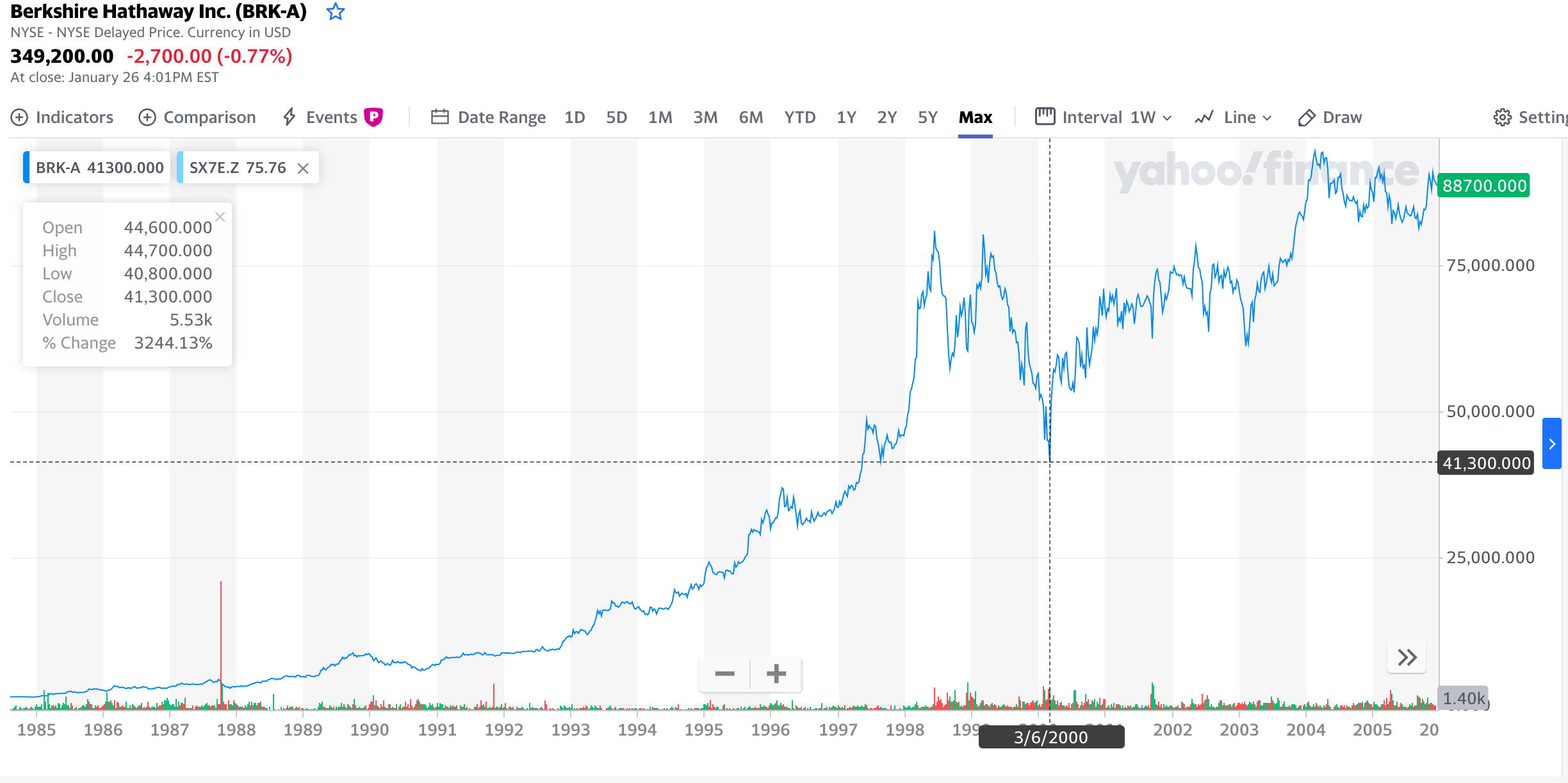
Notice how BKR.A stock almost halved between 1998–2000 as investors shifted their money to hotter IT stocks, but it bottomed out almost at the same time as Nasdaq peaked. Berkshire rose over 100% in the following years, while several tech stocks fell 90-99% and never recovered.
The market is not homogeneous; there is almost always something affordable and, in the opinion of the general public, boring to pick up somewhere in the market if one is willing to dig.
39 Likes
After discussing with a couple of small and medium-sized business owners, the perception that the corona has been good for others besides direct beneficiaries was confirmed. Travel expenses have dropped to a fraction, sick leaves have decreased, meal support has almost disappeared, office and negotiation expenses have dropped to a fraction, and personnel sauna evenings and other entertainment expenses are at a minimum… This effectively flows good directly to the bottom line. Some of this will become a more permanent practice with the change in operations, as even stubborn bosses realize that work progresses (in fact, often even better) even from a home office. Also, some previously unnoticed problems have emerged. This noticeably affects companies’ results, and the trend in the spring is upwards for some, even if the business itself has suffered a bit.
9 Likes
A new episode of Traders’ club is out, in which Lepikkö also shares his thoughts on the correction movement 

Short squeeze, Reddit’s meme stocks, and Elon Musk - these are the phenomena that have dominated market movements recently. Now that stock prices are being moved by investment forums and tweets from individual billionaires, is it time to empty your portfolio and prepare for the bubble to burst?
At the index level, the stock market is in a relatively calm phase, but beneath the surface, sentiment is glowing frighteningly hot in certain respects. Private investors are in the stock market with the largest debt leverage in history, Reddit’s Wallstreetbets has caused GameStop’s stock price to turn almost 90 degrees, and options trading is hotter than ever. What happens when morning dawns and the party of all time ends with the last call?
The most shorted stocks have offered significant excess returns since last April due to the short squeeze phenomenon. If we look at the 16 stocks whose float was over 40 percent shorted at the end of 2020, the average return since the beginning of the year is an incredible 59 percent. What happens when/if the situation normalizes?
Also, check out the latest hits from the meme market and professional trader Jukka Lepikkö’s news in Traders’ Club episode number 77!
13 Likes
It seems many heavily shorted companies are now experiencing a strong rally. In other words, shorts are being covered here and there. Has anything similar happened in stock market history? @Verneri_Pulkkinen
This should, in theory, raise the threshold for shorting, but what would it do to stock prices?
5 Likes
I can promise that April won’t be seen at these levels. If even I buy some damn stock without knowing what it even does after a 110% rise, then hype is rampant and euphoria abounds. There’s so much of it that I don’t even bother to research what company it is.
5 Likes
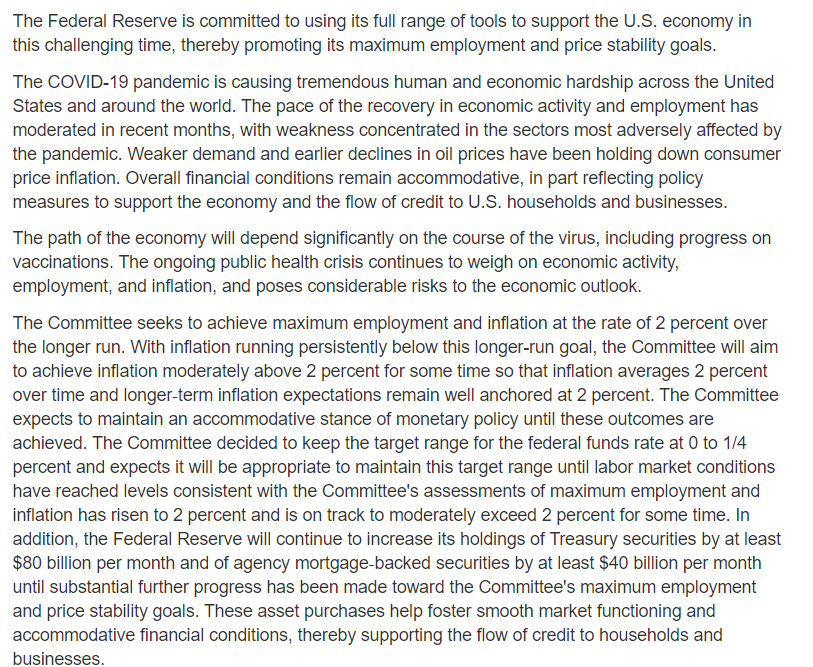
Good evening everyone! Like a calming and cooling compress on the forehead in the midst of this stock market frenzy, the Federal Reserve’s anticipated interest rate decision was announced, where the monetary policy stance and stimulus programs will continue unchanged.
44 Likes