🏆 Pitch your best investment idea! 🏆

What’s your best investment idea right now? Tell us with good reasoning and win Inderes Premium for 3 months, plus a surprise prize! The competition is currently ongoing, and you can participate by replying to this thread by Sunday, August 25th, at 11:59 PM.

First of all, a big thank you to @Hades for this excellent idea, and special thanks also to @Marianne_Palmu @Verneri_Pulkkinen @Antti_Jarvenpaa and @Mikael_Maijala, who were all involved in refining this idea into what we hope will be a long-lasting and recurring quarterly format, namely the forum’s own investor competition! :trophy:

Competition principle in brief:

  1. The competition recurs once a quarter.
  2. Participation time is 2 weeks (the competition is currently ongoing, and in the future, we will announce whenever a new competition begins).
  3. Pitch your best investment target by replying to this thread (long or short).
  4. Voting takes place by liking messages. The voting period continues for one week after the participation period, but messages can be liked at any time.
  5. You can give likes to as many as you want.
  6. The winner is the one whose pitch receives the most likes.

Prize:

  • Inderes Premium 3 months + surprise prize

More detailed rules:

So what exactly is being pitched here and to whom? Anything at all, and to us forum members! :blush: The stock to be pitched can be a company familiar to everyone, and the view can be consistent with analyst forecasts, or something completely opposite. There are no restrictions on the length of the justifications; ultimately, the audience decides how convincing the arguments were. :smile: You can also pitch why, for example, a cryptocurrency will collapse or a US tech stock will rocket to the moon. At least at this stage, we do not limit the target to be pitched, meaning only imagination is the limit, as long as the target is something that can be invested in (long or short). The time horizon for the development of the pitched target is also not limited; everyone can choose the most natural angle for their own pitch.

wolf-of-wall-street

When does the response time begin then? We will announce this separately each quarter, and at least this time, the response time is two weeks, but we will see what is a suitable time in the future. For the future, it is therefore perfectly permissible to draft a jaw-dropping pitch and let it mature in a drawer, only to unleash it into the competition when it’s ready, even if it’s a couple of quarters later.

When and whom to vote for? Voting simply happens by liking participants’ messages. However, there is no limit to how many messages you can like. You can also vote at any time, but after the two-week response period has ended, we will give the audience an additional week for voting, during which no new pitches will be accepted into the competition.

In addition to the forum’s admiration and respect, the winner will receive Inderes Premium for 3 months free of charge, as well as a surprise prize sent by mail. :trophy: The winner will be contacted via private message to arrange the details.

Any questions related to the competition can be asked in the coffee room and by tagging the undersigned or, for example, @Verneri_Pulkkinen, and we will try to clarify the competition rules if necessary.

Finally, a short disclaimer:

Referring to the forum rules, direct investment advice (“you should buy stock x”) is a licensed activity and therefore prohibited. Messages from competition participants should not be interpreted as investment advice. Participants’ messages are intended for informational and entertainment purposes only. Any statements, assessments, and forecasts are the views of their presenters. Inderes is not responsible for the content or accuracy of the information presented. Forum users are responsible for their own investment decisions and their outcomes.

134 Likes

Someone has to be the first…

CAMBI ASA – The ultimate sewage plant

They say the amount of shit in the world is constant. Despite population growth starting to decline, people are likely to concentrate their waste in even smaller areas due to urbanization. This means the amount of waste to be treated will increase. At least if we want to live in relatively decent conditions. Currently, half of the world’s waste is left untreated. This problem, combined with a budding collective desire for an energy production transformation, creates a business opportunity.

Product and Market Share
Cambi ASA from Norway has seized this opportunity. Cambi has developed a technology called Thermal Hydrolysis Process (THP) for treating wastewater.

image

The benefit of the process is that it improves biogas production potential by up to 50%, streamlines processes, and produces higher-quality end material.

image

According to management, Cambi is the market leader in its technological niche, with a market share of up to 90% worldwide. There are currently 89 plants in a total of 27 different countries, processing the waste of 118 million people. After Q1, the company had 16 plants under construction at various stages. The company has been manufacturing and developing the product since 1992, so it has a substantial pile of patents for protection.
Addition: I meant to write this, but forgot, that management sees the biggest risk as the low awareness of the technology. Additionally, customers are public entities, so sales and decision-making cycles are long.

image

The company consists of two segments:
Technology: Includes the design, manufacturing, and installation of THPs. This accounts for 75% of revenue.
Solutions: Includes maintenance of installed equipment, spare parts, expansions, etc. (meaning quite consistent revenue), and Grønn Vekst, which packages and distributes waste-derived material in Norway for use in places like gardens.
The Technologies segment is slightly more profitable.

Financial Situation and Outlook

As an investment case, the core idea of Cambi’s story is that over the past couple of years, they have managed to increase their order backlog significantly. As recently as the beginning of 2022, the backlog was barely hovering around 500 million NOK.

image

This should materialize into revenue over a three-year period. The installation time for the equipment is 2-3 years depending on the project. The gross margin also depends on the projects and fluctuates around 50% to 60%.

image
(On top of that, of course, comes new sales. Hopefully, at least now that the CEO has returned from paternity leave. :roll_eyes:)

And it seems to be doing so gradually when looking at the trailing 12-month revenue.

image

Regarding profitability, revenue growth is crucial for the operations to be profitable. From the graph below, it can be noted that historically, at the EBIT level, breakeven has occurred at a quarterly revenue of just over 100 million NOK.

image

The sharpest eyes might already notice that in Q1’24, with the same revenue, there was less “left in the tank” than a year ago at the same time. This is due to increased personnel costs. The number of employees has been increased by 17% to provide the workforce needed to clear the grown order backlog. Management also explained the low revenue by stating that project milestone payments did not fall into this quarter.

Stock Price and Valuation

After the price surges at the beginning and end of last year, the stock has been stagnating. At times it looked like a cup & handle might form, but currently, the curve looks more like a “sauna ladle” model.

image

This investment case could be based on the idea that management is telling the truth and Q1’s slightly weaker result was just a matter of milestone timing. At least one analyst from DNB following the company believes in this story. He gives a target price of 20 NOK. The theme is that Cambi is heavily undervalued compared to its peers at EV/EBITDA ~8x vs peers’ 12x. At that time, Cambi had liquid assets of over 330 million NOK, but 160 million NOK of that has been paid out as dividends. There is hardly any depreciation, etc. Apparently, the peers do have them, since that multiple was chosen. If this story holds up, there would be comfortable upside. For the dividend crowd, note that Cambi aims to distribute 60-80% of its earnings as dividends. For last year, a dividend of 1 NOK was paid, so at the last closing price, the dividend yield would be over 7%.

Disclaimer: This is a long pitch, so it’s written through shit-stained glasses. It may distort the truth. This is also not a deep-dive analysis but a pitch regarding an interesting situation. Do your own research before getting your hands dirty!

Acknowledgements:
@Polakki has written about Cambi on the forum previously:
https://keskustelut.inderes.fi/t/ostin-myin-juuri-asken-osa-6/42357/4017
as well as @Bjorninen:
https://keskustelut.inderes.fi/t/energia-alan-teknologinen-kehitys-ja-sijoitusmahdollisuudet/2568/9124
but I thought I’d boldly steal the idea for this competition, as I think there’s an interesting situation going on right now. Let’s share the prize if we win.

138 Likes

image

Danaos Corp - $DAC

Danaos is a New York-listed Greek shipowner whose business model is based on owning container ships and “chartering” them to shipping lines, such as Maersk, Zim, or Mediterranean Shipping Company, with contracts lasting several years. The shipping lines then decide for themselves how and where to use the ships.

In 2021-2022, global supply chains were disrupted as a result of COVID-19, which was a stroke of luck for shipowners like DAC. With ports in disarray, many ships had to wait for weeks to be unloaded and/or loaded. Consequently, the effective number of operating container vessels decreased and freight rates skyrocketed, leading shipping lines to want every ship they could get their hands on. DAC managed to negotiate excellent daily charter rates for its vessels AND lock in long-term contracts.

image

Following the peak prices of the supply chain crisis, greedy owners became excited and ordered an excessive amount of new container ships, which weakens the industry’s future prospects (supply >>> demand). However, the Red Sea crisis came at a convenient time for shipowners—freight rates rose as a result, which encouraged (and forced) shipping lines to increase their capacity again, giving owners a strong negotiating position.

DAC is currently trading at a TTM P/E of 2.8, so at first glance, the stock is not exactly overpriced. History is no guarantee of the future, but fortunately, DAC’s business model is.

image

As shown in the image, a large part of Danaos’s contracts continue for another couple of years, and the cash flow from them will cover the entire current enterprise value.

The company currently makes a profit of about $150m per quarter. This amount will gradually decrease in the coming quarters, but in 3 years, the company will have made a profit roughly equal to its enterprise value based on current contracts AND will still own its entire fleet (the scrap value of which is worth hundreds of millions).

Cash - debt + ships + current contracts = ~$3.5 billion VS. Mcap $1.6 billion // EV $1.7 billion.

Buffett: “Buy a dollar for fifty cents

And who knows, maybe in a couple of years there will be some new crisis that increases the demand for ships again?

Of course, the company also has negative aspects:

  • Not much money has been returned to shareholders; the dividend has remained at $0.75-0.8/quarter for a couple of years, and the company has reduced its share count by only about 5% over 3 years (although the company does not grant generous stock options, so the share count doesn’t increase either). In the last year, Danaos has expanded its operations into dry bulk ships. Dry bulk is actually a very promising sector for the coming years, but this still means the company would rather buy ships from outside at 100% of their price than buy back “its own ships” at 40% of their price through buybacks. The company doesn’t seem to care much for the lessons of corporate finance. The company has also bought stakes in a few other listed shipping companies and traded them successfully.
  • Investor relations is not a priority. For example, the latest quarterly presentation lasted a total of 15 minutes, including questions (of which there were 0).

Danaos is the cheapest company in the sector, but its competitors aren’t expensive either. DAC trades at about 0.45 P/NAV, Euroseas 0.6 P/NAV, Global Ship Lease and Costamare 0.65 P/NAV, and the clearly highest-quality MPC Containers at 0.85 P/NAV.

66 Likes

It might not quite meet the definition of a “small cap,” as this company’s market cap is 39 billion Swedish krona. The company is called Camurus, a Swedish drug development company. Camurus develops treatments for severe and chronic diseases as well as rare diseases, such as cancer, endocrine disorders, and opioid dependence. Drugs are developed both in-house and in collaboration with international pharmaceutical companies.

The company has already passed the riskiest start-up phase, and there are currently two drugs on the market for the treatment of opioid dependence. A third drug (with acromegaly as the indication) has passed Phase 3, and marketing authorization applications are currently under review by the FDA and EMA. The FDA decision is expected in 10/2024 and the EMA decision next summer. Positive results were obtained in Phase 3, so it would be a major surprise if the FDA and EMA applications were rejected:

Phase 3 results:

Opioid dependence is a major problem, especially in the US, so the market potential there is good. There are other drugs in the development pipeline, but it will likely take a couple more years (or more) for them to reach the market, if they do. Furthest along (in addition to the drugs already on sale and under regulatory review) are Phase 3 candidates for gastroenteropancreatic neuroendocrine tumors, chronic pain, and genetic obesity disorders.

Business development:

Näyttökuva 2024-07-26 kello 23.05.17

Last year’s revenue was 1,717 million, and the company’s guidance for this year is 1,740–1,860 million, but last year included 406 million in one-time milestone payments, so growth remains strong this year as well.

Regarding operating profit, the guidance is as follows:

“Profit before tax MSEK 330 to 450, an increase of 131% to 215% vs. 2023 excluding one-time
milestones revenues (-18% to -40% vs. 2023 total profit before taxes)” and there is also a clause: “Camurus’ full year 2024 guidance is reiterated and expects to finalize in the mid to high end of current guidance”

There are 58,636,918 shares outstanding, and at today’s price of 667 krona, the market cap comes to 39.1 billion krona. Based on the company’s guidance, the P/S would be 21. The company is net debt-free, so the EV/S is a bit lower. Analysts expect a revenue of 1,950 million for this year, which is more than the company’s guidance.

Profitability and profitability forecasts:

2019 2020 2021 2022 2023 2024 2025 2026
Net sales 105.6 336 601 956.3 1,717 1,949 3,210 4,428
EBITDA Margin (%) -332.39% -57.64% -14.2% 8.88% 31.45% 24.2% 44.55% 50.7%
EBIT Margin (%) -340.91% -61.08% -18.47% 7.52% 30.63% 23.32% 43.93% 50.16%
EBT Margin (%) -342.39% -61.48% -18.6% 7.65% 31.99% 25.04% 43.62% 51.23%
Net margin (%) -274.53% -49.78% -15.05% 5.81% 25.13% 19.31% 35.99% 42.12%
EV / EBITDA -11.5x -49.9x -92.3x 159x 53.3x 78.1x 24.8x 14.8x
EV / EBIT -11.2x -47.1x -71x 187x 54.7x 81.1x 25.2x 15x
ROE -65.58% -22.62% -10.66% 6.03% 34.69% 17.81% 40.82% 50.3%
Capital Intensity
CAPEX / Current Assets (%) 4.39% 0.99% 0.82% 0.2% 0.59% 1.13% 0.76% 0.61%
CAPEX / EBITDA (%) -1.32% -1.72% -5.79% 2.24% 1.88% 4.65% 1.72% 1.2%
CAPEX / FCF (%) -1.07% -1.37% -3.33% 1.92% 1.7% 9.6% 2.61% 1.64%

Over the last couple of years, ROIC has also turned positive; in 2022 it was 5.7%, last year 32.8%, and trailing 12 months 22.5%.

Edit: A brief note on acromegaly, which is the next drug potentially receiving marketing authorization. Acromegaly is a rare, slowly progressing disease where too much growth hormone is secreted. Most often, the cause is a pituitary tumor that causes overgrowth of bones and tissues, leading to various symptoms and, if left untreated, premature death. It takes an average of 5–6 years from the onset of symptoms to diagnosis, and patients receiving a diagnosis are around 40 years old. The prevalence is approximately 60 cases per million and the incidence is 4 cases per million per year. Currently, the primary treatment is surgery. Medication can be combined with surgery, or radiation therapy if both fail. The goal is to normalize growth hormone and IGF-1 levels. Surgery is currently the primary treatment, but if the tumor is large and cannot be completely removed, medication is also needed. Medical treatment involves somatostatin derivatives (octreotide or lanreotide); Camurus’s drug belongs to the former.

According to studies so far, Camurus’s drug is more effective than current treatments, which could lead to more efficient management of acromegaly. The patient can also self-administer the drug, as it is injected subcutaneously with an autoinjector, similar to how insulin is injected. Administration occurs once a month. In itself, the administration technique and method are not new.

At the end of Q2, there were a total of 53,000 patients using Buvidal/Brixadi (the molecule currently on the market), with a QoQ growth of 3,000 patients and an increase of approximately 5,000 patients since the end of Q4’23.

In Australia, injectable buprenorphine has over a 30% market share in the medical treatment of opioid addicts, and about 80% of this is Buvidal. There is also growth in other large European countries. In the US, sales grew 75% from the previous quarter.

With a quick search, there are about 2 million opioid abusers in the US alone, only about one in five of whom receive some form of medical treatment for it.

Therefore, opioid dependence is the company’s main product and it has real, significant potential!

This is from the Swedish small-cap thread. I will supplement later if I have time.

46 Likes

This investment can be combined with the idea that came in second, it’s that good. 100% into a 3-month fixed-term account, giving you time to think things over in peace and then invest at lower prices, getting more for the same amount of money.

8 Likes

Buy only high-quality family/major shareholder-owned investment companies with a proven track record of beating the local index. This provides significant tax and diversification benefits over time. For instance, the Wallenbergs’ Investor AB, Bernard Arnault’s Christian Dior, and why not even the giant Berkshire Hathaway to start with.

I wish I had realized as early as 2015 to start putting money into these, for example, in a 33/33/33 ratio. Purchases a few times a year, and preferably when they can be bought below the group’s net asset value (NAV). Depending on the investments, the weighting can be adjusted so that the geographical diversification is sensible. This way, you also get exposure to interesting unlisted companies that you wouldn’t otherwise have access to, at least not with small sums of money.

59 Likes

Graphene Manufacturing Group Ltd
https://graphenemg.com/

GMG has developed a proprietary production process to break down natural gas (i.e., methane) into its constituent elements: carbon (graphene), hydrogen, and certain residual hydrocarbon gases. This process produces high-quality, low-cost, scalable, “tunable,” and low/no-contamination graphene suitable for use in clean technology and other applications.

One application is the pouch cell battery (I don’t know a good Finnish translation for this, pussikennoakku?), which is currently of particular interest, and its testing is progressing well. Pure graphene is, of course, of interest to other industries as well, such as air conditioning.

image

image

Still in the startup phase, so who knows how this will turn out. I own shares in the company myself, because you have to try your luck a bit.
It’s worth checking out their website, and interviews with the CEO can be found on YouTube.

27 Likes

image

SaaS is awesome :sunglasses: and contact center is boomer. :frowning:

LD is one of Europe’s largest providers of SaaS-based contact center software. The company’s browser-based software can handle the needs of even the largest customers in customer service and sales.

Throughout the company’s journey, the stock has been considered expensive based on valuation multiples, and perhaps for good reason, but on the other hand, LeadDesk has been able to keep its software competitive. LD has gained extra competitiveness and inorganic growth by making relatively spot-on acquisitions, which have allowed the company to grow and add pieces to its software that have expanded and complemented it.

LeadDesk has faced challenges largely due to macro trends, but compared to the macro situation, the company has fared excellently. Furthermore, there have already been signs of market awakening specifically within the company’s target customer groups. There is plenty of demand, and especially in “conservative Europe,” there should be a large customer base that ought to slowly transition toward more modern solutions.

The stock has been languishing and heading downwards, and it can’t really be considered particularly expensive given the market’s recovery and the fact that there is—and will continue to be—demand for these kinds of products. Conveniently, LeadDesk has a nice piece of software that has been developed and complemented, so could it be the company’s time and the stock’s time?

The familiar theses might start getting interesting gradually as the industry + market start to really rock… oh right, those familiar theses were: a scalable business model and cost structure. Of course, there are other nice theses on the company’s side, like the arrival of AI into LeadDesk’s world—one example being an acquisition from Norway; I wonder if the company is at the forefront of this AI field…? And another example is this LD AI chatbot, which handles 86 percent of queries, and thanks to this fellow, the actual customer service agents were left with 22 percent fewer tickets.

Will the above-mentioned factors bring proper organic growth, pleasant inorganic growth from clever acquisitions, and even better profitability after the mandatory investments made earlier to LD in the coming years? The company’s foundation is solid and there are no huge weaknesses… the company is ready… is a knockout phase starting, where modern software with AI drops the clumsy players from the industry, allowing LD to grow and be profitable?

The industry has bottomed out / is bottoming out, but a recovery is visible + Alokas is in early with a big stake. Everyone can draw their own conclusions by looking at Alokas’s investment history returns and timing. :cowboy_hat_face:

image

EDIT: FAK, my brain was totally jammed while writing this, and it was hard to focus. :grimacing:

40 Likes

Physitrack (PTRK)

Physitrack is a fast-growing healthcare technology company that listed on the Nasdaq First North Premier Growth Market in June 2021. The IPO price was 40 SEK.

The company is British, listed in Sweden, and reports in Euros. Its main operational roots are in digital physiotherapy services, the majority of which originally took place in the Nordic countries, particularly Sweden and Finland. Now the operations are global, with sales worldwide and a focus on digital services for holistic wellbeing.

Physitrack offers innovative tools that revolutionize remote monitoring in physiotherapy and wellness, as well as telemedicine. Physitrack’s strategic acquisitions and continuous investment in technology have accelerated its international growth and further expanded its service portfolio.

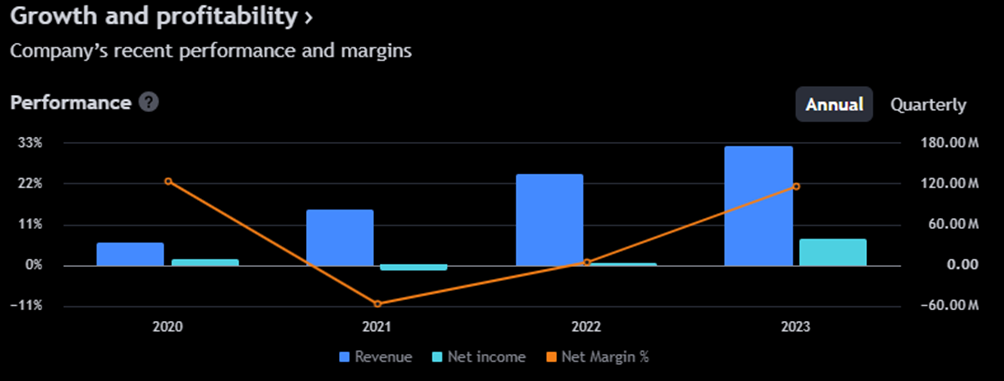
Revenue has grown steadily, as has profitability. Figures here are in SEK, source Tradingview.

image

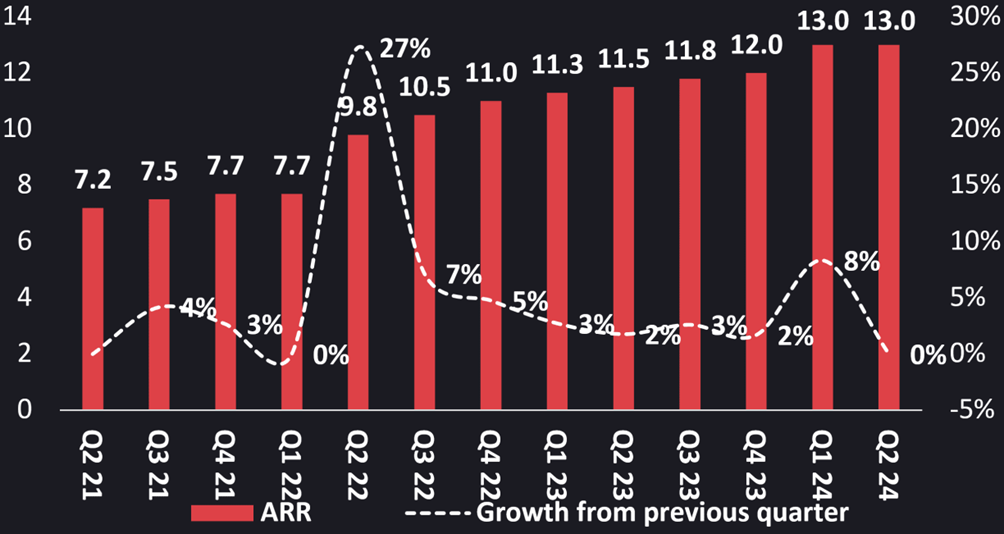
Inorganic growth has provided the foundation for organic growth, which over the last year has been successfully transitioned from projects to recurring billing. Temporarily, this has been reflected as slightly slowed growth, but ARR (annual recurring revenue) has risen steadily. Image taken from Redeye’s report (https://www.redeye.se/research/1018242/physitrack-short-term-challenges)

image

Operations are divided into two units: Lifecare and Wellness.

Lifecare produces digital tools for healthcare, specifically physiotherapy. This unit currently generates more revenue, but growth opportunities are more limited.

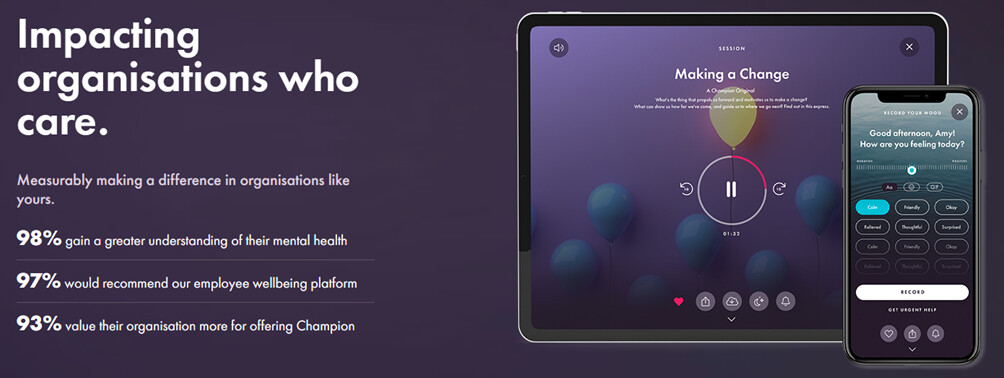
Wellness, on the other hand, focuses on holistic wellbeing, particularly supporting the wellbeing of client companies’ employees and complementing occupational health services. Wellness is still the smaller part of the company, but it is a clear growth engine for the future. At its core is the UK-based Champion Health (https://championhealth.co.uk/), one of the latest acquisitions, upon whose platform previous technologies have been or are being integrated.

image

Wellnow (https://en.wellnow.de/), for example, operates in Germany and is merging under Champion Health. Customers include:

image

Figures

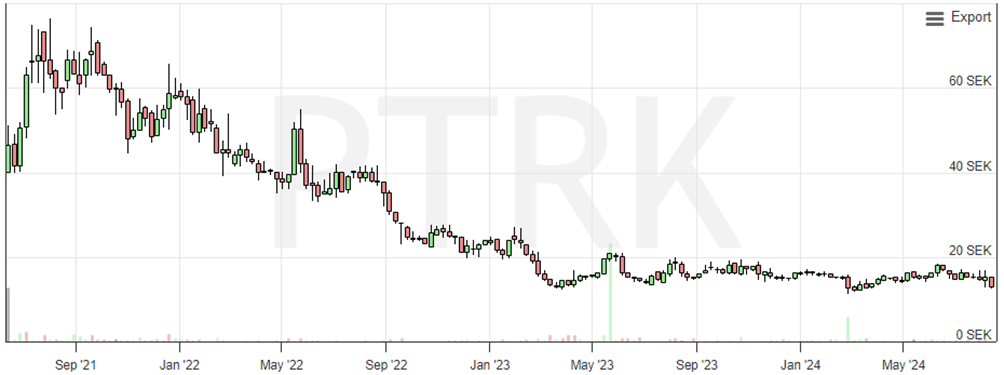
The share price performance has not been flattering since the early days of the listing due to several acquisitions and the resulting weakness in cash flow and profitability. Acquisitions were also carried out at somewhat tight valuations during 2021-2023, but their integration is nearing completion and the benefits are starting to come through.

image

However, no dilutive financing rounds have been conducted; instead, founder/CEO Henrik Molin wants to operate through profitable growth and cash flow, which has been achieved. IPO funds have been used for acquisitions, and there is now some debt, albeit managed. Cash flow is currently near zero, but through growth, this should correct itself now that no new acquisitions are in the pipeline.

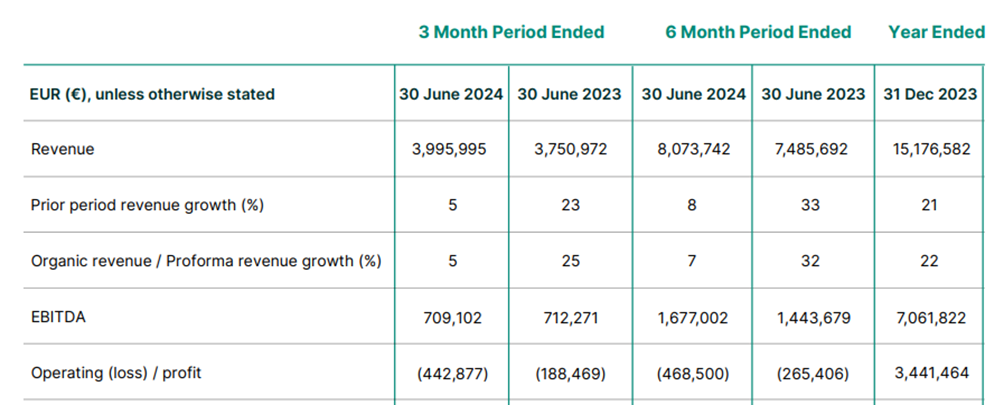
Latest Q2/24 report:
https://storage.mfn.se/18d95627-b8a6-461c-bacf-ad79527f6128/physitrack-q2-2024-report.pdf

image

Valuation

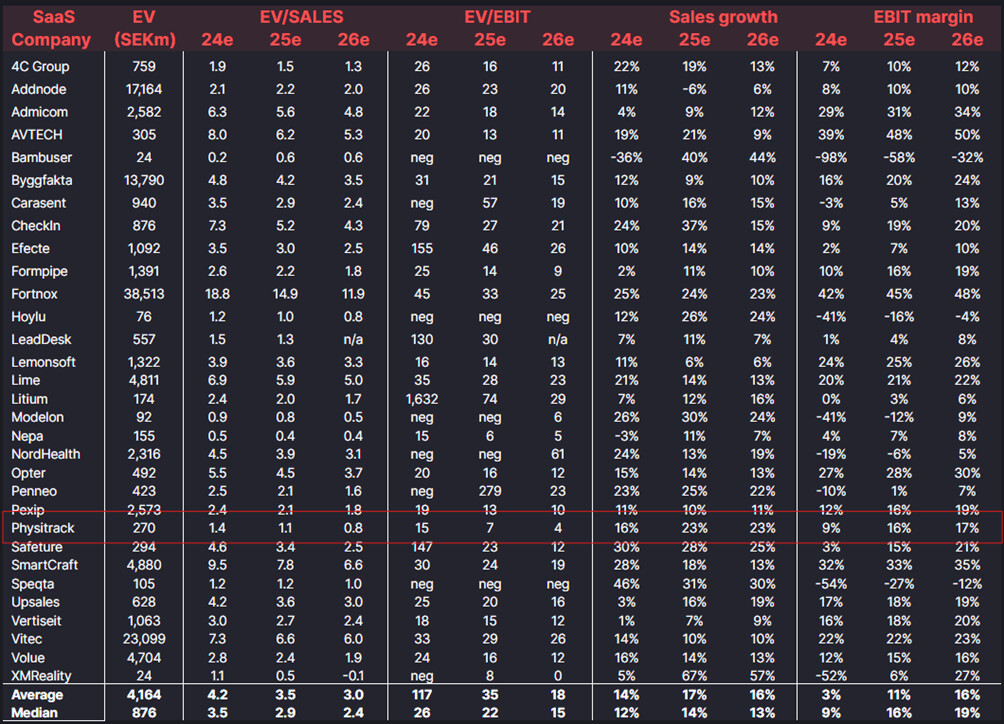
This is the “meat” of the Physitrack case. If we look at SaaS companies in the Swedish market, the valuation multiples are interesting to say the least.

For a well-growing SaaS company, EV/Sales is 1.4, next year 1.1 (!)
And how does EV/EBIT 15 sound, with 7 next year and 4 the year after?

image

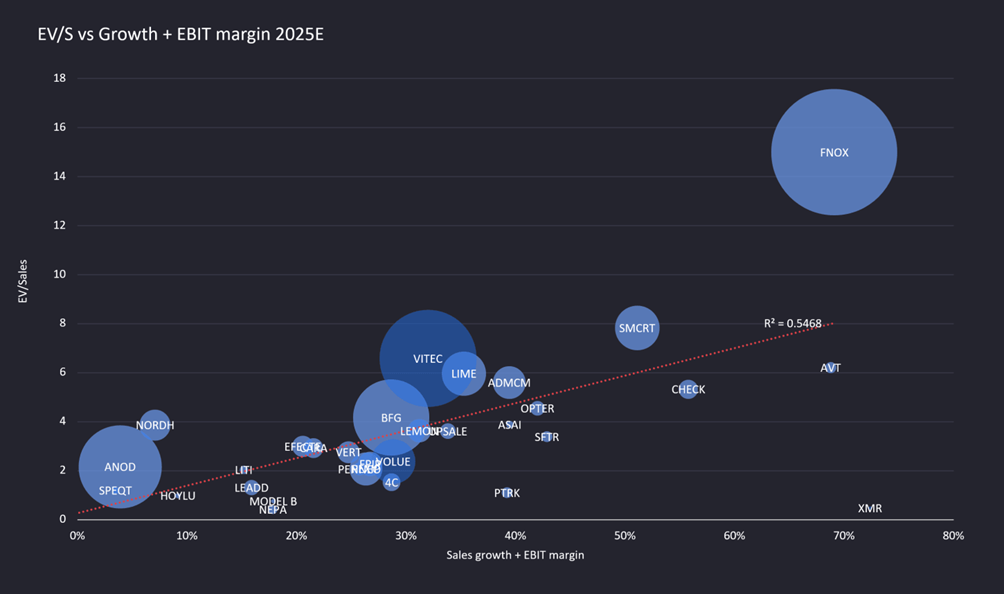
Or expressed another way, Rule 40. There in the bottom middle, meaning the valuation multiple is non-existent while growth + EBIT margin is among the largest.

image

Source: Redeye’s SaaS update after Q1 (https://www.redeye.se/research/1007799/redeye-saas-update-q1-2024-improved-profitability-and-growth-stabilized-genai-worries-across-the-pond)

Target prices:

In Redeye’s coverage, the Fair Value range is quite broad; after Q2, Bear 9 – Base 30 – Bull 75 SEK.
The share price is currently around 13 SEK.

Then, as the cherry on top, of course, AI.

A new part of the service has just been released to support sales and generate added value for both customers and the company.

Champion Health Plus, a division of Physitrack Plc, proudly announces the launch of its cutting-edge AI-driven musculoskeletal care platform, Nexa. This innovative platform offers self-triage, self-management, and seamless escalation to care professionals, providing comprehensive care through a national partner network of over 850 clinics across the United Kingdom.

https://storage.mfn.se/a5b0669a-31d1-4d87-8d2a-4dcb3be0ef05/physitrack-plc-champion-health-plus-unveils-ai-driven-musculoskeletal-care-platform-across-the-uk.pdf

image

More information and background can be found in the Physitrack thread

https://keskustelut.inderes.fi/t/physitrack-plc-ptrk-healthcare-and-virtual-wellness/23634/106

As a final word, a highlight from the CEO’s Q2 cover letter:

“Despite the short-term challenges, I am confident that we will see a positive turnaround in the second half of 2024. We anticipate ending the year with positive cash flow and a return to margin expansion”.

71 Likes

Here is a boring thesis for you. A mediocre company at a cheap price. Adjusted for risk, however, I believe there is nice return potential on offer.

ABN Amro

ABN Amro is the third-largest bank in the Netherlands after ING Groep and Rabobank. The balance sheet consists of mortgage and corporate loans, and the bank also has significant asset management operations.

The bank previously also had investment banking operations, but this CIB (Corporate & Institutional Banking) unit was divested after all sorts of problems. One example is the large losses caused by a Singaporean oil trading firm. https://www.spglobal.com/marketintelligence/en/news-insights/latest-news-headlines/new-blow-for-abn-amro-as-oil-trader-hin-leong-runs-into-trouble-fd-58084674\n

Typically, the investment banking operations of European banks have been more of a headache, and it is good that this part has been divested. This clearly lowers the bank’s risk profile.

It is noteworthy that the Dutch state has a large ownership stake in ABN Amro dating back to the financial crisis, although this has recently dropped below 50%.

https://www.abnamro.com/en/news/dutch-states-stake-in-abn-amro-less-than-50-percent

Thesis in brief:

  • An okay bank at a problem bank’s price
  • The bank targets a 10% ROE, which has already been exceeded
  • Has frequently been involved in discussions regarding corporate restructurings (M&A)
  • P/B = 0.56, P/E ttm 5.1
  • Upside of 40-50% compared to the nearest peer
  • If no correction in valuation occurs, a 10% dividend yield awaits, and potentially share buybacks (the latest program ended in May)

Profitability and solvency:

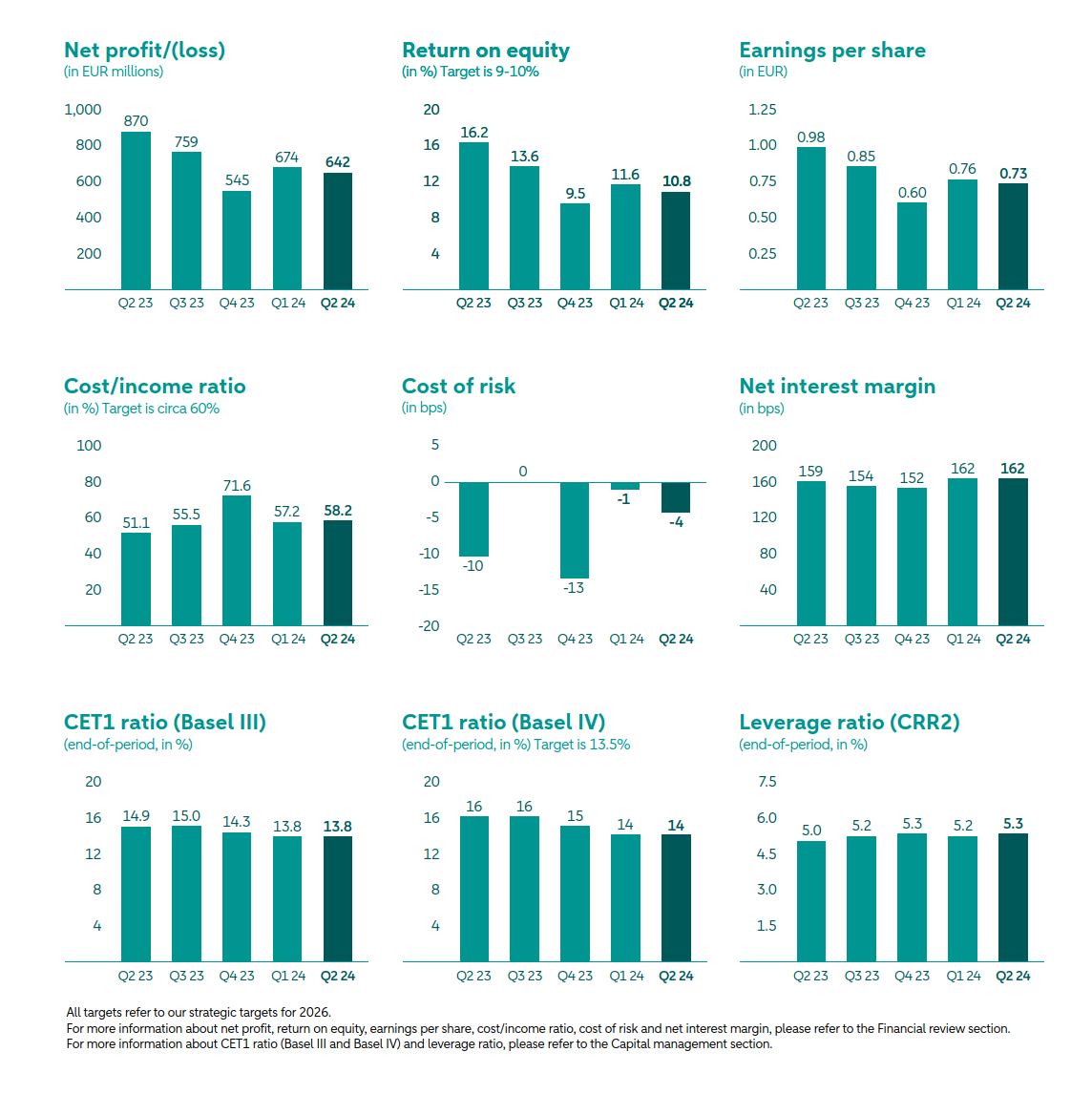
In 2023, the bank achieved a 12.2% ROE. In Q2, it was close to the 11% level; the internal target for 2026 is ten percent, and so far, these expectations have been exceeded.

NIM (net interest margin) was stable in the second quarter of the year, and the Cost/Income ratio was also below the target.

The bank’s CET1 capital ratio is 14%, with an internal target of 13.5% and a regulatory requirement of 11.2%. As a noteworthy detail, the bank reports so-called Basel IV solvency, which, as I understand it, should mean there is no risk from the impact of future regulatory changes.

Solvency is at a strong level, and the bank is theoretically able to distribute its entire result to shareholders if it wishes. The dividend policy is to pay out 50% of the profit.

Credit quality:

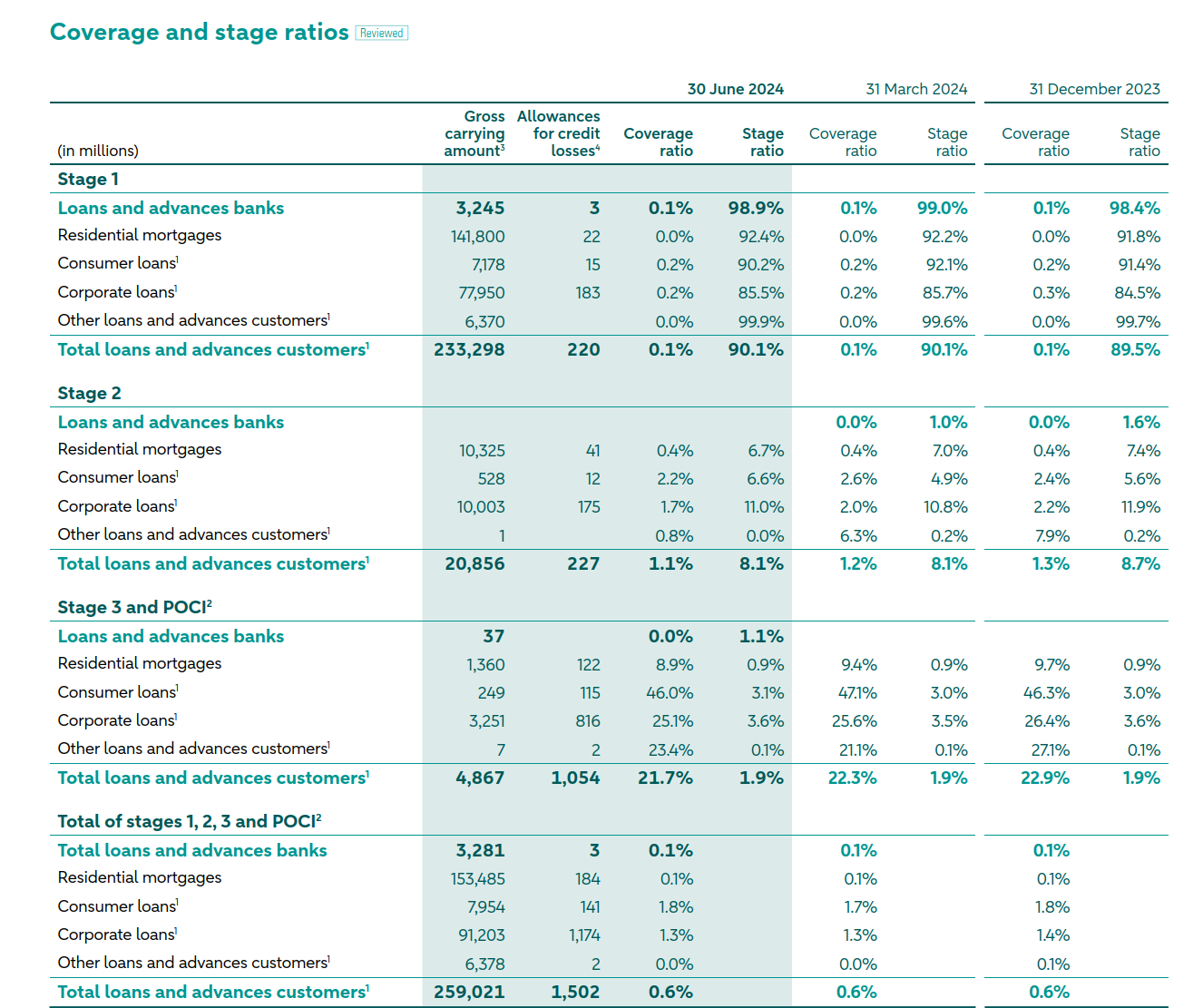
There also don’t seem to be any massive hidden risks in the loan portfolio. The share of Stage 3 loans in the loan portfolio is 1.9% and did not grow between Q1 and Q2, nor were there changes in the Stage 2 share (8.1%). (Stage 3 = impaired loans, Stage 2 = credit risk has increased).

The loan portfolio is slightly riskier than, for example, that of its good peer ING Groep, which has Stage 3 and 2 shares of 1.6% and 7.3%, respectively. (For comparison, the high-quality bank Nordea has a Stage 2 ratio of 7% and a Stage 3 ratio of 1%.)

Valuation:

The bank is cheap. Book value is 26.72 vs. a share price of approx. €15, making the P/B 0.56. P/E ttm is 5.1. If ROE stays at the 10% target, the P/E is 5.6. If the bank could reach a 12% ROE (which I don’t consider impossible), the P/E would be well under 5.

On the other hand, the entire European banking sector is cheap, so the above doesn’t necessarily say much yet. Is ABN Amro cheap compared to its competitors?

ING Groep is likely the closest peer. It can be argued to be a higher-quality bank; on the other hand, for example, at the start of the war in Ukraine, it had more exposure in Russia, so quality is also to some extent a subjective concept.

ING’s valuation is approx. 1 x book value, and the company has reached a 14% ROE. To simplify, one could think that ABN Amro deserves at least a 10/14 = 0.71 multiple, assuming a 10% target ROE, which has clearly been achieved. This would offer a 26% upside. With an 11% ROE, an acceptable multiple would be 0.78, and with a 12% ROE, it would be 0.86, offering a 40-50% upside.

Furthermore, the entire European banking sector is very inexpensive, and banks are priced with very high required returns on equity. A possible sector correction would, of course, also affect Amro and increase the return potential further. The previous calculation does not assume a sector correction, only relative valuation.

ABN Amro has also frequently been the subject of takeover rumors; years ago, rumors even suggested Nordea was supposed to buy it. Most recently, at the beginning of this year, there was speculation that Deutsche Bank was interested. If realized, a deal could be a windfall for shareholders, although it is probably best to consider corporate restructurings as a fairly unlikely scenario despite the rumors.

Risks

ABN Amro is a bank and has a relatively high amount of corporate loans. A severe recession could bring significant credit losses.

46 Likes

image

Waste firm.

Waste Connections is one of North America’s leading waste management operators, which has strengthened its position by focusing on smaller, less competitive markets and diverse revenue streams.
The company provides comprehensive non-hazardous waste services, including waste collection, transfer, disposal, recycling, and renewable energy production. Waste Connections serves approximately nine million customers across 44 U.S. states and six Canadian provinces. The company focuses particularly on smaller markets where competition is lower, and it often secures exclusive contracts for service provision, which brings stable and predictable revenue streams.

The company has demonstrated steady growth in revenue and profitability over the past decade, supported by effective cost management and strategic acquisitions. Although the risk of high capital costs and regulatory changes is present, Waste Connections’ focus on environmental responsibility and sustainable growth positions it well to continue its strong performance in the future.

Waste Connections’ main competitors in North America are Waste Management and Republic Services, which are the largest players in the industry. These companies compete in waste management, recycling, and renewable energy services, particularly in large and densely populated markets. Other competitors include smaller local and regional waste management companies operating in various states and municipalities, competing especially on pricing and service customization.

Main weaknesses:

  • High capital costs: The waste management industry requires significant investments in infrastructure, such as waste truck fleets, recycling facilities, and landfills. These ongoing investment needs can strain the company’s cash flow and increase its debt burden.
  • Sensitivity to regulation: The company’s operations are strictly regulated and are subject to changes in environmental legislation, which can affect operational costs and require additional investment. For example, tightening environmental regulations can increase expenses and impact the company’s profitability.
  • Dependence on specific markets: Waste Connections focuses specifically on secondary markets (smaller and less competitive areas). This strategy reduces competition, but at the same time, it may limit the company’s growth opportunities in large, more densely populated areas where competitors Waste Management and Republic Services are stronger.
  • High operating costs: The company has significant fixed costs, such as labor costs, fleet maintenance, and landfill management. Managing these expenses can be challenging, especially when external factors like fuel costs or labor shortages affect the market.

Also the valuation, which is absolutely shocking. The reason why it’s not in my portfolio and why I’ve missed out on all the returns. Story of my life. Below is a capture from Marketscreener of past and forecasted valuation multiples. 20-25 PE = a buy. Just have to wait a while.

image

25 Likes

My “analysis” was chosen at random. The method was to pick the midpoint company of the S&P 500 index, i.e., the company ranked 250th by market capitalization. The point of the whole thing is mainly to get to know and introduce the company. I do not have any holdings in this company. You can take this light analysis with a grain of salt, as it was put together from general information sources in a few hours. A deeper analysis would be needed to know how well the points in this write-up hold water.

The company selected was Corteva, which operates in the agricultural business. The only mentions of the company on the forum are from years ago in the “bought/sold” thread and recently here: https://keskustelut.inderes.fi/t/atkore-inc-sahkonsuojausratkaisujen-valmistaja/44743/41?u=lafe when Atkore’s CFO recently moved to become Corteva’s CFO.

Let’s start by creating an overview of the market situation. The overview is taken from https://finance.yahoo.com/quote/CTVA/

Kurssikäyrä

At first glance, the target would provide a +21% upside potential. Still, the trailing P/E looks a bit pricey at first sight, at least for a company that appears stable in terms of beta. The year 2023 was weaker than average in terms of profitability, and the Q2 report already showed signs of improvement. The forward P/E for this year is around 30, with the figure moderating to P/E 17 by 2026.

The quarterly dividend is $0.17, and the dividend yield is a relatively low 1.2%, which is below the industry average. In the US, competitors offer dividend yields of over 3%.

Next, let’s look at the company’s history, business, and industry, as well as what the near future looks like.

Competition:
Corteva, Inc. operates in the agricultural sector and is one of the largest in the market, but competition is provided by, among others, Syngenta (not independently listed, part of the Chinese Sinochem) and Bayer (primarily due to the acquisition of Monsanto). Among pure agricultural companies, it is the largest by market cap, but for example, Monsanto’s purchase price was significantly higher than Corteva’s current market cap. There are also other billion-dollar competitors in the market from India, Israel, China, Russia, and the United States.

History:
The company’s history intersects with US corporate history in a significant way. Behind it are DuPont and Dow Chemical, founded in the 1800s, whose paths crossed and final merger took place in 2015. The core of Corteva is formed by Pioneer Hi-Bred International, acquired by DuPont in 1999. In connection with/shortly after the final merger of DuPont and Dow Chemical, the companies split into three parts, where Dow (chemical industry) and Corteva (agricultural sector) were spun off from DuPont’s core business into separate companies.

Corteva’s business history is thus long, but short as an independent company. Trading in the shares began in June 2019.

Business:
What does the company do? (The business description is largely translated directly with DeepL, as the sector’s terminology is unfamiliar to me).

The company operates in two segments: “Seeds” and “Crop Protection.” So, the operations are directly related to agriculture and agricultural chemistry.

The Seeds segment develops and supplies advanced germplasm and traits that produce optimal yields for farms. You can check out the seed selection here: https://www.corteva.fi/tuotteet-ja-ratkaisut/Siemenet.html

The segment’s offering includes products and technologies that improve weather, disease, and insect resistance, herbicides for weed control, and food and nutritional characteristics. For example, the company is the number one in the North American market for corn and soybean seeds.

The Seeds segment also offers digital solutions that help farmers in decision-making to optimize product selection and maximize yield and profitability.

The Crop Protection segment offers products that protect against weeds, insects, and other pests, as well as diseases, and improve plant health above and below ground through nitrogen management and seed-applied technologies.

This segment provides herbicides, insecticides, nitrogen stabilizers, and herbicides intended for pasture and rangeland management.

It also serves industrial agricultural customers.

The company operates in the United States, Canada, Latin America, the Asia-Pacific region, Europe (including Finland), the Middle East, and Africa.

The company has been sued in the United States due to certain discount practices that were apparently implemented illegally (anti-competitive). There is also ongoing litigation with Bayer regarding certain seed products.

Financials:

The company guides for 2024 a revenue of approximately $17.2–17.5 billion and free cash flow of approximately $1.5–2.0 billion.

Roughly 2/3 of sales come from the Seeds segment and 1/3 from Crop Protection. In Seeds, sales are North America-driven (2/3), while in Crop Protection, sales are distributed much more evenly globally.

Sales are concentrated in the first half of the year because sowing and the growing season in the Northern Hemisphere mostly occur at that time. 65% of sales are made during H1, the rest in H2.

Revenue has been stagnant for a couple of years (billion $):

2024 (forecast): 17.2–17.5

2023: 17.2

2022: 17.5

2021: 15.7

And this year’s guidance of $17.2–17.5 billion doesn’t seem to change the picture.

Instead, the development of net income (billion $) & EPS (dollars per share) is interesting:

2024 (forecast): 1.2 / 1.76

2023: 0.7 / 1.03

2022: 1.1 / 1.58

2021: 1.8 / 2.37

So, 2023 was particularly weak. At least the company commented that pressure came from the tight competition and cost situation in the Crop Protection segment. Interest expenses also seemed to have jumped clearly in 2023.

Now, a significant increase in profitability is guided, and signs of this are visible in H1 EPS, which is already clearly better than in 2023, even though revenue is stagnant. Forecasts predict moderate growth and improvement in profitability for the coming years. I cannot take any stand on the probability of the growth forecast materializing with such a short acquaintance.

More forecasts and comparison to competitors’ pricing can be found here:

https://www.marketscreener.com/quote/stock/CORTEVA-INC-59241389/valuation/

Summary:

The company’s current pricing is not exceptionally attractive as it stands, not even compared to competitors. However, the company is capable of profitable results even in a challenging market. Competition is apparently quite tight, but the products seem reasonably attractive, and the varieties developed over years and patents in the crop protection side provide some kind of moat. It’s worth monitoring whether the company can restore its profitability to a higher level and if it succeeds in turning the stagnant revenue back to growth. If these succeed, the pricing looks much more attractive two years out, although still not dirt cheap. It should also be remembered that new products and innovations coming with great fanfare also contain elements of danger; a warning example of this is the billions in compensation paid by Monsanto (i.e., Bayer) for damages caused by herbicides.

So, the company goes on the watchlist, but I don’t personally see a sudden multi-bagger here. One might find something more interesting, but certainly riskier, among the competitors, as Corteva seems to have some competitive advantages related to brand awareness and product range due to its size compared to smaller competitors found in the stock market. Unfortunately, thin knowledge of the sector means I cannot assess the quality of the products of the companies in the sector and the competitive advantages of different companies relative to each other.

The latest 2024/Q2 report can be found here:

https://www.corteva.com/content/dam/dpagco/corteva/global/corporate/files/press-releases/07.31.2024_2Q_2024_Earnings_Release_Graphic_Version_Final.pdf

28 Likes

This is a differently structured pitch, so let’s keep the (Helsinki/Hesuli-investing) folks on the edge of their seats and leave the company name for the end…

Introduction

The future is hard to predict, but it hasn’t been for a lack of trying by companies. In addition to flying cars and fusion power, various types of smart glasses (virtual/mixed/augmented reality glasses) have been staple predictions of popular entertainment for decades.

I remember the first serious consumer glasses intended for gaming being sold back in the nineties. The market for them was like rear spoilers for Ladas—scarce. The hype came and went.

image

Artificial intelligence was also one of those science fiction regulars prophesied to radically change the future. Previously, enthusiasm was followed by a “nuclear winter”—now, it seems language models have finally made it out of the researchers’ back rooms and a bit further.

“Ahem, so you’re selling AI, even spot-price electricity salesmen are more original.” Not quite.

Who sells the picks to Klondike?

According to old wisdom, the richest man in a gold rush didn’t get wealthy from the ore, but through the hardware store. One of the biggest beneficiaries of the AI business has been Nvidia—graphics cards are the modern-day pickaxes.

What would be the equivalent opportunity for smart glasses? The cleverest among you are already pointing out that the smart glasses market hasn’t enriched anyone except marketing departments. But what if smart glasses are forgotten in the same abyss as 3D movie gimmicks…

image

Believe it or not, the market is starting to mature. Above are the covers of Tekniikan Maailma magazine from 1996 and 2024. The 1996 cover features computers finding their way into homes more broadly and new consumer sector devices: mobile phones. In the most recent issue of TM, a man with virtual reality glasses has made it onto the cover. I bet smart glasses will follow the same trajectory as mobile phones.

So, let’s try again. What would be the so-called game changer for smart glasses, so that one could even hope to get rich? What would make them turn from a momentary amusement into a standard tool?

Smart glasses require at least a smaller size, better resolution with fast focusing, and sufficient battery life—and as you can guess, I’ve a special case only for you, my friend!

Polight ASA - a global player with lenses?

A competitor to traditional VCM lens technology (small electric motors) is a plastic lens bendable with piezo-electricity (TLens), whose lightness and fast adjustment time, combined with low power consumption, fulfill these criteria. The portfolio of the Norwegian Polight ASA (Oslo Stock Exchange) in the field of smart glasses is becoming substantial.

image

The same lens technology can be used in scanners, mobile phones, the automotive industry—generally in devices where fast focusing and lightness are critical. As I understand it, the high-end smart glasses from the Finnish company Varjo contain lenses made by Polight. Some universities even use the lenses for real-time imaging of the brains of living mice!

The company itself positions its product strengths as being best suited specifically for smart glasses, where device architecture and standard solutions are currently taking shape. The foothold in terms of design-wins is already good, and as the pipeline in the image shows, more is expected.

At the same time, there is a link to AI, which is one of the reasons for the new hype surrounding smart glasses—AI is finally predicted to be the killer app that smart glasses have been seeking for decades. You see a painting, and the AI tells you what you are looking at. (Perhaps sometimes you’ll wish your gaze was better controlled…)

It is clear that the “eyes” of smart glasses must focus quickly so that image recognition is as accurate as possible. This is where piezo technology helps, removing the so-called “pumping” motion that VCM suffers from.

Secondly, the same piezo technology can be used to improve the display resolution of smart glasses. The product, Twedge, is still a prototype, but the potential to cut power consumption even further is so significant that I anticipate it being an even higher-margin product than the TLens.

Does this hockey stick have a blade?

And then there’s the business. The rise of the “hockey stick” blade is expected, and the company is still loss-making, partly due to R&D. The combination of growing volumes and excellent lens margins is expected to yield owners a generous share… of growing shareholder value. But only if the market moves in the desired direction—either regarding smart glasses or another vertical.

Thank you for your attention—let’s keep the pitch short and without further ado, I welcome you to explore Polight ASA’s own thread or the offerings from Polight’s Capital Markets Day (CMD) in June!

https://keskustelut.inderes.fi/t/polight-asa-nokian-kameraosaamista-norjalaisissa-kuorissa
https://s201.q4cdn.com/176420087/files/doc_financials/2024/sr/2024-06-05_polight-cmd-presentation_final.pdf

55 Likes

Do you want to invest in the best-performing Swedish investment company?

Do you want to invest like Warren Buffett?

Do you want to invest in one of @Verneri_Pulkkinen’s and @timontti’s favorite companies*, but hop on board with a 25% discount?

If you answered yes, yes, and yes, buy Investment AB Spiltan!
(Not investment advice)

Spiltan is an investment company that buys and owns stakes mainly in small unlisted and listed Swedish growth companies. Per Håkan Börjesson has served as the CEO since the beginning and is also one of the founders. Börjesson states that the company follows Warren Buffett’s investment philosophy. Spiltan’s goal is long-term ownership without an explicit exit strategy and a 15% annual return. You can read more of Börjesson’s thoughts in the books he has written or from the Sparklubben he founded.

Spiltan began operations in 1986 with 200 kSEK in capital and a share price of 2.5 SEK. Spiltan’s ATH is 360 SEK, so at its peak, it was a 144-bagger. Today, the company’s value is 6,137 MSEK with the share price at 197.6 SEK. Despite the recent price drop, the returns over the last ten years are the best among the investment companies included in ibindex.
image

The largest investments are Paradox and Spiltan Fonder, both of which, according to Börjesson, are 100-baggers and explain a large part of Spiltan’s excellent returns. The Buffett fandom is also visible in the portfolio, as a line of Berkshire Hathaway has found its way into a portfolio otherwise consisting of Swedish companies.
image

Due to Paradox’s share price decline, its weight in the portfolio has decreased significantly, currently standing at only 30.79%. Spiltan’s diversification has thus slightly improved, but the NAV discount (substance discount) is nonetheless at an above-average level of around 25%. Regarding Paradox, my own view is still rudimentary, but fresh analysis can be found there: Paradox Interactive - by Ole and Learning To Grow (substack.com). There is also a dedicated thread: Paradox Interactive Ab - Karttojen ja strategian kuninkaalliset - Osakkeet - Osakesijoittaminen (inderes.fi)

Spiltan’s listing moved to the NGM Main Regulated market on May 20, 2024, and at the same time, trading changed from weekly to daily, so the stock is now considerably more liquid. The change of market also enables Spiltan to perform share buybacks.

Following the market change, Nordnet assigned Spiltan a collateral value (40%) that was previously missing, so now is a good time to scoop this up with leverage as well.

*Paradox seems to have appeared in Verneri’s portfolio in May and Timontti’s portfolio in June. Verneri still holds it, and according to X, Timontti still held it at least on July 3rd. Sorry for the stalking! :grin:

117 Likes

[Markus Kajo’s voice]
Here is a matchless investment opportunity for one fellow member of the species or another.

Some may already be familiar with the company, as in the 90s it produced mobile phones featuring the most advanced Snake game on the market. The company prospered, and money flowed in through the doors and windows. Later, things went pear-shaped in that business. Today, the company manufactures 4G and 5G gizmos for telecom operators, the deeper understanding of which is difficult for the average owner.

In expert circles, earnings beats and positive profit warnings are anticipated to occur as frequently as Olympic medals for Finland. For us seasoned shareholders, the atmosphere preceding interim reports is akin to sitting in a dentist’s waiting room, pretending to read a four-year-old issue of Tekniikan Maailma, while fearing whether one is in for a root canal or if a simple drilling and tartar removal will suffice this time.

The company has proven its ability to produce top-tier results (or at least okay results, occasionally) under extreme conditions where interest rates drop near zero for years on end.

The American options rascals (Aov Group) toss the company’s share price around once a month. Almost always, the price swings downward and has never returned to its previous levels, leaving the stock heavily undervalued because of them.

CEO Lundmark has somewhat questionable merits from his time with his previous employer, Fortum. Specifically, the investments in Russia and the acquisition of Uniper from the Germans. But one learns best from one’s mistakes, and surely he would no longer engage in risky deals or buy loss-making businesses. …Right?

Nokia. Nothing for it but to weep at the market… and WSB. [/Markus Kajo’s voice]

25 Likes

They say all’s fair in love, war, and pitching competitions. Now that the top spot in the poll has been lost, it’s time to bring out the big guns.

Cambi published its Q2 results today after the market closed. The pitch included mentions such as these:

The numbers were actually quite good! The company reached records in both revenue and operating profit. The trailing 12-month revenue exceeded the 1 billion (jaardi) mark for the first time.

Revenue was NOK 306 million in the second quarter, the highest on record for a quarter and up 29% from NOK 238 million in the same quarter of 2023. It reflects good progress in executing construction contracts, with several important milestones reached. At the end of the second quarter, there were 18 ongoing construction contracts, an increase from 14 contracts one year earlier.
image
The result is slightly dampened by the fact that the order backlog decreased. Its future was commented on as follows:
image
image

Now we wait for the share price reaction. Does the market value the earnings or the order backlog more?
Update: Q2 EBITDA exceeded DNB’s forecast at 82.3 MNOK vs 65 MNOK. On the other hand, H1 EBITDA fell short of last year’s figure, 118.7 MNOK vs 120.40.

38 Likes

SCI – Service Corporation International (NYSE: SCI)

Tätä kilpailua varten mietin pitkään seuraavia asioita:
Mistä löytyisi yhtiö, jonka liiketoiminta on vakaalla pohjalla, jonka keskiössä on kestävä kysyntä, ja joka tuottaa hyvää pääoman tuottoa? Itseasiassa en ole alasta lukenut täällä foorumilla ollessani kertaakaan

Tämä yhtiö toimii kuluttajille suunnatulla alalla, joka tuskin koskaan kiinnostaa intohimoisesti isoa joukkoa kuluttajia, sijoittajia tai olisi altis suurille kuplaantumisille sijoittajien euforian takia. Yritys on alallaan keskittynyt etenkin vakavaraisempien kuluttajien ja etenkin heidän perheidensä palvelemiseen, ja se todennäköisesti hyötyy vanhenevasta väestöstä, sekä yhdysvaltalaisesta vauraasta suuresta ikäluokasta, joka on siirtynyt elämässään vaiheeseen, jossa yrityksen palvelut ovat todennäköisesti ennen pitkää tarpeellisia. Jos häät ovat elämän ensimmäinen juhla, jossa kuluttaja kulkee elämys ja laatu edellä, ovat hautajaiset toinen.

Service Corporation International
Liiketoiminta

Service Corporation International (NYSE: SCI) on vuonna 1962 perustettu Yhdysvaltojen suurin (alan liikevaihdosta noin 17%) hautaus-, muisto- ja hautuumaapalveluiden tarjoaja. Yrityksen liikevaihto vuonna 2023 oli noin 4 miljardia dollaria, sekä nettotulos 537,32 miljoonaa dollaria.

Yhtiö tarjoaa noin 24 000 työntekijän voimin palveluitaan 1,483 (31/12/2023) hautaujaispisteessä (Funeral Service Location) ja 489 hautausmaassa, jotka sijoittuvat 44 osavaltion, 8 Kanadan provinssin, Kolumbian ja Puerto Ricon alueille. Ylivoimaisesti suurin keskittymä on Yhdysvalloissa 1,306 Funeral service lokaatiolla ja 476 hautausmaalla. Näissä kohteissa järjestettiin noin 690.000 hautaus, polttohautaus tai muistotilaisuutta vuonna 2023.
10-K -Raportin mukaisesti noin 90% yhtiön kaikista toimipisteistä ja maa-alueista on sen omistamia, ja loput vuokrattuja kohteita.
Yhtiön tunnettuja brändejä on Dignity Memorial, National Cremation Society ja Neptune Society.
SCI:n palvelu- ja tuotevalikoimaan kuuluu yksilöidyt hautajaistilausuudet, eletyn elämän juhlistamiseen tarkoitetut palvelut (Catering, juhlatilat, muistolaatat, kukat jne.), sekä hautuu- tai tuhkaustuotteet, kuten arkut, mausolemit, uurnat ja niin edelleen.

Yhtiö on erityisesti keskittynyt varakkaampien ihmisten palvelemiseen, eikä sen valikoimasta löydy nk. Budjettituotteita. Yhtiön 2023 tulospuhelun mukaisesti yhtiö näkee keskittymisen varakkaampaan väestönosaan keinona suojautua inflaatiolta (varakkaat ihmiset ostavat kalliimpia hautajaisia, eikä näissä tilaisuuksissa usein muutenkaan osteta sitä halvinta). Lisäksi yhtiö toteaa hintapisteen olevan sellaisessa kohdassa, ettei yhtiö ole huomannut esimerkiksi Walmartiin ja Costcoon tulleiden budjettiarkkujen ymv. Vaikuttavan sen marginaaleihin ollenkaan.

Vuodesta 1962 yhtiön liikeidea on ollut kutakuinkin sama.” Our original business plan was based on efficiencies of scale, specifically reducing overhead costs by sharing
resources such as preparation services, back-office administration support, transportation, and personnel among funeral service locations in a business “cluster.”
We set out to apply this operating strategy through the acquisition of deathcare businesses in other markets over the next three decades. Beginning in 1993, we
expanded beyond North America, acquiring major deathcare companies internationally." Suomeksi tiivistettynä yhtiön liikeideana on siis strategiset yritysostot fragmentoituneen markkinan konsolidointia varten. Yhdistämällä monia pieniä tai keskisuuria yrityksiä saman katon alle yhtiö pääsee nauttimaan mittakaavaeduista esimerkiksi keskitetyillä taloushallinto- ja myyntiorganisaatioilla.

Kuten aiemmassa kappaleessa sanoin, yhtiö pyrkii konsolidoimaan monen pienen toimijan kesken hajautunutta alaa, ja onkin tässä onnistunut. SCI:illä itsellään on noin 17% markkinaosuus liikevaihdolla mitattuna, ja se operoi pinta-alaltaan 30% Yhdysvaltain hautausmaiden pinta-alasta. Muilla suuremilla toimijoilla markkinaosuudet ovat yhteensä laskettuna noin 5%. Loput 77% on jakautunut pienien, usein paikallisten, toimijoiden kesken.

Yhtiön liiketoiminta jakautuu karkeasti kahteen segmenttiin - Atneed ja Preneed:
AT NEED: Tarkoittaa kuoleman hetkellä tarjottuja palveluita, kuten hautausta/tuhkausta, hautajaisia, kukkia ja hautapaikan ylläpitoa.
PRE NEED: Pre need tarkoittaa ihmisille etukäteen myytäviä palveluita – asiakas voi halutessaan ostaa etukäteismaksua vastaan itselleen/puolisolleen/naapurilleen hautapaikan, hautakivet, hautakukat tai muita palveluita. Preneed tuotoista yhtiö saa vakuutusyhtiön tavoin liikevaihtoa ja sijoitettavaa varallisuutta ENNEN kuin sen tarvitsee asiakkaalle suorittaa yhtään palvelua. Suurin osa tästä liikevaihdosta realisoituu vasta kuoleman hetkellä kun palvelu tarjotaan, mutta sopimuksiin kuuluu usein esimerkiksi 10% etukäteismaksu.

Yhtiö ei pyri kasvattamaan markkinaosuuttaan suoraan yritysostoilla, vaan kattavalla tarjonnalla personalisoituja muistoesineitä ja muistotilaisuuksia asiakkaan toiveiden mukaisesti. Viimeisten vuosien aikana alaa on vallinnut polttohautauksen trendi, mitä varten yhtiö on investoinnut mittavasti asianmukaisiin palvelumalleihin ja tuotetarjontaan.

Kasvu ja kannattavuus

Yhtiön julkilausuma tavoite on 8% - 12% vuosittainen tuotto osakkeenomistajille. Tämä jakautuu yhtiön mukaisesti seuraavasti: 5% - 7% orgaaniseen liikevaihdon kasvuun, ja loput pääoman palauttamiselle. Q2 tulospuhelussa toimitusjohtaja mainitsi yhtiön näkyvät seuraavan kolmen vuoden tulokselle olevan haarukan ylälaidassa, eli noin 10 – 12%. Tulospuhelussa myös toistettiin yhtiön edelleen pyrkivän jakaa omistajilleen kasvavaa osinkoa ja jatkavansa osakeosto-ohjelmaansa.
Seuraavaksi katsotaan, miten yhtiö on tavoitteisaan lähihistoriassa onnistunut:

Yhtiön liikevaihto oli vuonna 2017 3,1 miljardia dollaria ja vuonna 2023 4,1 miljardia dollaria. Nettotulos samalla ajanjaksolla per osake on parantunut 2.91 (vuonna 2017 kasvua yli 200%!) vuoden 2023 3.57 dollariin. Kaikkien aikojen tuloshuippunsa yhtiö teki koronakuolemien vuoksi vuonna 2021 – 4.57 dollaria osakkeelta. Vuodesta 2005 yhtiön osakekohtainen tulos on noussut 28 sentistä 3.57 dollariin, vastaten 15.19% CAGR – kasvuvauhtia! Vuosien 2012 – 2022 vuosituotto oli 693% osingot mukaan lukien. Yhtiön kokonaistuottoa selittää kaksi asiaa: 1) kasvava osinko 2) omien osakkeiden ostot maltillisilla arvostuksilla. Yhtiö onkin ostanut yli puolet osakefloatista markkinoilta ja mitätöinyt ne.

Jotta yhtiö pääsee tavoitteeseensa tulee seuraavissa asioissa onnistua:

  1. Yhtiön tulee pysyä markkinajohtajana niin markkinaosuuksilla, kuin asiakastyytyväisyydellä mitattuna. Tässä yhtiötä auttaa personoidut brändit, joista mainittiin aikaisemmin, sekä panostukset henkilöstöön. Lisää henkilöstöstä seuraavassa kappaleessa.
  2. Yhtiön on onnistuttava allokoimaan pääomia tuottavasti. Yhtiöllä ei ole varaa konsolidoida markkinaa pelkästään kasvun vuoksi, vaan sen on painotettava omistaja-arvoa jatkossakin.
  3. Preneed myynnistä saatavia tuottoja tulee sijoittaa riski-tuotto profiililtaan onnistuneisiin kohteisiin, ja Preneed liikevaihdon tulee jatkua odotetun kaltaisena. Koska Preneed – asiakkaista saatavat tuotot eivät vaadi yhtiöltä suurempia toimia saati kustannuksia, on tämä segmentti yrityksen tulevaisuuden tuotoille ja investointimahdollisuuksille merkittävä. Yhtiön preneed backlog 31/12/2023 oli 14,8 miljardia dollaria.
  4. Yhtiö tähtää noin 3,5x – 4x lainoitusasteeseen. Täten makroympäristö ja raha- ja rahoitusmarkkinoiden kireys vaikuttaa suoraan yrityksen tulokseen. Yhtiön tämän hetkinen keskikorko on 4,35% ja TTM sijoitetun pääoman tuotto noin 8,3%. Vaikka lainoista suurin osa on kiinteäkorkoisia tällä hetkellä, ei se tarkoita sitä, että tulevaisuudessa yhtiön on yhtä helppoa allokoida lainarahaa tuottavasti kuin historiassa.

Henkilöstö

SCI:n toimiala on lopulta hyvin henkilökeskeistä ja asiakkaan kokemus on todella paljon kiinni siitä, miten häntä palvellaan alusta loppuun saakka – onhan kyseessä usein hyvin raskas ja erittäin henkilökohtainen tapahtuma. Koska yhtiön tavoitteena on palvella mahdollisimman laajalti varakkaimpia yhdysvaltalaisia kotitalouksia, tulee sen myös ottaa rodulliset asiat huomioon niin palkkauksessa, kuin palvelutarjonnassa. Yhtiö onkin panostanut DEI – asioihin huomattavasti viime vuosina. Yhdenvertaisuuspanostukset ovat mahdollisesti merkittävässä roolissa myös liiketoiminnan tuloksen osalta, sillä yhtiön ja sen työntekijöiden tulee osata tarjota uskontokunnasta ja alkuperästä riipummatta laadukasta ja henkilökohtaista palvelua asiakkailleen.

Yhtiö siis työllistää noin 24 000 henkilöä. Näistä henkilöistä 17 600 on kokoaikaista. Viimeisten vuosien aikana kokoaikaisten työntekijöiden osuus on laskenut divestointien ja organisaatiorakennemuutosten takia noin 24 000 kokoaikaisesta työntekijästä nykyiseen 17 600 (noin -27%). Henkilökunnan alkuperän jakauma on yllättävän lähellä Yhdysvaltain väestön jakaumaa.

image

Yhtiö kertoo sivuillaan tarjoavansa työntekijöillensa kilpailukykyistä palkkaa, kattavan koulutuksen työhön ja stipendejä korkeakoulutukseen, erittäin kattavan terveydenhuoltosuunnitelman, sekä sijoittajan kannalta tärkein tieto: Yhtiö haluaa täyttää lähes jokaisen avoimen työpaikan sisäisellä hakijalla. Näin taataan yhtiön tavoitteiden ja tietotaidon pitkäaikainen hiominen, sekä tietenkin pyritään mahdollisimman hyvään asiakaskokemukseen yli ajan. Yhtiön vuoden 2023 henkilöstön vaihtuvuus oli noin 26%, mikä saattaa kuulostaa hurjalta, mutta Breau of Labor Statisticsin mukaan retail ja hospitality toimialoilla henkilöstön vaihtuvuus voi ylittää jopa 60%!

Työntekijöiden ja johdon omistautuneisuudesta kertoo jotakin myös seuraava kuva:

Kuvasta näemme, että lähes jokainen johtokunnan jäsen on ollut johtokunnassa yli vuosikymmenen! Nykyinen toimitusjohtaja Thomas L. Ryan on ollut yhtäjaksoissessa työsuhteessa vuodesta 1996. Johtokunnassa vähiten aikaa istunut henkilö, Lori Spilde, liittyi yhtiön palvelukseen jo vuonna 2000. Sijoittajat voivat siis ainakin huoletta olettaa johdon olevan pitkällä tähtäimellä yhtiön kehityksessä mukana myös vastaisuudessa.

Arvostus ja sijoitusteesi

Kuvassa eniten oikealla oleva sarake on viimeiset 12kk ja vasemmalla vuosi 2017.
Pikavilkaisulla arvostuksesta voidaan sanoa sen verran, että yhtiön oma pääoma on tällä hetkellä arvostettu lähihistoriaan nähden varsin korkealle P/E:n olevan noin 22. Kuitenkin yhtiön operatiivista tuloksenteko kykyä mittaavan EV/EBITDA – tunnusluku on lähihistoriaan verrattuna varsin maltillisella tasolla. Yhtiön korkean velkataakan vuoksi katsoisin itse mieluiten tätä, myös velat huomioonottavaa tunnuslukua. Kannattavuus mittareista voimme todeta yhtiön onnistuneen varsin hyvin säilyttämään marginaalit niin koronassa, kuin viimeisien vuosien koronnosto- ja inflaatiosyklissä – juurikin defensiivisen toimialansa ja asiakassegmentinsä vuoksi! Ennätystulokset tehtiin toki koronavuosina, joka yhtiön mukaan johtui ylimääräisten kuolemien sysäyksestä, joka ennenaikaista kysyntää monen perheen kohdalla. Analyytikkoennusteiden mukaan yhtiön tuloskunto säilyy kasvavana, ja kasvaa noin 4,3 dollariin osakkeelta vuonna 2026. Liikevaihtoa yhtiön ennustetaan tekevän noin 4,5 miljardia ja EBITDA% olevan noin 30%
Tämän toteutuessa olisi yhtiön PE vuoden 2026 tuloksella 17,8 ja EV/EBITDA 11,6.

Yhtiön tuloksentekokykyyn voi mielestäni olla myös tulevaisuudessa luottavin mielin, etenkin yhdysvaltain väestöpyramidin takia. Yhdysvaltalaisen väestöpyramidin oletetaan kehittyvän siten, että vuoden 2020 23,3 miljoonaa yli 75 – vuotiasta muuttuu vuonna 2040 jopa 45 miljoonaksi, vastaten 93% noususta tässä ikäluokassa! Todennäköisesti maahanmuutto myös pitää Yhdysvaltain väestökehityksen vähintäänkin kohtuullisena tästä tulevaisuuteen. On myös hyvä muistaa, että vuonna 2070 tapahtuvat kassavirrat saavat diskonttolaskelmissa häviävän pienen arvon (dollari liikevaihto tänään on arvokkaampi kuin dollari liikevaihtoa huomenna – saati 46 vuoden päästä!). Paitsi, että SCI toimii ikääntyvien ihmisten parissa, suurin osa sen toiminnasta tapahtuu seuraavissa osavaltoissa: California, Texas, Florida. Näiden osavaltioiden väestöpyramidin kehitys taas näyttää seuraavalta:

image

Lopuksi tietenkin sana osingoista:

Kuten aiemmin todettu, yhtiön osinko on kasvanut 17% CAGR vuosina 2005 – 2021. Yhtiö jakaa silti edelleen vain noin 30% tuloksestaan osinkoina ulos, ja tähtää 30 – 40% jakoväliin. Näin ollen yhtiöllä on erittäin hyvät mahdollisuudet jatkaa osinkopuolueen miellyttämistä myös tulevaisuudessa. On myös hyvä huomata, että lähes kaikki “osinkoaristokraatit” jakavat noin kolmanneksen tuloksestaan ulos, jotta kasvuvaraa on myös tuleville vuosille. Jako-osuus antaa tietysti myös tilaa mahdollisille omien osakkeiden ostoille myös tulevaisuudessa.

116 Likes

This is a rather difficult competition for me personally. The intro mentioned that this repeats once a quarter, so there are two days to respond before starting to think about the next quarter’s idea. Personally, as an investor, I feel I should name my largest holding, Investor AB, and I’ve been considering it. However, the current situation is that the Swedish krona has weakened and the Riksbank has cut rates twice. Rate cuts usually weaken a currency and signal economic difficulties. At the same time, Investor’s share price is near its peak, so buying Investor right now doesn’t seem like a great idea—especially since the NAV discount (substanssialennus) is closer to historical lows than highs.

Generally, I find the economic situation challenging; the Fed and ECB are expected to cut rates. When rates are cut, the economy is usually performing poorly and needs liquidity. This tends to show up especially in cyclical companies. As an “idea,” cyclicals can already be found at very attractive prices, but whether it’s the right time to buy is a different matter. I’ll quote a post from the market direction thread here:

So now is a time when fewer and fewer business ideas are profitable. Unless earnings improve, the share price usually falls. I don’t want to be overly bearish, and it’s quite possible the market cycle peak is still ahead. It could be that the Fed/ECB cut rates slightly and the economy continues to roll along happily afterward. However, I believe some companies are struggling, and stock picking becomes crucial.

An idea is not the same as a purchase, but since these are meant to be done once a quarter, I think now is a time to play it a bit safe. That’s why I would harness the best minds I know to interpret the market situation. In my view, the situation in Europe already looks more difficult and risky due to Russia’s moves, so I am directing my view mainly across the pond with fewer risks. My choice is a fund, Spiltan Globalfond Investment Bolag. It mainly consists of investment companies whose management has proven their mettle in many storms. In the long run, it has outperformed the index with lower volatility.

image

Largest holdings:
image

I personally don’t know Constellation Software among the largest holdings, but looking at the fund manager’s other picks, like Alphabet for example, they haven’t exactly missed the mark. Then I return to the largest holding, which is Berkshire Hathaway. I’ve been following it, and Buffett has made major moves in his portfolio just this past quarter, selling roughly half of his Apple position and similarly Bank of America. The Apple sale caused quite a market reaction; for example, Lepikkö cited it as one reason for the correction. To me, the sales were understandable. Apple may currently find it challenging to grow its sales, and weakening consumer demand could show in its relatively high-priced products. Bank of America, on the other hand, is likely currently earning its peak net interest margin, which will start to weaken as rates fall. Buffett, meanwhile, bought the insurance company Chubb, which benefits from high rates by investing insurance premiums into fixed income. Interest income will continue to improve; the pain is felt more in banks than in insurance companies. Berkshire has a lot of cash, which is invested in T-bills whose yields will start to improve as rates drop. The company has a lot of insurance business where earnings can still be expected to improve.

So, there’s a list of picks from an investor I respect that make sense to me. The gentleman is 94 years old, so there are certainly risks involved. Well, the portfolio also includes other investment companies like Danaher, Fairfax, and Prosus. There is discussion about them on the forum in the investment companies thread, at least. Fairfax was recently featured in the investor communications thread. There doesn’t seem to be much writing on Prosus, but it has at least been an investment for Mohnish Pabrai (I haven’t checked the current situation). He bought the company because it was a cheap way to get exposure to Tencent. Generally, I think this provides a very broad “investment idea” required by the thread.
image

image

image

image

If those geopolitical tensions start to de-escalate at some point, there is bounce potential in those. They aren’t massive parts of the portfolio, but they are included.

Here is a superficial presentation of my idea. For an active fund, it is reasonably priced with a 0.5% fee. Edit: Adding a technical chart; not top quality as it’s taken from Investing.com.
image

RSI is rising and moving through 50%. 50 MA and 20 EMA acting as resistance; once through, there’s room to rise. The lines mark a rough consolidation area; once through that, there’s room for new highs by a notch, and then another new high would give room for a stronger rally. The upper part of the consolidation is uncertain.

51 Likes

Laitetaan tänne maanantaina kirjoittamani “Pitch” / deep dive ruotsalaisesta I-Techista, joka raportoi tänään erinomaiset Q2 luvut.

Case description

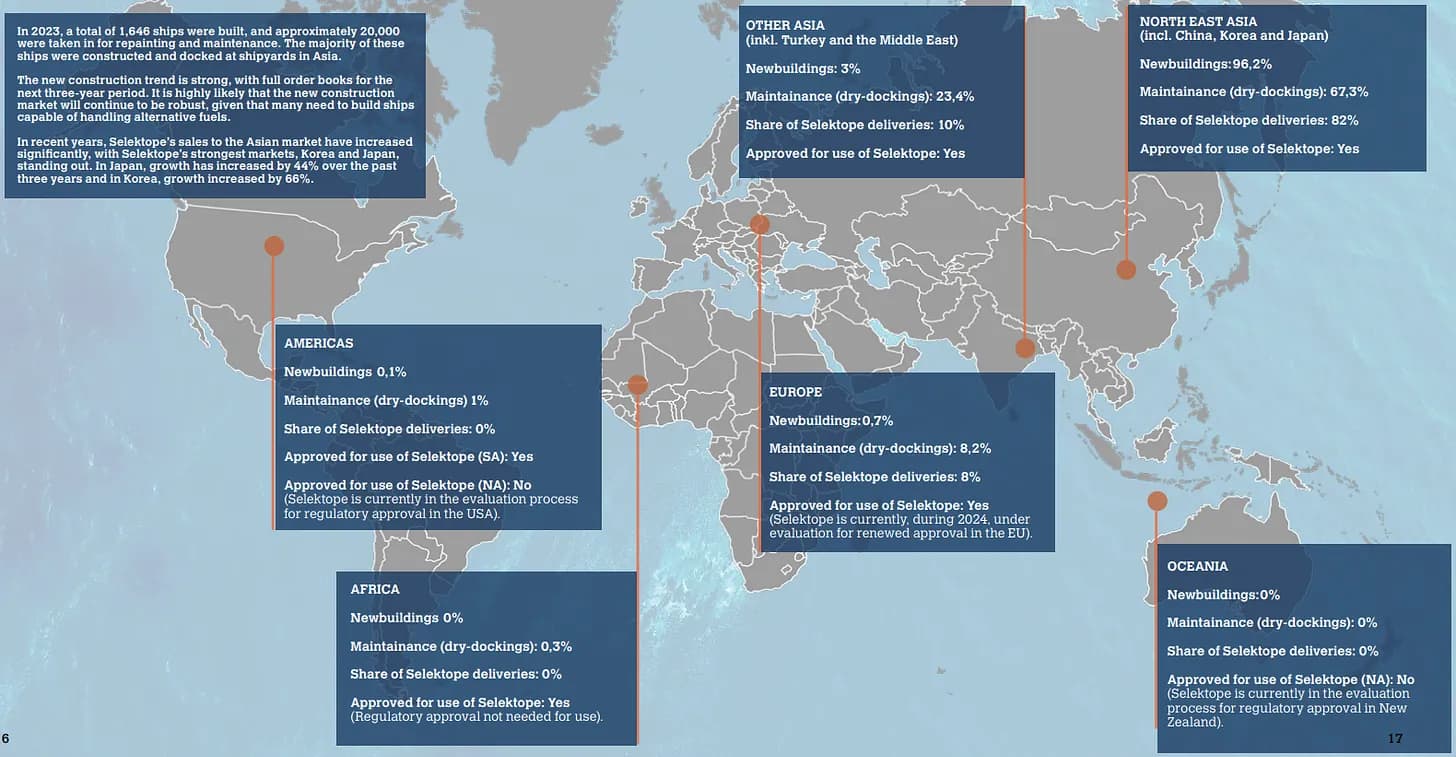
I-Tech is a Swedish-listed company with a market cap of SEK 557 million (EUR 49 million) and a net cash position of SEK 88 million. In 2023, I-Tech generated revenue of SEK 121 million, with a 19% EBIT margin and a 41% ROIC. Given its asset-light business model and high scalability, I-Tech is well-positioned to achieve significant growth while maintaining very attractive ROICs. Despite the strong financial profile, the company is trading at relatively low multiples, with an EV/EBIT NTM of 10.4x and an NTM P/E of 14.2x, reflecting an all-time low valuation level driven by market concerns about potential regulatory disapproval from the European Chemical Agency (ECHA) in the EU region. However, the EU region accounts for only approximately 10% of I-Tech’s total addressable market and about 5% of its sales.

Why does this investment opportunity exist?

In May 2023, an expert panel coordinated by the European Chemical Agency (ECHA) recommended that Medetomidine, the active ingredient in I-Tech’s product Selektope, should be classified as an endocrine disruptor (ED) for humans. This classification means the chemical could potentially interfere with hormonal systems, which would prevent I-Tech’s customers from selling their products in the EU. I-Tech disputes this recommendation, arguing that the grounds for classifying Medetomidine as an ED are not valid.

In response, I-Tech emphasized that the recommendation is an early step in a lengthy regulatory process and is not legally binding. The company plans to continue defending its product and lobbying EU governments against the recommendation. I-Tech argues that the supposed adverse effects, such as reduced stress response and altered blood sugar levels, are not significant and occur only at high doses that are irrelevant to Selektope’s use.

In June 2024, the ECHA’s Biocidal Products Committee (BPC) agreed with the initial recommendation, moving the decision to the European Commission. The Commission will now determine whether Medetomidine can still be approved under specific conditions, such as negligible exposure, essential use, or if banning it would cause significant societal harm. I-Tech remains optimistic, highlighting that the EU only represents 10% of its market, with most sales in Asia, where regulations are less stringent.

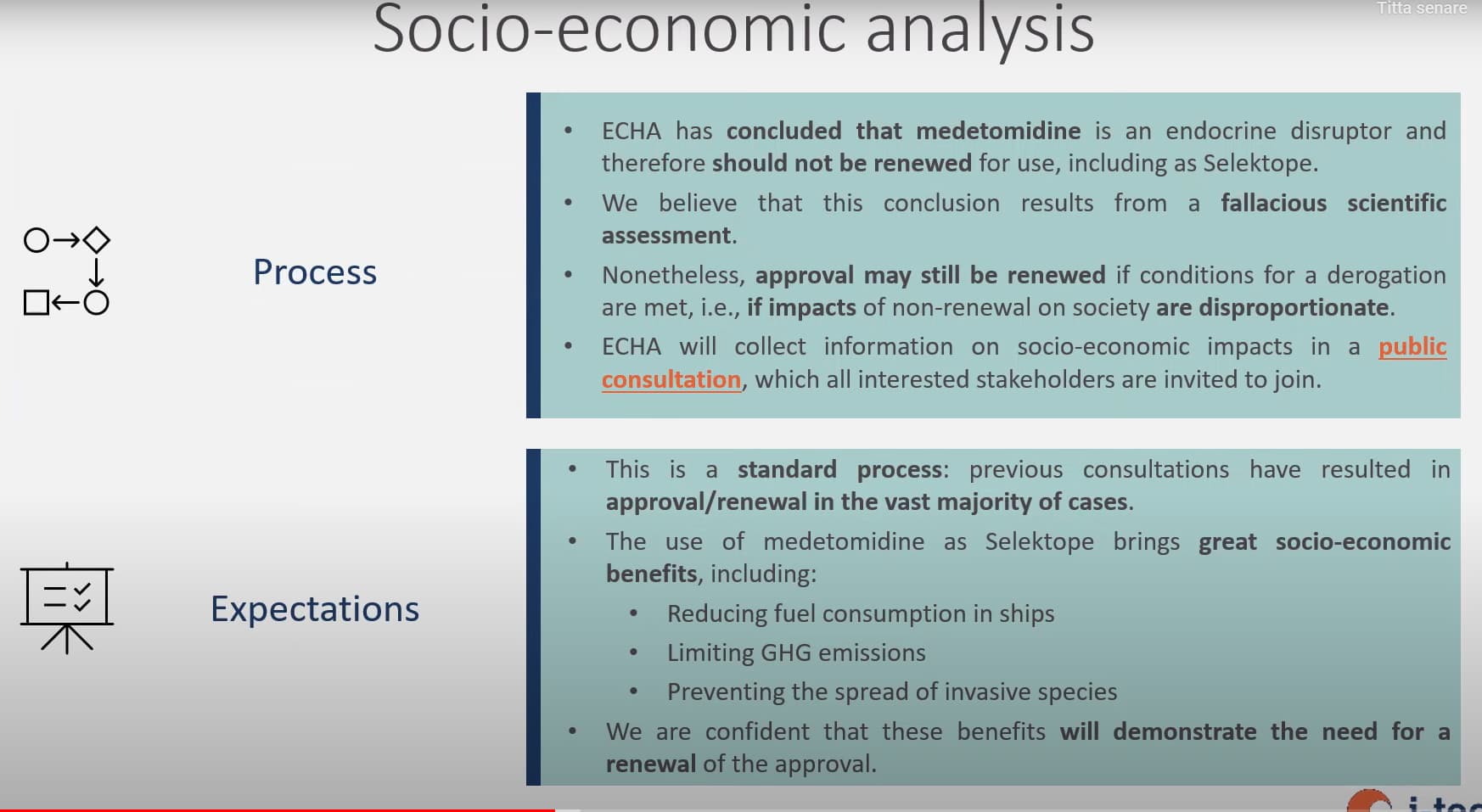
The renewal process is currently in the socio-economic analysis phase. Throughout this phase, stakeholders like shipowners, shipyards, paint producers, and others will be invited to provide their feedback on Selektope, discuss its benefits, and argue for its continued availability in the market. I-Tech is committed to making a significant investment to bring together all stakeholders and establish the groundwork for continued approval in Europe, despite the problematic classification. I-Tech has conducted a broader third-party report on the significant benefits of Selektope. This is because I-Tech believes that the advantages of utilizing Selektope, including the reduction of CO2 emissions and the prevention of the spread of invasive species, are significant for the European market, even though it represents a smaller segment for both the I-Tech company and I-Tech’s customers. The decision-making process is expected to conclude by June 2025.

I-Tech continues to gather support from different stakeholders and participate in public consultations to argue for the continued use of Medetomidine. Despite the setback, the company believes it has a strong case for renewal. During the Q2 webcast today, the deputy CEO said, “We have great confidence that the European Commission ultimately will make the wise decision that Selektope should get continued approval for the European market.” It is important to note that the EU has historically revisited decisions in similar cases after strong evidence for greater socio-economic benefits.

Company description

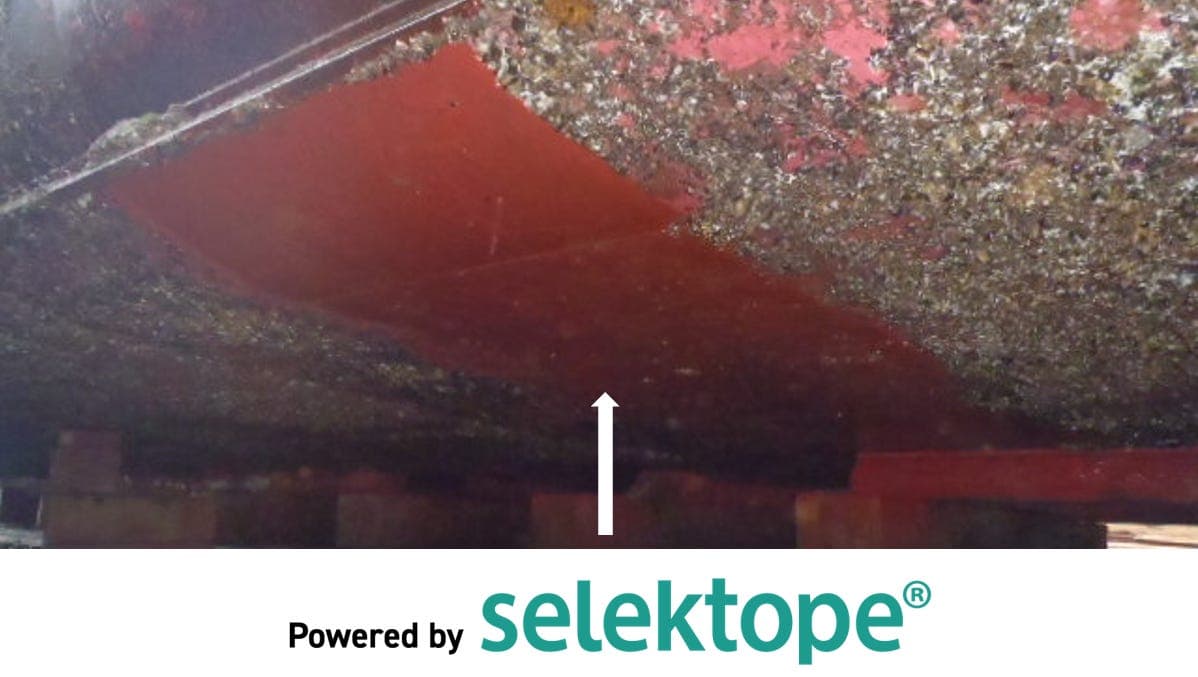
I-Tech was founded in 2000 as a spin-out research project from the University of Gothenburg and Chalmers School of Technology. Today, I-Tech offers a patented active antifouling ingredient, Selektope, used in marine coatings with high efficiency against sea barnacles. All large vessels use some type of marine coating, and because Selektope is highly efficient, it is used as an ingredient in premium antifouling paints. I-Tech sells Selektope directly to its customers, who are large international paint manufacturers that formulate and sell marine coatings to end-users, such as shipowners and operators. I-Tech has active collaborations with seven of the nine largest paintmakers, who hold approximately 90% of the marine coating market, and four of them have officially launched commercial products including Selektope. The current official customer list includes Chugoku Marine Paint, Jotun, Hempel, and PPG (added in 2024). The narrow addressable customer base allows I-Tech to scale revenue quickly and disproportionately to costs.

I-Tech’s business model

As explained, I-Tech is an ingredient company. It sells Selektope to marine coatings manufacturers in powder form at a price per kilogram under the governance of supply and license agreements. The business model is based on direct sales, with fast pricing adjustments, as roughly 90% of the antifouling paint market is covered by nine players. I-Tech has outsourced the production of Selektope to pharmaceutical-grade facilities, but the production process IP and rights are owned by I-Tech. This allows the company to focus on sales, R&D, and regulatory matters. Below is an explanation of the company’s value chain.

The key factor in I-Tech’s business model is its collaboration with leading marine coating manufacturers. Together with these manufacturers, I-Tech helps to optimize their new antifouling products that also contain Selektope. In these collaborations, I-Tech acts as an R&D partner. Selektope can be used either as a primary antifouling ingredient or as an effect booster, which broadens its range of applications.

Currently, I-Tech has various types of collaborations with the nine largest paint companies. This is crucial to ensure that Selektope is included in their future products. This approach has been successful, and in 2023, I-Tech signed a new license agreement with one of the world’s largest marine paint companies, Akzo Nobel. Selektope is now qualified to be included in future product launches. As a result, I-Tech is moving toward commercial relationships with seven of the nine dominant paint companies in the industry. Below is a table of the different collaborations.

While I-Tech’s current focus is on commercial vessels, it has stated an interest in entering the leisure boating segment as well. Currently, I-Tech serves customers in the leisure boat antifouling market through partnerships with Pettit Marine Paints and as a supplier to Vemar. Additionally, CMP offers a paint product containing Selektope® that is specifically formulated for leisure vessels.

Product analysis

Selektope® is an organic, metal-free biocide that is an important component in marine antifouling paints, primarily preventing barnacles from settling on coated surfaces. Selektope contains medetomidine, which was originally used as a drug in both human and veterinary medicine due to its strong sedative properties. For barnacles and similar marine organisms, medetomidine has a unique receptor-stimulating effect, causing the animals to become hyperactive. Upon exposure to medetomidine, a swimming behavior is induced that prevents barnacle larvae from attaching to surfaces. This effect occurs at very low concentrations of medetomidine and does not harm the animals, with the effect ceasing approximately 2-3 hours after exposure ends. Twenty years after the first patent filing for Selektope, I-Tech has become a proven and recognized supplier to leading paint makers around the world.

Selektope’s and Antifouling Coatings’ Value Proposition to End-Users

Decreased Fuel Costs: If barnacles cover 10% of a hull, 36% more engine power is required for a vessel to maintain the same speed. For ocean-going ships, hard marine fouling can lead to an increase in fuel consumption and emissions by up to 40%. Meanwhile, fuel costs can account for up to 50% of the total expenses for shipowners. With Selektope, ships can significantly reduce friction, leading to lower fuel consumption and costs.

  • Decreased CO2 Emissions: Reduced power demand and lower fuel use also result in decreased CO2 emissions. Global vessels contribute a sizeable amount of the world’s CO2 emissions, a figure expected to rise with global trade. Regulations on maritime shipping are tightening, increasing pressure on ship operators and owners to reduce CO2 emissions. Many interest groups are also pushing for change; for example, the Poseidon Principles initiative is supported by a large group of leading shipping banks that advocate for a global framework integrating climate impact into sustainable shipping financing.

  • Longer Anchor Times: Although ship operators aim to maximize vessel utilization rates, there are times when ships must remain at anchor. Vessels with hulls coated in Selektope®-containing paints can withstand extended periods at anchor, even in challenging waters, and resume operation with hull performance unchanged. This results in significant fuel savings and reduced greenhouse gas emissions during scheduled or unexpected idling periods.

  • Access to All Ports: In some regions, ship operators are required to declare a vessel’s hull condition before arriving at a port to gain entry approval. In some cases, vessels have been denied port entry due to biofouling on the hull and niche areas, which pose a significant biosecurity threat.

  • Fewer Maintenance Expenses: Selektope helps avoid the need for regular hull cleaning by divers, resulting in significant financial savings. Each cleaning can cost between USD 15,000 to USD 45,000, depending on the size of the ship. Biofouling generates direct costs for cleaning services and causes missed cargo revenue, as ships must typically remain stationary during cleaning.

Market

The antifouling paint market is projected to reach USD 13.6 billion by 2027, expanding at a compound annual growth rate (CAGR) of 8%, driven by several key factors. Regulatory pressures, including the International Maritime Organization’s (IMO) guidelines on fuel consumption and increasingly stringent restrictions on biocides in antifouling paints, are significantly influencing the market’s growth trajectory. Selektope, a key ingredient in the industry, is currently incorporated in approximately 2% of all antifouling paints sold. I-Tech estimates its total addressable market (TAM) to be between USD 350 million and USD 500 million in sales, with sell-side analysts closely aligning, placing the TAM at around USD 400 million.

An important factor in the end-user market is its heavy concentration in Asia. Globally, Selektope’s delivery patterns closely mirror trends in the shipping industry. Over 95% of all new ship construction projects are concentrated in China, Korea, and Japan, making this region the undisputed leader in shipbuilding. In terms of dry docking, Asia, including Turkey, accounts for the majority of the market. Countries outside these regions represent only a small portion of the maintenance market.

Competitors / competing technologies

The antifouling industry is highly competitive, with cuprous oxide dominating the market as the primary biocide, present in around 90% of coatings. Major manufacturers offer a range of copper-based paints, including Selektope-copper combinations. However, concerns about copper’s environmental impact and its high market share have driven competition to find alternatives.

ECONEA®, developed by Janssen PMP (a Johnson & Johnson company), offers a metal-free alternative using the biocide tralopyril. It is about 10 times more active by weight than cuprous oxide and can be used alone or with other biocides to enhance performance while reducing copper levels.

SEA-NINE, produced by LANXESS, is a soft-fouling agent based on DCOIT, known for its rapid degradation in marine environments, making it a more environmentally friendly option. In 2022, I-Tech and LANXESS collaborated to optimize formulations, showing promising results in reducing biocidal loadings without sacrificing performance.

Competitive position

I-Tech has established partnerships with seven of the nine largest paint companies, positioning itself strongly in the antifouling market. As the industry increasingly seeks eco-friendly alternatives due to regulatory concerns over the environmental and health impacts of biocides, I-Tech’s Selektope stands out for its low required concentration and effectiveness in reducing biofouling.

To combat hard fouling, four effective technologies are currently recognized: copper-based antifouling, Selektope (medetomidine), tralopyril (ECONEA), and silicone-based antifouling. Tralopyril (ECONEA) is a direct competitor to Selektope, with a similar biological spectrum, but it is primarily used in the leisure boat market, where it requires higher concentrations (100g/liter) compared to Selektope (2g/liter), which is a disadvantage from a regulatory perspective. Compared to copper-based antifouling products, a few grams of Selektope can replace half a kilogram of copper in the formulation of a coating. Selektope offers superior static performance and, due to its very high efficiency at just 0.1% w/w, it can be mixed with most types of ingredients in the market today. Additionally, Selektope is highly effective in all marine environments.

Because Selektope can be mixed with most types of ingredients, I-Tech is actively working on integrating Selektope with other agents, including copper and DCOIT (SEA-NINE), and exploring silicone-based antifouling, though this is still in the early research stages. Many alternative antifouling methods present collaboration opportunities rather than threats to I-Tech’s market share. The company’s strong patent portfolio and the lengthy regulatory approval process (10-15 years in the EU) further solidify its competitive position, allowing it to build a robust presence in the commercial shipping market while securing exclusive contracts with customers.

I-Tech’s competitive advantages / MOAT against competing technologies and potential new market entrants

As mentioned above, Selektope offers several advantages over other antifouling options. It is highly effective at very low concentrations, and unlike copper-based products, it is metal-free, making it less harmful to marine ecosystems. Additionally, Selektope’s ability to blend with a variety of other ingredients, including copper, DCOIT (SEA-NINE), and potentially silicone-based antifouling agents, gives it a versatile edge.

Biocides are heavily regulated in most major markets, and obtaining approval for a new biocide can take over a decade of research and regulatory processes. This, coupled with I-Tech’s ownership of utility and manufacturing patents for Selektope, creates a significant barrier to entry for new competitors. As regulations have become more stringent and the number of approved biocides has decreased, the demand for approved substances like Selektope has risen. Selektope is already approved in key markets such as the EU, Japan, South Korea, and China.

The patent protection for Selektope is a critical factor in I-Tech’s competitive advantage, as it safeguards the unique application of medetomidine in the marine industry. This protection is expected to help I-Tech achieve a dominant market position, with regulatory approvals and exclusive customer contracts secured before the patents expire in 2035.

Securing a new customer typically takes around 10 years, which underscores I-Tech’s commitment to long-term development and testing with its clients. Once a partnership is established, the paint manufacturer undertakes various screening activities to confirm the biocide’s effectiveness over several biofouling cycles, which can span several years. This is followed by focused development with a select few formulation candidates. If successful, one or two of these candidates may be tested on ships through test patches, which require an additional three to four years before final conclusions can be drawn. In some instances, larger or full-scale tests are conducted to verify the industrial viability of the product.

An antifouling product must perform effectively across different environments, ship speeds, and water temperatures. To ensure this, I-Tech prioritizes supporting all customers in integrating Selektope into their paint formulations. This support includes help with chemical and technical challenges, as well as guidance on the optimal use of Selektope, provided by I-Tech’s team of engineers and specialists. This comprehensive support strengthens partnerships and positions I-Tech as a key partner in the product development process.

Customers/players in the marine coating market

The global marine coating market is highly concentrated. The nine largest players dominate the market, holding an estimated 90% market share. The three biggest players are Akzo Nobel, Jotun, and Chugoku Marine Paint (CMP), with market shares varying depending on the source. In general terms, the market share distribution looks like this:

  1. Akzo Nobel - 20-25%
  2. Jotun - 15-20%
  3. Chugoku Marine Paint (CMP) - 10-15%
  4. Hempel - ~10%
  5. PPG - ~10%
    Next 4 (including Kansai, Nippon, KCC, and Sherwin Williams) - 20-25%
    Rest - 0-10%

I-Tech has published that seven of the nine largest manufacturers are its customers. In its IR materials, I-Tech has stated that CMP, Jotun, and Hempel are official customers with commercial products. The majority of I-Tech’s revenue comes from CMP. Additionally, in March 2024, the company announced that PPG had unveiled a new antifouling product featuring I-Tech’s Selektope within its premium coating range, PPG NEXEON 810. The product is currently being rolled out and will soon be available across all key regions in the commercial shipping industry. Furthermore, as mentioned earlier, I-Tech signed a new license agreement with Akzo Nobel in 2023, with Selektope now qualified to be included in future product launches.

With its current partnerships, I-Tech is well-positioned to increase its penetration in the number of ships painted per year.

Ownership

Given the size of the company, I-Tech has a relatively low level of insider ownership. However, its ownership structure includes some reputable names, such as Pomona-Gruppen and Nea Partners, which together own approximately 20% of the share capital. The company’s size and limited float create an obstacle for many ‘sizeable’ investors to enter. However, part of the investment thesis is that as the company grows, it will attract more institutional investors, creating upward pressure on the stock.

Financial history

I-Tech has a very impressive financial history and has demonstrated its scalability as it has grown in size. With limited capex investments and an acceptable NWC level, the company can convert over 90% of its EBIT into FCF. This also enables a very high ROIC.

The consensus estimate is that I-Tech will be able to continue growing its revenue as the penetration of Selektope increases.

Risks

Investing in nano caps like I-Tech comes with higher risks. Below are listed the key risk factors, that I have on the case.

  • EU Regulatory disapproval risk - In May 2023, an expert panel coordinated by the European Chemical Agency (ECHA) recommended that Medetomidine, the active ingredient in I-Tech’s product Selektope, should be classified as an endocrine disruptor (ED) for humans. This classification means the chemical could potentially interfere with hormonal systems, which would prevent I-Tech’s customers from selling their products in the EU. I-Tech disputes this recommendation, arguing that the grounds for classifying Medetomidine as an ED are not valid. In response, I-Tech emphasized that the recommendation is an early step in a lengthy regulatory process and is not legally binding. The company plans to continue defending its product and lobbying EU governments against the recommendation. I-Tech argues that the supposed adverse effects, like reduced stress response and altered blood sugar levels, are not significant and occur only at high doses that are irrelevant to Selektope’s use.

In June 2024, the ECHA’s Biocidal Products Committee (BPC) agreed with the initial recommendation, moving the decision to the European Commission. The Commission will now determine whether Medetomidine can still be approved under specific conditions, such as negligible exposure, essential use, or if banning it would cause significant societal harm. I-Tech remains optimistic, highlighting that the EU only represents 10% of its market (and 5% of the sales), with most sales in Asia where regulations are less stringent. The decision-making process is expected to conclude by June 2025. I-Tech will continue gathering support from industry stakeholders and participating in public consultations to argue for the continued use of Medetomidine. Despite the setback, the company believes it has a strong case for renewal based on the limited availability of alternatives and the essential nature of its product.

  • Regulatory risks in other regions - as Selektope is classified as a biocide, and is therefore affected by extensive regulation in several jurisdictions. Should Asia or other important regions forbid the use of Selektope, this would affect I-Tech negatively.

  • Product risk - I-Tech only sells one product, Selektope

  • High customer concentration - Given the structure of the marine coating industry, I-Tech has a very concentrated customer portfolio. This risk comes even bigger as CMP accounts for a majority of the revenue. Would I-Tech lose its partnership with CMP, it would affect the business significantly at least in the short run. However, CMP has been a big promoter of Selektope and there are no indications of scaling down the partnership.

  • New products or technologies coming to the markets - Would new more effective and cheaper technologies come to the market, these would pose a major risk for I-Tech operations. However, the development process of new coatings and commercial paints is long, which can partly be seen in the case of I-Tech and Selektope as well (founded in 2000 and 2023 SEK 121m in revenue). The big paint manufacturers are quite conservative and need to have strong proof of concept to sign on licensing agreement. I-Tech has now been able to come across that line with the biggest players in the industry.

  • Key person risk - Given the size of the company, the key person risk is quite significant in I-Tech’s case, however, the key persons have served the company for a long time and now the current CEO is converting to a Chairman role and new promising CEO from marine coating industry has been hired (Markus Jönsson).

  • High exposure to new build - Roughly 60% of the revenue comes related to new build projects and 40% dry-docking.

  • High exposure to Asia - Roughly 90% of the revenue comes from Asia. However, in I-Tech’s case, I would argue that it is even a positive thing, given that the market is there. In any case, I will add big exposure to Asia as a possible risk.

Valuation / IRR-% expectation (next 5 years)

I-Tech currently trades at an EV/EBIT NTM of 10.4x, and NTM P/E of 14.2x. Given the quality of the company and the associated risks, I believe these multiples are arguably low and currently at an all-time low (based on a limited data period).

According to my model, I-Tech’s expected return is at a very attractive level. Even though my basic assumptions are below the consensus analysts’ estimates, I arrive at an expected annual return of ~20% over the next 5 years for I-Tech at the current price (SEK 46.80 per share). In my opinion, this is at least reasonable considering the risks, which are also partially accounted for in the model’s projections.

Catalyst

  • Renewed approval by the European Chemical Agency (ECHA) for the EU - Management
  • New customers officially commercialize products containing Selektope.

Jos samantyyppiset yritysanalyysit laadukkaista pohjoismaalaisista nano/small/mid-cap yhtiöistä kiinnostaa, niin kannattaa pistää seurantaan: Search "gardenstreetcapital" on Substack

41 Likes