With dividends or without? Dividend thread

Now, even I had mixed up the meanings of over- and undervaluation in my verbal explanation regarding an investor selling their own shares. Price corrections in any direction do not matter, as I explained above, but changes in valuation multiples do. Let’s clarify the scenario further with additional calculations, as precise verbal expression is so damn difficult.

By calculating the balance sheet, the share price before profit distribution should be 100,000 / 1000 = 100, but the share price is actually 120 (P/B is 1.2). The company thus buys 10,000 / 120 = 83.(3) shares and 916.(6) shares remain. If after this the valuation deflates and the P/B returns to 1, the share value is 90,000 / 916.(6) = 98.(18). The investor has to sell 10 / 98.(18) = 0.10(185) shares and is left with 0.898(148) shares. A year later, the company’s share value happens to still be priced at a P/B of 1, i.e., 100,000 / 916.(6) = 109.(09). The value of the investor’s assets is 10 * 1.11(1) + 0.898(148) * 109.(09) = 109.(09).

If, on the other hand, after the buyback the valuation deflation remains incomplete and the share is priced at 100, i.e., the P/B is 100 / 98.(18) = 1.0(185), the investor sells 10 / 100 = 0.1 shares and 0.9 remain. Then, when a year later before profit distribution the valuation has dropped to a P/B of 1, the company’s book value per share and thus the share value is 100,000 / 916.(6) = 109.(09), but the investor’s assets are 10 * 1.11(1) + 0.9 * 109.(09) = 109.(29).

The investor has made a profit by creating their own dividends while the share was still overvalued relative to its future valuation. This would have happened anyway, regardless of the timing of the buybacks and the P/B at the moment of the buybacks, because the investor’s selling operation is a completely separate event from the company’s profit distribution at a separate point in time.

For comparison, if in the second year before profit distribution the P/B of 1.0(185) had been maintained as the company’s valuation multiple: The company’s share is 1.0(185) * 109.(09) = 111.(1) and the investor’s assets are 10 * 1.11(1) + 0.9 * 111.(1) = 111.(1).

We can therefore state that in a company’s share buybacks, over- and undervaluation at the time of purchase do not matter. Only and exclusively the investor’s own choice of the selling price (not the timing) affects whether it is profitable for them or not to create their own dividends. And even in that choice, it is not the share price that matters, but the difference between the valuation multiple at the time of sale and the valuation multiple at the future comparison point (which cannot be known in advance). This is a completely different matter and independent of the company’s choices for profit distribution.

KalleH is talking about the company’s choice of whether to pay the same profit distribution as dividends or as buybacks. 740_GLE is talking about the company’s choice of whether to pay a different distribution as dividends or a different distribution as buybacks.

1 Like

My voting power isn’t sufficient to change the distribution policies of S&P 500 companies, so I have to pick stocks that already have dividend policies defined for my needs.

That’s why I’m talking about what companies actually do. The decision isn’t dividends vs. share buybacks, but rather a slowdown in share buybacks that is more pronounced than the reduction in dividends during a recession, as we can see from the charts I cited earlier today.

2 Likes

I continued the calculations from my previous post by looking at what happens if the P/B is not 1.

  1. Calculating based on the balance sheet, the share price before the distribution should be 100,000 / 1,000 = 100, but the share price is actually 120 (P/B is 1.2). Let’s assume that in a year, i.e., at the comparison point of the second year, the P/B is still 1.2, meaning there is no valuation difference between the distribution and the comparison point.
    a) When distributing dividends: After the dividend, the share is 1.2 * 90,000 / 1,000 = 108, the investor has 10 + 1 * 108 = 118. A year later, the share is 1.2 * 100,000 / 1,000 = 120, the investor has 10 * 1.11(1) + 1 * 120 = 131.(1)
    b) When buying back shares: The company thus buys 10,000 / 120 = 83.(3) shares and 916.(6) shares remain. The new share value is 1.2 * 90,000 / 916.(6) = 117.(81). The investor sells 10/117.(81) or approximately 0.0849 and is left with 0.9151 shares. A year later, the share is 1.2 * 100,000 / 916.(6) = 130.(90) and the investor has 10 * 1.11(1) + 0.9151 * 130.(90) = 130.(90).

  2. Calculating based on the balance sheet, the share price before the distribution should be 100,000 / 1,000 = 100, but the share price is actually 80 (P/B is 0.8). A year later, the P/B is still 0.8, meaning there is no valuation difference between the distribution and the comparison point.
    a) When distributing dividends: After the dividend, the share is 0.8 * 90,000 / 1,000 = 72, the investor has 10 + 1 * 72 = 82. A year later, the share is 0.8 * 100,000 / 1,000 = 80, the investor has 10 * 1.11(1) + 1 * 80 = 91.(1).
    b) When buying back shares: The company thus buys 10,000 / 80 = 125 shares and 875 shares remain. The new share value is 0.8 * 90,000 / 875 = 82.(285714). The investor sells 10/82.(285714) or about 0.12152(7) and is left with 0.87847(2) shares. A year later, the share is 0.8 * 100,000 / 875 = 91.(428571) and the investor has 10 * 1.11(1) + 0.87847(2) * 91.(428571) = 91.(428571)

With a high P/B, when distributing dividends, the share price drops more than the dividend; with a low P/B, less.

With a high P/B, a share buyback carried out by the company and a sale of shares by the investor is a worse idea than paying a dividend; with a low P/B, it is a better idea.

I stand corrected if no one can find an error in that. By calculating theoretically, it cannot be argued that share buybacks and dividend payments yield the same result for the investor’s wealth after the distribution from the same pot in the same situation in every scenario.

I think the point 740_GLE raised about the US system is valid, but the challenge is that acting differently would require successful market timing, which is difficult. It would probably be clearest for the average company just to set as clear boundaries as possible so that management isn’t tempted to tinker with poor timing. Shareholders can then play around if they feel like it.

But because dividends are so important, it easily ends up with share buybacks being the flexible element, and they can easily be timed incorrectly. Considering this, it would probably be better if share buybacks and a moderate base dividend were clearly decided upon, and any potential surplus was paid out as special dividends. This strategy might work better, as there is likely to be a surplus closer to the market peak.

Of course, if the shareholder is sophisticated, they can sense when the company is buying even though they should be selling, and sell their own shares. But since the default is easiest to do nothing, it would likely be better in practice for a company’s strategy to be fundamentally sensible for a lazy shareholder.

If we think about it playfully, the optimal CEO would be someone who times things perfectly and says at the bottom, “you’re not getting any dividends; I’m buying back our cheap stock like crazy. Those who sell are no longer with us—too bad for them.” Then at the peak: “here are just dividends; our stock is too expensive. And mind you, don’t use the dividends to buy more yourselves—sell to some fool instead!” :slight_smile:

2 Likes

All in all, this is yet another good reason to invest in indexes, so you don’t have to agonize at all over which company is operating in what way at any given stage and what my opinion on it would be.

Exactly. Currently, timing is being done to the owner’s detriment. Stopping the harmful timing of share buybacks is technically easy. It is enough to follow a pre-announced distribution ratio between buybacks and dividends. The amount of profit to be distributed varies, but the ratio between dividends and buybacks remains the same.

Thank you for the interesting perspective, which I hadn’t even considered.

I have been campaigning for a steady, continuous distribution ratio between dividends and share buybacks, which I believe is easily implementable in practice if the owners’ understanding is sufficient.

Opportunistically emphasizing share buybacks in situations where value is cheap would, of course, be the ideal scenario, but selling the implementation of that method to the owners might be challenging?

If the markets function rationally, the share price drops by the amount of the dividend regardless of the P/B ratio. This means the ratio does not remain the same when the dividend is detached unless it was already exactly 1 to begin with.

2 Likes

This is where the simplicity of the valuation model comes in. If a company’s P/B is 100, do you think a euro given to the company is worth 100 euros? When a euro leaves its cash reserves, do you think the market value drops by 100 euros? If that same company takes out the maximum amount of debt, that would be quite a way to pump the market value sky-high.

P/B doesn’t mean that the value of the cash in the company’s coffers is always P/B-fold. It just means that the company is valued in a certain way relative to its current book value—which can be very far off. And that multiple can change all the time. For example, when a dividend is detached or when the company gets some cash.

On average, investors don’t think it happens as you described. Rather, when a dividend is detached, money disappears from the balance sheet, which lowers the share price only by the amount of the dividend, not by 100 times the dividend. As a result, the P/B changes when money disappears from the balance sheet.

No single key metric really works in these kinds of analyses. Someone might look only at P/E, but that completely ignores the company’s balance sheet and cash. And thus leads to wrong conclusions about profit distribution. A company’s value is a messy combination of its balance sheet and expectations of future returns, and none of these can really be left out of the equation.

So if we make a reasoned assumption that the dividend affects the share price by the amount of the dividend (as empirical studies show it largely does), your calculation does not hold, and as has been stated, dividends and share buybacks are completely identical events both now and for the future—only taxation and costs differ. And taxation is lighter on a book-entry account (AOT) by selling.

4 Likes

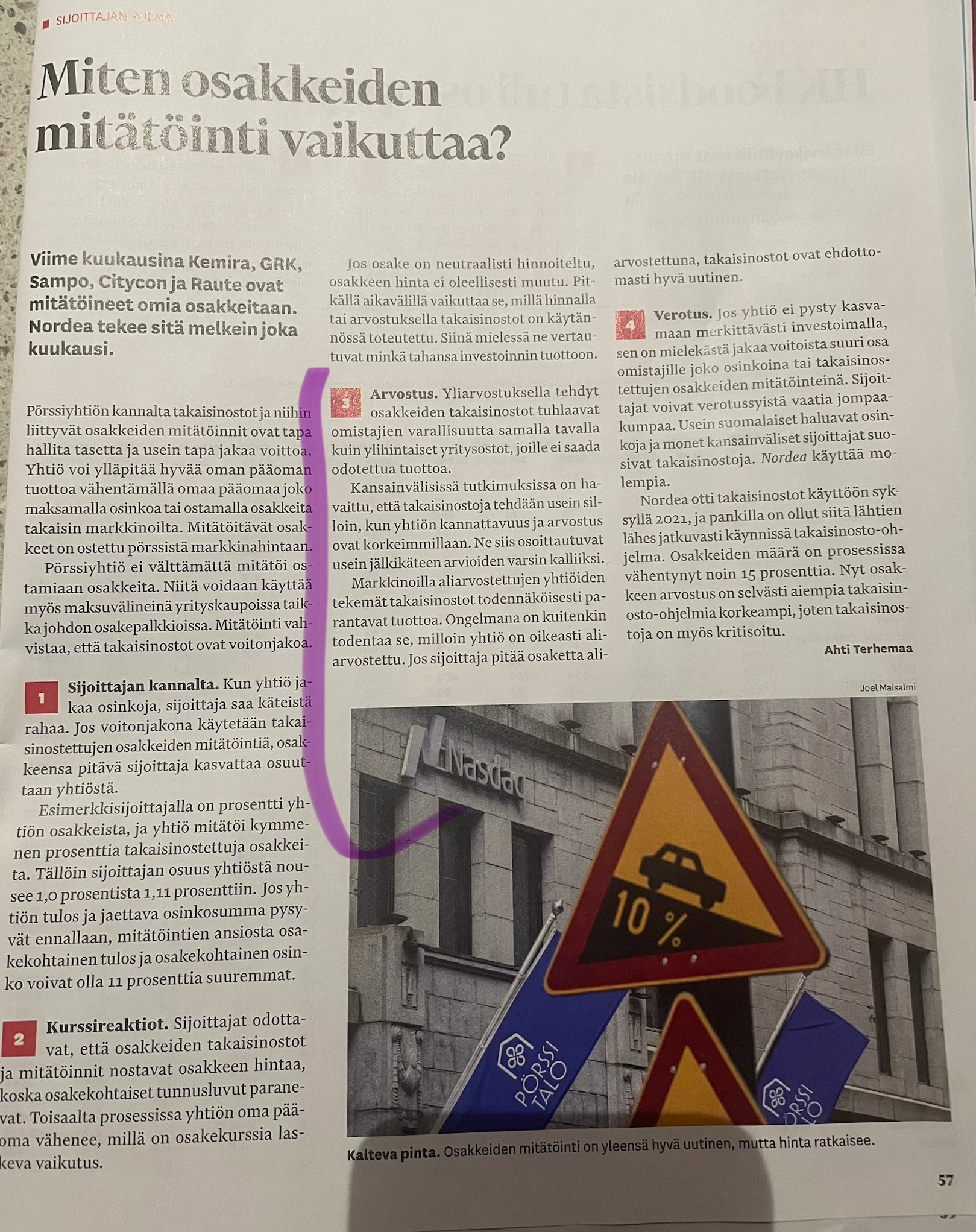
A recent article from Talouselämä on the subject.

I’m not interested in increasing that ownership stake because the share of the company is so small, just like with any regular person. I don’t see Mirko’s post in this thread; maybe it’s in some other thread? I certainly understand the company’s perspective on the matter and don’t believe anything new will come from them in that sense.

And someone in the thread claimed that Nokia’s share buybacks weren’t exactly burning money :woozy_face:. 19 billion up in smoke :dashing_away:

1 Like

I’m not talking about real-world accounting figures. I’m talking about theoretical “perfect world” values in modeling where B is exactly the value of cash flows generated by capital, and P is the market view of the same thing reflected in the stock’s valuation. So, in full equilibrium without over- or undervaluation, P/B must necessarily be one. In my calculations, I looked at how it affects things if there is specifically over- or undervaluation.

I assumed the model would maintain that dividends and share buys and sells would produce the same end result even under misvaluation. But instead, I got a mathematical demonstration that buybacks are a bad idea over time if the market factors in more cash flows for the company than it ultimately produces. The difference is in the per mille range, but it’s there nonetheless. Probably some contradiction between linear in dividends (only the balance sheet changes in the numerator of the share value) vs. hyperbolic in buybacks (where the number of shares changes in the denominator).

I don’t doubt that there might be a theoretical error in the model as it is. Compared to the real world, there certainly is an error, but I’m not looking at the real world right now. That’s why I mentioned it with the words “unless someone finds an error.” I would be interested to know what the correct model is and what is wrong with this one.

I find it quite natural that in an overvaluation situation, the ex-dividend drop leads to a larger decrease in stock value than the dividend itself, because from the perspective of market expectations, not only does cash leave the balance sheet, but also the future cash flows it would have generated. If this weren’t the case, the P/B ratio would just increase, meaning capital would be expected to produce even more, which doesn’t hold true in such a theoretical model any more than a P/B deviating from one implies a cash flow value greater than B.

However, the amount of the dividend is known well in advance of the ex-dividend date. Therefore, efficient markets would have naturally priced that situation in beforehand. The ex-dividend event should not, then, contain anything “extra,” regardless of what the P/B ratio might be.

Irrelevant in this theoretical model. In the model, the situation is first that the company has capital on its balance sheet, which is assumed to yield the same as long as it remains in the capital, and then it no longer does. The model doesn’t even need to assume that there would be transition periods in between or certain information not mentioned in the setup before or after the events. There are only events that change the setup and their immediate consequences.

If the model assumed that the markets knew anything about dividends or share buybacks, then the P/B would be 1 precisely because the dividend and its detachment would have already been priced into both P and B.

I think you are going astray in your reasoning by assuming the same valuation for the entire balance sheet. It is quite typical for a company to have equipment/technology/expertise that generates money, and then a certain amount of accumulated profit. The valuation of equipment/technology/expertise is uncertain and may involve over- or undervaluation. Retained earnings, however, are clear, and their distribution does not automatically correct any valuation error related to the rest of the balance sheet.

This is the same point, in other words, as in paapaa’s message above.

So, if you drop the assumption that the dividend payout changes the share price by a different amount, you will likely reach the same conclusion in your calculations. If a stock is overvalued and the valuation eventually corrects, staying invested is not a good idea, whether additional investments are made through dividends or share buybacks.

2 Likes

You really want to mix real-world factors into the theoretical model :slightly_smiling_face:… That isn’t essential for the modeling either. If in the world of the model all capital has a return of 11.(1)%, then that’s how it is and the results should reflect that.
I already tried. I don’t. Examining the matter is still ongoing, however. Interesting topic.

Rather, I would say that when I expand my calculations into future branches and out of all kinds of M & M equilibrium setups, I am simply stepping outside the official theoretical models on this subject. Since they are only defined within certain limits, those limits don’t seem to cover the consequences of forced under- and overvaluation a year later. At least I haven’t seen these calculations or even reflections on “what if there’s a valuation difference” (i.e., in profit distribution; in derivatives, those were thoroughly covered basic stuff) in a single bachelor’s or master’s level textbook or lecture slide over the past few years.

By the exact same logic, you could say “I’m not interested in dividends because my share of the dividends paid by the company is so small, just like for every other average Joe.”

19 Likes

Yes, there is some truth to @740_GLE’s point. In real life, there is evidence that share buybacks decrease or stop during crises, but dividends are often the thing companies hold onto more tightly.

As has been noted many times above, buybacks and dividends are “interchangeable” with each other, but in real life, the portfolio of someone living off investment returns is harmed if they have to sell more shares than the company buys back—meaning their ownership stake in the firm decreases.

Even if the share price eventually recovers, the number of shares may have decreased so much during the lean years that the FIRE-retiree is forced to head back to the cash register at McDonald’s.

Still, that doesn’t make the buyback model worse than dividends, and in fact, the distribution method there is already different, so the comparison itself isn’t even fair to buybacks.

Here are the links:

2 Likes

Yep. After thinking about it enough, I have indeed concluded that in a Modigliani & Miller world (on whose work the irrelevance of profit distribution is, as I understand it, based), it holds that the market and the firm have access to the same information and that this information is used efficiently. Setting P/B to anything other than one violates this framework. I’m a bit embarrassed now that I didn’t grasp this automatically.

The calculations themselves are correct, but they take into account a random anomaly—a factor that doesn’t belong in the M&M model world, i.e., a valuation error—which leads to the destruction of shareholder value when buying back shares at an overprice (the share count doesn’t decrease in the same proportion as equity per share increases, or something to that effect). This is a similar stretching of boundaries as, say, calculating time dilation at speeds exceeding the speed of light in physics. It’s not wrong, but the calculations are no longer operating within the M&M theory framework; instead, they present an anomaly that cannot persist—just as in theory, arbitrage cannot exist in option pricing, or at least not for very long before it is inevitably corrected.

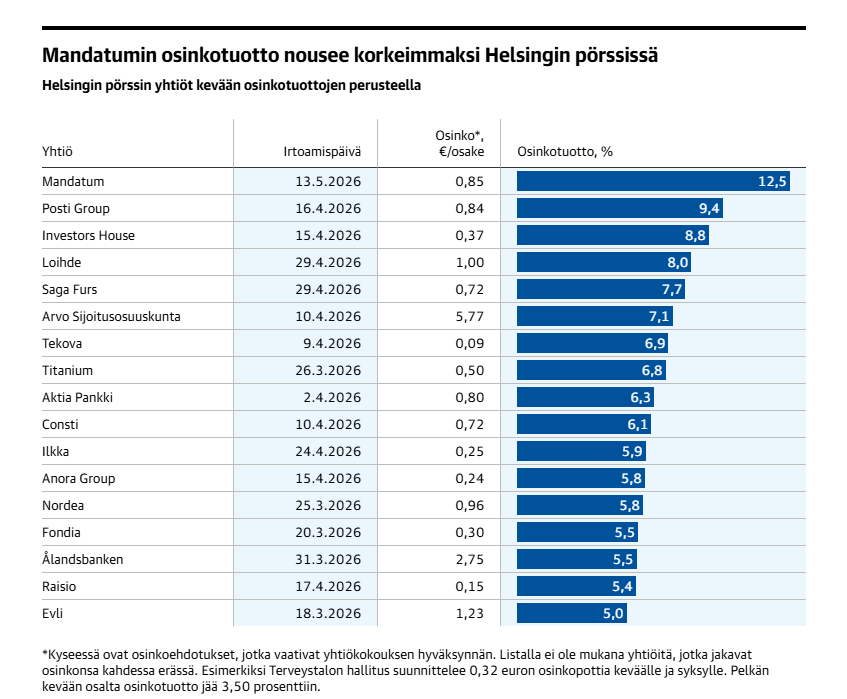
For dividend hawks, Kauppalehti offers today’s dividend news:

5 Likes

And here is a breakdown of this spring’s dividend stocks in a few sentences per company (all those paying a dividend yield over 5%). Parhaat osinko-osakkeet 2026 - Omavaraisuushaaste

2 Likes

Lassila & Tikanoja could be added to the list of this morning’s announcers, i.e., at a share price of €7.56, a dividend of €0.42, 5.55%.

2 Likes