Good questions! Feel free to add more below if other forum members have questions for Alexander.
I plan to publish an earnings preview tomorrow, but here are a few of my own thoughts. In Q2, signs of a recovery in the demand environment intensified, but at the same time, raw material prices were in a sharp uptrend. In this cycle, Orthex communicated that they would be more proactive regarding price increases compared to 2022. April sales were presumably still made with raw materials purchased at lower prices, but for May-June, I estimate that margin pressure broke through. Price increases will certainly provide support to revenue and mitigate the rise in raw material costs. At the same time, the company has presumably reduced promotional sales to defend its relative profitability, which in turn lowers volume-based sales and limits revenue growth. This is likely to be reflected particularly in the development of growth markets, where promotions are used more than in the Nordics to win new customers and shelf space.
So, as I see it, the balancing act between growth and profitability has been highlighted during the quarter. I wouldn’t be surprised at all if discretionary growth investments were postponed due to the quarter’s margin pressure.
It seems a bit like Carnegie has stopped covering Orthex, as their forecasts are no longer available on Bloomberg and the analyst who followed the company has stopped covering almost their entire portfolio. It’s a pity, as this means a reasonable consensus can no longer be reached. We’ll see if this is just a temporary phenomenon.
Here are Thomas’s pre-game thoughts ahead of Orthex’s earnings report next Tuesday
Due to the rise in oil prices following the conflict in Iran, we estimate that Q2 has been a balancing act for the company between growth and profitability. We expect revenue to have grown modestly, driven by the Nordic countries, but for sharply increased raw material prices to have weighed on profitability since May.
Mixed quarterly report, perhaps leaning towards a defensive victory. Of course, the situation in Iran will keep uncertainty high in the coming months, and Q3 EBIT will also be under pressure.
@Thomas_Westerholm good questions, especially the last one. Yes, they are definitely “loading the elephant gun” and likely aiming to expand through acquisitions to get closer to end customers in Central Europe…
Orthex doesn’t seem to be generating much interest among investors at the moment, but at least it pays a decent dividend twice a year while the stock price treads water.
Below is the Q2 in a nutshell and an interview with CEO Rosenlew:
April–June 2026
Invoiced sales were EUR 22.5 million (21.2)
Net sales grew by 5.2% and were EUR 21.6 million (20.5)
Adjusted EBITDA was EUR 2.7 million (2.9)
Adjusted EBITA was EUR 1.4 million (1.7), or 6.3% of net sales (8.4)
Operating profit was EUR 0.8 million (1.7)
Cash flow from operations was EUR 1.8 million (-0.8)
Earnings per share (EPS) were EUR 0.01 (0.05)
We reacted quickly to rising raw material costs with price increases, which supported profitability and strong growth in the Nordic countries.
January–June 2026
Invoiced sales were EUR 44.9 million (43.1)
Net sales grew by 4.0% and were EUR 43.2 million (41.5)
Adjusted EBITDA was EUR 6.0 million (5.8)
Adjusted EBITA was EUR 3.4 million (3.4), or 8.0% of net sales (8.3)
Operating profit was EUR 2.9 million (3.4)
Cash flow from operations was EUR 5.3 million (3.9)
Here is the company report from Thomas following Orthex’s Q2
Orthex’s Q2 figures were operationally slightly stronger than our expectations, although one-off costs related to strategic projects pushed the reported result below our forecast. During the review period, the pick-up in Nordic sales and resilient gross margins demonstrated the company’s ability to pass on increased production costs to their own prices. Following the strong performance in the Nordics, we have slightly raised our forecasts for the coming years and are updating our target price to EUR 4.8 (previously EUR 4.4). We are upgrading our recommendation to Accumulate (previously Reduce).
Quotes from the report:
Balance sheet remains strong
Orthex’s free cash flow for the beginning of the year was at a healthy level of EUR 3.1 million. Supported by strong cash flow, the balance sheet remained solid, and the net debt to adjusted EBITDA ratio was only 1.1x at the end of the review period (Q2’25: 1.4x), which is well below the company’s target upper limit of 2.5x. A strong balance sheet provides Orthex with resilience against negative surprises, such as those in the Middle East. Additionally, it provides flexibility for potential acquisitions and organic investments, which can be used to strengthen production capacity closer to Europe’s growth markets.
I was left with a bit of a mixed impression of this.
In the interview, the answer to the last question and the so-called “smirk” gave me the impression that these might be costs related to an acquisition.
On the other hand, in the webcast itself, those €0.6m costs were described as follows:
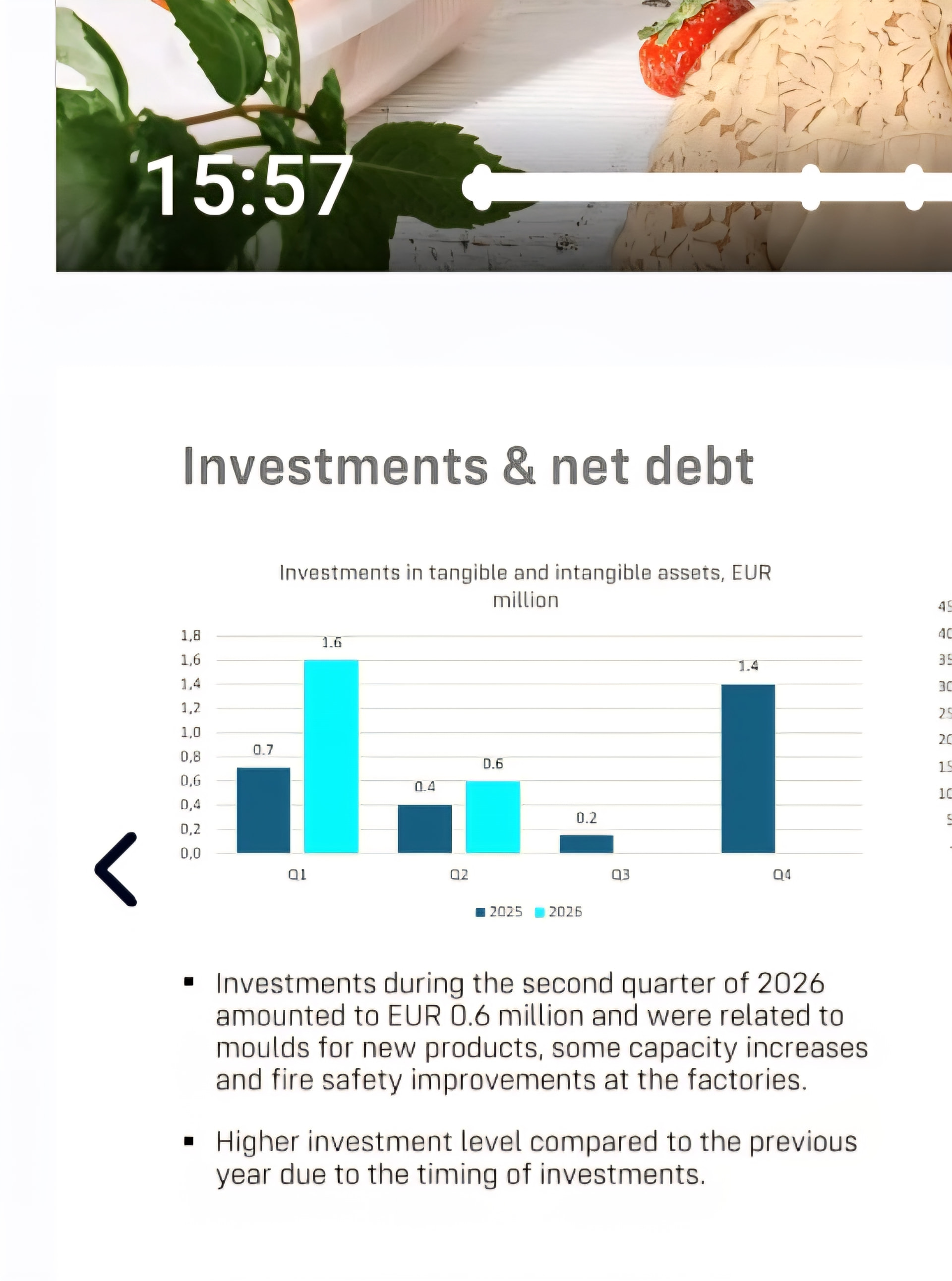
“Investments in the second quarter (Q2) of 2026 were €0.6 million and were mainly related to molds for new products, increasing production capacity, and improving fire safety at the factories.”
Edit. CFO Saara Mäkelä said that most of the costs were due to the “product novelty projects” portion.
Could “some capacity increases” = related to an acquisition? Who knows.
Isn’t it exactly the case that Orthex is looking to acquire production capacity? It would be hard to justify otherwise. The strategic costs are quite high, though, if they don’t include something beyond standard investments.
Orthex reminds me a bit of Innofactor and the idea that management would probably be more comfortable doing their work outside of the stock exchange. Although, the interest on the stock market isn’t exactly massive right now anyway. Perhaps certain bureaucratic gears and the pressures associated with them would be removed from everyday life.
They could also team up with the Swiss company Rotho and form a high-quality brand house that dominates Central Europe and the Nordic countries. And go private in the same swoop.
I personally don’t believe this is related to M&A, as investment bankers mostly charge for their services only once the transaction is completed, and the company has not yet announced anything of the sort. I would sooner believe that they have been working on strategy with consultants. If it were related to legal fees, they probably would have disclosed that at this stage too
Alexander at least did not confirm that no more one-off costs would fall into Q3, so the work might still be ongoing, or perhaps he just didn’t dare to answer off the cuff regarding the timing of the invoicing in case it partially spills over into Q3. I don’t dare take my own speculation any further than this.
The sum is similar, but those are tangible investments belonging to basic business operations. A one-off item is something that is interpreted as weakening the comparability of figures due to its rarity.