I read very carefully the article “Why is AI struggling to discover new drugs” published in the FT a week ago.
The article in the Pharmaceutical Journal was very much in line with the FT in that AI will probably speed up drug development, especially in the early stages, but the further one goes in the phases and clinical stages, the more the decisive role of humans is emphasized.
There is also a lot of AI hype in the pharmaceutical industry. For example: combining bioinformatics, genomic data, proteomics, and other “big data” type datasets gives AI a lot of prospects, if the data is of high quality.
As the FT states, the hype and, for example, the promises of some companies in the field have been too rosy, and results have not been produced as expected. To our knowledge, there is not a single approved AI-based drug developed in the world.
The article in the Pharmaceutical Journal states the important role of computing capacity. Quantum technology – when it gets working – would be like a turbocharged AI. In 10-20 years, quantum and AI may have a significant impact on drug development. But not without humans.
Orion also has reason to invest in these. That is clear.
So, are new, better medicines being developed faster? Yes, the article you linked explains quite well that the power and benefits of AI can be utilized specifically in the R of R&D, i.e., the research phase. When moving to the development phase, meaning human trials, that part is more difficult to speed up with AI. AI cannot speed up biology.
Orion’s competitors are accelerating drug development with artificial intelligence. How is Orion faring in this competition? We at Orion are also already utilizing artificial intelligence in the research phase of new medicines. We are also constantly striving to get better at it and find new ways to utilize AI.
Could this weaken the competitiveness of Orion’s existing medicines in the medium term? Regarding human medicines on the market, one could make a very rough simplification here and divide the products into darolutamide and other medicines. IF a competitor currently had a project progressing on the research side that could potentially be a competitor to darolutamide, the product would still have to go through the clinical development phase, which would take several years (e.g., darolutamide took 8.5 years from the start of Phase I to the first approval). As for the rest of the human medicine portfolio, those products are generic, meaning they operate in already competitive markets where competitors are other generic medicines and potential new innovations. If new innovations are not truly revolutionary, there will still be demand for generic medicines due to their cost-effectiveness.
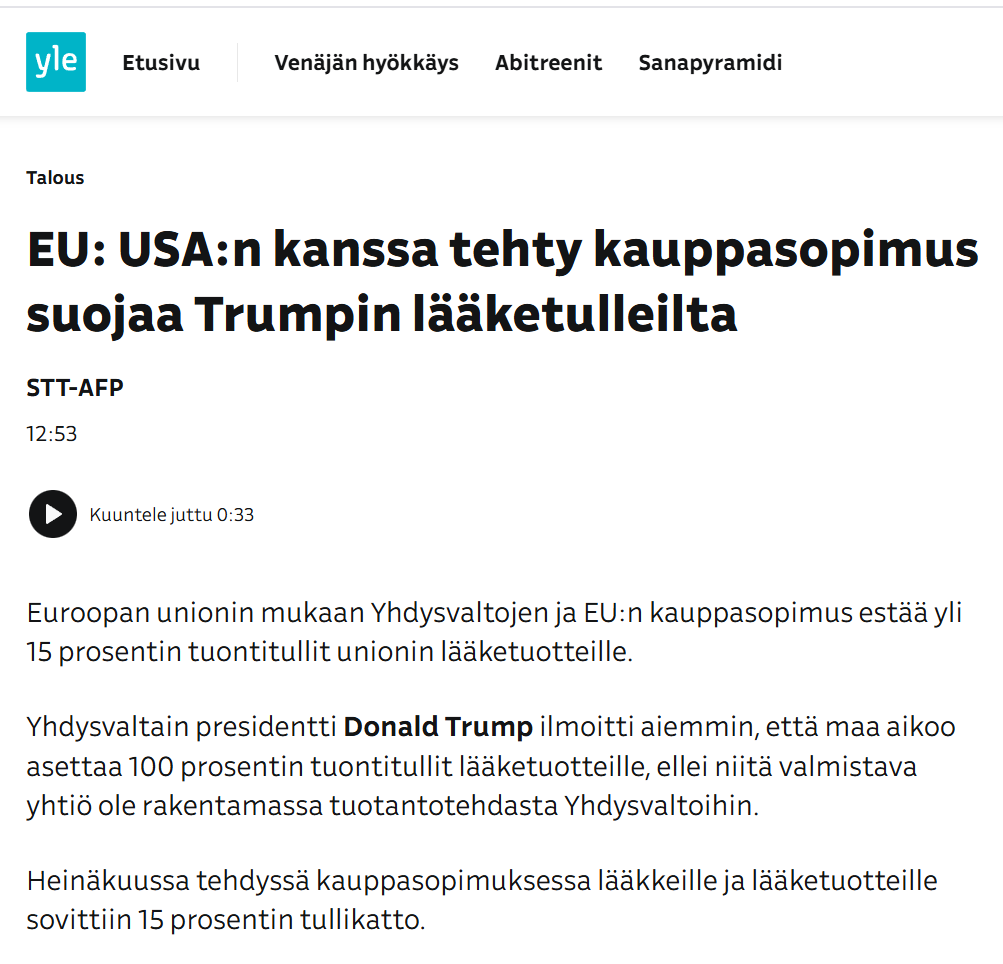
In the EU-US trade agreement, there is a maximum 15% tariff cap for medicines and even lower for generic drugs. A potential problem is that the “agreement” is still a political guideline document and not a final, legally binding one.
In principle, pharmaceutical exports from the EU area should therefore be protected from the 100% tariff slapped on patented medicines last night. But will Trump now tear open the whole package with the EU as well and try to impose one hundred percent tariffs on European pharmaceutical products too? For example, in Germany, they are not sure that the EU’s 15% tariff cap for medicines would definitely hold, and disputes may be ahead.
A recent example of subsequent interpretations that broadened the scope was seen when steel and aluminum tariffs were unilaterally interpreted by the US side to also apply to downstream products made from these raw materials.
So, let’s hope for the best, but with Trump’s USA, nothing is out of the question😡
Orion’s Head of Investor Relations Tuukka Hirvonen on US tariffs: “Cool heads, let’s see what eventually emerges, 15% tariffs should be quite manageable.”
This is likely again part of Trump’s negotiation tactics.
If 15% tariffs continue to be applied, nothing will change for Orion. If tariffs rise to 100%, Nubeca’s sales would decrease significantly. 60% of Nubeca’s volumes come from the United States, and it accounts for 10-15% of Orion’s operating profit, according to OP’s estimate. Roughly estimated, a higher tariff level could cut Orion’s operating profit by 5%. However, Orion’s growth story relies on Nubeca, and higher tariffs would cause a significant dent in it.
On average, only 10–15% of drug candidates that reach the clinical phase are approved as medicines.
Overall:
Approximately only 0.01% (or 1 / 10,000) of original drug candidates ever become approved and marketable medicines.
In light of this factual information, it would be more sensible if pharmaceutical companies primarily reported on successes and the progress of drug candidates rather than their discontinuations.
Given that the success rate of drug candidates is so low, investment decisions should not be based on them.
Even in Orion’s case, the greatest expectations are directed towards already marketable products, such as the Nubeqa® cancer drug, whose indications are constantly expanding.
There you have it. As I recall, in veterinary medicine, that drug is an effective treatment, but presumably, there it’s about temporary sedation, if I’ve reasoned the matter correctly. A stop in phase two is certainly a setback, but the silver lining is probably that the accumulated losses from development costs would be tragically greater if one has to throw in the expensive towel only in phase three.
There are plenty of links on the internet with figures, and the results are similar regarding success rates. Below are a couple of links if you are interested in the topic:
I didn’t quite understand what you mean. Orion certainly shouldn’t “throw in the towel”, I don’t understand where you got such an impression from my message because I haven’t written or hinted at anything like that.
Orion had a long period of stagnation when there were no big hit drugs, but Nubeqa has turned the picture around for at least a few years. However, patents expire in the 2030s. Of course, there are new plans to expand its use, and currently, all of Orion’s divisions are quite profitable. The risk is that the company will no longer develop in terms of results and share price, even if the ‘ok’ situation persists.
Still, “cheaper, better pharmaceutical companies” is an interesting statement.
-Sure, Pfizer is available at a discount, but the patents for its anchor products are about to expire, and there’s no information on new ones. Orion clearly has a longer good outlook.
-Eli Lilly has a top-tier product portfolio, for example, in its breadth compared to Orion, but the price is really salty.
-AstraZeneca is doing well, but e.g., China risks are high, although Orion’s USA dependence is also high.
-Novo is available affordably, but over a hundred competitors are entering its main earning segment, weight-loss drugs, and the outlook raises conflicts, as income from its other products is much thinner.
Etc.
So, which ones might be cheaper and better compared to Orion? I’ve been eagerly searching for such companies🤩
One shouldn’t make slightly provocative challenges like @Pohjolan_Eka’s when there isn’t really time in everyday life to respond to these completely understandable reply messages But I’ll try quickly and a bit regrettably briefly:
The view on Orion’s expensive valuation (relative to peers) is naturally based on a combination of Orion’s current medicines, pipeline, and current valuation.
But what are better alternatives in the pharmaceutical sector? In my opinion, there are two clear ones:
Novo Nordisk. The company is cheaper by direct comparison (P/E, P/FCF), its current products are better / better positioned, and its pipeline is better. Its intangible capital (in Finnish: expertise in its own strengths) is much greater than Orion’s: Novo’s expertise and position in the diabetes segment are incredibly strong. Orion doesn’t really have anything like this to compare. So, simply put, the company is higher quality, larger, and better, yet cheaper. If you want to discuss Novo and the weight loss market more, it’s better to move to Novo’s own sandbox, but in short, I think the markets are completely wrong here.
Pfizer. The company is much larger and, by most common metrics, cheaper than Orion, and its earnings predictability is, in my opinion, better than Orion’s in the long run. So I don’t quite buy your claim that Orion’s future outlook is supposedly better It has, in my opinion, a bunch of good and stable pieces in its portfolio, e.g., in the vaccine sector and the Vyndaqel product family, although Eliquis’s patent has largely expired. If Orion is to be valued higher than Pfizer, then Orion should have an outrageously large and expected earnings growth far into the future. The only problem is that Orion has good next few years, after which there may be, for example, a decrease in revenue and weakening results. Orion is pretty much a one-trick pony at the moment, and its small size poses a great risk as to whether the next success will come. So if you want predictable and certain results far into the future, I would choose Pfizer at this price. If, on the other hand, you want good and as predictable as possible growth in earning power for your portfolio, I wouldn’t buy either, as Pfizer’s future prospects don’t offer any interesting growth either.
So there are, for example, those couple of cheaper and better ones, quite clearly in my opinion. Other targets you mentioned can then be discussed one way or another. Novartis is, in my opinion, one more that is more interesting than Orion, which I certainly wouldn’t buy or hold at all at the current price.
I don’t quite get a kick out of Astrazeneca myself; it has some interesting pieces, but I’m not excited about it at the current price either. Difficult to compare to Orion. Eli Lilly, on the other hand, is such a specialty that it’s a really difficult case. The valuation is completely outrageous, although its pipeline and current portfolio clearly provide the best growth conditions for the coming years. Very difficult to value.
And it shouldn’t be understood that I’m some kind of eternal bear on Orion. I also had Orion, as did my father’s portfolio, which I manage. The moment for an Orion investor was to buy some time ago from over +30e (for my own + father’s portfolio). The sales, of course, went too early between 45-60e, but that’s how it is.
It’s worth trying to compare Orion to Kenvue or Organon, for example. Both have strong brands that have lost their patents, but still sell consistently well. Both are very affordable with their P/E ratios. Orion, similarly, has a strong domestic painkiller, basic cream, and asthma treatment portfolio. They could be valued at a PE of 15, for example. Now the P/E is something else, of course because of Nubeqa. but that only lasts for a while.
In pharma, the wheel always has to be reinvented every 10 years. There are no permanent moats. (scale or “company culture” could at most be one..?) There’s probably a good reason why Buffett never invested in these.
Orion probably has a lot of these long-term holders, many of whom are perhaps doctors. And as the only big pharma company in Helsinki, it is probably chronically valued at a slight premium.


 But I’ll try quickly and a bit regrettably briefly: