The outcome is more than uncertain. Trump’s tactic in these threats is based on a balance of terror, and many things have later turned neutral. I don’t believe Orion will comment on the uncertain situation in any way.
7 Likes
12 Likes
Here is Lisa’s interview regarding the results and long-term product development projects.
This time I didn’t ask about tariffs, because the situation regarding them is still completely up in the air with Trump. They have been discussed in previous interviews. Let’s see if they materialize by the Q3 interview.
00:00 Spring development
01:20 Nubeqa development
02:05 Parkinson’s drugs in Japan
03:00 Easyhaler sales potential
04:10 Veterinary medicines
05:34 Sales portfolio
06:55 Product development pipeline
12:30 How to stay grounded
19 Likes
Siltanen has made a company report after Orion’s Q2 results. 
Orion’s Q2 surprised positively on many fronts, the most important of which is naturally Nubeqa’s high-margin growth. The company’s outlook has improved in both the short and long term as a result of business growth and the expansion of research pipeline opportunities. We are once again raising our forecasts based on Nubeqa’s faster-than-expected sales acceleration. Despite the forecast upgrades, we believe the risk-reward ratio remains unattractive after the strong share price increase in spring and summer.
7 Likes
European Union Approval for Darolutamide’s Third Indication in the Treatment of Patients with Advanced Prostate Cancer
10 Likes
ODM-105 is an interesting project at Orion, and in that regard, I noticed
At least in Finland, clonidine is a blood pressure medication. It would be interesting to know if it has an indication for insomnia and/or anxiety elsewhere, or if it is mainly off-label use, i.e., outside of official indications?
2 Likes
Clonidine is indeed not directly marketed as a sleep aid anywhere, so its use is off-label. Post-traumatic stress, to which sleep disorders are closely linked, is mentioned in some treatment guidelines. For example, it’s used for veterans in the US. A domestic review mentioning clonidine [https://www.duodecimlehti.fi/duo16842]
Orion aims to develop a more selective drug, meaning one that lowers pressure less. An otherwise physically healthy person can tolerate a drop in blood pressure, but an elderly person might fall during nocturnal bathroom trips. And clonidine would be too long-acting; tasipimidine’s half-life should be significantly shorter. Phase 1 has been passed, so safety has already been preliminarily deemed sufficient.
Finland, Germany, and Poland as research sites. And Turku. https://clinicaltrials.eu/inn/tasipimidine/
It’s good that the ongoing Phase 2 is a comparative study against placebo, meaning efficacy data will be reliably obtained. Surprises can always arise at this stage, in addition to efficacy comparison. If blood pressure drops too much in some individuals. Or if the QT interval lengthens too much, leading to arrhythmia susceptibility. Warnings about interactions with other medications may arise.
Furthermore, according to current guidelines, the US market may not open if a significant number of patients treated there have not been in the trials. Well, it’s still possible to expand in Phase 3 later if a green light is received in Europe. And in Turku.
10 Likes
Today, July 27, it was reported that the EU and Trump have agreed on 15% tariffs, although the metal and automotive industries are apparently going their own way. What will happen to medicines? Are they perhaps coming in some Trump-style late train, with crippling tariffs.
EDIT: I dug up more information, medicine tariffs are actually according to previous agreements, meaning quite steep tariffs…
3 Likes
Yeah, Trump’s speeches had caused confusion here too, but von der Leyen said very clearly that medicines are subject to the general 15% tariffs. With the exception of certain generic medicines, which certainly do not have significant importance for the overall picture.
2 Likes
The problem here is that the party who remembers what was agreed upon, Ursula Von Der Leyen, means nothing when/if Trump decides to open the matter.
Drug pricing is a significant domestic political issue for Trump. At least ostensibly, there is a desire for production to be moved to the United States.
3 Likes
Orion caught in the midst of a confusing tariff situation. In addition, as the cherry on top, the US Secretary of Commerce recently announced that “massive” pharmaceutical tariffs are just around the corner.
4 Likes
The outlook is uncertain in all respects at least until approximately November 7, 2028, unless Trump’s antics are somehow restricted after next year’s midterm elections. However, I don’t believe this will happen. Until then, we will closely follow whatever comes to the mind of the decade’s sketch character in the morning. And it can indeed be anything. We are once again living in overly interesting times.
4 Likes
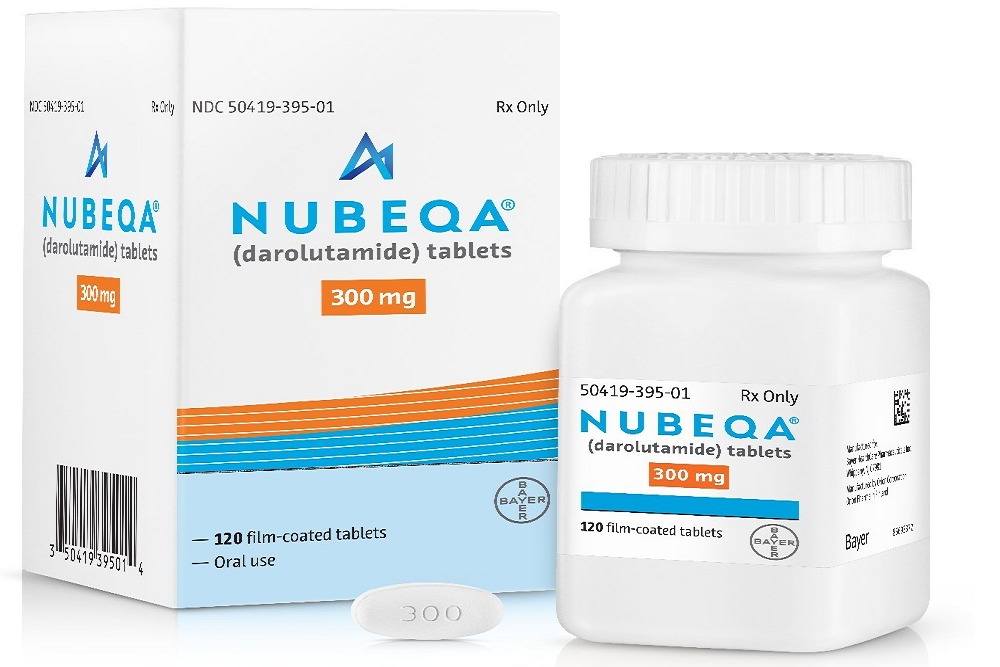
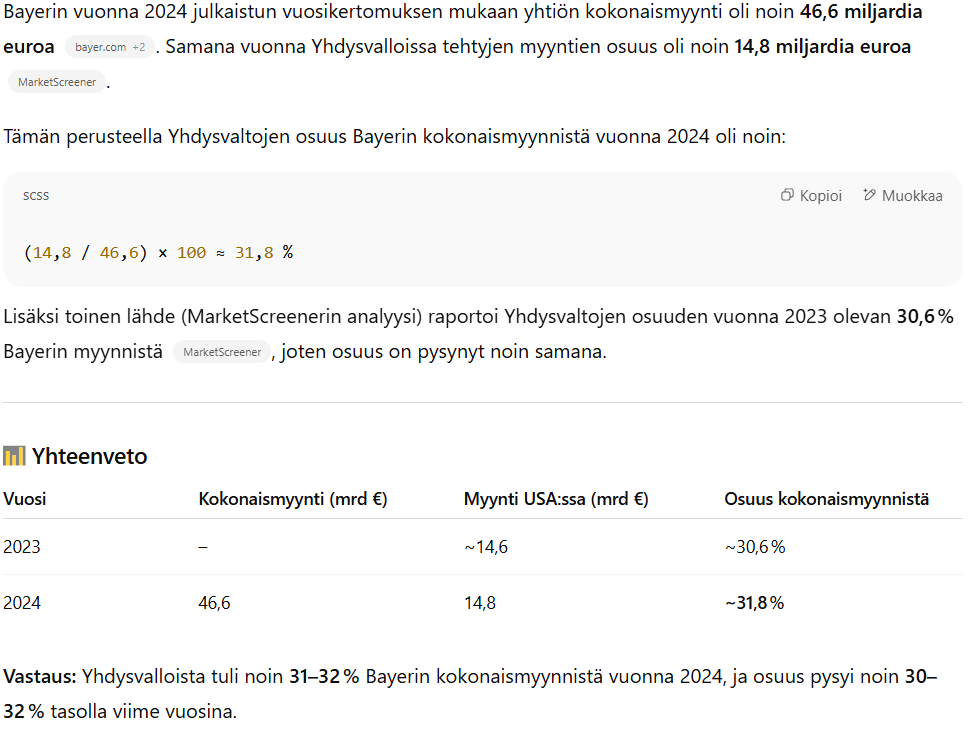
Tariffs will indeed hit Orion. Orion acts as a “contract manufacturer” for Bayer regarding Nubeqa in regions like the USA, where they are sold in Bayer’s packaging. The medicines are manufactured in Finland.
It remains to be seen what will happen, and on what schedule. What’s new is that the US administration is now threatening a 3-tiered imposition of tariffs, and at the same time, a forced reduction of prices independent of tariffs.
3 Likes
1 Like
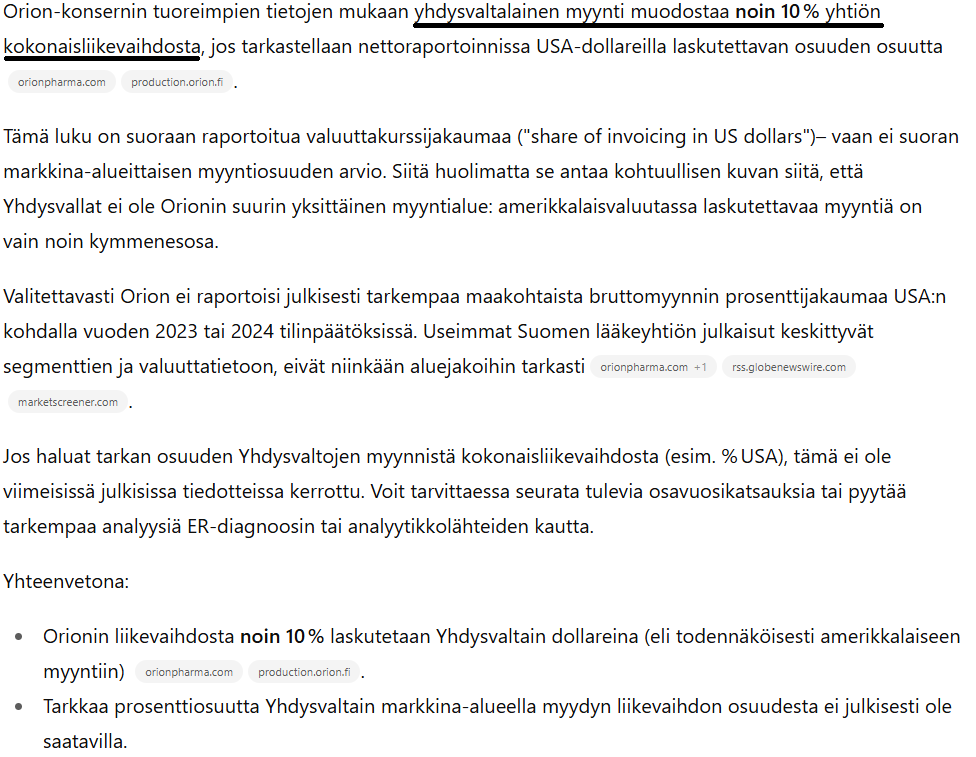
Indeed, 10% of Orion’s sales are in US dollars.
But Nubeqat is Bayer’s sales there.
Surely, the business with Bayer is in Euros?
3 Likes
2 Likes
Regarding medicines, there’s something I don’t understand about this customs mess. Americans buy medicines manufactured in the EU because they are not, or cannot even be, manufactured elsewhere. Medicines are bought because they are needed to increase people’s lifespans or improve their quality of life, and this is certainly not something one wants to compromise on. European pharmaceutical giants, whose products Americans already buy anyway, hardly have any incentive to build factories in the US, where cost competitiveness is very poor.
What have I misunderstood?
5 Likes
even if all medicines were manufactured in the USA, the situation would not change, because
Free Pricing: Unlike in many European countries, in the United States, pharmaceutical companies can generally set the prices of their medicines themselves. In Europe, authorities, such as the Pharmaceutical Pricing Board (Lääkkeiden hintalautakunta) in Finland, negotiate and regulate the wholesale prices of medicines. This limits pharmaceutical companies’ ability to arbitrarily raise prices.
Healthcare System: The United States’ healthcare system is complex and market-driven. It has several intermediaries, such as insurance companies and pharmaceutical charities, all of which add to the costs.
Trump has an unfortunate trait in that he can never critically reflect on the US. Well, that’s just how it is.
3 Likes
Orion’s Tuukka Hirvonen was presenting his company as an investment at the Stock Investor’s Week.
Topics:
4 Likes
Orion’s competitors are accelerating drug development with artificial intelligence. So, new, better drugs are being developed faster? Could this weaken the competitiveness of Orion’s existing drugs in the medium term? How is Orion performing in this competition? Thoughts?
2 Likes