Orion - What is the future outlook?

I’ve been wondering the same, even though Inderes at least seems to have a buy recommendation out. I sold it when I needed buffer cash, and now I regret it because the buffer is untouched and the share price is +6 euros compared to when I sold it.

Could there be some psychology at play here, with a pharmaceutical company somehow benefiting from the current situation, or does Orion offer a safe haven with its defensiveness, and people aren’t selling, especially as the share price keeps moving forward? Who knows.

E: I wouldn’t buy either.

Thanks for taking the time to list those points that I couldn’t be bothered to write on my phone.

Darolutamide was the reason I jumped on board over a year ago, but I’ve dropped out during the spring. We’re still following, but not with full focus.

You make good points about Orion’s competitiveness, but now we could consider why the stock has been given a buy recommendation, and what risks are associated with Orion.

I perhaps see a psychological risk of sales starting and a snowball effect, considering the current price. My neighbor sold, should I sell too (while I still can)?

1 Like

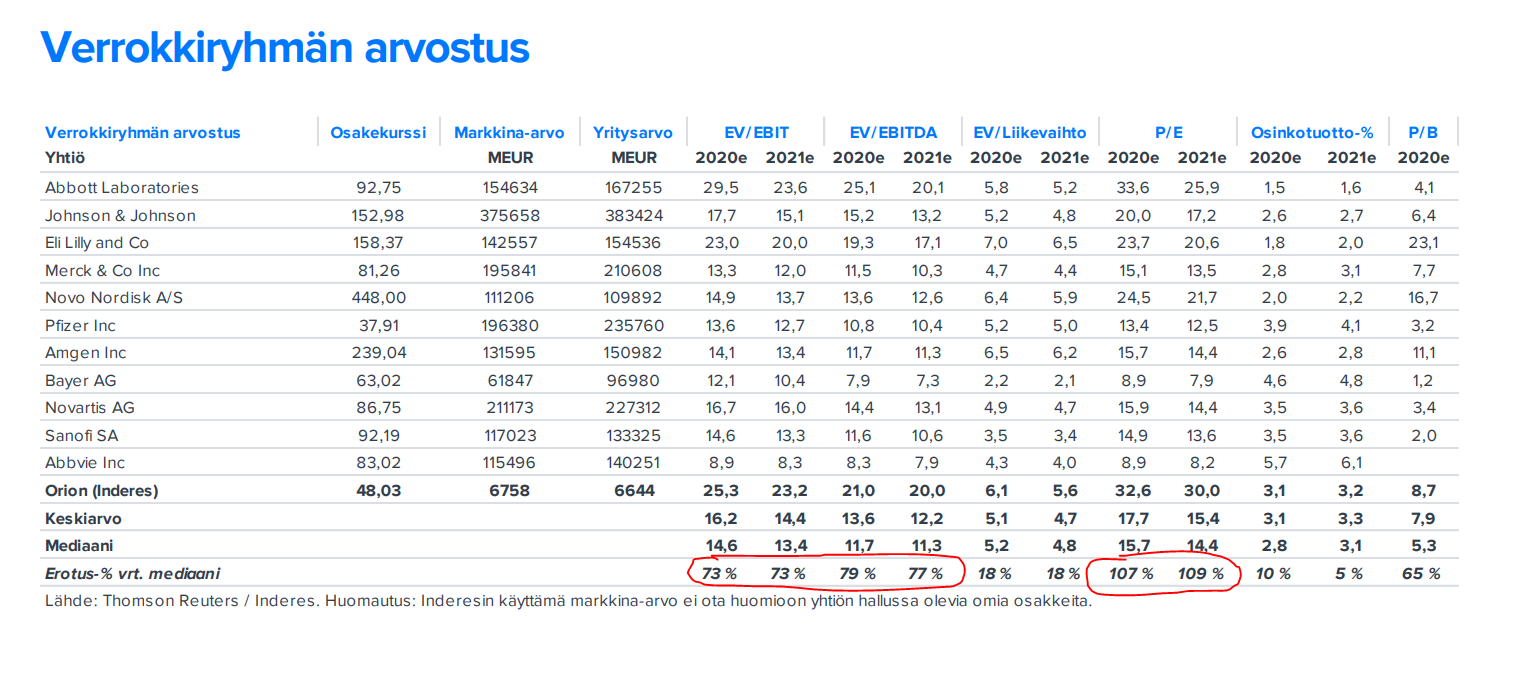
Some good points have emerged. If I owned Orion, I probably wouldn’t sell now, but I wouldn’t buy it at this price, or even a little lower. I can’t fully justify when or why I would buy it at all. Logically, the price is high (P/E 37, P/B 9, dividend yield 3.2% from Inderes), but at least in this market situation, investors are still paying it, just like for Kone.

I don’t have very high hopes that hydroxychloroquine will become a cure for corona (though it’s still possible), nor do I believe that the consumption of asthma medications would rise so tremendously, not to mention the demand for pain and fever medications, which was temporary.

I’m not entirely familiar with Orion’s research and development, what might be coming from there and when. In my work, I deal with medicines, and by gut feeling, I’d say new things don’t come very often, but Orion does have a lot of medicines for hospital use only, and that part is less familiar to me.

Psychologically, for me and certainly many other Finns, Orion feels like a safe and good investment. “A Finnish pharmaceutical company,” could it be any better? It always somehow manages, even when things are tougher? That’s probably why I’m following this myself, even though it feels like there might be more profitable opportunities among foreign pharmaceutical companies. Everything depends on the investment horizon and one’s own requirements for the investment; one has to make those decisions oneself, and if one justifies it with psychology and is happy with it, then why not? This is not a bad investment, but there are probably better ones.

And all this as the thoughts of a rather greenhorn. :hugs:

1 Like

Peer Group Comparison

Merck Operating Income USD 12.24 billion and Market Cap
USD 205.6 billion, ratio 16.8
ROE 37%
Dividend Yield 3%
Payout Ratio (from earnings) 59.32%

Pfizer Operating Income USD 12.24 billion and Market Cap
USD 207.4 billion, ratio 14.9
ROE 25.6%
Dividend Yield 4.14%
Payout Ratio (from earnings) 50.17%

1 Like

Orion has one problem: unrealistic valuation. The pharmacy price of Oxychlorin is about €0.3/tablet, the patent has long since expired, and its potential use in COVID patients will be a course of treatment. Personally, I prefer it when the demand for a pharmaceutical company’s product is continuous, e.g., Novo’s insulins and other diabetes medications. Predicting winners in the pharmaceutical industry is an impossible task, so I have only bought through pharma funds :wink:

1 Like

Orion’s performance doesn’t look bad. I already regret selling some of it :joy:

@Petri_Kajaani doesn’t seem to believe that the market values a counter-cyclical industry even more than usual during these times. Since interest rate markets are the same for everyone (they don’t price in much interest for decades), Orion can be allowed a clearly higher P/E ratio than before, and a really clearly higher one than in cyclical industries. I, myself, won’t sell at a price starting with 4.

1 Like

Of course, during times of crisis, markets appreciate counter-cyclical industries, and valuations can climb high when interest rates are low, as we’ve seen on the Helsinki stock exchange with companies like Elisa and Orion. However, all asset classes also have an opportunity cost, which should not be forgotten.

But could you answer one question for me that I haven’t been able to figure out yet: If you want to pick a stock from a counter-cyclical industry (e.g., pharmaceutical companies right now), why would it be Orion, and not one of the other companies in the peer group? Orion is actually about 2x more expensive than its international pharmaceutical peer group on all earnings-based valuation multiples, and its dividend yield is at the same level. Why invest specifically in Orion when cheaper/larger/more stable/more profitable alternatives are available? Not to mention all the other alternatives from other industries and the general pricing of the stock market.

6 Likes

That’s a good question that I can’t answer. I personally think that Orion has a long and glorious history and has shown itself capable of “miracles” before when its future potential has been doubted. Furthermore, Orion’s research work is cost-effective, and for example, prostate cancer is increasing rapidly. The stock price is a story.

3 Likes

P/B and EV/EBITDA include a lot of company discretion. The P/E ratio is good when comparing peer groups, but poor in a time series because it does not take into account the interest rate level. In a time series, one should compare excess return, i.e., earnings yield over the risk-free rate, e.g., the 3-month and 10-year average that I use.

Touché @Petri_Kajaani.

However, one attribute was forgotten from the comparison. Perhaps the most important one… i.e., growth prospects?
Others may be cheaper, larger, more stable, and more profitable, but what do the future and profitable growth look like in your opinion?

Positive drivers for Orion’s EPS growth would presumably come from the respiratory drug portfolio, especially if respiratory tract damage and symptoms become more common as a result of the Corona pandemic. Darolutamide will create a fairly certain revenue stream in the near future.

And what about new drug candidates in the pipeline? Levosimendan for ALS is already in phase III.

These were some additional thoughts as a challenge. I certainly understand your perspective on the company’s valuation. On the other hand, it’s great that the company is valued so highly. It reduces the risk that our country’s only reasonably sized and well-employing pharmaceutical company will be bought out from the stock market. Orion could also now consider M&A activities since the share price is quite high.

1 Like

But is Orion the only company in the peer group that has new drugs coming in the R&D pipeline and good earnings growth prospects? Valuation multiples are forward-looking for all companies in the peer group and they also take into account each company’s earnings growth prospects from consensus forecasts. It would be strange if Orion was the only company in that peer group that would have new drugs coming and that would benefit from the coronavirus such that it would deserve such a premium valuation?

In our forecasts, Orion is expected to grow by an average of 6-7% per year until 2025, which is clearly faster than the average growth of the pharmaceutical market, and to achieve the company’s target operating profit margin (EBIT 24-26%). In 2025, our revenue forecast is 1.5 billion (i.e., +43% from the current level) and the operating profit forecast is 394 MEUR (i.e., +57% from the current level) and the EBIT margin is 26%. Our forecasts already include truly strong earnings growth expectations. In 2025, Orion would achieve an EPS of 2.2 euros with our forecasts, and even with that, the P/E ratio at the current share price (48€) is 22x, which is really high and clearly above even the peer group forecast calculated with this year’s earnings estimates. Orion’s share pricing is thus at least 5-10 years ahead of other peer companies.

Summa Summarum. Our forecasts already include truly significant earnings growth expectations related to Easyhaler, Nubeqa, and ALS, and yet after 5 years, with measured earnings (significantly higher earnings than now), Orion is valued clearly above the current pricing of the peer group and the general market level. I don’t understand this.

Can you explain why this is?

6 Likes

Shouldn’t the P/E ratio, taking into account time series and/or interest rates, also rise for all companies and the general valuation level of the stock exchange? Why has Orion’s P/E ratio risen faster than both its peer companies and the general valuation level of the stock exchange in recent years, and is currently in a league of its own compared to them? Low interest rates should then also affect other companies and raise their multipliers.

1 Like

You’re absolutely right. I don’t know why Orion’s odds are so much better than its peers, but I appreciate the company for its past track record, just as I do Elisa.

2 Likes

In drug development, the future potential also largely applies to option pricing, as seen in so-called single-product companies. Orion operates with a relatively small research unit, which has, however, achieved many results. Could it be that Orion has more drug development potential relative to its size than larger companies, and therefore option pricing is more significant?
Ping @Petri_Kajaani

Well argued, @Petri_Kajaani! Surely, from that comparison group, some company should have quite similar growth prospects (6-7% per year) or even better. It is also possible, of course, that such a company in the comparison group is then brutally undervalued.

In the pharmaceutical industry, averages and average figures are perhaps a bit misleading, as there are numerous companies in the sector whose results can rocket thanks to a new Breakthrough drug. On the other hand, there are also companies whose results can collapse when a drug’s patent expires.

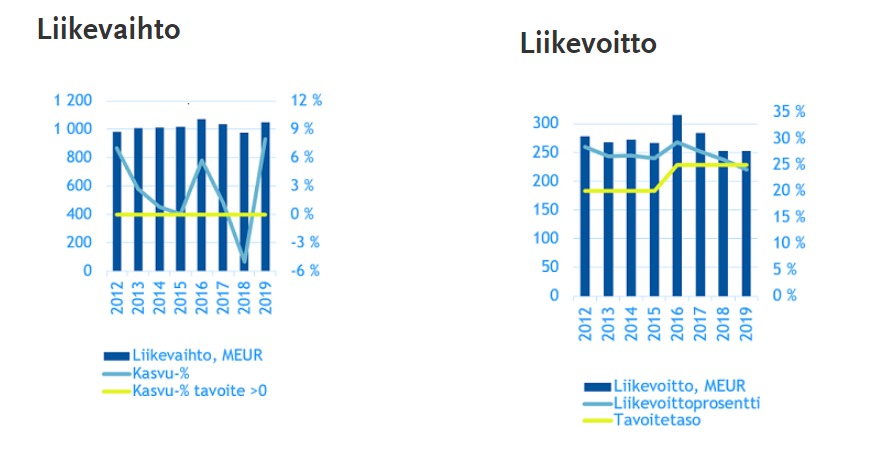
I would also assume that Orion’s EPS can fluctuate significantly more in one direction or another compared to Pfizer and J&J. As one example, isn’t the Easyhaler product family a significant part of Orion’s result, and shouldn’t the growth of that product family be significantly reflected as a percentage growth in Orion’s EPS? Of course, you have estimated that the company will achieve 55% EPS growth from the 2019 financial statement’s EUR 1.42 by 2025. Quite OK growth, but could there be even more growth in that time?

In addition to the products mentioned, Orion offers a drug used in intensive care, and the company is a significant manufacturer of hydroxychloroquine. So it is possible that the company is quite well positioned for the near-future market environment.

Finally: what if industry experts and active investors consider the ALS candidate almost a sure success, and have modeled the future cash flows from the drug as significantly larger and more probable than in your model?

And I apologize for challenging so much! :smiley: You have done really great work with Kamux and Harvia, and I really appreciate your analyses.
It is certainly impossible to mathematically model the counter-arguments I presented and include them in the determination of the stock’s fair value. But could such factors explain Orion’s seemingly miraculous valuation?

2 Likes

It’s also worth noting that our forecasts for the coming years 2020-2025 include quite a “hockey stick” in terms of revenue and earnings, considering that Orion’s revenue and operating profit have not really developed in any direction since 2012. However, the stock has generated quite good returns during the same period, which has mainly happened in the form of dividend payments and an increase in valuation multiples.

4 Likes

Great discussion! :+1:

In the pharmaceutical industry, a strong company has a diverse portfolio for various (common) diseases and product development that regularly brings new products to the market. In my opinion, Orion might not quite reach this level in terms of diversity, even though asthma is a very common disease. Similarly, for example, Novo Nordisk has also largely focused on treating diabetes (and obesity), but that too is a very common and still growing disease. NN seems much more attractive to me at the moment than Orion, even though it’s hitting all-time highs.

Orion itself boasts a lot about the success of the Easyhaler product family, but does @Petri_Kajaani have any information about its global market share? Other companies also have these same drug substances (for some products), even in similar combinations. So, even if the demand for asthma medications grows due to the coronavirus, is it so self-evident that the demand will hit exactly the Easyhaler product family? Of course, it is possible that for some reason the demand is directed specifically at it (even though many asthmatics prefer to use competitors’ products, but the doctor prescribes it and hospitals supposedly use products according to contracts).

Maybe I don’t know - I mean, I don’t know about Orion, but I bought quite a lot of it a couple of years ago. Immediately after that, parties who seem to know something have consistently recommended selling. I haven’t sold. I’ve taken the dividends and the value of the investment has increased by over 40%. And I’m still not selling. Have I done something wrong here? :sweat_smile:

3 Likes

I keep getting emails, texts, and inbox messages asking: “Why do analysts hate Orion and the recommendation is always SELL?” It’s true, we’ve been wrong for a long time, the company is excellent, the valuation has always been high, but it’s only gotten higher, and in Orion’s case, it’s always been difficult to assess this market-accepted valuation level.

This week, 3 out of 7 members of the management team also moved to the selling side:

Satu Ahomäki (Director, Commercial Operations) -€142k
Liisa Hurme (Director, Supply Chain) -€528k
Virve Laitinen (Director, Specialty Products) -€377k

11 Likes