EGARA advises operators, platform providers, and suppliers on technical and operational compliance in regulated markets. For implementations targeting Finland, including vault solutions, practical technical guidance, and local legal advice, we work in close cooperation with our local partners Ubetec and the law firm Nordic Legal, who are directly involved in supporting clients on the ground.
6 Likes
Great that there seems to be new business on offer in that direction. Which was to be expected. The question is, when will the contracts start getting signed?
2 Likes
Or how many have already been written… We don’t know this, and these (too) contracts are hardly shouted about too much
This is also quite understandable, as gaming companies have not yet released information about a possible entry into Finland.
2 Likes
50 applications have been received.
6 Likes
I don’t know if this is the same old stuff, but it’s also fresh on Aeye’s website.
2 Likes
The processing time for gambling license applications was estimated at around 6 months. You’d think they’d need to start planning those with Ubetec or other similar companies well in advance? Or is there anyone here who knows more about these things? So personally, I suspect/hope that revenue will start coming in by the 4th quarter at the latest, if deals are signed at all?
3 Likes
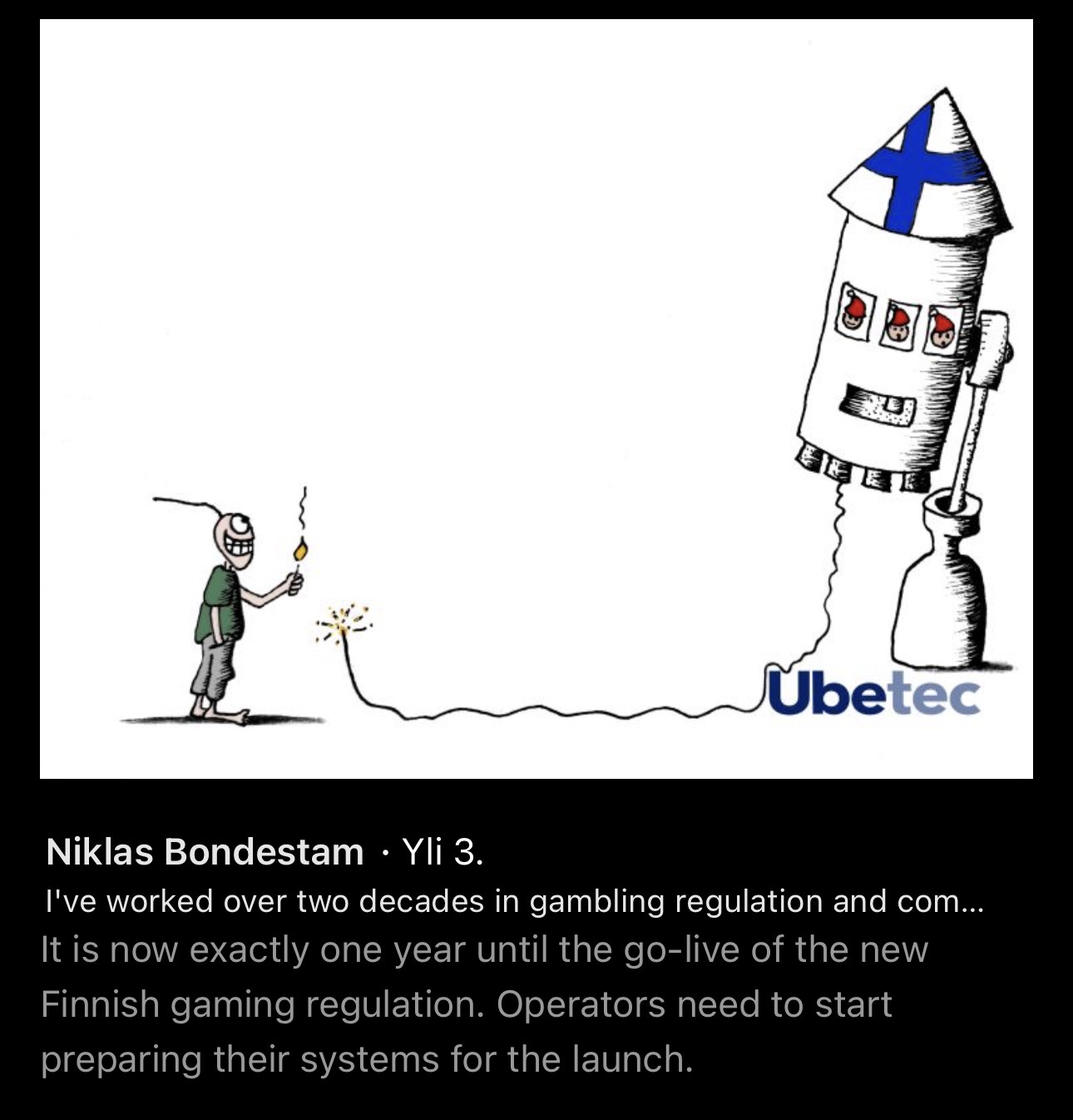
well now, looks like it’s taking off right like a rocket with the elves on board. I wonder if this is signaling an upcoming Santa Claus rally 
9 Likes
Easy to relate to that elf in the passenger seat. Been sitting in the passenger seat for many years 
6 Likes
I believe this Ubetec will become a “dark horse”.
It will save the whole company.
6 Likes
As the month has turned, here is another comparison of the changes in the TOP 100 owner list. All in all, a fairly quiet month, especially considering that the company published its Q2 results in August.
Optomed – Changes in the Top 100 Owner List 31.7.2026 → 31.8.2026
Comparison between the lists at the end of July and August. 98 owners out of 100 were on the list in both months, of which 79 had no changes.
Total number of shares increased 21,453,297 → 21,495,911 (+42,614). Held by Top 100: 52.90% → 52.51%.
1. Increased (already on the previous list)
| Owner | 31.7. | 31.8. | Difference |
|---|---|---|---|
| * Skandinaviska Enskilda Banken, Helsinki Branch | 407,093 | 473,390 | +66,297 |
| 4capes Oy | 70,000 | 100,000 | +30,000 |
| Seppälä Visa Matias | 40,000 | 55,000 | +15,000 |
| Moilanen Jaakko Sakari | 125,177 | 135,177 | +10,000 |
| * Citibank Europe Plc | 73,475 | 79,856 | +6,381 |
| Poutanen Arto Kalevi | 45,000 | 50,000 | +5,000 |
| Haapala Lasse Henrikki | 91,420 | 95,803 | +4,383 |
| Korhonen Tuomo Tapani | 36,020 | 37,700 | +1,680 |
| Soininen Pasi Martti Olavi | 26,964 | 28,429 | +1,465 |
| Airaksinen Esa Ilkka | 30,000 | 31,439 | +1,439 |
| Alanko Juha Markus | 24,500 | 25,000 | +500 |
| Kettunen Jani Eljas Petteri | 41,134 | 41,389 | +255 |
| * Clearstream Banking S.A. | 27,797 | 27,805 | +8 |
| Total | +142,408 |
2. Decreased (already on the previous list)
| Owner | 31.7. | 31.8. | Difference |
|---|---|---|---|
| Danske Invest Suomi Osake | 418,972 | 315,773 | −103,199 |
| Nordnet Livsforsikring As Fin Branch | 61,092 | 44,561 | −16,531 |
| Mandatum Life Insurance Company Limited | 70,160 | 64,560 | −5,600 |
| Pöyhönen Lauri Sakari | 28,501 | 26,500 | −2,001 |
| Laurinlahden Kontio Oy | 70,000 | 69,000 | −1,000 |
| Kähkönen Jouko Juhani | 50,463 | 49,664 | −799 |
| Total | −129,130 |
3. Dropped off the top 100 list
| Owner | Rank 31.7. | Shares 31.7. |
|---|---|---|
| Scene Cars Oy | 33. | 90,016 |
| Centro-Data Oy | 63. | 39,855 |
| Total | 129,871 |
The cutoff limit for the August list was 25,000 shares, so both have sold at least enough for their holding to drop below the limit. Scene Cars has sold at least 65,016 shares, Centro-Data at least 14,855.
4. New entrants to the list
| Owner | Rank 31.8. | Shares 31.8. |
|---|---|---|
| Salonen Petri Paavali | 81. | 28,819 |
| Setälä Lauri Tuomas | 93. | 25,500 |
| Total | 54,319 |
The cutoff limit for July was 24,500 shares, so neither was on the list. Salonen has bought at least 4,319 shares, Setälä at least 1,000.
12 Likes
Petri Salonen probably hasn’t bought them, but rather received them as share-based compensation.
3 Likes
That’s right. These are shares received as board remuneration, not purchased.
1 Like
Singapore Shows AI-Based Fundus Screening Works at Scale
Singapore has been using the SELENA+ AI system for retinopathy screening since 2020. The system is now in use across 23 polyclinics, screening approximately 120,000 to 200,000 diabetic patients annually. The AI analyzes fundus images in about three minutes and detects glaucoma and age-related macular degeneration in addition to diabetic retinopathy.
Of particular interest for Optomed: the article’s image shows an Optomed Aurora on the table. This is not a completely new connection, as Optomed and EyRIS have previously showcased the integration of SELENA+ with the Aurora camera. According to Optomed, SELENA+ was designed to work seamlessly with the Aurora.
In other words, this is no longer just an AI pilot, but an annual screening process for hundreds of thousands of patients where Optomed’s camera is still prominently featured. In my opinion, this is a very interesting data point regarding Optomed’s international AI screening business.
27 Likes
Great that they are screening so much! Where are our euros.
One might assume the volume from China to be tenfold once that cooperation gets properly underway
5 Likes
Roche has published new material. Partnerships are not mentioned at all:
What did Roche share at ARVO 2026?
Roche stated that it presented over 45 abstracts at the ARVO 2026 congress, of which 20 were oral presentations, covering five retinal diseases. The focus was particularly on three products:
- Vabysmo (faricimab) – treatment for AMD (nAMD), diabetic macular edema (DME), and retinal vein occlusion (RVO)
- Susvimo – continuous drug delivery to the eye via an implant
- Vamikibart – investigational IL-6 inhibitor for retinal inflammatory diseases.
Of particular interest to Optomed is this:
Roche reported using a deep learning algorithm to analyze real-world OCT images of Vabysmo patients.
Roche has an ongoing VOYAGER study, which analyzed global Vabysmo real-world data from over 350,000 patients. Roche shared at ARVO that their proprietary machine learning algorithm, ROSA, segmented the retinal images collected in the study.
In my opinion, this is a very interesting observation regarding the Optomed mystery
So, Roche was not only talking about drugs at ARVO.
It was talking specifically about eye imaging + AI + detection/analysis of retinal diseases.
And even more specifically:
OCT images → deep learning → analysis of retinal structures/anatomy → evaluation of treatment impact.
Roche has its own ROSA algorithm for this.
But here comes an important distinction:
ROSA is not the same thing as Optomed’s algorithm.
ROSA appears to be a research/analysis tool used by Roche for analyzing OCT images. Optomed’s secret collaboration, on the other hand, based on the company’s own comments, has been related to an algorithm being developed together with a major pharmaceutical company, with commercialization currently under negotiation.
And an even more interesting timing
On July 23, 2026, Roche released its H1 results, in which it highlighted Vabysmo as one of its top five growth products. Vabysmo’s sales were one of the significant growth drivers for Roche Pharma.
The following day, Roche also announced that Susvimo received a positive CHMP opinion in the EU. Susvimo enables continuous drug delivery to the eye and can reduce the need for injections to about twice a year in nAMD patients.
And one thing stands out: Roche announced in April that VOYAGER’s real-world image analysis utilized a deep learning algorithm, whereas Optomed has stated it is developing an algorithm together with a Top-10 pharma company.
7 Likes
Hi @Koukku1
Thanks for your contribution. However, I would like to kindly remind you of the section in the investment forum rules which states that:
Recently, there have been several posts in the thread that appear to be largely or entirely AI-generated. Such long AI responses can easily be quite heavy to read, and the added value of a few lines of your own quality analysis can be much greater. Everyone can spar with AI about the topic themselves if they wish. It is also, of course, proper etiquette to mention which part of the post is AI-generated.
Shall we continue the discussion among humans, and use AI for screening, summarizing, and proofreading where it excels?
…
Then to the contribution itself: Your post should probably be interpreted to mean that Roche is hardly the mysterious Big Pharma partner, at least based on this, but AstraZeneca could be a possible option. Personally, I don’t grasp what Roche’s OCT images have to do with Optomed, nor why this Roche part is relevant to an Optomed investor in the first place.
17 Likes
If AstraZeneca is aiming to screen tens of millions of patients with the HHA program and has continuously expanded the program to new regions (such as Egypt and Morocco), then with Optomed being involved in this development of the CKD algorithm with its handheld camera, would that be an indication that the device, instead of just being a retinal camera, is an essential part of pharmaceutical companies’ AI-based screenings for various diseases?
And would this create a new perspective → As I understand it, the market still prices Optomed purely as a screening device for eye diseases (such as diabetic retinopathy). Are we talking here about being an AI platform for screenings?
HHA - Healthy Heart Africa
CKD - Chronic Kidney Disease
10 Likes
There is no doubt that pharmaceutical companies want to know as early as possible about any disease or even the risk of it. The eye sees a lot, and through the eye, you can see even more. A fundus photo or an OCT scan is like a market analysis for a pharmaceutical company. Sales potential. You can see directly what can and needs to be sold. I can’t shake the thought that in addition to the genuine health benefits, there are huge business benefits in the air, and through that, a high risk of some sort of misuse as well. “A developing disease profile is visible in your eye – take this so the potential disease doesn’t materialize – 10 years from now, maybe.”
Could it be that in Roche’s case, an OCT is needed when evaluating the effects of a drug or treatment, but a fundus photo is enough to detect a risk or disease? I.e., OCT for drug development, Optomed for sales. I’m not claiming this is the case, but it’s likely possible.
Precisely this kind of artificial intelligence makes “nonsense diagnoses”, which is why Western control, such as FDA approvals, is an important part of the whole. Overdiagnosing is not accepted, and as I understand it, this has weeded out one potential competitor in the US market.
You can only lose your credibility once, and I wouldn’t want to believe that companies with tens of billions in revenue would resort to overdiagnosing just for the sake of endless growth.
Of course, in the third world, government control and regulation is not as strong as in more developed countries, but I would like to believe that ethics and values also guide the operations of, for example, the company I own.