So, in the interim report, they were hyping up the wild growth of AEYE’s time-and-materials billing, but this $4500/3mo isn’t that, right? Good Lord, that’s only 100 cameras 
That product archive is usually a page that should be hidden by default; after all, it doesn’t even contain the Lumo camera, just a tripod. It’s used to store old data or to demo what the product will look like in the web store menu. This is what should be displayed to the customer:
It seems like there’s a different payment model for almost every customer these days, and that’s a good thing, as a very small clinic can’t take on a multi-thousand-dollar camera and instead commits to a longer period with a smaller monthly fee. Then, for volume (over 180 diagnoses per year), they are charged $40.
1 Like
The Medicare reimbursement for CPT 92229 is $43.80, so the breakeven rate is 35 scans/month. Plus time spent, etc. Let’s remember that the most common general medicine practice in the US is a small clinic with a few doctors. They probably can’t manage to get that number of scans. And, of course, they would need more than that to make it profitable. Priced too high; it only suits large centers. They, in turn, will probably buy a proper tabletop camera.
7 Likes
Recent research supports the use of portable cameras in many cases and usage environments; of course, desktop cameras also have their place. I place more weight on this 5-year study than on forum speculation. The research team included Digital Diagnostics founder Abramoff, who is likely not particularly biased toward handheld cameras.
…
Five-year cost-effectiveness of AI for adult diabetic eye exams—a health system perspective
Abstract
Teleophthalmology and artificial intelligence (AI) -based retinal screening have emerged as scalable approaches to improve detection of diabetic retinal disease (DRD), yet their economic value within U.S. health systems is not well defined. We developed a 5-year Markov model to evaluate the cost-effectiveness of these alternative strategies against screening by an eye care professional (ECP) across two scenarios: a small primary care network and a large integrated health system with Willingness-to-Pay (WTP) ranges, respectively, of $400–1500 and $800–3500 per patient over 5 years. AI-based strategies yield 3 times more screenings completed, 3.6–3.8 times more true positives, and 7.5–8.0 times more patients who initiate treatment than ECP. Teleophthalmology strategies are moderately effective. The most cost-effective strategy for each scenario depends on health system scale and WTP. For a primary care network with $400 WTP, teleretinal via handheld camera is preferred for sites screening ≤ 2282 patients; handheld AI otherwise. At $1500 WTP, teleretinal via handheld camera is preferred for sites with ≤ 884 patients, handheld AI for 885–1476, and stationary AI otherwise. In an integrated health system at $800 WTP, ECP dominates across volumes of 250–14,000 patients. At $3500 WTP, teleretinal via handheld is preferred for ≤ 1393 patients per site; stationary AI otherwise. AI-based strategies, particularly handheld AI, are cost-effective with larger patient volumes and higher WTP thresholds. Their cost-effectiveness is driven by real-time diagnostic feedback that enables earlier detection and reduces costs associated with managing advanced forms of DRD.
..
https://www.nature.com/articles/s41746-026-03078-3
49 Likes
That is indeed a model; calling it a “five-year study” is a bit misleading. It’s worth reading the methods in the supplements. The model’s assumptions favor AI screening.
True, all kinds of docents can write this and that, but let’s see—if real-life 5-year results ever emerge, the numbers will likely show something completely different….
5 Likes
I rarely give such advice, but in this case, it fits. Therefore, I would suggest asking an AI about the qualifications, experience, etc., of the researchers—whatever you might want to know when evaluating whether they are capable of conducting research in the field. I received quite interesting answers myself. But this is something you should do yourself.
Furthermore, even if the situation were that there is a conscious desire to favor an AI tool—and a manual one at that—one could ask oneself where that leads and for what reason it would be done. I draw the conclusion that the intent in this direction is strong—not a bad thing from the company’s perspective.
However, let’s include a few highlights (these are what the AI dug up):
Qualification: International pioneer in medical AI. He developed the IDx-DR (now LumineticsCore) system, which was the first fully autonomous AI diagnostic device in history to be approved by the U.S. Food and Drug Administration (FDA). Extremely high academic qualifications (over 430 peer-reviewed publications).
Qualification: Veteran in healthcare informatics and biostatistics. Special expertise in decision theory, evidence-based medicine, and modeling clinical workflows when implementing AI.
Qualification: Internationally recognized expert in operational activities and industrial management. Their research focuses on how AI can be integrated into care pathways to improve healthcare efficiency, accessibility, and equity. They have been selected, among other things, as one of the world’s top 40 business professors under 40.
Qualification: Top expert in the treatment of type 1 and type 2 diabetes in children and adolescents. Wolf has led several clinical trials (such as the ACCESS and SEE studies), which have shown that autonomous AI screening performed in a clinic increases the coverage of eye examinations for young people from under 50% to as much as 95%.
Qualification: Top-tier clinician-researcher in eye diseases. Channa specializes in the surgical and medical treatment of diabetic retinopathy and other retinal diseases. They are currently leading a large, multi-million dollar federal (NIH/NEI) funded AI-BRIDGE study, which aims to prevent vision loss caused by diabetes using AI.
12 Likes
Moro!
It just crossed my mind regarding that BP deal—will they set up a JV (joint venture) shop for this HHA project too, following the Chinese model with an 80/20 split?
The HHA project already has a broad customer base ready to go. The need for cameras is quite substantial. Of course, screening agreements need to be made with the national leadership/ministry of each country.
Let’s hope for rapid progress. After all, those negotiations with BP have probably been going on for well over a year now.
1 Like
More evidence of the benefits of using AI in diabetic retinopathy screening, this time from Oman. At some point, only backward healthcare organizations will fail to utilize AI.
..
Key Takeaways
- Oman’s national AI diabetic retinopathy screening programme has screened over 43,000 patients across 25 health facilities in its first phase, according to Times of Oman.
- The AI system has flagged more than 12,000 high-risk cases and operates at a reported 91.3 percent diagnostic accuracy rate.
- Clinic wait times for eye assessments have dropped 87 percent, from 62 days to just 8 days, and diagnostic time per patient has fallen from over an hour to roughly 15 minutes.
- Operational costs for the screening pathway are down 43.2 percent, freeing up specialists to focus on complex cases.
- The Ministry of Health, through its National Center for Virtual Health, plans to extend the programme to remote areas, add glaucoma and keratoconus detection, and build a locally trained AI model using Omani patient data.
..
43,000 Screened: Oman's AI Eye Tool Cuts Wait Times 87% - AI in Oman
18 Likes
Now the sample size is starting to be right. 43,000 patients
2 Likes
Oman’s referral rate looks roughly similar to one pronounced by a human as well. Apparently, a camera-agnostic AI algorithm developed in Singapore is in use.
No one is claiming that AI screening wouldn’t be cost-effective, but Optomed’s product market fit is unfortunately poor for the main market, i.e., the United States. Classic Nokia-Finland engineering: they made technically, by specified features, looking like the world’s best product (a handheld fundus camera with an AI algorithm) but failed to understand the specific characteristics of the target market.
4 Likes
Use cases are expanding in South Africa:
21 Likes
The moderation will probably remove this, but Optomed’s silence is really starting to feel like this (quite a few years have passed)… or are there any fellow sufferers?

27 Likes
The silence certainly doesn’t bother me. In the healthcare sector, matters progress differently than, for example, in consumer markets. Have patience, fellow investors.
5 Likes
Unfortunately, quite a few Finnish “startups” stall out due to a lack of money and commercialization skills. The world moves so fast these days that time passes them by when capital is scarce and there’s no courage to invest enough.
This Optomed seems to belong to this group, which was satisfied with the IPO money obtained from the “Hesuli” (Helsinki Stock Exchange) and has since tried to go global while pinching pennies, and now the juice is about to run out mid-journey.
6 Likes
Where is that world-leading speed visible when no one gets FDA approval for a portable camera? The speed is visible in the technology, where others are lagging behind.
3 Likes
does anyone else have any information about that Ubetec Oy? Things are probably going to start buzzing nicely early in the year when the gambling market opens up. I can’t really find any information about that company anywhere
1 Like
Ubetec Oy is quite possibly a latent growth driver for Optomed. Aurora Aeye is the big deal in the group, but this could be an interesting factor from a profitability perspective. Interesting observations emerge from the company’s background, registrations, and timing:
-
Background and Ownership Connection: Ubetec is strongly linked to Optomed (Optomed Software Oy, formerly Commit Oy) through, among other things, the sales director’s dual role, website infrastructure, and long-standing expertise in governmental systems.
-
Operations and RegTech Solutions: The company is not a gaming company; instead, it provides regulatory technology (RegTech) to operators. Its product portfolio includes Ubetec DQ-Engine (data validation), Ubetec Vault (secure vault service for gaming data), as well as authority interface test platforms and responsible gaming tools.
-
Timing and VAT Registration: The company has applied for VAT liability starting April 1, 2026. The timing coincides perfectly with the transition of the Finnish gambling market to a licensing system on January 1, 2027, with operators’ compliance preparations currently underway.
-
Market Potential: During the first few weeks, 10–20 applicants are expected (and an estimated total of over 50 operators), creating a high demand for technical regulatory expertise.
-
Ubetec Oy has submitted an official statement on the National Police Board’s (Poliisihallitus) Lottery Administration draft regulations for the new gambling system (via lausuntopalvelu.fi in spring 2026).
In its statement, the company raised technically precise and critical questions regarding the upcoming regulation, including:
-
Long-term Storage: Ubetec questioned the exact purpose for which the required five-year long-term storage is intended (e.g., whether it resolves consumer disputes).
-
Costs and Reporting: The company pointed out that excessively detailed or real-time reporting requirements might unnecessarily increase costs and slow down the entry of new operators into the market.
This demonstrates that the company has been actively involved from the start in influencing and lobbying directly within the regulatory landscape regarding the technical requirements of the new licensing system. The company’s personnel (such as COO Niklas Bondestamin and Sales Director Juuso Erixon) are active in international industry events and seminars (such as ICE Barcelona and Hipther Tallinn), which bring together a wide range of iGaming operators, regulators, and other stakeholders.
-
9 Likes
Proactive FQHC is currently offering a pilot grant of up to $4,000 in 2026 for FQHCs to test automated retinopathy screening.
- approximately 5 FQHCs will receive the grant
- 3-month pilot
- camera + implementation costs can be covered
- the program is vendor-agnostic
-
Vendor-agnostic pilot program
= a vendor-independent pilot program, where the participant can choose suitable technology from various vendors.
-
- the application period ends on September 30, 2026
- priority is given to Native American Health Centers and centers in California, Nevada, and Arizona.
This means that there is currently a concrete procurement channel for an FQHC screening pilot.
FQHCs:
- provide primary care, often for low-income and uninsured individuals
- receive specific federal subsidies
- often use sliding scale fees based on the patient’s ability to pay
- treat a large number of diabetes patients
- are often located in areas with limited health services.
For Optomed’s Aurora AEYE, FQHCs are an interesting market because diabetic retinopathy screening can be performed directly during a primary care visit, without the need for a separate eye clinic appointment.
15 Likes
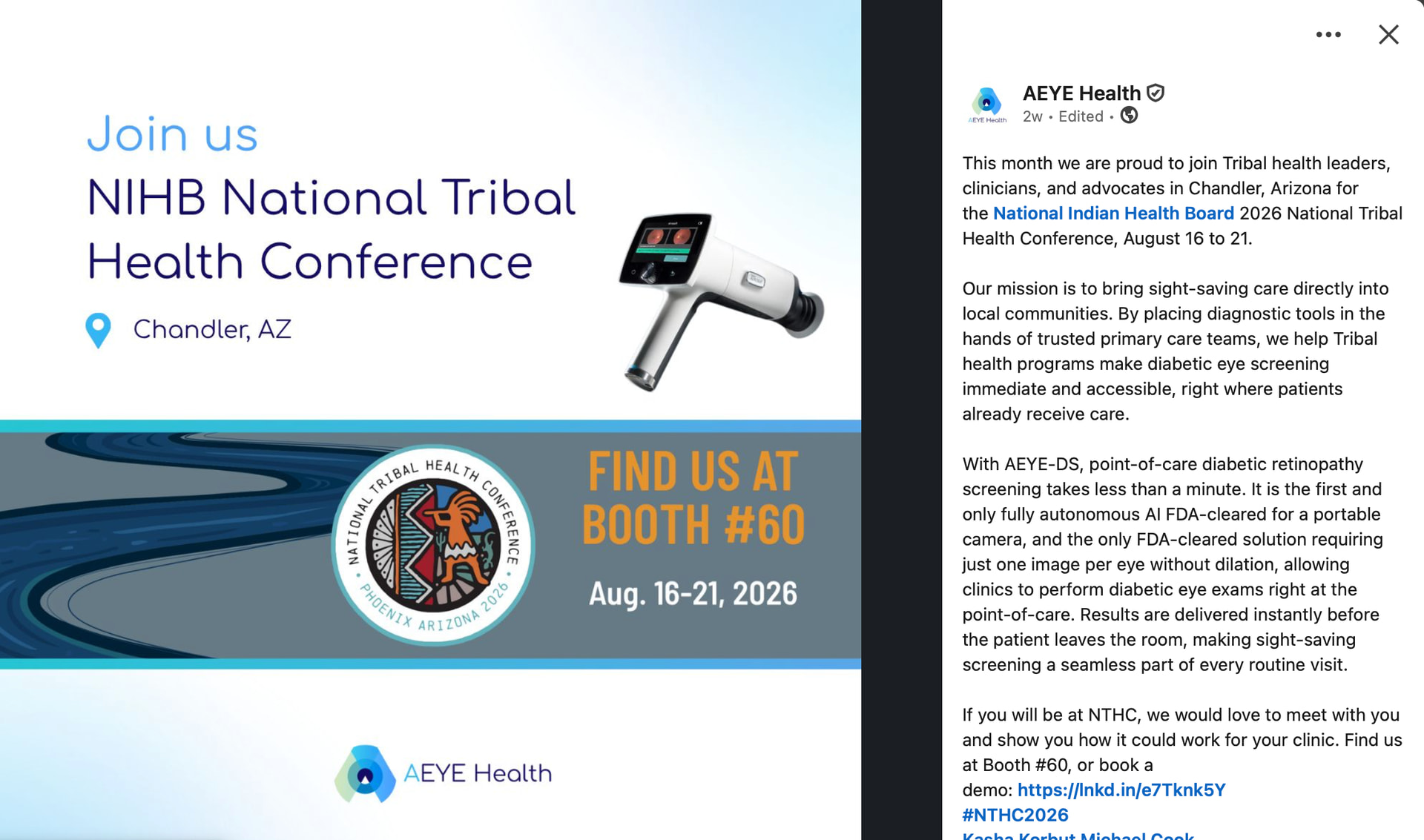
AEYE Health’s trade show appearances a couple of weeks ago were pretty spot on => seems like the target audience was at least right on the mark if we’re talking about Native American Health Centers 
12 Likes
It actually works well with the “Big Three.” This is a formal, branded joint marketing alliance => Nordic Legal represents almost all betting operators entering the Finnish market. Could this hit the nail on the head for Ubetec?
ICE Barcelona 2026, booth SG19 — “Welcome to Finland: One-stop shop for the Finnish market”
| Company | Role in the alliance | Person in photo/mentioned |
|---|---|---|
| Ubetec (Optomed) | Technical compliance, data, RG tools | Niklas Bondestam / Juuso Erixon |
| Nordic Legal | Legal: licenses, AML, regulation | Pekka Ilmivalta |
| The Finnish Gambling Consultants | Business consulting | Reijo Anttila (Partner) |
6 Likes