Olvi future outlook thread

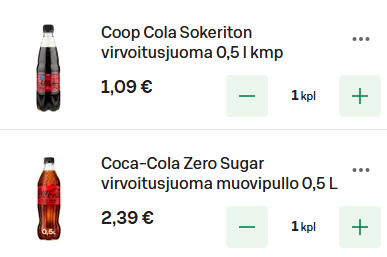
The video also mentioned Olvi’s 2.0 cola. The taste somewhat resembles Max, but it has a strange aftertaste, and even though many people like it, it doesn’t work for me.

Instead, a strong recommendation for the sugar-free COOP cola, which Olvi produces. A positive surprise, and the taste is surprisingly close to that AI Santa’s zero, a bit moderately subdued like a stock, but no, not bad at all. I recommend it! I mean COOP Cola, not the stock.

Which one would you get yourself?
image

4 Likes

Nora Hortling of Olvi Awarded for Board Work | Kauppalehti

The award certainly went to the right place! Just based on what I read in an interview and considering everything Olvi has been through in recent years. And yet, how the board has focused on new ventures and new opportunities.

11 Likes

Based on the level of discussion, Olvi might be the world’s most boring company.

On Friday and Monday, however, we got some news worth mentioning—specifically, the completion of previously announced acquisitions.

”02.01.2026 14:00

Olvi plc has completed the acquisition in which it purchases a majority stake in the shares and voting rights of the Brewery International group. The practical arrangements related to the execution of the acquisition were finalized, and the deal took legal effect on January 2, 2026.

Olvi announced on December 3, 2025, that it had agreed to acquire a 51% majority stake in Brewery International, a well-known beverage import and distribution group in Norway and Sweden. The agreement includes an option to acquire the remaining shares later. The group includes the Brewery International companies, which focus on brewery products, and the Mission Wine & Spirits companies, which focus on high-quality wines and spirits. The group employs a total of 29 people.

The parties finalized the practical arrangements related to the execution of the transaction, and the deal took legal and accounting effect on January 2, 2026.”

”05.01.2026 16:00

The competition authority of Bosnia and Herzegovina has approved the acquisition in which Olvi plc purchases all shares and voting rights of the Banjalucka Pivara company. The acquisition was completed, and the documents related to the change of ownership were submitted today to the local district court for registration.

Olvi announced on September 15, 2025, that it had agreed to acquire Bosnia and Herzegovina’s largest brewery, Banjalucka Pivara. The company is known for its strong brands and market position, and it has a solid and rapidly growing footprint in Serbia as well. Banjalucka Pivara d.o.o. was founded in 1873 and employs approximately 240 people.

The parties received approval from the competition authority and finalized all practical arrangements related to the execution of the deal. The documents related to the change of ownership were submitted for registration today, January 5, 2026, to the local district court. The transaction took legal and accounting effect on January 2, 2026.”

For me, the stock almost stealthily became the clearly largest holding in my portfolio towards the end of last year.
35 Likes

Good that you brought up Olvi’s acquisitions. This is part of Olvi’s new path, where growth is being sought from elsewhere in addition to Belarus. Olvi is the largest investment in my stock portfolio. Now, with some Buffett-style patience, things will turn out well.

14 Likes

Olvi’s challenges in Denmark, originally at Vestfyen, have continued for a long time. The deal with COOP was terminated by them, as Vestfyen has had delivery difficulties for years. There is plenty to do, and some in Denmark will miss the old Coop Cola. Andreas drank 6 liters a day. More in the article.

7 Likes

I’ve tried googling Danish discussions related to Jolly Cola. Consumer sympathy and interest in the brand seem to be high. But it is worrying that many complain about poor product availability, e.g., in the Copenhagen area. It’s great that product sales multiplied last year. But something is still wrong if the product is being marketed heavily and yet it’s some damn collector’s rarity in stores.

6 Likes

“Olvi is expanding its beverage range by launching an entirely new Olvi Long Drink product family.

In connection with the new launch, Olvi is also introducing a new event concept called Long Live, which combines music, culture, experiences, and inspiring environments into a unique ensemble. The first Long Live event will be held at Tahko on February 6–7, 2026.”

19 Likes

Judging by the share price drop, Olvi’s business comes from exports to the USA. But share prices live a life of their own and the company lives its own. Today, news was received about the completion of a previously announced acquisition:

23 Likes

OP maintained its “reduce” rating in its analysis update, but raised the target price from 30 euros to 32 euros.

Previously, OP estimated that Olvi would fall a couple of percentage points below the lower end of its old guidance. Now it predicts that the lower end of the guidance, 80 MEUR, will be reached just barely.

What is striking in the forecast changes is that at the end of October, OP predicted Olvi’s dividend paid for last year would jump to 1.6 euros, and now the forecast has dropped to 1.4 euros. Dividend forecasts for future years were also cut; e.g., for 2027, a dividend of 2 euros was still predicted back in the autumn, and now 1.6 euros. With the exception of the Brewery International acquisition, all acquisitions had already been announced before the previous update, so that doesn’t explain it either.

In my opinion, the previous dividend forecast was incomprehensible considering Olvi’s traditional dividend growth rate and the investments made. Now we are on a realistic track. But I can’t find a rational reason for the analyst’s wavering views. Then again, with analyst Kaurola, many of the figures in the analysis have been in the “ballpark” category.

6 Likes

Olvi is certainly a company one would like to follow and own, but the same problems remain as a millstone, and there might even be more now (Denmark).

The company’s operating profit excluding Belarus is clearly below 50 million and net profit somewhat below 40 million, meaning a P/E ratio somewhere between 17-19 if the “monopoly money” is considered frozen.

The Belarus results exist for accounting purposes but are not truly accessible. From a free cash flow perspective, the situation is even worse. In Belarus, investments are relatively lower, so more surplus cash accumulates there than the profit suggests.

In Denmark, they are making a 5 million loss per year, and things have gone even worse than for Anora’s Globus Wine (from a results perspective). This is a little-discussed topic and has been buried under Olvi’s profitable Baltic operations. The company’s previous success has been partly based on acquiring breweries and systematically improving them. Apparently, Denmark is a market of a different caliber than the previous Baltic expansion. Olvi has nothing to offer in Denmark when facing giants like Carlsberg and Royal Unibrew.

Olvi does have a good balance sheet and apparently intends to buy its way out of this mess, but those burdens should be fixed; otherwise, the end result is very contradictory and messy, which it has certainly been since 2022. The company has a lot of work to do with both new and old acquisitions.

11 Likes

Having tasted those terrible syrupy beers from the Danish giants, which I suppose represent their volume products, one might think otherwise. However, whether it is specifically Olvi’s subsidiary that could bring competition to volume products is another matter.

Regarding Denmark, Jolly Cola remains a great mystery to me—or more precisely, the fact that its demand is clearly exceeding supply. And that is quite a terrible situation. I wonder if the bottleneck lies with the retailers or production, the latter of which has certainly not been top-notch for the Danish company in terms of supply reliability.

OP forecasts Olvi’s operating profit to grow to EUR 91.1 million this year (the forecast for last year was thus EUR 80 million) and to EUR 97.8 million the following year. What is positive about these forecasts is the diminishing significance of Belarus. Of course, the entry into the Balkan region will surely bring more country risk.

6 Likes

Or could Olvi’s share price stagnation and decline stem from the fact that a decent slice of Olvi’s profit still comes from Lukashenko’s sphere of influence?

This is a bit like the situation with the milk packaging manufacturer Elecster here in Pirkanmaa, where “we just have to be in the Russian and Belarusian business for reason x,” even though other Finnish listed companies left 2-3 years ago.

I would say that some kind of ESG assessment should be conducted on Olvi.

3 Likes

In my comment, I was referring to price movements on individual days.

Well, they actually have to stay in Belarus for now. The last time Olvi tried to withdraw from the country, the state slapped them with a 12 million euro fine. Furthermore, legislation has been used to block any changes in ownership.

4 Likes

So they don’t have to be there. The fine and the loss on sale certainly sting, just as they did for other Finnish listed companies that sold their firms for a pittance after the slaughter began.

When referring to Belarusian legislation, surely the assessment of its legal impact can be limited to Belarus itself? Meaning, for a principled listed company, the loss of the Belarusian business brings losses according to its economic weight in its operations. But when a Western company refers to the binding nature (and rules-based nature :wink:) of Lukashenko’s or Putin’s legislation, it is then up to the investor’s moral perspective to judge it. Some cynic might say that, for example, Olvi, Tikkurila, or Elecster do not want to give up an important business, but rather want to wait and hope that the war ends and business then continues.

4 Likes

That’s how it is. I could just donate the brewery to Lukashenko. That is the only realistic alternative. The path chosen now is that the brewery is operated in the absence of realistic alternatives, and investments are limited to maintenance investments made using the brewery’s own internal financing.

8 Likes

Isn’t it time for Olvi’s owners to take responsibility and finally cut their ties to Russia for good? I was reading the Inderes thread “Russia, Ukraine and the choices of consumers and investors” and there was, for example, a principled comment regarding Teboil Finland that had received a lot of likes, quite rightly and for good reason!

“The Financial Supervisory Authority estimated to Helsingin Sanomat on Thursday that banks may freeze Teboil’s cash flow even on a fast schedule due to a sanctions decision. Finnish banks are not formally required to follow US sanctions decisions, but in practice, they must comply with them, as they could otherwise become targets of sanctions themselves.”

“Only one thing annoys or puzzles me here: Why only now?

In particular, I want to wish a h**lishly difficult entrepreneurial journey to those who became Teboil dealers after the 2022 full-scale invasion and have given misleading or mocking comments to the media regarding the Teboil boycott. Next time, it might be worth considering those business risks a little more carefully. Especially if considering franchise-style entrepreneurship with a company linked to a dictatorial state waging a war of aggression.”

2 Likes

Well, a buyer was still being sought for the Belarusian operations until the state in question blocked the sale process. Selling is not a matter of will; it is impossible and illegal. The only consequence of an attempted sale would be sanctions, not a completed deal. Accordingly, the business has been adjusted to that reality, for instance, in a way that Olvi’s Western money does not flow into investments there.

Today, I lightened my position in Olvi and added to Tokmanni. Simply because of price movements, as I did the opposite last week. And perhaps soon vice versa again. However, I’m not quite convinced about the ethics of those Chinese consumer goods either. And we are both likely typing our messages on machines assembled from Chinese components.

Fraternizing with dictatorial states indeed carries risks and problems. In the case of Olvi’s Belarus business, I see a very real risk—and for some reason, investors have almost completely ignored it—that Russian assets will be confiscated (which is right), and as a reaction, Russia’s vassal state will nationalize Western companies.

In my own calculations, I value the Belarus business at zero when considering Olvi as an investment case.

11 Likes

Above is the disclaimer :blush:.

But yes, your views regarding Olvi (and Teboil) are clear. Regarding your original comment, I am still simply of the opinion that Olvi will at some point have to make its own final reckoning/harakiri regarding its important Russian connection. I commented on your Olvi share price remark because many see the risk both financially and as moral distress. To avoid repetition, I won’t continue on this anymore.

Readers of this thread, rather invest in Nokian Panimo instead (I don’t own it, JuhaR probably still does). Good products and domestic work.

2 Likes

Olvi and its shareholders are constantly paying a price for that connection. And the benefit derived from the business there is mainly theoretical due to dividend payment restrictions. But there is nothing to pity or call unfair about that.

A highly recommendable company, especially from a consumer perspective. Reasons why I have more money tied up in Olvi than in Nokian Panimo include:

  • Nokian Panimo lacks non-alcoholic beers in its selection.
  • In Nokian Panimo’s non-alcoholic products, sugar-free options are conspicuous by their absence.
  • At Nokian Panimo, the political risk is elevated in the sense that the operating profit is largely dependent on the small brewery tax discount.

But both breweries can be found in my portfolio.

3 Likes

Personally, I don’t think at this stage of the conflict that now would be a good time to give away the Belarusian operations for free. Selling is not possible, and donating doesn’t make sense right now. They should have withdrawn from Belarus quickly right after the war started, if that’s what they wanted to do.

It doesn’t seem like there’s been any terrible reputational damage from staying in Belarus. Finns still enjoy Sandels, and there seems to be financing available for improvements to the Iisalmi factory and for acquisitions, despite all the ESG talk.

The war will end at some point, and then we’ll see what happens to the Belarusian operations. Aren’t Russian athletes slowly returning to the Olympics as well?

9 Likes