Novo Nordisk - Europe's most valuable company?

Novo has long deserved its own thread, but no one has had time to create a starter post.

In the Global Quality Companies thread, @JNivala wrote concisely about Novo

NOVO NORDISK

Novo is Denmark’s Nokia, but with the difference that Novo has better prerequisites to continue its excellent performance and thus avoid Nokia’s dismal fate. I’ll keep the message relatively short so everyone has the patience to read it.

Novo is a pharmaceutical company founded in 1923, specializing particularly in diabetes. As a doctor, this field is very close to my area of expertise. From a pharmaceutical company’s perspective, diabetes is very attractive, because even though the etiology of diabetes varies significantly, it can generally be said that it is primarily a lifestyle disease. And specifically, as people globally live “more abundant” lives, diabetes as a disease becomes more prevalent. Thus, the TAM (Total Addressable Market) is growing, and thanks to its long history and scale, Novo has clear competitive advantages specifically in the treatment portfolio for this disease. The pharmaceutical industry is a business with high barriers to entry, as it requires significant capital for product development and is also very heavily regulated in all market areas.

Novo’s focus has been quite purely on diabetes treatment, but now also on the treatment of obesity, which is on everyone’s lips. In fact, these topics are essentially related, as the effective “weight loss drugs” discussed today were primarily developed as diabetes medications. It is logical that a solution for weight management was found this way, because as I described at the beginning, the relationship between diabetes and overweight is close.
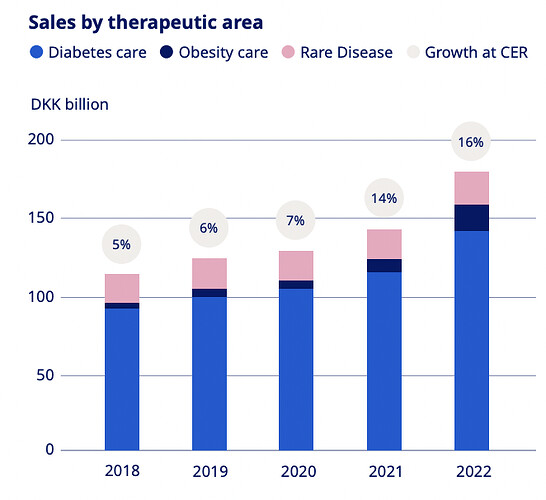
Novo’s sales distribution clearly illustrates where the money comes from:
This emphasis is clearly visible in Novo’s pipeline:
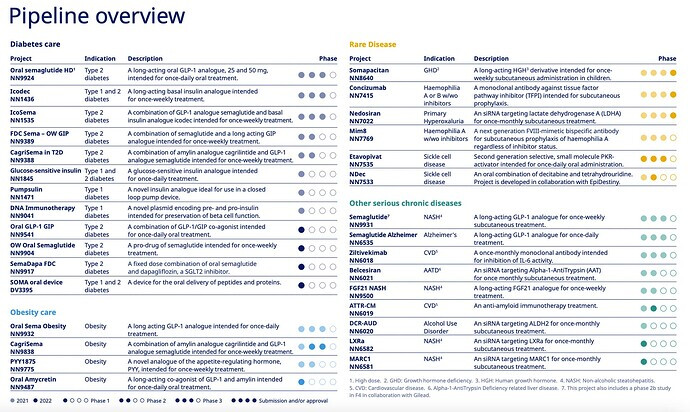
From this, it is clear that the strongest growth is now driven by obesity drugs, either for this indication or through “off-label” use.

Novo meets all criteria for a top-quality company with its historical key figures:

  • ROIC has varied greatly, but the > 15% criterion has been met effortlessly.
  • Revenue growth from 2010 - H1/2023 is approximately 8.5% p.a.
  • Net income growth from 2010 - H1/2023 is approximately 13% p.a.
  • Net profit margin is > 30%

And we have every reason to believe that things will continue, briefly here are some points:

  • High barriers to entry (regulation, capital requirements, requires specific expertise in drug development, etc.)
  • TAM continues to grow for diabetes
  • Medical treatment for obesity is only in its early stages in terms of sales volumes

The most significant threat is related to this medical treatment for obesity. As seen from the valuation multiples, the market is pricing in significant profitable growth through obesity treatments. And it is undeniably quite clear that in the coming years (e.g., 2024-2028), the company will almost certainly grow at pleasant rates in terms of both revenue and profit.

However, there is also a risk here. Although this thread is not intended to discuss valuation in more detail, it is good to understand that Novo’s market value relies heavily on the narrative of the triumph of obesity drugs. However, in the long run, there is a valid and significant threat that a clearly more effective medical treatment will be invented that displaces the current GLP1 analogues. This could, for example, be completely outside Novo’s area of expertise, or a competitor’s products could simply be better. This change in narrative would be devastating for valuation multiples, as mere excellence in diabetes treatment would not nearly justify current multiples.

Link directly to the message: Globaalit laatuyhtiöt - #43 käyttäjältä JNivala - Osakkeet - Inderes forum

The Global Quality Companies thread is worth following regarding Novo: Globaalit laatuyhtiöt - #43 käyttäjältä JNivala - Osakkeet - Inderes forum
And there has been previous discussion about Novo in the Pharmaceutical Industry thread: Lääketeollisuuden teknologisia huipputuotteita etsimässä: tasaista tylsää vai vuoristorataa? - Osakkeet - Inderes forum

41 Likes

Oh, finally a dedicated thread for the gem of the Nordics! :heart_eyes: Big thanks to @jaska7 for keeping the Novo discussion alive on the forum, even though the forum as a collective has missed this diamond!

On Twitter, a strong recommendation for @citrini7 who follows Novo and Eli Lilly with a keen eye. Link Spotify to the Odd Lots episode where Citrini, aka James van Geelen, visited. I think the episode gives a good overview of GLP-1 drugs. Citrini also published a long piece behind a paywall, discussing the impact of GLP-1 drugs on investments in other sectors. Upgrading from Overweight: The Effects of GLP-1 Drugs on the Investment Landscape

Citrini first wrote about GLP-1 in September 2022 and seems to know the industry well. But a small word of caution, as due to his great success, the guy probably has quite a strong bullish bias.

My excuse for not investing in Novo has always been the relatively high price (I looked into Novo in autumn 2020 :skull:), Novo’s dividend, and Denmark’s unpleasant withholding tax practices. In part, Novo’s profile seems similar to Nvidia’s: it always looks expensive, yet it keeps conjuring up new products that cause hype and justify a high valuation. Nowadays, Denmark seems to handle withholding taxes a bit more humanely. Näin haet tanskalaisten osakkeiden osingon lähdeveron takaisin
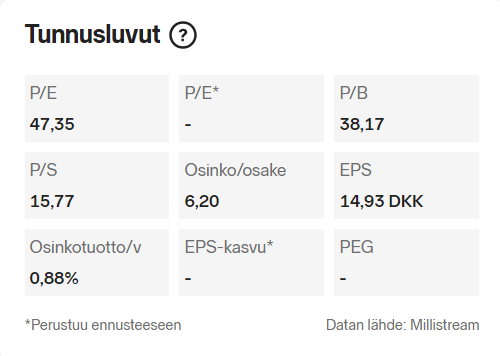
Key figures from Nordnet:


It looks expensive, but what will the future growth be?

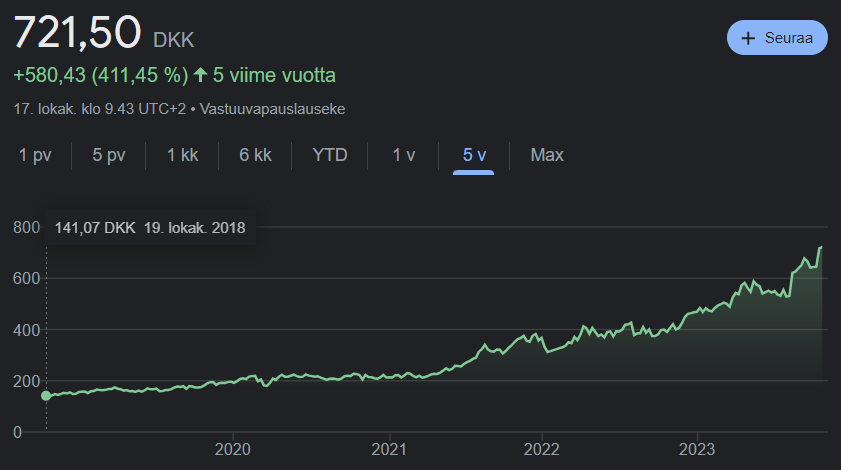
5-year return (CAGR 38.6%):

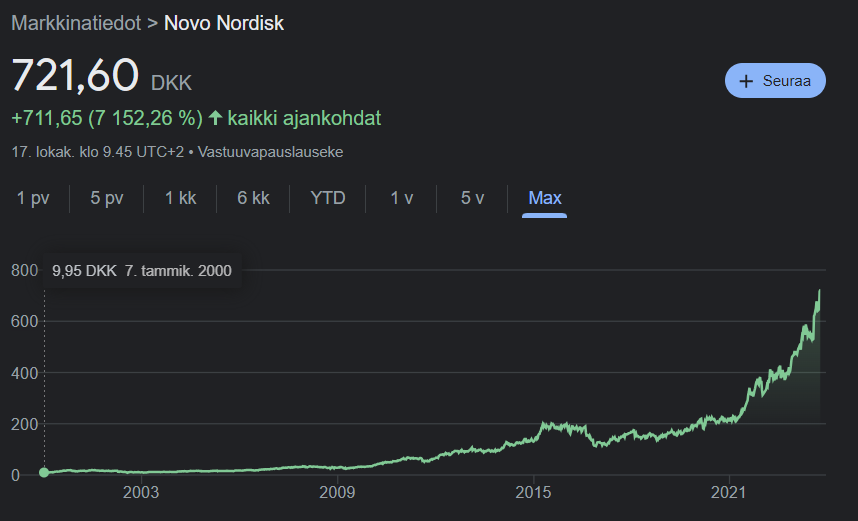
Since the IPO in 2000 (CAGR 20.5%):

6 Likes

Thanks for the interesting opening! I have also been interested in Novo Nordisk lately and have tried to study it, but so far I haven’t managed to convince myself to own the company. The fundamental reason relates specifically to this quote:

Novo Nordisk’s valuation is currently entirely dependent on one card, namely Ozempic/Wegovy. Of course, I understand that the company has other very profitable business, but the current stock valuation seems to be built on the growth of obesity drugs. This is fine in itself if this one product is on stable ground in the long term. When making an investment decision, I would want to be very sure about this, but I’m not quite convinced yet.

The first reason for my uncertainty was already touched upon in the original message.

Unfortunately, there is no significant improvement in sight in the pipeline (see image above). But if we look at the pipeline of the main competitor, Eli Lilly, it looks completely different. There, tirzepatide is just coming onto the market, which is a dual agonist and, based on good evidence, a MORE EFFECTIVE weight loss drug than semaglutide alone (at least among those with diabetes). Additionally, Lilly has retatrutide in its development pipeline, which is a triple agonist, and its preliminary evidence is much better, even close to the effectiveness of bariatric surgery. Of course, it will take years for this to reach the marketing phase, but Eli Lilly is certainly much better positioned specifically in the medical treatment of obesity.

So Eli Lilly clearly has a more promising pipeline for future new obesity drugs; this was already well-addressed. This is concerning in itself, but it might not even be enough right now. Currently, almost every pharmaceutical company is pushing into the same markets. What if the next generation’s hit drug is Altimmune’s pemvidutide?

https://altimmune.com/pemvidutide/

Or Innovent Biologics’ mazdutide?

Or Boehringer Ingelheim’s survodutide?

https://diatribe.org/survodutide-shows-promising-weight-loss-and-cardiometabolic-benefits

Or Pfizer’s danuglipron?

https://www.pfizer.com/news/press-release/press-release-detail/pfizer-provides-update-glp-1-ra-clinical-development

Or even Shionogi’s MGAT2 inhibitor S-309309? There are currently an insane number of candidates in the pipelines of various companies.

https://www.medgadget.com/2023/06/obesity-clinical-trial-pipeline-insights-100-key-companies-investigating-their-lead-candidates-to-improve-the-treatment-space.html

I personally cannot see who will ultimately be strong in this battle in the long run. Novo Nordisk and Eli Lilly have the advantage of being first to market, and they will likely dominate it initially. But how long will that advantage last? This is, of course, the nature of the entire industry, but that’s exactly why I personally prefer pharmaceutical companies whose valuation is based on a slightly broader range of drugs.

The second reason relates to the protection of Wegovy’s IP. Understandably, Novo Nordisk’s patents are currently being challenged on many continents and from many different directions. Take this latest challenge as an example.

https://www.reuters.com/legal/litigation/us-patent-office-will-review-novo-nordisk-patent-related-wegovy-ozempic-2023-10-04/

Is the patent protection strong enough to withstand all attacks? I personally cannot grasp this well enough. The risk here is that if the protection fails, it opens the door for biosimilar manufacturers to bring their own products to market. If this happens, the stock valuation will drop very quickly.

It would be nice to hear @JNivala’s thoughts regarding these challenges. I’m not a doctor myself, so it’s very possible I’ve overlooked some things.

17 Likes

I can comment as another doctor. I treat diabetes and obesity, so I follow these medications quite actively.

I completely agree with the comment above. The market is so attractive and MANY competitors are coming.
Of course, the first to market gains a “Viagra” status that carries for years, but in the long run, I don’t find it likely that Novo will maintain its position.

In many drug classes, studies have found that medications arriving later to the market are at least marginally more effective products, which then rise to become the first-line recommendations.

And it already appears that Lilly’s upcoming products are more effective and thus the primary choices for treating obesity (and likely diabetes as well).

17 Likes

First of all thank you all for your contribution to this thread on what I view is the best company in the Nordics (since 2014 Novo has averaged ca 74 percent Return on Equity)

(full disclosure: followed Novo since 2013 and a shareholder as of 2016, which may partially explain my bullishness on Novo).

My point with this commentary is not as much as on the current hype surrounding Novo and Glp-1, which you all have covered well. It a big future market and everyone wants in. But its a hype, and Novo and Eli Lilly will milk the market as long as they can and make tons of money, especially in the US, where patients (or insurers) pay upwards to 15000-17000 usd per year. A testament of this hype is that Bloomberg has almost daily an article on this subject. Bloomberg rarely covers the Nordic companies.

My point is rather to point out my rationale for why I believe Novo and Eli Lilly will in the long - term be winners (they are already dominating the insulin market, and currently the glp-1 market) in the pharma market.

The main reason is their ownership structure. Both companies have as their biggest owner a non-profit agent or foundation. These provide stability and longevity for upper management to pursue new drug development on a difficult scale. This not a luxury other big pharmaceutical companies have, as they are more so at the mercy of the market and quarterly reporting.

For example: The multi-year trials conducted by Novo on e.g glp-1 are
rather rare, and their extensiveness covers more than governmental requirements costing Novo millions. Novo of course is pursued by monetary incentives here:

  1. To prove their product is more “safe” than their competitors and

  2. they are cynical in the way that they are trying to get governments around the world to classify both diabetes and obesity as “kansantauti” so that society will actually pay for these.

As a result even if (or when) Novo looses its leading role in the glp-1 market long-term shareholder can enjoy the financial quality leadership of this company. Since 2014 Novo has bought back annually 1,5- 2 percent of the outstanding shares. Pre-split (in aug/sept) Novo had bought back almost 14 percent of all the shares (2014-2022). This is especially rewarding for non-Danes and the dividend tax policy of the tax authorities in Denmark.

Regardless of what happens with Novos position in the Glp-1 market I view that the future is rather bright (but I am not buying at these levels). People are living more unhealthy and its a growing market. Almost 40 percent of all adults in the world is overweight and Goldman expects the market in 2030 to hit 100 billion.

Edit: Novo also has a strategy to buy small pharma companies as an add on to current developments in the sector of their choice. The have also been rather active buying up small add ons the last years. From a investor perspective I really like this approach rather than big acquisitions where the seller usually knows more than the buyer and ending up overpaying in the long run.

15 Likes

I feel like the following is on the mind of an enthusiast regarding Novo Nordisk:

Does a pharmaceutical company’s home country affect its popularity in drug sales, for example, in the USA? In other words, are drugs from a US company more sought after, or is their procurement favored by the government?

I would be grateful for an answer.

I don’t really believe that this has much significance. I’m sure that in the States, these decisions are made based on data and availability. Insurers play a central role here. However, I believe that all the larger pharmaceutical companies have major teams in place to manage relationships with insurers. As a recent example, one could mention how GSK and Pfizer started selling their respective RSV vaccines at almost the same time this year. GSK is currently projected to get an even larger slice of this pie.

And even if this did matter, an increasingly large part of Wegovy’s production seems to be in the USA. Catalent’s Brussels plant messed up a few too many times, and production has now been started at Thermo Fisher’s Greenville plant in North Carolina.

https://www.fiercepharma.com/manufacturing/novo-nordisk-contracts-thermo-fisher-make-wegovy-amid-catalent-woes-reuters

4 Likes

Hi!

Thanks for your reply, there were some points worth considering here. I’ve been pondering rebalancing my portfolio, as Novo has ballooned within it. I just can’t bring myself to sell Novo.

Thanks for sharing your point of view too! In general I agree with you that Novo Nordisk has a fantastic track record of being a well-managed, high quality company. Of course I would love to be able to say I bought shares ten years ago, but I didn’t and there’s not much I can do about that now. So the only decision I have to take is whether I should buy them now, at the present valuation. That’s what I was discussing from my own point of view above. No investment advice, obviously, everyone should make their own calls. Just trying to lay out my own thoughts.

Even if I mostly agree with you, just for the sake of the discussion, I’m going to take a bit of a contrarian view here. I’ll argue that the opportunities to buy a high quality company on the cheap are now behind us and not coming back.

Yes, in the next couple of years Novo Nordisk is going to make a massive amount of dough before the competitors catch up. As long as they get their manufacturing up to speed. This seems to be already reflected in the company’s valuation multiples, so at the current valuation you’re already paying for the near-future success. But what is it going to do with all that money? They have a couple of options for capital allocation.

  • Extraordinary dividends. Unloading the cash would be of course nice for shareholders, but this is rarely the path companies choose.

  • Share repurchases. Would this really be beneficial for shareholders at the current valuation? This we will be able to judge in 5 years from now, but at the moment I have my doubts.

  • Investing back into existing business. Does Novo Nordisk really have unlimited investment opportunities within its own business with returns in the excess of 15%, as outlined earlier? To the scale that they can pour in billions and billions of extra Wegovy cash and always continue to get >15% return for it? If so, I would be pissed if I was a shareholder and they had been paying me a dividend instead for all these years. But I doubt they have such opportunities. Their obesity pipeline, as discussed above, seems to be a testament to this.

  • M&A. This seems to be the preferred way of capital allocation. Even if the market for this has gotten a lot more favourable in the last year, here it is even harder to find deals at the returns the company has shown to be able to achieve in the past (and which has been apparently set here as a criterion for a high quality business). They will end up blowing up their balance sheet with goodwill from these acquisitions like the rest of the pharma sector has done and ROIC will take a downturn.

I do realise that this is a positive problem for the company. I am simply pointing out that if M&A or investing all the excess cash (future excess cash that you pay for already when you buy the shares today) back into existing business is the way to go, I would be very hesitant to project the kind of ROIC we are used to seeing into the future. Therefore, the end market will grow and Novo Nordisk will continue to be successful in addressing it, but it may not fulfil the criteria for a high quality business for so far into the future anymore.

I don’t really follow your argumentation here. In the case of Novo Nordisk the ownership of the non-profit appears to be something below 30%, for Eli Lilly even in the 10% range. Are you saying that as a result the management gets more freedom to take on riskier high-cost projects in R&D? And spend more on clinical trials where it was not necessarily needed, just in case? To me, this simply increases the risk level of the investment to the rest of the shareholders, which should be reflected in your discount rate. Sometimes the risks pay off, like in the case of GLP-1 and sometimes then not. I don’t see the benefit to the rest of the shareholders, except in that a potential hostile takeover is going to be very unlikely to succeed. I must have missed something.

8 Likes

Would it be appropriate to write in Finnish, since we are in Finland and you also know the language?

1 Like

Thanks for the input. And I cannot argue with your valid points as such.

But let me attempt to outline some investment thoughts I follow with regard to Novo. I am not as such a numbers guy, but rather I try to understand the operating and operational context in a specific sector and choose what I view are the winners in that sector. I look at corporate governance, and try to get a feel for the sector, such as barriers to entry, governmental oversight etc.

One key element in terms of selecting “winners” is their ability to maintain a high RoE. And Novo has been able to perform above their peers for years. And as consequence Novo has never been cheap and probably wont be either. But can they maintain that high RoE into the future? My “guess” is as good or bad as anyone else.

A key component of Novo success I would argue is the Novo Nordisk Foundation and how it operates. If I remember correctly Novo has two share classes, one that is traded and then the Foundation shares which has more votes by share giving the Foundation more or less complete control (even though they own below 30 percent). That is one of the main reasons Novo cannot be taken over by a competitor.

My point with Novo Foundation is that provides Novo mgm with stability. Novo upper mgm has low turnover and there are internal promotions only (usually). That creates what I view a competitive advantage in relation to peers. And its creates a culture for a long term view in the pursuit of new products. It also sets the parameters for how money is invested or spent. I think the most likely form of capital return is share buy backs regardless of where the share is trading at. Bigger M&A unlikely. They will continue the path they have been on for decades. (Novo had had some successful spin offs as well, e.g. Novozymes).

Also, the Novo Foundation is by far the biggest donor of money to anything pharma related in Denmark. They give money to start ups, universities, and other actors with the aim to find the next “golden egg” in Denmark (which may or may not be beneficial for Novo.)

This also has a political component attached. Novo Foundation creates so much goodwill in Denmark that there are no political attention or attacks of how much Novo is earning (compare this with banks)

The drawback with this model is that very few in Denmark has the courage to criticize Novo of how it operates and it selection where its focus is on. It has more or less all bets on diabetes and obesity although it tries to broaden its focus to other sectors as well.

Well this focus has served Novo well so far, and I continue to believe that will also serve well in the future given that people are getting more fat and Novo and Eli dominates the diabetes market (the third player, Sanofi, gave more or less up in developing new insulin). That in it self is a money maker machine as Novo has ca 1/3 of the insulin global market. The obesity market as add on and a bonus.

The biggest threat and challenge is a political one, and then I refer to US. Democrats will do almost anything to lower the prices in the Usa on insulin and in the long term also the glp-1 market (or there will be more of a competitive landscape here in 2-3 years). And finally there are also challenges in China, especially on patent protection.

But all in all I think Novo will continue to be one of the innovators in the insulin ans glp-1 market given the duopoly of Eli and Novo. I am not worried by new competition in the glp-1 market. This is just normal capitalism behavior.

9 Likes

Sorry for writing in English but me writing in Finnish would take to long for me even to consider it. Finnish is my third language.

22 Likes

Eli Lilly’s “Novo Nordisk killer” Mounjaro is a perfectly valid point from a competitive perspective, as it has proven more effective in trials than Novo’s Ozempic.

Roughly half of Novo’s revenue comes from GLP-1 analogs; most of these (over 80%) are Ozempic, with the remainder being Rybelsus and Victoza. Victoza sales are declining as they are being replaced by oral medications or once-weekly injectables. Rybelsus has received a boost due to Ozempic shortages, although Rybelsus has also suffered from supply issues.

About 17% of Novo’s revenue comes from “obesity drugs,” namely Saxenda and Wegovy. In practice, however, these are very much the same thing, as Saxenda and Victoza are one and the same drug, but from a reimbursement perspective, one is indicated for diabetes and the other for weight management. At least in Finland, you cannot get “cross-reimbursement” for these; if one is experiencing a shortage, you won’t get the other brand name covered by insurance.

Approximately 20% of Novo’s revenue comes from insulins. I don’t expect the insulin market to grow very rapidly; it’s more of a “stable core business.” The rest of the revenue comes from rare disease medications. There may be potential there, but their revenue hasn’t grown much; the growth engine, as I see it, is specifically GLP-1 and non-insulin treatments for diabetes and obesity.

The market focused on weight management is only at the beginning of its growth. I don’t believe Novo will lose revenue in absolute terms, even if a competitor’s drug is superior. Naturally, new and better drugs will take their share and capture more of the new patient starts. I don’t believe that in the coming years, for instance, patients would actively switch from Ozempic to Mounjaro or another drug if the medication has worked as desired. I wouldn’t panic over this (I have owned Novo practically continuously since 2008), but I would also consider whether Eli Lilly might be a good investment at its current price. I already considered it expensive “50% ago,” but it has just kept chugging higher and higher.

It is quite true that Eli Lilly’s pipeline looks more promising than the drugs currently in Novo’s pipeline. Generally, I believe that market shares shift slowly, and if it starts to look like Novo is permanently losing ground, I would reconsider my position. The situation certainly requires active monitoring, and one cannot rest on the laurels of past success.

12 Likes

Thank you, it’s nice to have a dedicated thread for this quality company. On board since 2012 and still staying the course. There is no significant reason to sell a well-managed gem operating at such a level of profitability.

1 Like

Here is Antti Leinonen’s piece on weight loss drugs from an investor’s perspective; it only takes a few minutes to read. The article naturally mentions Ozempic and Novo Nordisk. :slight_smile:

The article contains plenty of points that aren’t necessarily directly related to Novo Nordisk, but there might be some content that could interest the readers of this thread.

There are a few factors limiting the widespread use of weight loss drugs. Both Ozempic and Mounjaro cause significant side effects, at least for now, and because of them, the medication may not be suitable for everyone suffering from overweight. Drug prices are also reported to be high. In the United States, monthly costs are in the range of a thousand dollars for both drugs.

Article subheadings:

  1. Miracle drug from Denmark
  2. The drug could slim down the results of consumer product manufacturers
  3. Stocks lightened by the weight loss drug
3 Likes


https://ml-eu.globenewswire.com/Resource/Download/45fa8d52-86a0-406b-979d-5fea553b821a

3 Likes

A few news items from recent weeks regarding obesity treatments and, consequently, Novo Nordisk.

Eli Lilly’s Zepbound (the same active ingredient as Mounjaro, used for treating diabetes) was approved in the US for the treatment of obesity. As I understand it, this is Lilly’s first approval for obesity treatment, and it will surely take some market share from Wegovy, which is struggling with availability issues.

https://www.cnbc.com/2023/11/08/fda-approves-eli-lilly-drug-tirzepatide-for-obesity.html

At the same time, AstraZeneca entered the race by purchasing the rights to Chinese Eccogene’s oral GLP-1 candidate.

https://www.fiercebiotech.com/biotech/astrazeneca-ceo-long-term-glp-1-play-weight-management-not-obesity

AstraZeneca CEO Pascal Soriot had an interesting perspective on the market’s direction. The drugs currently on the market reduce not only fat but also muscle mass, and Soriot is steering AstraZeneca toward this niche.

A day after AstraZeneca inked a new $185 million licensing deal to reenter the GLP-1 frenzy, CEO Pascal Soriot says the future marketplace will center less on treating obesity and more on sustained weight management.

“One of the key pieces for us is to have an agent that will target those people and help them lose a bit of weight,” he said at a press briefing Friday.

Though leaders like Eli Lilly and Novo Nordisk have shown that their injectable options can help patients lose north of 20% of their body weight, Soriot doesn’t think that’s really what most patients will need. Instead, GLP-1s will be used most by patients who want to lose somewhere between 5-10%, be it for cosmetic reasons, to prevent future metabolic issues or both. He said future generations of the class are likely to be oral small molecules that are part of a combination treatment to limit muscle loss.

8 Likes

The company is investing 2.1 billion in its French production facility. No paywall.

The expansion will double the size of the production facility. The construction project has started and will be completed in stages between 2026–2028. The investment is expected to create over 500 new jobs, and 2,000 new jobs during the construction phase.

7 Likes

Following up on the previous point, now Roche has also entered the game with a small 2.7 billion investment.

https://www.fiercebiotech.com/biotech/roche-inks-27b-carmot-buyout-muscle-obesity-market-securing-injectable-and-oral-assets

The comments are along the same lines as those from AstraZeneca’s CEO above. Competition in this sector is going to be really tough.

As Schinecker explained, Roche is studying the potential for its anti-myostatin antibody to strengthen the muscles of people with spinal muscular atrophy (SMA). While SMA was the focus at that time, the Roche CEO acknowledged how ownership of a drug that could support muscle development was shaping the company’s thinking about the obesity opportunity.

“The GLP-1s and the GLP-1/GIP incretins have one big problem. And this problem is muscle loss. So it’s an option that we are looking at how this antibody can play a role there in the future,” Schinecker said.

5 Likes

Bloomberg had an interesting article today on Zealand Pharma (mid sized pharma company located in Denmark) whose share has even outperformed Novo share this year.

This company may be worthwhile to keep an eye on as it has somewhat a different take on the obesity sector than e.g. Novo. Zealand re-focused its company in 2020 to entirely focus on obesity. And many of its employees are former Novo employees.

It has four different candidates in the pipeline targeting obesity. Below is a link to one.

5 Likes