Nokian Panimo - on a mission to make thirst a pleasure

Just for fun, I thought I’d put together a summary of Nokian Panimo (Nokia Brewery) based on what I’ve read from their site and also here. I was just going to do it for myself, but then I shared it here to bother others. It also includes thoughts from discussions I’ve had and my own amusing conclusions. :slight_smile:

The company has grown steadily and surely, as @Omavaraisuushaaste pointed out in their “IPO” text. They also highlighted how the company almost went bankrupt like many other small breweries, although it survived. Of course, it’s important to remember that a lot of time has passed since then, and the company as a whole has grown and changed significantly.

It’s a highly competitive industry, but it has risen to a relatively significant and stable position. An optimist would think it’s big enough, but not too big to be agile. An optimist might continue by saying that the company, with its selection, isn’t too bulk, but also not too sophisticated – not even in terms of prices, meaning it’s in just the right position.

The excise tax has sparked a lot of thoughts here and there, and it only applies to beer, which is the company’s main product. Quoted from Evli’s report (March/2025):

Loss of tax relief is not a concern for Nokian Panimo at the moment

In 2024, Nokian Panimo received an alcohol tax benefit of approximately 2.2 million euros. The tax system is structured so that if beer production reaches 15.0 million liters, the company would lose this benefit entirely – which would result in a loss of a 3.3 million euro tax deduction. In 2024, production was approximately 6.1 million liters, so beer production would need to grow 2.5 times to reach this limit. Thus, we see the loss of tax benefit as a distant concern, as this production volume is, in our opinion, far on the horizon. Additionally, the production of other beverages can be expanded, so overall growth is not solely dependent on beer production. The company itself has stated its intention to remain a small brewery, meaning the goal is not currently to exceed 15.0 million liters of beer production.

There has also been discussion about the company’s ownership, and I don’t have anything particularly special to say. It has been quiet in both directions (Inderes insider trading “table” (premium only):


Reading the messages in this thread, and the articles and analyses found via links, it seems that, broadly speaking, there’s a consensus on the company’s pros and cons, as well as its threats and opportunities. Of course, there are also more clearly differing views one way or another.

What interests me about the company is that it feels like it’s just the right size – big enough and agile enough. I imagine the company has positioned itself correctly, meaning it doesn’t offer overly bulk products nor overly fancy expensive drinks. In my imagination, the company is also capable of making and experimenting with suitable products to succeed in the future.

The company is familiar to many, and certainly mostly in a good way thanks to its products. It doesn’t really have to compete on bulk, and my feeling is that, if managed sensibly as a large enough entity, it will be able to operate more economically efficiently than its smaller competitors in the future (plus, currently, the company has good resources to implement all sorts of things). I also point out that the selection includes slightly better “store volume drinks,” as well as sufficiently good quality indulgence drinks for people like me without being too expensive, and then those “Ferraris/Lambos” for those with better taste & for brand elevation.

Beer sales have only risen slightly recently, but other beverages (like soft drinks) have risen significantly. It’s interesting to see what new products will bring and the efforts to enter new categories, as well as how the company’s healthy cash reserves will be used in the future.


There are many good messages and links to good articles and analyses in this thread. Perhaps among the individual linked “articles/analyses,” @JHeiskanen’s relatively recent article about the company stands out:


I’ve been researching the company for fun, and these texts + compilations are made for myself, but I thought I’d share them here too. Any possible errors are either my misunderstandings or my own conclusions – then again, the smartest thoughts are mostly compiled from here and there.

There has been talk about figures here, both key ratios and valuation multiples, but if someone is willing to delve into them more here for everyone’s enjoyment – along with future scenarios – that would be pleasant. I won’t share my own, as they almost always have had “interesting bits” and/or clear errors. :sweat_smile:

9 Likes

Laitila is changing its CEO for a change:

From the perspective of Nokian Panimo, it is interesting that Laitila is more reserved in its comments regarding a potential stock market listing. This means the number of breweries on the stock exchange is unlikely to increase anytime soon.

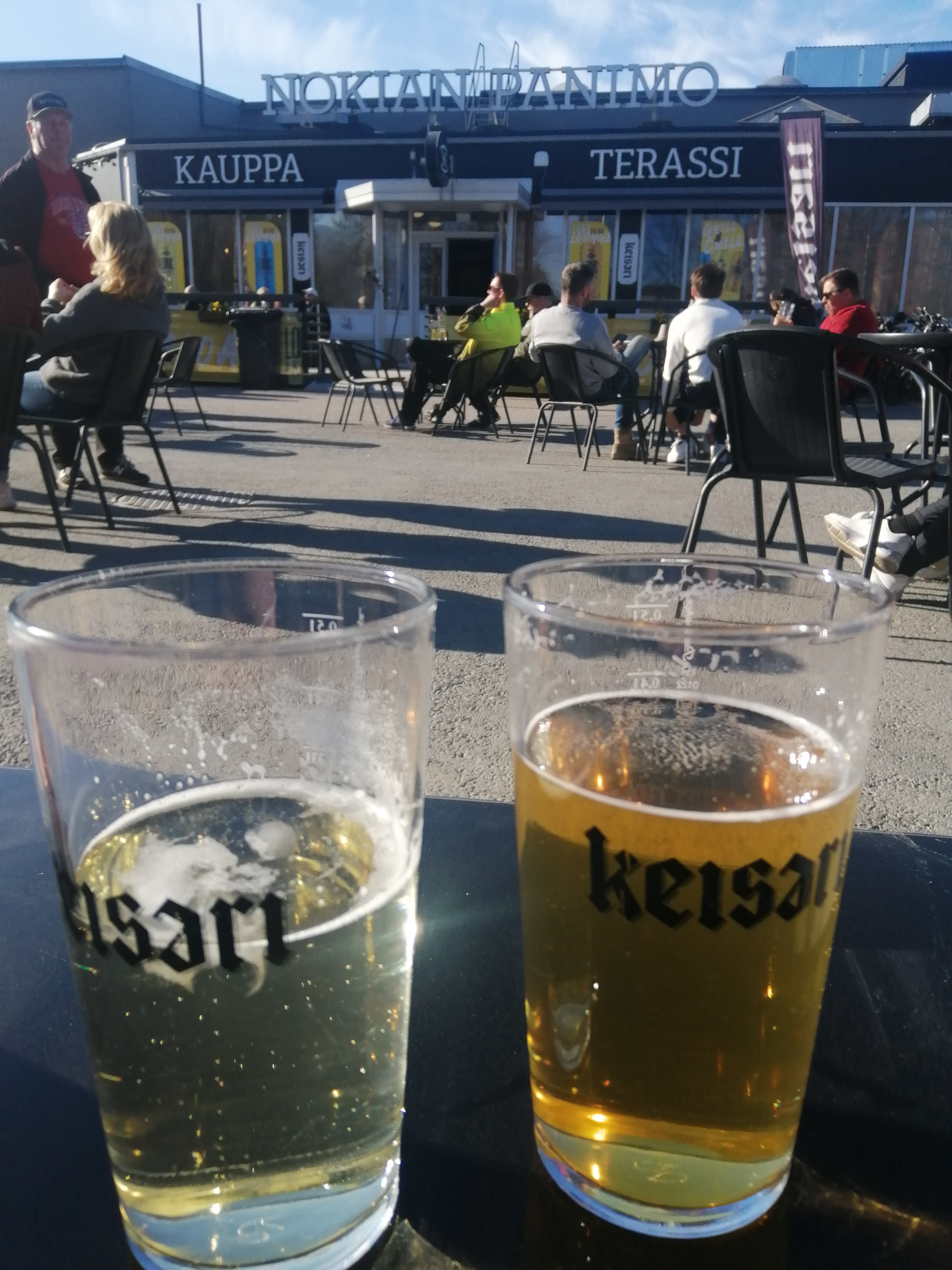
P.S. Yesterday I stopped by the Keisari shop to pick up the best shareholder discounts.

14 Likes

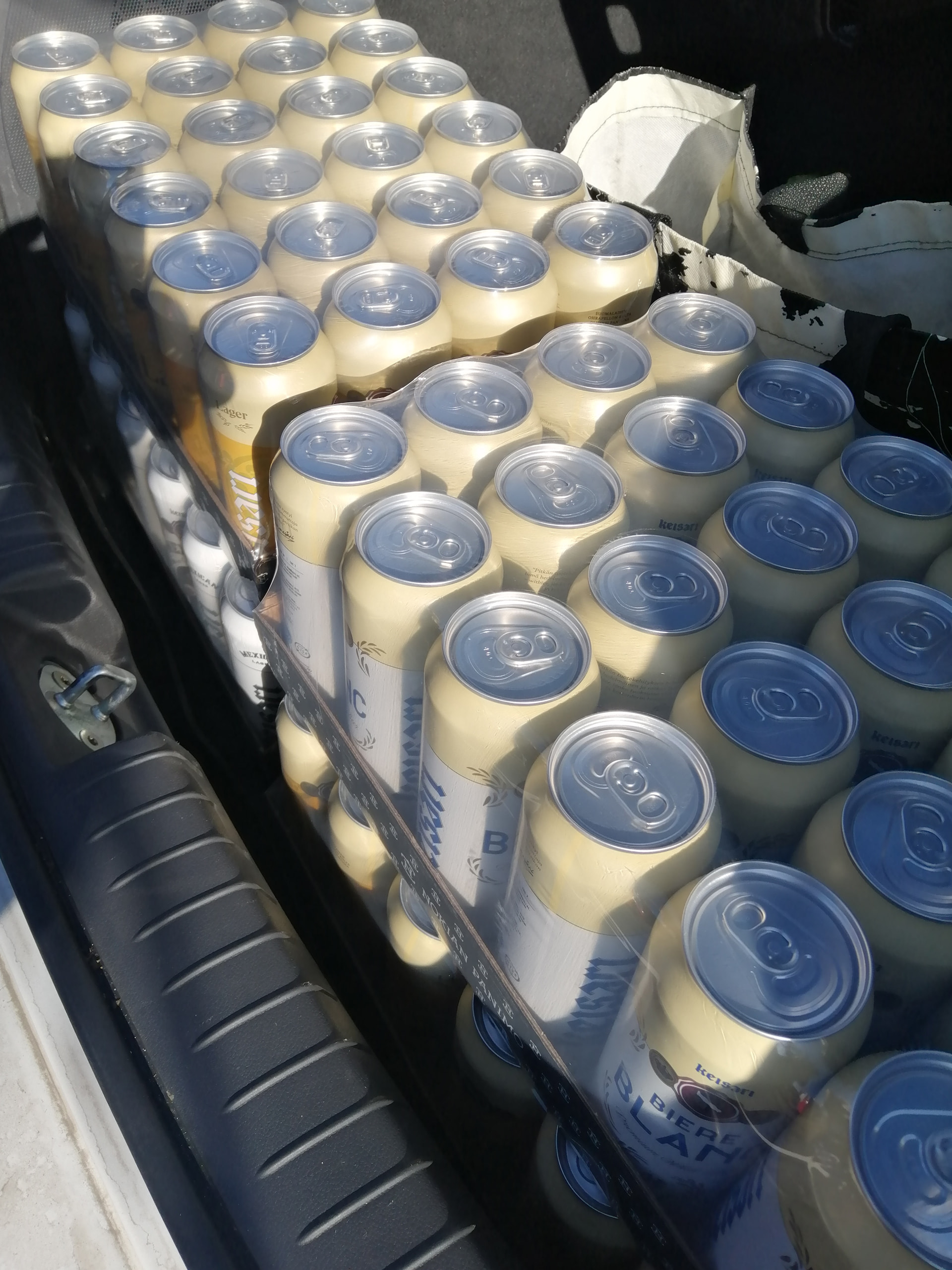
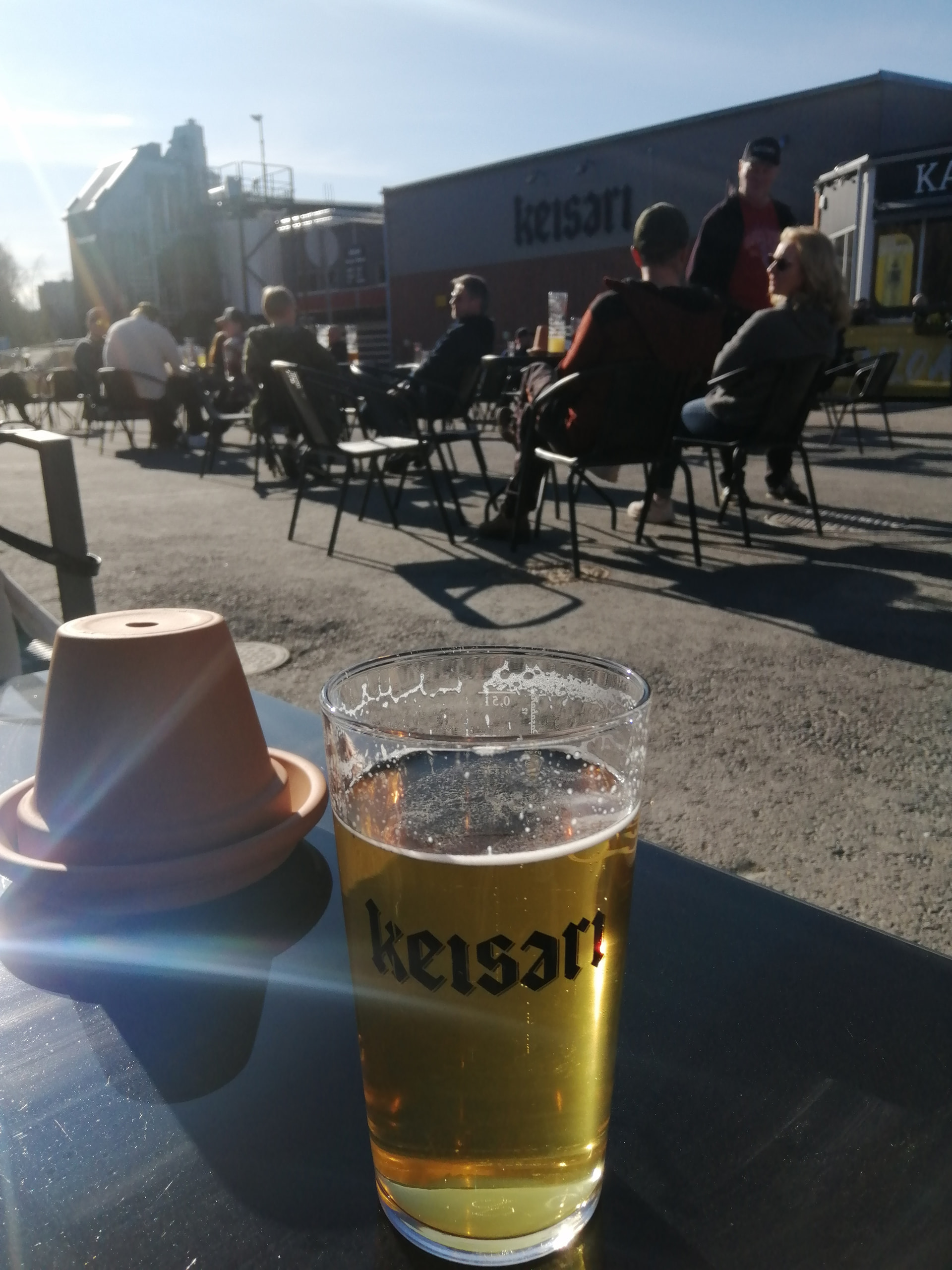
There were plenty of people on the terrace throughout the evening, and some discounted beers to go in the trunk.

9 Likes

I stopped by the same place for the same reasons earlier today. I wonder if the upcoming Grill & Chill has now been expanded behind that new logistics center as well. There wouldn’t be enough space otherwise.

And to include at least a shred of investment-related matter, why is it that all of Nokian Panimo’s alcoholic products are in half-liter cans? It might be a logistics and/or cost issue, but for my taste, smaller cans would work better. I could have certainly asked this at the annual general meeting as well. :grin:

3 Likes

Matter of opinion. In my view, the half-liter beer can works better as a product sold individually. Multi-packs are a different story. And a significant portion of specialty beers in stores are in larger cans or bottles anyway.

One more observation, regarding how the can itself represents a significant cost item in the overall total. One would imagine that, when allocated per liter, a larger can is a significantly more cost-effective option.

10 Likes

Let’s keep the thread alive. In three weeks, on May 13th, a sales review will be published. In connection with this, the brewery will report on first-quarter volume development and provide information on market trends, but no financial figures.

Nokian Panimo’s new beers, Keisari Biere Blanc and Keisari Hinode, went on sale on February 2nd. Off the top of my head, the company mentioned during the earnings release at the end of February that the drinks were available in about 400 stores, but that retail coverage would expand significantly by Easter. Discussions at the Annual General Meeting indicated that the products have been well-received. One could assume those product launches have a reasonable impact on Q1 sales.

On March 10th, ten new products were launched in the categories of water, soft drinks, mocktails, long drinks, and ciders. There is no information regarding the growth rate of the number of points of sale for these.

Something that has received less attention is that Keisari lager is on a sales campaign in the S Group from March 4th to May 2nd and is very prominently displayed in stores, at least in the Pirkanmaa region. And the stock is moving. I would assume this has the biggest impact on the quarter’s liter sales development.

I noticed last week already that Evli’s page lists a target price of 3.0 euros for the stock: https://www.evli.com/en/products-and-services/equity-research/companies/nokian-panimo However, in the latest published report, the target price is 2.6 euros, and I can’t think of anything else that would have caused such a jump in a month, so apparently they’ve just made a slip-up while updating the website.

Since analysts estimate their target prices by looking at the valuation levels of peers, it’s interesting to see how Royal Unibrew’s total share price drop of about 30% seen today and yesterday reflects on the target prices of domestic breweries. On the other hand, before the correction, Royal was a company valued at quite high valuation multiples compared to its peers.

8 Likes

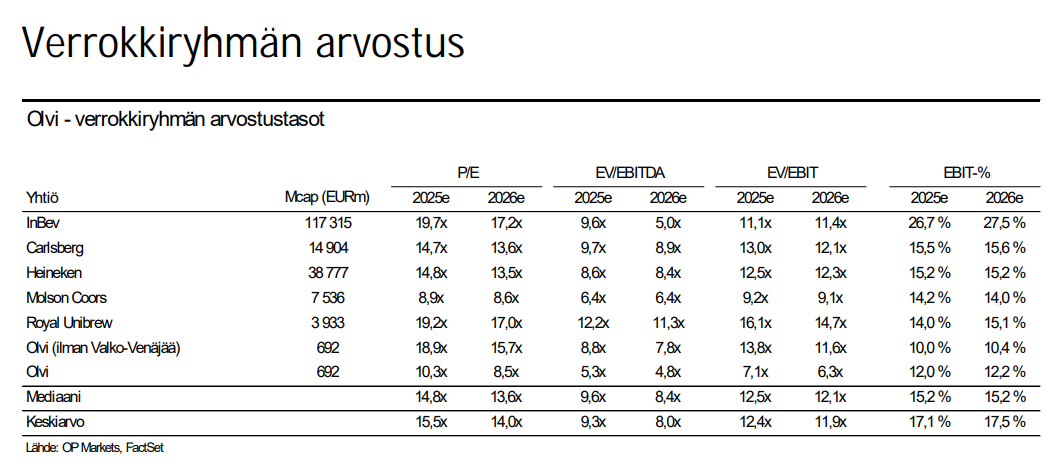
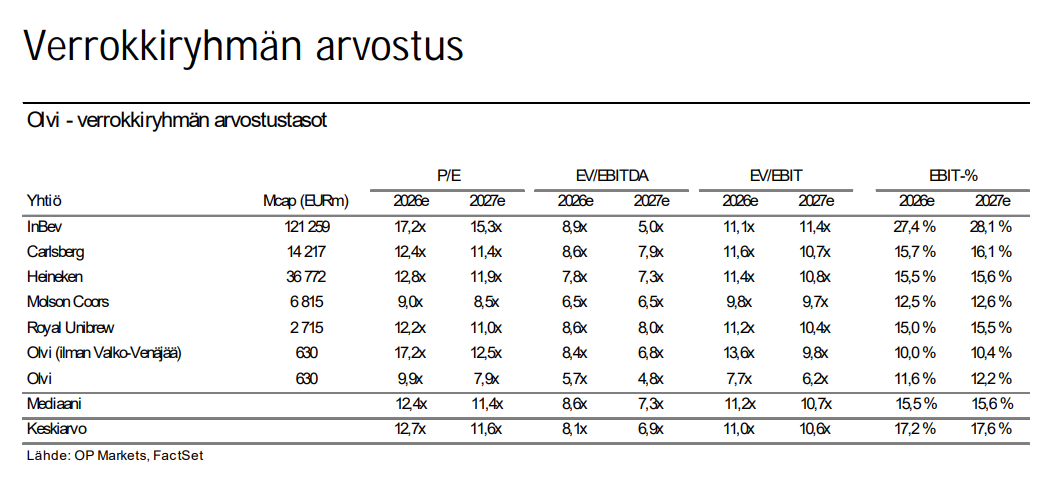
I’ll return to the valuation levels of peers through the peer group tables found in OP’s Olvi analyses:

In January of the current year (Olvi’s earnings preview Feb 2, 2026):

Current figures (Olvi’s earnings comment April 27, 2026)

Quite a significant decline. Even if the reasons for Royal Unibrew’s decline are not yet reflected in the 2026–2027 earnings forecasts.

In Evli’s forecasts, Nokian Panimo’s P/E for the current year is a steep 20, and 17.1 for next year. EV/EBITDA is 8.5 and 7.4. EV/EBIT 12.8 and 11.5.

5 Likes

Well, this might not fit perfectly into this thread, but there was something in this podcast that might interest investors following this thread; the kind of “nice-to-know stuff” that you can also manage without. :slight_smile:

The more of a product is produced, the cheaper that individual product becomes – we’re talking about economies of scale. How is it possible that small breweries still survive? Their market share is 6–8 percent of beer sales, depending on the calculation method. Brewery history in Finland has been a history of numerous regulations and provisions. EU membership enabled free competition and a boom in founding small breweries began. Initially, brewery shops were not allowed to sell only beer; they also had to have groceries on the shelves. Sales and delivery to the buyer’s doorstep are still prohibited – for Finnish breweries, that is; you can order beer to your home from abroad. During the first free years, about 40 small breweries were founded, but the number dropped to half of that within a few years. A new rise began in the 2010s. Now there are well over a hundred small breweries. The guest is Jyri Ojaluoma, Chairman of the Board of the Finnish Microbrewery Association.

7 Likes

The bid-ask spread looks pretty grim:

Inderes is responsible for updating the list of Nokia Brewery’s (Nokian Panimo) largest shareholders, so the changes for April are not yet visible online. More active operators already got the figures displayed on Friday.

EDIT: The list did update after all. At the top end, ex-CEO Marcus Kanerva’s company, Eurocredit, has continued to trim its position. However, no explanation was found for that hefty sell order of approximately 50,000 shares; that sell order appeared as early as Friday.

6 Likes

Financial data for the past year has been released for MBH Breweries Oy, the largest craft brewery after Laitilan and Nokia Brewery:

Impressive performance from a company that has spent a long time plowing through losses. Revenue growth last year was 15.5%, and on a turnover of approximately seven million euros, they achieved an operating profit of nearly one million.

5 Likes

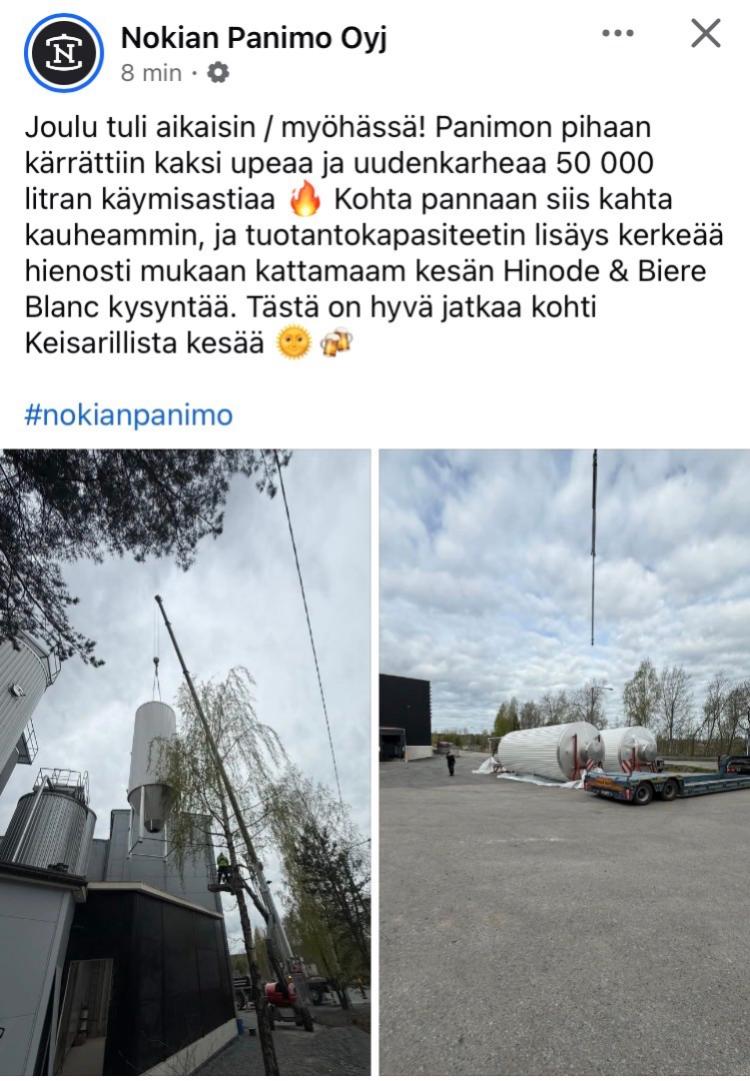
Forget those nonsense “Hesuli” (Helsinki) tech firms and turn your gaze toward a real growth company. New buildings and tanks are popping up on the plot constantly.

At the beginning of the week, I visited the brewery to ensure that Q2 sales volumes are developing favorably, and I grabbed six cases of Minea water for my summer stock at the shareholder price. At the same time, I got to witness that construction miracle live in person.

23 Likes

IS readers have once again voted for their favorite beers:

Compared to last year’s vote, Sandels’ lead in first place is growing. However, Nokia Brewery’s (Nokian Panimo) Keisari Lager sits impressively in 5th place as clearly the most popular craft beer, receiving nearly 50% more votes than Marsalkka and over 50% more votes than Kukko, which were the other craft beers in the TOP 10.

Here is IS’s previous reader poll:

One can always argue about quality, but the results say something about brand awareness and the relative appeal of the products.

4 Likes

That’s wild

I personally thought we would reach slightly over ten percent growth at this stage of the year. Especially since January-February were challenging for the industry.

11 Likes

"The volume of liters sold by Nokian Panimo grew by 22.3%, reaching 2.3 (1.9) million liters. This strong growth was driven by the timing of Easter sales, which fell mostly in March this year, campaigns scheduled for the early part of the year, and the largest launch of new products in the company’s history, totaling 14 items.

During the review period, our beer sales volume grew by 23.1%, totaling 1.6 (1.3) million liters. According to Finnish Grocery Trade Association (PTY) statistics, the volume development of the Finnish beer market during the review period was down -2.3%."

In other beverages, our sales volume grew by 20.3%, totaling 0.7 (0.5) million liters. The growth in other beverages is explained by new product launches as well as good performance in existing products. In March, we introduced a new series of Minea flavored waters and non-alcoholic alternatives to our cider and long drink product lines. The market sales volume grew by 0.3% in soft drinks and 1.2% in waters (PTY), while the market for other alcoholic beverages was declining (PTY).

Strong growth, clearly faster than the market then.

7 Likes

We managed to get a bit more volume than usual today, and a few thousand shares moved from that over 50,000-block sell order priced at 2.5 euros. But otherwise, the report doesn’t seem to be triggering much of a reaction.

As I see it, the factors explaining the strong performance in Q1 will be even more pronounced in Q2, with the exception of Easter.

4 Likes

Nearly 12,000 shares fewer, meaning just over 38,000 units, remained on the ask side at €2.50 at the close.

One would think that if any company announced over 20% growth in a zero-growth market, the share price would rise. Especially when there is a proven long-term track record of delivering specifically profitable growth.

I was truly surprised by the amount of growth, but apparently, empirical observations made during grocery runs point in the right direction. First, there was the S-Group campaign, now it seemed to be K-Group’s turn; mocktails were selling for May Day, and regarding new releases, every store visit has shown shelf spaces either emptying out or being noticeably emptier than neighboring spots.

Perhaps this will fly under the radar for a while longer, as the valuation isn’t exactly super cheap. But if growth stays at that level for the full year and we get a hot summer, I’m sure this stagnation (mörnintä) will come to an end.

I’ve been slowly adding a few shares at a time and will continue at the same pace. It’s tasting good.

4 Likes