Twitteri herää hieman myöhässä, kun on yli kaksi kuukautta tästä Nokian postauksesta, mistä esim arkkitehtuurin kuva on kopioitu.
Scale-across networking for AI factories | Nokia
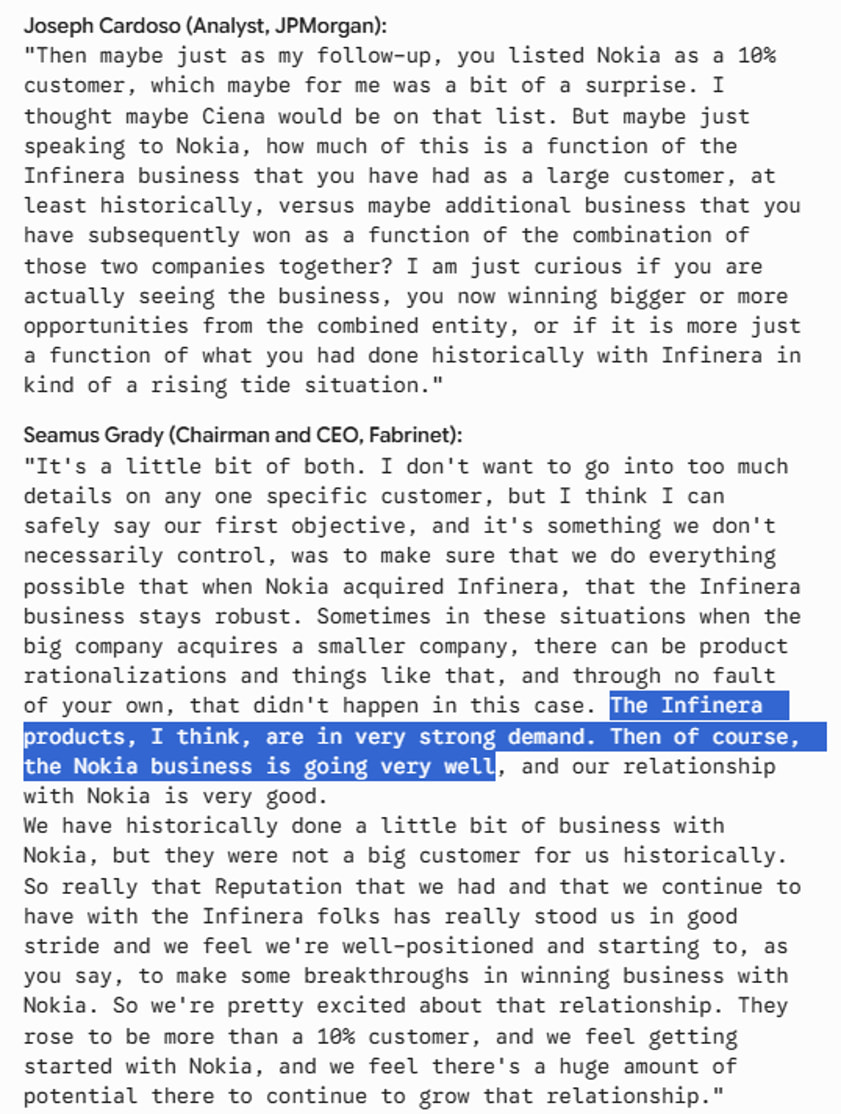
2026 Optica Executive Forum and OFC event tapahtuma oli maaliskuussa 2026 ja Nokia yhdessä Metan ja Google ym muiden kanssa keskusteli/esitteli aiheen. Eli Nokia on tässä oletettavasti ratkaisevassa roolissa, myös Metalla, ketä näistä ei paljoa hihku. Ciena käsittääkseni ollut pääasiallinen toimittaja, mutta jatkossa?
Nokian sivuilta kopioitu:
To reduce training times, leading AI and cloud providers are building increasingly larger clusters, with multiple one million XPU clusters planned for 2027. There are, however, significant challenges with acquiring the space and gigawatts of power needed to support over one million XPUs in one physical building. Scale-across networking helps overcome these challenges by enabling multiple distributed data centers (and their XPUs) to be interconnected across different locations and power grids to form a computational super-cluster.
Key optical technologies for scale-across
To address the needs of high-capacity, low-latency scale-across networks, the optical industry is also innovating in multiple areas simultaneously, including:
- Coherent pluggables. AI and cloud providers are rapidly adopting 800ZR+ZR+pluggables due to their high performance, small footprint and lower power consumption. For scale-across applications, 800G ZR/ZR+ pluggables are commonly hosted in backend switches/routers although thin transponders provide an alternative deployment option.
- High-capacity optical line system terminals. High port count, direct-attach ROADMs such as the 1830 GX RD66 can multiplex 64 or more wavelengths onto a fiber to enable 50-75 Tb/s using a single sled. Alternatively, fixed-filter solutions, such as the 32-port C-band only OMD32, cost-effectively multiplex 25-38.4 Tb/s of transmission capacity onto a fiber.
- Multi-rail inline amplifiers (ILAs). As ILA huts are space and power constrained, amplifying hundreds of fiber pairs every 50-100 kms can be challenging. Nokia’s multi-rail ILA enables in-line amplification of 160 fiber pairs per rack, a 40-fold increase in density compared to legacy ILAs and an 8x improvement compared to today’s state-of-the art conventional ILAs.
- Hollow-core fiber (HCF). While still relatively expensive and early in terms of mass commercialization, hollow-core fiber delivers 30% less propagation delay than today’s single-mode fiber. Looking ahead, HCF can be beneficial to scale-across applications by extending the practical distance between data centers by 40-50% while delivering similar latency results as single-mode fiber.