Shut down about a year ago. Not news as such. OEMs make the hardware so cheaply thanks to high volumes. The same components are also used in standard servers. Standard server technology in a small package, for small volumes. Technology that may have more demand in 6G networks.
The new edge-GPU-AI hardware is a different matter in the sense that it is integrated into the BB hardware (baseband hardware), and thanks to this and the Nvidia partnership, there is no competition in the field yet. Still, sales volumes are likely limited compared to NI’s products.
First of all, GPUs are not coming to the radio. Power consumption is an obstacle here. To the baseband as well, yes. First, GPUs will run operators’ AI apps (read the previously linked T-Mobile piece), and I believe that AI inference will be brought to the edge to reduce latency and simply to distribute the load to locations where power is already available. However, dedicated inference processors (NPUs) are coming to the market, which NVIDIA doesn’t have; instead, all the work is done by the GPU. Which is not energy efficient.
Regarding the earlier question of whether operators sell processing time to hyperscalers. Maybe, that business model is already being practiced by data center firms around the globe. But is edge capacity sufficient for that? Not at the start, at least.
Projects come to a screeching halt if the money runs out. The funding taps are turned off very easily if the product doesn’t sell. On the US side, it’s worth sucking up to the Saudis and other headscarf-wearers right now.
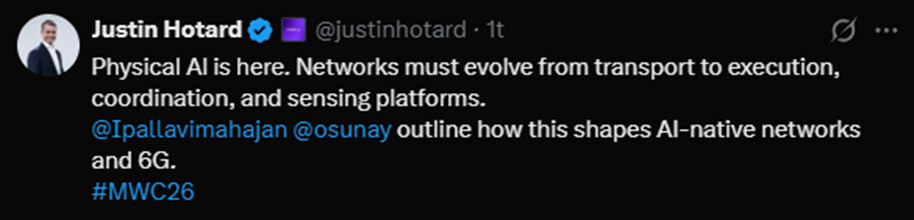
The text categorizes the relationship between AI and the network into three emerging classes:
AI Over the Network (Generative and contextual intelligence): AI applications don’t just consume data; they are interactive and latency-sensitive. Inference is moving from data centers to the network edge so that AI agents can communicate with each other in real time.
AI Within the Network (Physical intelligence and control): When AI controls robots or cars, the network becomes part of the control loop. This requires millisecond-level synchronization so that, for example, a swarm of robots can move like a single organism. The network provides a “common time context.”
AI From the Network (Sensing infra - ISAC): The network itself turns into a sensor (Integrated Sensing and Communications). Radio waves are used to sense the environment (e.g., drone detection or parking analysis), and this data is processed in real time on the network’s integrated GPU platforms (AI-RAN).
2. Architectural Convergence
Nokia emphasizes that an “AI-native” network isn’t created just by improving radio technology. It requires a transformation of the entire system:
AI-RAN & Shared Computing: Telecom traffic and AI tasks are run on the same accelerated computing platform (GPU). This prevents the network from fragmenting into separate “islands.”
Agentic Autonomy: The network doesn’t just operate according to pre-set scripts but makes goal-oriented, “reflex-like” decisions independently.
Monetization: These new capabilities (latency-free performance, sensing, compute location) are turned into billable products via the Network-as-Code model.
3. Strategic Alignment: Software Gravity
One of the most important observations in the text is that Nokia has chosen the path of an open ecosystem.
The network must adapt to prevailing AI development environments (such as Nvidia’s ecosystem).
If a company builds its own closed accelerators, it risks remaining an isolated “proprietary island” that application developers cannot reach.
What does this mean for a Nokia investor?
The new definition of 6G: 6G is no longer just about faster data; it is the first generation where computing and sensing are built into the core architecture.
Transition from hardware sales to a nervous system: Nokia is positioning itself as the nervous system of a global intelligent world. This increases the company’s importance in critical AI infrastructure.
MWC 2026 as the stage: Nokia will use the March trade show to demonstrate that these are not just visions, but that “AI-on-RAN” and autonomous operations are already functional technologies.
Nokia has joined the ranks of two other big names.
MARKET CAP, USD:
Micron 470 B
Nokia 42 B
Broadcom 1,540 B
The picking of winners and losers has begun, and a few companies will stand the test of time and continue to break out in 2026 and beyond. Three of these long-term winners are Micron, Nokia, and Broadcom.
You may be surprised to see Nokia on this list. The telecom company is restructuring down to two main divisions: network infrastructure and mobile networks. Both divisions will play their respective roles in AI data workloads and cloud services.
Nokia’s pivot into AI is backed by a $1 billion investment from Nvidia
“Up to 156 jobs will be cut in Finland. Change negotiations will begin on March 2.
Mikko Hautala, Head of Geopolitics and Government Relations, says in a message to employees that jobs may be reduced in Finland, particularly in the mobile networks business.
According to Hautala, the intention is to simplify Nokia’s operating model as a result of the ‘network transformation’ brought about by AI.”
This is great news, by the way. Nokia selected exclusively - no Cisco or Arista. Switches and routers, SR Linux software, and probably pluggables (ICE-X) to go with them.
Certainly not the world’s biggest deal, but you have to start somewhere in Europe too - and perhaps this edge is the long-term trend. Nokia’s proven competitiveness in this area is pleasing, especially since we are still in the very early stages of this in Europe.
Nokia has proven to be a trusted connectivity partner in this mission, and they are playing a critical role in building secure, reliable data center networks for our ambitious Edge node project.
You hit the nail on the head. Telefónica’s edge data center network delivery isn’t just a switch or a fiber connection. Nokia is providing here:
Data center network IP + optics + telemetry/automation
5G infra and RAN integration
Edge-core integration
AI-ready platforms
In other words, a full infra-stack that is more than the sum of its parts. This is also a recurring business model where Nokia signs agreements with operators according to their edge data center strategy, which is a new emerging market.
While hyperscaler DC switching is the toughest market to break into, Nokia is delivering the entire optical + IP routing + NOS + automation + edge-core integration here, and the IP layer is one of the most profitable and strategically binding parts.
GTP5.2 estimates the value of the Telefónica deal at ~€100–200M over several years. If this scales across Europe, ~€1–2bn cumulatively, and the global telco-edge rollout ~€2–3bn over the 2026–2030 period. At the peak phase, ~€300–600M annually?
It’s interesting how Nokia’s share price drops on the Helsinki stock exchange on quite low volume and starts rising after the NYSE opens, and the same thing happens the next day.