It’s hard to see operators (especially smaller ones) renewing their networks because of a recommendation without separate compensation. Customer churn is, of course, a different matter.
8 Likes
I wasn’t aware of DNA’s connection to Huawei; we’ll aim to get rid of it as soon as possible 
22 Likes
This has certainly been strange behavior from DNA. They used to be firmly in Ericsson’s camp, but a few years ago they did a total U-turn regarding RAN in favor of Huawei. This was at a time when “everyone else” was saying that we should get rid of Huawei. On top of this, they run ads like “the network doesn’t matter, life does” – it went something like that.
To be honest, I hope for nothing but trouble in this regard, because the warning signs have been echoing and yet the decision was made to rely on Chinese authoritarianism for something so critical. I think the security side has been severely neglected, although the company emphasizes otherwise and also says they use several different network equipment vendors.
It should also be noted that Telia relies entirely on Nokia’s expertise, and Elisa decided at the same time as DNA to move much more decisively away from Huawei.
Edit: Oh, one more thing – fortunately, for the joint network of Telia and DNA, a new decision was made to turn to Nokia – the previous contract was with Huawei. So what I wrote earlier doesn’t apply to that part.
34 Likes
Keep your pants on and let’s get the topic back to Nokia ASAP. Does anyone have actual research results showing that DNA is entirely in Huawei’s camp, or are we just going by gut feeling here?
The only article I found with a quick search said the following in early January:
"IN FINLAND, DNA uses network equipment and software from Ericsson, Nokia, and Huawei in its networks. In Northern and Eastern Finland, the company has established a joint network company with Telia, which two years ago chose Nokia as its partner for its 5G network.
‘We always choose the best equipment and software for each purpose. When our network is distributed among equipment from different manufacturers, we are actually able to improve security, even though it requires a bit more work from us.’
Especially the United States has claimed that Huawei’s products are suitable for espionage, but has not presented evidence. Huawei has denied the allegations.
‘We have not detected any security issues in Huawei’s devices, even though all devices are carefully tested in advance. In these matters, we naturally cooperate a lot with the authorities, and nothing unusual has emerged.’"
2 Likes
It’s not based on gut feeling but on long-term tracking. Personally, I was talking about the RAN part, and yes, DNA does use other equipment manufacturers in its network. A network is more than just the RAN, after all, and the core is implemented by Affirmed Networks. Naturally, DNA doesn’t want to make a big deal out of it. I also mentioned that for the shared networks, the supplier is Nokia, even though there was originally a contract with Huawei for this.
Telia has publicly stated that it relies 100% on Nokia for its RAN; Elisa currently has RAN agreements with both Nokia and Ericsson. Elisa did start building its 5G network with Huawei equipment, around the Salo area if I recall correctly. However, Finland’s relatively high dependency on Huawei, which was mentioned above, is mainly explained by DNA. For some reason, DNA seems to be the only operator that hasn’t made its RAN agreements public.
Below are a few observations.
During 2019, the winds of change were blowing. One can only guess the reasons why Ericsson took a backseat. It’s possible that DNA’s new owner, Telenor, influenced the choice of radio network equipment supplier, as the supplier selection and the Telenor acquisition coincide in timing. At DNA’s Q2/2019 earnings call, it was stated that evaluation was still ongoing and no supplier or suppliers had been chosen yet. A bit later, at the Q3/2019 interim report press conference, CEO Jukka Leinonen said that DNA would utilize technology from several different equipment manufacturers in the future.
However, all current 5G implementations have been carried out with Huawei’s technology, so DNA has clearly moved toward a single-vendor strategy in 5G. According to our observations, 5G installations implemented with Ericsson’s technology in Hyvinkää and Paarmarinne in Vantaa have been swapped to Huawei.
https://mt-tech.fi/dna-korvaa-ericssonin-5g-tukiasemia-huaweilla/
DNA’s current 5G network uses Huawei base stations. The company also has a contract for base stations with Ericsson, but so far the network has been built using Huawei’s technology.
The operator only allows Western equipment manufacturers into its core network. These handle, among other things, subscriber and billing data as well as traffic control.
– Radio networks [2G–5G networks] are not considered critical networks. With these suppliers, the policy is more open, says DNA’s CTO Tommy Olenius.
These are, of course, partly old information, but there hasn’t really been a whisper from anywhere that the situation has changed. And we also remember that technically Ericsson was ready right at the start of the 5G cycle, so the swaps cannot be explained by incompleteness—as could have been the case with Nokia at that time.
39 Likes
Alright, a new week and a new contract in India. And it’s actually good to see something other than just radio networks.
Nokia today announced that it has entered into a partnership with Netplus Broadband, an Internet Service Provider (ISP) in India, to supply its Multi-Access Gateway Broadband Network Gateway (BNG) application for access management, hosted on the FP5-based 7750 SR, and the 7250 IXR, which provides high-density aggregation, to scale Netplus’ broadband services throughout Northern India. Netplus has operations spread across 400 plus cities and towns in several states in Northern India, with the biggest in Punjab.
34 Likes
"This year, the study included two new award categories measuring the quality of customer user experience. Telia Finland ranked first in both categories.
Telia Company achieved a total of eight category wins across various countries. The high quality of Finnish networks is reflected by the fact that other Finnish operators also ranked among the top 10 operators globally in the evaluation of network consistency."
“A functional and secure society relies on reliable and high-quality networks. Our domestic mobile networks, built in partnership with Nokia, have now been independently verified as the most consistent in the world in terms of quality,” says Telia’s CTO Jari Collin.
25 Likes
https://twitter.com/PekkaLundmark/status/1635288160728121345
Lundmark has apparently also gone to say hello to Modi.
41 Likes
12 Likes
A few of you might remember that I’ve made a fuss about this topic in this thread before. For the most part, I enjoy the serenity that comes with a more mature age without any major pressure or stress, but if someone were to invite me to promote a project like this on an outrageously tight schedule, I’d join without pay—or well, at least for next to nothing. And I mean chip manufacturing too, not just design.
Chip manufacturing requires cheap energy, plenty of water, and an insane amount of investment capital. Of course, many other things too, but these three are quite hard to get more of or conjure out of thin air. Finland is actually only missing one of these three.
A chip manufacturing plant uses millions of liters of water per day and consumes as much energy as a small city. We have plenty of water, and in the future, we’ll have enough clean energy to share. The stable ground can be considered a bonus. The level of education is high and—at least for now—our country is safe and stable. Everything works. We could surely attract foreign experts to chip development and manufacturing here as well.
European leadership in this field is unlikely to be achieved through city-led initiatives alone. A national mega-project should be established behind this. You know, something American BIG—and not some Sunny Car Center. Well, one can dream. 
According to the City of Tampere press release, the initiative is backed by the Technology Industries of Finland’s semiconductor industry group and its corporate partners, VTT, Tampere University, Aalto University, and the cities of Tampere and Espoo. They see that Finland has excellent opportunities to become a leading European country in chip expertise.
Nokia is, of course, a veteran with its own SoC chips already. Finland could well be at the absolute top of Europe in this field.
Veijo Kontas, who is responsible for Nokia’s SoC development, points out that the development of next-generation 6G and AI chips has already begun in Finland.
”The Chips from Finland initiative increases investor interest in coming to Finland to develop chip technology and provides students in the field with good learning environments.”
41 Likes
I already linked news related to this topic in the Panostaja thread nearly two years ago.
11 Likes
I can’t recall off the top of my head a head of state tweeting about a meeting with a CEO. But we’ll take it. Great stuff. Surely an unforgettable experience for Pekka too.
I suppose we can assume from this that India’s digitalization will continue strongly with Nokia’s favorable assistance.
37 Likes
Nokia CEO Pekka Lundmark on the 2022 results [Financial Results 2022]
In the Technologies business group, we currently have two license renewal processes and related litigations underway, in which we have already received several favorable court rulings. This has strengthened our confidence in our approach that defending the value of our patent portfolio is more important than reaching specific deadlines.
At the end of the year, one of our long-term licensees exercised its option and converted its license into a perpetual one, and we recognized the entire related unrecognized revenue in the fourth quarter.
—————>
In Nokia Technologies, we remain in two litigation/renewal discussions. Several court rulings have validated our position giving us confidence in our approach to prioritize the value of our portfolio over achieving specific timelines. At the end of the year, a long-term licensee exercised an option to extend its license in effect into perpetuity.
Is it* [Apple?] - if so, supergood!
—————>
Is the licensee that exercised its option Apple?
- in my opinion, the indicators and other observations strongly suggest that
- Apple and Nokia are now in a permanent mutual intellectual property agreement - if so: Super good!
7 Likes
The signs pointed to that perpetual agreement being with Microsoft.
If it is with Apple, I think it’s bad news because an astronomical sum wasn’t received for the perpetual deal. At least I personally expect billions from Apple in regular rolling payments over the coming years.
17 Likes
I think you have a bit of a misconception regarding that permanent/perpetual part. It most likely means that for a one-time payment, you get the patents forever. In the coming years, no fees will be running.
The other way around, this would be completely nonsensical from the buyer’s perspective. Meaning a perpetual license where fees would continue to run every year. → Apple or anyone else has almost certainly not bought such a thing from Nokia, even if it would be a good thing for Noksu’s shareholders.
7 Likes
I would also guess Microsoft:
“Nokia will retain its patent portfolio and will grant Microsoft a 10-year license to its patents at the time of the closing. Microsoft will grant Nokia reciprocal rights to use Microsoft patents in its HERE services. In addition, Nokia will grant Microsoft an option to extend this mutual patent agreement in perpetuity.” /Microsoft to acquire Nokia’s devices & services business, license Nokia’s patents and mapping services September 3, 2013 | Microsoft News Center
18 Likes
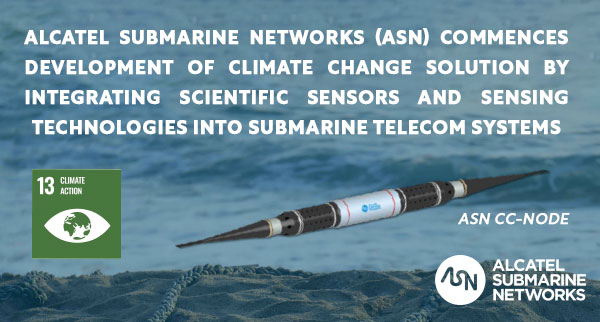
Alcatel Submarine Networks (ASN) starts development of #climatechange Solution by integrating scientific sensors & sensing technologies into #submarine telecom systems https://linkedin.com/feed/update/urn:li:activity:7041234311345283072
#pressrelease #climate #sustainability #cable #industry #telecommunications #suboptic
15 Likes
“Nokia wants to outperform its rivals and take the lead in the Indian market for private 5G networks, which the Finnish telecom equipment manufacturer projects would reach $240 million in sales by 2027 and have a deployment potential of over 2,400 sites nationwide.” https://www.wionews.com/india-news/indian-pm-modi-meets-nokia-ceo-pekka-lundmark-discuss-indias-digital-infrastructure-571949
There was talk about private networks, and the estimate above reveals that their growth is slow… Hopefully, in wealthier countries, we will be talking about a completely different private network market in five years than India’s meager 240 million dollars. Other companies are also competing for this pot. On the other hand, if 4G is still more significant than 5G in private networks even in five years, then the total pot would be clearly larger than what was mentioned. And of course, it must be remembered that we are talking about new sales that will complement operator sales.
9 Likes
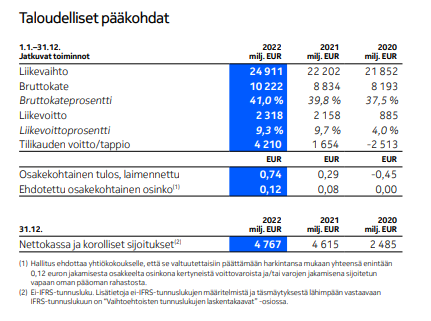
How many years will it take for Nokia to achieve a 14% comparable operating margin? I expect that 14% should be achieved in 2025. Would this be possible?
”In 2022, the net sales growth of our four business groups with profit responsibility accelerated.
This is a good foundation to continue towards our long-term target
of growing faster than the market and achieving a comparable
operating margin of at least 14%(1).”
Pekka Lundmark
President and CEO
Inderes has answered the question about timeframes in the Inderes Q&A section.
“Short-, medium-, and long-term targets” – these terms are seen almost daily in company materials. Could you clarify these expressions with more specific / clearer definitions?
Inderes’ comment
Hi,
There are no standards for these, which makes the reader’s job difficult and causes confusion. Basically, short-term means one year, medium-term 1-3 years, and long-term can mean 3-5 years and beyond, depending on the company. The longest known long-term plan is likely held by Japan’s Softbank, which has a 300-year plan.
15 Likes