Nel ASA - Hydrogen Technology Since 1927

Here are the comments from H2-View. If I have ever written that this hydrogen business is a marathon, I will now state: it’s an ultra-marathon;

Nel’s revenue fell 31% as losses more than tripled in a “demanding” 2025

Norwegian electrolyser company Nel reported a 31% drop in revenue in 2025 as losses more than tripled, capping off what the CEO described as a “demanding year” in the hydrogen sector.

The company’s operating loss grew from 389 million Norwegian kroner ($40.7 million) to 1.365 billion Norwegian kroner ($142.9 million), and its revenue fell to 963 million Norwegian kroner ($100.8 million). EBITDA also increased from –173 million Norwegian kroner (–$18.1 million) to –275 million Norwegian kroner (–$28.8 million).

Despite growing losses, the company’s cash reserves remained relatively stable, falling from 1.87 billion Norwegian kroner ($195.7 million) to 1.6 billion Norwegian kroner ($167 million).

Additionally, its order intake grew to the level of 2023 results, rising from 977 million Norwegian kroner ($102 million) to 1.13 billion Norwegian kroner ($118 million) in 2024. The order backlog thus stood at 1.32 billion Norwegian kroner ($138 million) compared to 1.6 billion Norwegian kroner ($167 million) in 2024.

However, Nel said that delays in government incentives, high interest rates, and high construction costs led to a “lower than expected” order intake.

As a result, the equipment manufacturer paused production of its alkaline electrolysers at its flagship factory in Norway and performed other “steady and disciplined work” to reduce operating costs. The company’s workforce was reduced by 15% to 346 employees.

“As a result of the slowdown in activity, Nel adjusted its organisation and production capacity to match expected market growth,” the full-year report stated.

Revenue for its alkaline segment was 562 million Norwegian kroner ($58.8 million), down 44% from 2024. The order backlog shrank 83% to 99 million Norwegian kroner ($10.4 million). This followed Nel pausing production of the technology at its flagship 1 GW Herøya electrolyser plant.

PEM fared better. Technology sector sales grew 5% to 401 million Norwegian kroner ($41.9 million) and order intake by 157% to 1.03 billion Norwegian kroner ($107.8 million). The order backlog also grew 171% to 878 million Norwegian kroner ($91.9 million).

Over one billion Norwegian kroner ($104.9 million) was recorded through depreciation, amortisation, and impairments.

Of this, 361 million Norwegian kroner ($37.8 million) relates to Herøya’s new 1 GW production line, which manufactures next-generation pressurised alkaline electrolysers. Additionally, 439 million Norwegian kroner ($46 million) relates to goodwill and intangible assets associated with the acquisition of the PEM division.

Commenting on the tough results, CEO Håkon Volldal said that 2025 was “anything but a lost year.”

“In many respects, it became a turning point,” he said. “Our financial performance in 2025 reflected the market in which we operate… 2025 was a year of steady and disciplined work. Much of it was invisible. Much of it was not fun. But all of it was necessary for long-term success.”

7 Likes

I want to reiterate this. Reliance’s schedule is the end of 2026. Nel’s technology. You’d think a deal announcement would be coming… 10 months until the end of the year.

Production
‘All under one roof’ | Oil firm run by India’s richest man promises three million tonnes a year of green hydrogen by 2032
Reliance Industries Limited plans to start operating an electrolyser gigafactory by the end of next year.

4 Likes

My strong assumption is that NEL has a clear connection to this project. If anyone finds more information on the subject, good;

Mumbai (India), 16th March 2026: Reliance Industries Limited (RIL) has entered into a
binding long-term Supply and Purchase Agreement (SPA) with Samsung C&T Corporation,
South Korea, for the supply of Green Ammonia over a 15-year period commencing in the
second half of FY2029.
The SPA, valued at more than US$3 billion, is one of the largest binding long-term Green
Ammonia off-take agreements globally.
The SPA sets a new benchmark in the global energy landscape, with India emerging as an
exporter of green fuels produced through an end-to-end value chain anchored in the
country, including the domestic manufacturing of critical clean-energy equipment, aligned
with India’s National Green Hydrogen Mission (NGHM).
Building a New Global Benchmark for Green Energy
RIL is developing a fully integrated New Energy platform spanning renewable energy,
energy storage, green hydrogen, and downstream green fuels and chemicals, supported by
in-house manufacturing of critical clean-energy technologies.
A central pillar of RIL’s New Energy ecosystem is the indigenisation of critical clean-
energy technologies in India, including Solar modules, Battery Energy Storage
Systems (BESS), and Electrolyser systems, in line with the Government of India’s vision
for self-reliance and domestic manufacturing leadership.
By integrating these capabilities within a single ecosystem, RIL aims to deliver green energy
solutions that are competitive, scalable, and reliable for global markets while strengthening
India’s industrial base.
The agreement with Samsung C&T is the first in a series of long-term offtake partnerships
supporting the scale-up of RIL’s New Energy platform

6 Likes

NEL cooperation is also mentioned here. H2 View;

https://cm.h2-view.com/t/t-l-wtykun-yuftlhjuu-d/

4 Likes

Here’s a story about Samsung and NEL from H2 View:

Also a mention of the cooperation between Samsung and Reliance.

https://cm.h2-view.com/t/t-l-wtdkjhk-yuftlhjuu-o/

4 Likes

H2 View;

NEL mukana;

https://cm.h2-view.com/t/t-l-wijhyhd-yuftlhjuu-m/

5 Likes

Asiallinen.

Nel ASA: Employee long-term incentive program

(April 10, 2026 - Oslo, Norway) Reference is made to the Annual General Meeting of Nel ASA (Nel, OSE:NEL) held today where the updated guidelines regarding determination of salary and other compensation to executive personnel, and the one-time LTI vesting deviation related to a new LTI plan was approved, effectively initiating a new Performance Share Unit (PSU) program, while simultaneously discontinue the previous share option program.

The Company is replacing its previous long‑term share option plan, which had no performance requirements, with a Performance Share Unit (PSU) program that includes performance criteria, long‑term vesting and strict limits on awards, aligning executive remuneration closely with shareholder interests and prevailing market practice. As part of the transition to the new LTI structure, a one‑time technical deviation from the three‑year vesting requirement has been approved, whereby participating executives cancel all existing vested and unvested option awards and instead receive two compensating PSU tranches vesting after one and two years, respectively. For the new LTI program, annual PSU allocations are capped at a value of up to 50% of base salary for the CEO and up to 30% for other executives, and may be reduced based on individual annual performance, ensuring responsible, performance‑based long‑term incentives.

A total of 14,933,025 PSUs have today been granted under the new program. Each vested PSU entitles the holder to receive one share in the Company. The number of PSUs will be reduced based on pre-set performance criteria at the end of the performance period. Remaining PSUs after adjustment will, pursuant to the vesting schedule, vest in full three years after the grant date, except for PSUs granted under the one‑time technical bridging program. Vesting is subject to the PSU holder’s continued employment with the Company at the time of vesting.

Primary insiders in Nel ASA have received the following grants of PSUs, in accordance with the terms described above:

Håkon Volldal, CEO, has been granted 1,159,173 PSUs vesting in one year, 1,159,173 PSUs vesting in two years, and 1,159,173 PSUs vesting in three years. Mr. Volldal has voluntarily forfeited all his 1,500,000 options as part of the agreement. Following the grant, Mr. Volldal holds 0 shares and 3,477,519 PSUs.
Kjell Christian Bjørnsen, CFO, has been granted 476,900 PSUs vesting in one year, 476,900 PSUs vesting in two years, and 476,900 PSUs vesting in three years. Mr. Bjørnsen has voluntarily forfeited all his 600,000 options as part of the agreement. Following the grant, Mr. Bjørnsen holds 20,000 shares and 1,430,700 PSUs.
Birgitte Nordvik, Chief Project Officer, has been granted 357,143 PSUs vesting in one year, 357,143 PSUs vesting in two years, and 357,143 PSUs vesting in three years. Ms. Nordvik has voluntarily forfeited all her 190,000 options as part of the agreement. Following the grant, Ms. Nordvik holds 0 shares and 1,071,429 PSUs.
Marius Løken, Chief Technology Officer, has been granted 447,165 PSUs vesting in one year, 447,165 PSUs vesting in two years, and 447,165 PSUs vesting in three years. Mr. Løken has voluntarily forfeited all his 450,000 options as part of the agreement. Following the grant, Mr. Løken holds 0 shares and 1,341,495 PSUs.
Anne Liberg, Chief Human Resources Officer, has been granted 328,743 PSUs vesting in one year, 328,743 PSUs vesting in two years, and 328,743 PSUs vesting in three years. Ms. Liberg has voluntarily forfeited all her 300,000 options as part of the agreement. Following the grant, Ms. Liberg holds 0 shares and 986,229 PSUs.
Stein Ove Erdal, Chief Legal Officer, has been granted 390,581 PSUs vesting in one year, 390,581 PSUs vesting in two years, and 390,581 PSUs vesting in three years. Mr. Erdal has voluntarily forfeited all his 600,000 options as part of the agreement. Following the grant, Mr. Erdal holds 0 shares and 1,171,743 PSUs.
Todd Cartwright, Chief Commercial Officer, has been granted 408,987 PSUs vesting in one year, 408,987 PSUs vesting in two years, and 408,987 PSUs vesting in three years. Mr. Cartwright has voluntarily forfeited all his 450,000 options as part of the agreement. Following the grant, Mr. Cartwright holds 0 shares and 1,226,961 PSUs.
Tushar Ghuwalewala, SVP Operations, PEM, has been granted 378,288 PSUs vesting in one year, 378,288 PSUs vesting in two years, and 378,288 PSUs vesting in three years. Mr. Ghuwalewala has voluntarily forfeited all his 390,000 options as part of the agreement. Following the grant, Mr. Ghuwalewala holds 0 shares and 1,134,864 PSUs.
Mats Bohman, VP Operations, Alkaline, has been granted 321,429 PSUs vesting in one year, 321,429 PSUs vesting in two years, and 321,429 PSUs vesting in three years. Mr. Bohman was not in possession of any options. Following the grant, Mr. Bohman holds 0 shares and 964,287 PSUs.

3 Likes

Kauppaakin välillä;

Nel ASA: Receives a USD 7 million purchase order for containerized PEM equipment

(April 17, 2026 - Oslo, Norway) Nel Hydrogen US, a subsidiary of Nel ASA (Nel, OSE:NEL), has received a purchase order from Mesure Process, a subsidiary of Synqo Energies, for containerized PEM electrolyser equipment with a total value of about USD 7 million for its European project. This is the second purchase order Nel has received from the client. The units will supply hydrogen refueling stations and industrial use. Synqo Energies, previously MPH Énergie, will operate as the EPC supplier and deliver the complete hydrogen refuelling package, owned by a consortium, including the off-takers.

Mesure Process designs and develops integrated solutions across three core areas: projects, products, and services. The company supports industrial customers and operators in industry, and heavy and energy‑intensive mobility, in transitioning their processes and infrastructure to new energy sources.

“This project marks an important milestone for Mesure Process. It reflects our ability to design and deliver integrated hydrogen infrastructures as an EPC+M partner, combining engineering, system integration and operational expertise to support the development of low-carbon mobility and industrial uses,” says Marcello Venturi, Managing Director of Mesure Process.

“We’re very pleased to secure this repeat order from Mesure Process, which underlines their trust in our technology. The MC platform is gaining strong momentum, with its fully modular design enabling easy transport and rapid installation, making it a highly versatile solution across a wide range of applications,” says Todd Cartwright, CCO of Nel ASA.

The PEM electrolyser will only produce renewable hydrogen which will serve the client’s hydrogen distribution (mobility) and export (industry), a site that is expected to be operational in 2027.

9 Likes

I have long avoided hydrogen stocks for the reason that I haven’t seen viable commercial markets where investments can be financed.

Now, however, I have been looking for information on future solutions for aviation fuels, because the availability of crude oil has become significantly more difficult. The need for alternative fuels is great, and at the same time, new fuel-efficient aircraft make it possible to introduce—even in small quantities—fuels that are slightly more expensive but environmentally friendly and delivered through a reliable supply chain. Without knowing Nel ASA in more detail, I see the company gradually having a good opportunity in the value chain of the nascent e-SAF market.

5 Likes

Huomiseen…mielenkiintoista;

Nel ASA - Upcoming commercial launch

The official commercial launch of Nel ASA’s next-generation pressurized alkaline electrolyser platform on May 6, 2026, represents a pivotal shift in the company’s strategy to lead the global green hydrogen market through unmatched cost efficiency and industrial scale. This technological leap is heavily backed by a €135 million grant from the EU Innovation Fund (one of the largest in Nel’s history), specifically awarded to industrialize this new platform at their Herøya facility in Norway.

The funding covers up to 60% of both capital and operational costs, providing the financial runway to scale production capacity toward a massive 4 GW annual output, effectively bridging the gap between innovative prototyping and the high-volume, low-cost manufacturing required to meet Europe’s ambitious climate goals.

15 Likes

AI Summary.

Nel ASA has announced a next-generation pressurized alkaline electrolysis system (Pressurized Alkaline), the development and testing phase of which has lasted over eight years. The new technology is designed to address the challenges of green hydrogen production: high costs and plant complexity.

  • Significant cost savings: The system drops estimated turnkey total costs (CAPEX) to below $1,450 per kilowatt (for a 25 MW plant), which is 40–60% less than current market solutions (which can be up to 3,000 USD/kW).
  • Technical features: The equipment is fully modular and factory-built (skid-based), which speeds up installation and reduces on-site construction work. The system operates at 15 bar pressure and produces 99.99% pure hydrogen, reducing the need for external compression.
  • Production and financing: Nel manufactures the equipment at its Herøya plant in Norway. Annual production capacity is currently 1 GW and can be scaled up to 4 GW. The project has received up to 135 million euros in funding support from the EU Innovation Fund.

Interesting: This could make projects viable that were not feasible with previous technology. And of course, the EU support is essential - NEL’s actions are in line with EU objectives.

13 Likes

Lexus and all energy sector experts, how do you value this reform in terms of the market and the EU’s renewed business environment? Is this a so-called gamechanger?

Personally, I was looking forward to this reform very much, but I am unable to properly evaluate it other than in terms of costs, modularity, and sufficient manufacturing capacity.

Has there been any discussion anywhere about the efficiency level at which these new boilers operate?

Unfortunately, I won’t pass as an energy industry expert, but I believe I can pass as a sensible investor. On a general level, I have believed in the rise and arrival of the hydrogen sector, later began to doubt it, and have once again leaned towards being more confident. As I understand it, NEL is in a reasonably good position if things start moving in the direction of green energy. Unfortunately, I cannot say if this is a so-called gamechanger, and I haven’t even found information regarding the efficiency.

Edit: I thought about things a bit more, and perhaps the upcoming next-generation PEM platform is what would actually be the gamechanger. This will, however, take some time.

Martin Creamer (Publishing Editor, Mining Weekly) : My question is just when do you expect to launch the next generation PEM? When is that likely? And what advantages will it bring?

Håkon Volldal (CEO, Nel) : If I could give you an exact date, I would. If there’s one thing we have learned, it’s that technology development is uncertain. It takes time. Look at pressurized alkaline. We’ve worked on that for eight years. You have a pretty good idea what you want to do, and then there are always tricky things that you need to overcome. Could be pertaining to the concept design itself, could be pertaining to availability of materials, or you end up with a cost that you don’t like, so you have to re-engineer it. With PEM, we have the ambition to build a full prototype stack this year. That has to be tested, and then we need to spend some time to get partners to help us industrialize it. It will take, as I said, a couple of years.

Håkon Volldal (CEO, Nel) : Whether that means we can launch it end of 2028 or mid-2028, or if we will launch it late 2028 or in 2029, I’m not able to say at the moment. When it comes to the benefits, the benefits of the new PEM platform is that our goal is to take the cost down by 70% on a stack level. In a PEM system, the stack is the most expensive component. That means we can significantly reduce CapEx. It will be a low CapEx, low OpEx solution. That’s the sort of the holy grail. You get the cake, and you can eat it. Compared to pressurized alkaline, it might have even better energy efficiency, and it could have a smaller footprint at a lower cost. The response is, as always with PEM, fantastic. It’s more dynamic than pressurized alkaline.

However, I ran the Q1 transcript through an AI and asked what was said regarding the topic. Below are the answers.

Based on the call, Nel’s new pressurized alkaline electrolysis system is the company’s main focus and a strategic “leap” forward. Several important points emerge from the transcript specifically regarding the technology, its cost structure, and efficiency.

1. Efficiency and Technical Advantages

Regarding efficiency and technical advantages, the following was mentioned:

  • Better Energy Efficiency: CEO Håkon Volldal states that the pressurized operating method improves overall energy efficiency because it reduces the need for separate downstream compression.
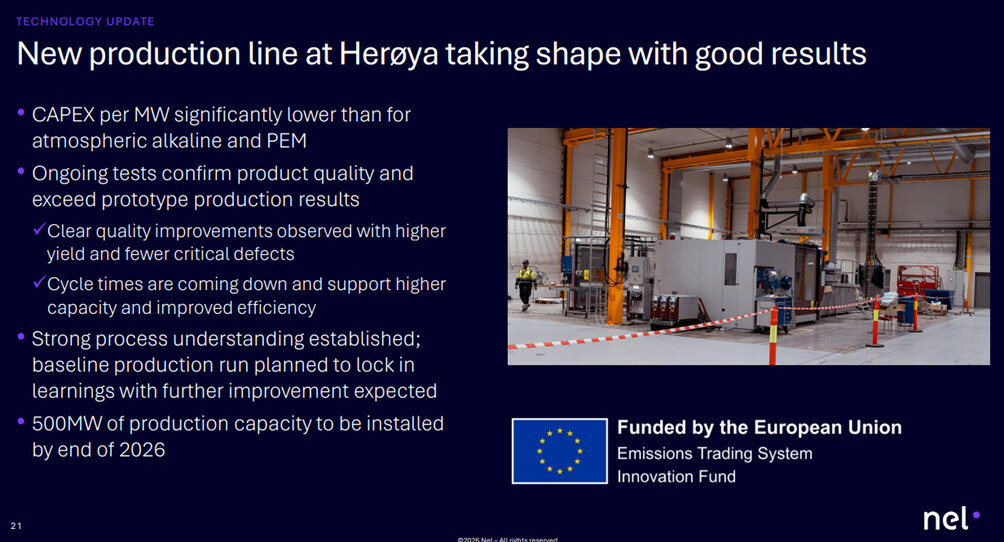
  • Test Results: Continuous testing at Herøya has confirmed the product quality, and they even exceed the prototype results. Volldal mentions that yield has improved and critical failures have decreased.
  • Benefits of Pressurization: Nel had pressurized technology as far back as 20 years ago, but at the time, it did not offer advantages over atmospheric systems. Now, the technology has been “reinvented” since 2018 to meet modern requirements.

2. Cost Structure (CAPEX)

This is perhaps the most significant point of the call. Nel believes the new platform will change the cost logic of the entire industry:

  • Significantly Cheaper: According to Volldal, the CAPEX (capital expenditure) per megawatt for the new concept is “significantly lower” compared to both traditional alkaline technology and PEM technology.
  • Competitiveness: The system is designed to enable customer projects that were previously not economically viable due to costs being too high.

3. Modularity and Scalability

  • No More Customization: Unlike current projects which are often bespoke, the new platform is fully modular and based on standardized “skid” units.
  • Industrial Manufacturing: The equipment is assembled and tested at the factory before delivery, which reduces complexity at the installation site.
  • Capacity: The goal is to have the first 500 MW of production capacity installed by the end of 2026.

While Volldal does not provide an exact percentage figure for efficiency in the call, he emphasizes the improvement in overall efficiency specifically at the system level due to pressurization and better process control. He also notes that the next-generation PEM platform (coming later) may be even more energy-efficient, but pressurized alkaline is already a major leap forward.

9 Likes

Big thanks to “Lexus”. Personally, I’m waiting for that modularity and clearly more efficient pricing to give sales a boost. On the back end, it’s obviously good that capacity won’t run out immediately.

Looking at the bigger picture, if the rest of the world doesn’t learn the constraints of fossil fuels now, with Trump and Hegseth messing around, then leadership is absolutely dismal. We’ll see.

As a further addition… this really should provide solid potential for Samsung, Reliance, and Saipem.

3 Likes

Oslo (Infront TDN Direkt): The EU is awarding a total of 124 million euros, equivalent to approximately 1.35 billion NOK, to the Norwegian companies GreenH and Gen2 Energy for the development of renewable hydrogen for use as fuel in shipping.

This was stated in a press release from Enova on Thursday.

The support is equally divided between the companies and will go toward the construction of production facilities for renewable hydrogen with a planned startup in 2031. GreenH will build its plant in Sola, Rogaland, while Gen2 Energy will build in Mosjøen, Nordland.

“The EU has now awarded significant amounts of support to two Norwegian maritime hydrogen projects. These projects are important both for the development of the Norwegian hydrogen industry and for the long-term transformation of our energy and transport systems,” says acting CEO of Enova, Rune Holmen.

The press release from the European Commission on Thursday states that nine hydrogen production projects have been selected under the third auction of the European Hydrogen Bank (EHB). The projects are spread across seven countries and are expected to provide nearly 1.1 gigawatts of electrolyzer capacity as well as produce over 1.3 million tonnes of hydrogen during the first ten years of operation.

The selected projects will receive a total of around 1.09 billion euros in EU funding from the Innovation Fund, financed through the EU Emissions Trading System (ETS).

Summary.

The EU is granting a total of 124 million euros (approx. 1.35 billion NOK) to the Norwegian companies GreenH and Gen2 Energy for the development of renewable hydrogen as a maritime fuel.

The support is divided equally between the companies and is intended for the construction of hydrogen production plants. The plants are scheduled to start operations in 2031.

  • GreenH will build its plant in Sola (Rogaland).
  • Gen2 Energy will build its plant in Mosjøen (Nordland).

The European Commission selected a total of nine hydrogen projects in the European Hydrogen Bank (EHB)'s third auction. These projects span seven countries and are expected to bring nearly 1.1 gigawatts (GW) of electrolysis capacity.

Not directly related to Nel, but Nel and Gen2 Energy have collaborated for years and have previously signed letters of intent and engineering contracts. Both Norwegian projects aim for industrial scale and maritime applications. Nel’s new pressurized alkaline electrolyzer is designed specifically for such large-scale stationary plants.

11 Likes