Unfortunately, I won’t pass as an energy industry expert, but I believe I can pass as a sensible investor. On a general level, I have believed in the rise and arrival of the hydrogen sector, later began to doubt it, and have once again leaned towards being more confident. As I understand it, NEL is in a reasonably good position if things start moving in the direction of green energy. Unfortunately, I cannot say if this is a so-called gamechanger, and I haven’t even found information regarding the efficiency.
Edit: I thought about things a bit more, and perhaps the upcoming next-generation PEM platform is what would actually be the gamechanger. This will, however, take some time.
Martin Creamer (Publishing Editor, Mining Weekly) : My question is just when do you expect to launch the next generation PEM? When is that likely? And what advantages will it bring?
Håkon Volldal (CEO, Nel) : If I could give you an exact date, I would. If there’s one thing we have learned, it’s that technology development is uncertain. It takes time. Look at pressurized alkaline. We’ve worked on that for eight years. You have a pretty good idea what you want to do, and then there are always tricky things that you need to overcome. Could be pertaining to the concept design itself, could be pertaining to availability of materials, or you end up with a cost that you don’t like, so you have to re-engineer it. With PEM, we have the ambition to build a full prototype stack this year. That has to be tested, and then we need to spend some time to get partners to help us industrialize it. It will take, as I said, a couple of years.
Håkon Volldal (CEO, Nel) : Whether that means we can launch it end of 2028 or mid-2028, or if we will launch it late 2028 or in 2029, I’m not able to say at the moment. When it comes to the benefits, the benefits of the new PEM platform is that our goal is to take the cost down by 70% on a stack level. In a PEM system, the stack is the most expensive component. That means we can significantly reduce CapEx. It will be a low CapEx, low OpEx solution. That’s the sort of the holy grail. You get the cake, and you can eat it. Compared to pressurized alkaline, it might have even better energy efficiency, and it could have a smaller footprint at a lower cost. The response is, as always with PEM, fantastic. It’s more dynamic than pressurized alkaline.
However, I ran the Q1 transcript through an AI and asked what was said regarding the topic. Below are the answers.
Based on the call, Nel’s new pressurized alkaline electrolysis system is the company’s main focus and a strategic “leap” forward. Several important points emerge from the transcript specifically regarding the technology, its cost structure, and efficiency.
1. Efficiency and Technical Advantages
Regarding efficiency and technical advantages, the following was mentioned:
- Better Energy Efficiency: CEO Håkon Volldal states that the pressurized operating method improves overall energy efficiency because it reduces the need for separate downstream compression.
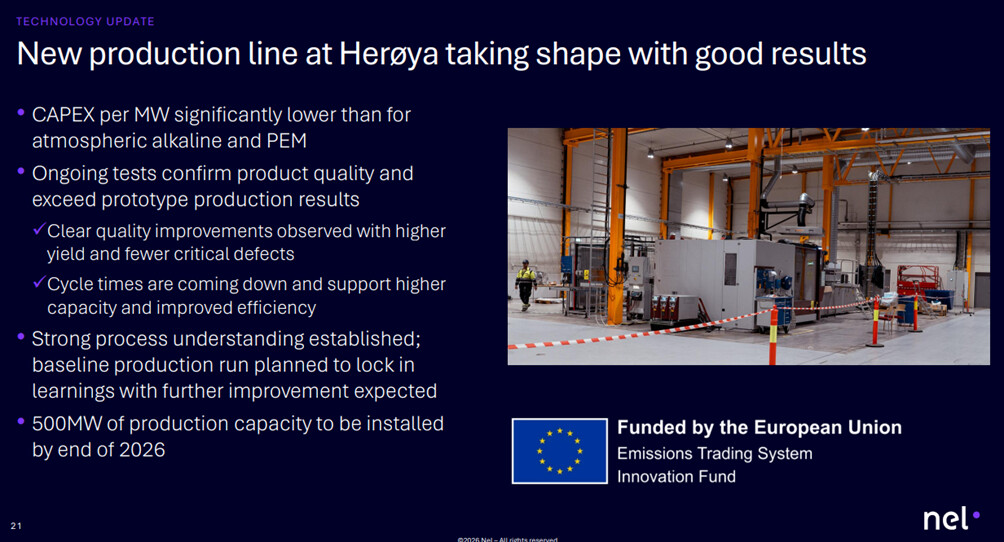
- Test Results: Continuous testing at Herøya has confirmed the product quality, and they even exceed the prototype results. Volldal mentions that yield has improved and critical failures have decreased.
- Benefits of Pressurization: Nel had pressurized technology as far back as 20 years ago, but at the time, it did not offer advantages over atmospheric systems. Now, the technology has been “reinvented” since 2018 to meet modern requirements.
2. Cost Structure (CAPEX)
This is perhaps the most significant point of the call. Nel believes the new platform will change the cost logic of the entire industry:
- Significantly Cheaper: According to Volldal, the CAPEX (capital expenditure) per megawatt for the new concept is “significantly lower” compared to both traditional alkaline technology and PEM technology.
- Competitiveness: The system is designed to enable customer projects that were previously not economically viable due to costs being too high.
3. Modularity and Scalability
- No More Customization: Unlike current projects which are often bespoke, the new platform is fully modular and based on standardized “skid” units.
- Industrial Manufacturing: The equipment is assembled and tested at the factory before delivery, which reduces complexity at the installation site.
- Capacity: The goal is to have the first 500 MW of production capacity installed by the end of 2026.
While Volldal does not provide an exact percentage figure for efficiency in the call, he emphasizes the improvement in overall efficiency specifically at the system level due to pressurization and better process control. He also notes that the next-generation PEM platform (coming later) may be even more energy-efficient, but pressurized alkaline is already a major leap forward.