“Forced” peace already looms as Trump takes power, but which companies would quickly benefit from peace? Certainly the construction and infrastructure sectors, and practically everything except the arms industry. If sanctions against Russia start to be lifted, a completely new market would open up, but it’s unlikely they will be lifted immediately. There is no return to Russian energy, but energy prices might at least stabilize. Which companies would benefit, whether European, American, or even Finnish? Views?
2 Likes
Regarding construction and infrastructure, it’s very difficult to guess who would benefit (Ukrainian construction companies, of course).
Among Finnish companies, Olvi would be a fairly certain beneficiary. The highly profitable operations in Belarus could be permanently kept within the company. Lukashenko would probably allow the payment of dividends to the parent company in Finland in the usual way. Olvi’s current valuation seems to discount the Belarusian operations close to zero.
3 Likes
Didn’t Tieto have a big office in Ukraine?
But perhaps more on a macro level, the beneficiaries are:
- Construction companies that go there to rebuild buildings, infrastructure, and such
- Drone industry (especially the defense industry)
- Ukraine’s own energy industry, which gains a completely new scale of market for gas sales (to those who previously bought it from Russia) and perhaps also nuclear power, though nuclear power plants probably require repair first?
- Manufacturers of equipment that performed well in the war → new orders, especially from “former” buyers from Russia (India probably the largest). This has already begun, see Poland’s massive orders.
An imposed peace is unlikely to benefit many Western companies if the outcome is that Russia achieves significant victories in the war and Ukraine is left on edge waiting for what happens next.
Sanctions against Russia will surely be lifted at some point, but it’s futile to imagine that things would return to normal. Who would want to invest in that unpredictable dictatorship anymore? And perhaps, besides me, some other consumer has also thought that the appropriate duration for a personal boycott of Russian products is for life.
7 Likes
What kind of peace would that be if the sanctions imposed on one party for starting the war remained in force? What would Russia gain from such a peace or why would it agree to it?
If the sanctions are lifted, Neste and the forest industry would be the biggest beneficiaries among Finnish listed companies. These would again be able to buy cheap raw materials from Russia.
2 Likes
There’s that reputation question again. Of course, a high-caliber businessman doesn’t look at such things  But I bet quite a few people will avoid buying from there, even if the sanctions are lifted.
3 Likes
There’s always someone who doesn’t care, starts buying from Russia, and gains a huge advantage over competitors if they refrain from using the market’s cheapest raw materials.
If Finnish forest companies and Neste were to act this way after the lifting of sanctions, they would, of course, be clear losers after a peace agreement in Ukraine.
I would assume that substantial packages of money and favorable loans will be given for the reconstruction of Ukraine from both the United States and the EU, and China will probably not stand by idly but will want to buy its share in Ukraine. These usually include an obligation to use the money in a way that benefits the donor and financier.
Now, based on that, one can start to consider what that reconstruction actually means? Construction industry supply chain, energy and information technology infrastructure, consumer business, etc.
China has likely played its cards in such a way that it won’t get a share, at least not on very favorable terms.
1 Like
Construction companies are certainly a viable target. Who will go there and on what scale is certainly open. Logical players are certainly at least Wienerberger and Strabag from construction companies (Austria).
Many Polish companies are certainly in a strong position, whether it’s about construction or something else, even starting from clothing. Those could be researched if interested.
Perhaps someone establishes a fund (ETF etc.) in the style of “PAVE Ukraine,” i.e., infrastructure development.
Airlines certainly, when they can fly over the country. Wizz Air, for example, would at least get more traffic.
1 Like
Finnair and Nurminen Logistics had profitable routes through Russia to China before the war broke out, so they could benefit from peace.
Reconstruction will also raise the prices of construction industry products in Finland if a large amount of global resources is directed to Ukraine. How could that affect Lapwall, Betolar, etc.?
Infrastructure construction will require a lot of crushed stone of different grain sizes, so perhaps Metso could also benefit.
1 Like
You can buy Kernel Holdings directly from Degiro
Kernel Holding S.A. is the largest producer of sunflower oil in Ukraine
It operates under the brands Shchedry Dar , Stozhar and Chumak Zolota , exports oils and grain worldwide, and provides storage for grains and seeds. It produces 8% of sunflower oil in the world and its products are supplied to sixty countries. It operates 28 grain elevators in Ukraine with a total storage capacity of 2.34 million tons of grain, the highest among private-sector companies in the country.
Does anyone have experience with the company? The stock price seems to have recovered well. There were some delisting fears, but they seem to be behind us now, right?
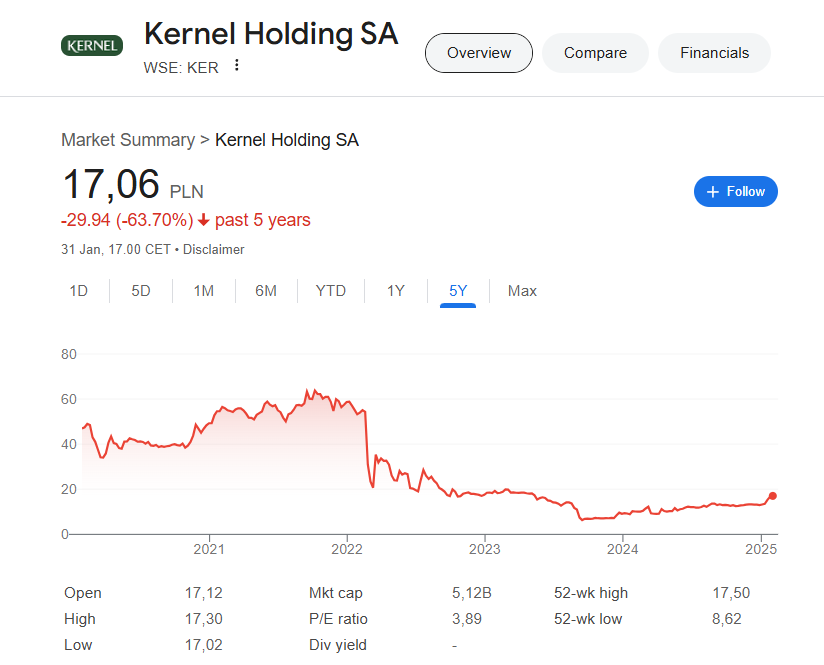
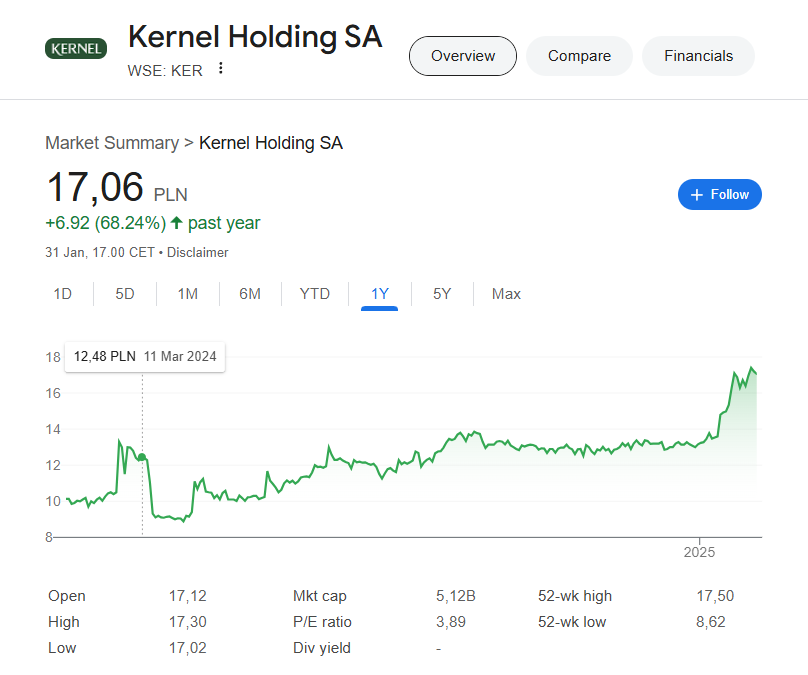
Well, it says there
“The Company is still in the process of delisting, which began in spring 2023, but it will be
completed once the Polish Financial Supervision Authority approves it. This approval is
currently on hold due to legal challenges from
8 minority shareholders, who collectively own
0.4% of the shares in Kernel and have contested the delisting decision in Luxembourg
court.”


Environmental damage caused by the war amounts to billions of euros. Lamor could therefore have many opportunities if/when the environmental damage is remedied at some point.
1 Like
In this matter, at least a few essential points should be considered:
-
Will the end of the war be permanent, or will a Trumpian “peace” encourage Russia to continue its military campaigns later, either in Ukraine or elsewhere in Europe? The dire warnings issued by Trump and his Secretary of Defense mean extremely harsh treatment not only for Ukraine but also for all countries bordering Russia (incl. Finland) and the sowing of seeds of future potential danger.
-
If some kind of peace comes, will relations with Russia normalize and in what way? One would expect some changes, but a return as if nothing had happened is quite unlikely. And Russia’s takeovers and seizures of Western companies during the war are strongly remembered. Property protection = 0 there.
-
Among individual companies, Finnair and Fortum could be highlighted. If overflights via Russia to Asia return, SuomiAiri would certainly get strong tailwinds. Asia was the company’s main earner.
Russia seized Fortum’s numerous energy plants (thermal power, wind power, hydropower) during the war, and a lawsuit is ongoing. Their value has been estimated at 3-4 €, which would mean a 20-25% boost to Forza’s current share price of about 14 €. Of course, one can ponder the condition of the power plants (e.g., when Porkkala was handed over to Finland, there might have been feces etc. up to the ceiling left by the Russians), but one would assume that basic operations like energy production were protected there. In my calculations, and as a cynical realist in this context, I would estimate a 2 € addition to the share price + improved dividend-paying capacity, both of which together are quite significant.
- When Volodymyr Zelenskyy visited Finland, he hoped for Finland to invest in education for Ukraine’s reconstruction, in addition to providing weapons. Besides supporting education itself, there would be much to fix in school construction, their design, building materials would be needed, etc. Finnish companies also have promising defense industry cooperation, e.g., in drone and satellite matters, but these companies are not (yet) listed on the stock exchange.
4 Likes
I could imagine that contracts are also awarded, remembering good supporters. Fortunately, Finland has supported Ukraine a lot relative to its size.
What a stroke of luck that I stumbled upon this thread. In recent days, I have been listing companies that could benefit from reconstruction. Here’s a link I shared in another thread: https://www.undervalued-shares.com/weekly-dispatches/rebuilding-ukraine-99-stock-ideas-for-a-peace-deal/
Polish stocks. They are likely to benefit due to their geographical location.
Budimex - Poland’s largest construction company
Stalprofil - Polish steel distributor. NET/NET.
Stalprodukt S.A - Polish steel producer. Negative cash flow and very capital-intensive business, but a very large net cash position. Just bought 10% of its own shares. NET/NET.
Selena FM - Manufactures construction chemicals, e.g., sealing adhesive. The company has focused on geographical expansion in recent years, and the earnings leverage could be surprisingly strong when the cycle turns. Currently expensive and has a messy balance sheet.
Kernel Holding SA - Ukrainian grain producer and trader.
Ferro SA - manufactures pipes and sanitary products.
Ulma - Simple construction site equipment. E.g., frameworks and similar.
Fabryka Farb i Lakierów Sniezka SA - Polish paint seller. In 2023, 10% of its revenue came from Ukraine. One factory on the Ukrainian side, on the Ukraine-Poland border.
European stocks.
Austrian construction companies have already experienced a full bull market due to Trump’s election. They have risen 40-60% in four months. Historically, the multiples are still not bad.
Strabag - The larger of the Austrian companies.
Porr - Smaller, but has a history in Ukraine.
Billfinger - German construction company focused on energy infrastructure construction.
Others:
Akzo, Henkel, and Arkema. Paint companies. Options available.
6 Likes
If Ukraine’s mineral resources start to be extracted from the ground, would there be demand for Metso?
1 Like
If and when peace comes, which construction companies from Finland will be in a strong position for the reconstruction of Ukraine?
1 Like
Probably hardly any, but rather losers due to rising construction costs.
20 Likes