Many people probably don’t end up emptying their portfolios because they invest for a longer term than, say, 4, 6, or 12 months. For emptying the entire portfolio and returning to the market to be more profitable than holding, one must successfully time sales, purchases, and take into account taxes, etc. Because of these, not many succeed in timing.
@Pohjolan_Eka certainly had good points in the text, but emptying the entire portfolio and returning after 4 months sounds quite hasty to my ears, but everyone has their own way.
I understand and agree with your thought that there are no clear upward drivers visible at the moment. In my opinion, emptying the portfolio could be a reasonable solution at this point if the shares were bought at roughly these ATH levels. However, if the portfolio contains assets, for example, from the March lows, and the purchase price is below the company’s fair value, I wouldn’t dare to bet that I would get those companies as cheaply anytime soon, if ever again. I understand that this is influenced by the individual’s wealth and whether they play more defensively or offensively, but the most essential thing, in my opinion, is what price one paid for their companies at the time in relation to the current business level. I don’t dare to radically predict macro in any direction myself; I play with probabilities and fine-tune the portfolio’s content in a defensive or offensive direction according to the prevailing situation
The purchase price shouldn’t have any impact on the selling decision (except for taxes), for example, I think dividends should always be relative to the current price, not the purchase price. Or we’ll get stuck in some “purchase price trap” where we couldn’t, for example, sell our revenues from a model portfolio, because it offers a 25% dividend yield on the purchase price.
On the other hand, if you manage to make such a move with the entire portfolio that you can buy the old ones back for about 10% cheaper, then you’ll be 10% ahead of your “non-trading-self” for the rest of your life. That is, you would have managed to trade the first 10% in the corona dip, but would have been involved in the remaining 20% or 40% of the dip. At that point, when your portfolio is, say, 1.1M or 11M, etc., the “non-trading” portfolio would only be 1M or 10M. Of course, this might backfire on the second or third trading attempt.
This probably depends on the types of companies chosen for the portfolio. However, you are a smarter investor when you make a portfolio selling decision when markets are high. If your anticipated scenario of a new economic shutdown and money printing materializes, the ratio of production to money supply will weaken, leading to inflation. However, the good thing about stocks is that companies’ business operations adapt to inflation. For indebted companies, inflation is even a good thing.
You can’t get returns from interest rates because central bank actions prevent it. In my opinion, in these allocation decisions, it is essential to know the limits of central bank power. The central bank’s task is not to annoy bond investors but to support economic growth through monetary policy. Due to the high indebtedness of society, interest rate growth even in an inflation scenario does not seem likely. This is a rather peculiar bull argument for stocks (the most hated bull market ever).
My allocation at the beginning of the year was 100% cash when markets were high. I bought half the value of stocks during the corona dip in March-April. I imagined that the decline would continue longer. Now, again, I am in a situation where I cannot find stocks that meet my return requirements. However, the companies have mostly done well in the corona crisis, and I don’t consider any of my three companies overvalued to the extent that I would want to sell them. So, I am also prepared for a market downturn.
Yep, generally timing the entire market is really difficult (actually impossible): that’s why moving the entire portfolio at once is a risky move. Overall, stock investing is probably easier when decisions are made on a company-specific basis, not based on macro-level analysis, although macro should not be forgotten in the background. It has relevant effects on many companies.
Often, the best returns are made by holding monstrously good companies for long enough: it doesn’t hurt much if you don’t believe in short-term growth drivers if the long-term factors are in order. The global economy has not been permanently ruined by this crisis (either). This too shall pass. Thus, I don’t see it as contradictory to hold stocks even if you don’t believe in a rise for even a year or two, if taxes and other factors penalize sales, plus, as stated, it’s possible that the market won’t behave as expected and getting back in proves difficult, impossible, or in the worst case, it’s done in FOMO after a big further rise and then it crashes!
That’s a good point and deserves a longer reflection.
I would say that in the New Economy, people believed (as I understand it, I didn’t invest then, of course, but I was probably building LEGOs, which was a good hobby too) in super bright future prospects. As I understand it, in the financial crisis, the Fed’s decision to let Lehman fail came as a surprise, as the Fed had saved all sorts of things since the banking crises of the early 1980s, 1987, 1998 when LTCM blew up, etc. A good reminder that authorities don’t always act as expected, but it perhaps also taught the Fed what kind of storm would come if a TBTF was allowed to collapse uncontrollably.
Now, people don’t believe in any new economy, but mostly hope for the economy to return to the satisfactory level of 2019. Admittedly, in the tech sector, things are moving fast, and certainly for many companies, expectations will prove too optimistic, but the market as a whole is not a party. Investors are still quite selective. The sentiment is, in some places, already a bit alarmingly cheerful, which makes me cautious too.
Yes, the stock market still looks at results, at least in most cases. Good reminders though, that stimulus isn’t always enough to raise prices. Now, stocks are not entirely detached from fundamentals either (forward P/Es are elevated, but those figures are still reasonable for the entire market level compared to the IT bubble, for example).
I would see, and this is my own perspective and not an official Inderes view, that the continuation of stimulus and thus some kind of preservation of the stock market’s earnings level is more likely than a retreat from stimulus, which would be a fiasco for the stock market. That risk is still good to keep in mind! Markets rarely crash when all tubes are connected to the patient. Cutting the tubes would, of course, be an unpleasant plot twist…
And stimulus isn’t a magic cure forever either: sometime, no one knows when but sometime, a peak will be reached where inflation rears its head. Then many things will get messed up. The risk is perhaps unlikely now, but it is perceptible nonetheless.
So stimulus, both fiscal and monetary (i.e., central bank stimulus), is not without long-term risks, and they are not magic tricks for eternal happiness.
I would decline it, and the reasons are partly above, but I’ll summarize a few here. And these are my own points; everyone has their own investment horizon and style
a) A big drop feels (no one in the stock market has certain knowledge of anything, so the word “feels” is probably an honest choice) unlikely, although I wouldn’t be surprised by a 20% correction either. But by a big drop, I mean a >30% drop.
b) There is a possibility that if/when uncertainty clears after the elections and more stimulus pours in, the stock markets will rise further.
c) Getting back in is not easy if the price level is higher than expected: macro-level forecasting is impossible, and the stock market can behave contrary to one’s seemingly rational assumptions.
d) There is a genuine possibility that, ironically, zero interest rates, stimulus, etc., could drive the stock market into a bubble. Being out of the market means missing that option entirely.
e) My own companies in the portfolio are such that it’s fine to sail in black waters with the majority.
P.S. I guess this discussion can continue in this thread. I, for one, would be happy if such an army of skeptics attacked my stock picks every time I opened my portfolio.
So here it is, after 3 months of practice, I’ve found a portfolio with which I’ll continue the work more systematically. Along the way, I bought a total of 19 different companies, but today I cleared out the remaining small positions and transferred some into these. I still have a bit of cash on the side.
Index Funds
20 %
Smart Eye
13 %
Kamux
12 %
QT
9 %
Harvia
8 %
Tokmanni
8 %
Kone/Cargotec
7 %
Genovis
7 %
Sampo
6 %
UPM
5 %
Citycon
4 %
The funds are about 20% and the slightly duller dividend/value stocks are about 40% of the total. The remaining 40% is then in the QT/SE/Genovis/Kamux axis, from which good growth is sought. These will be topped up in roughly the same proportion for now, with the goal of getting the portfolio to five figures by spring.
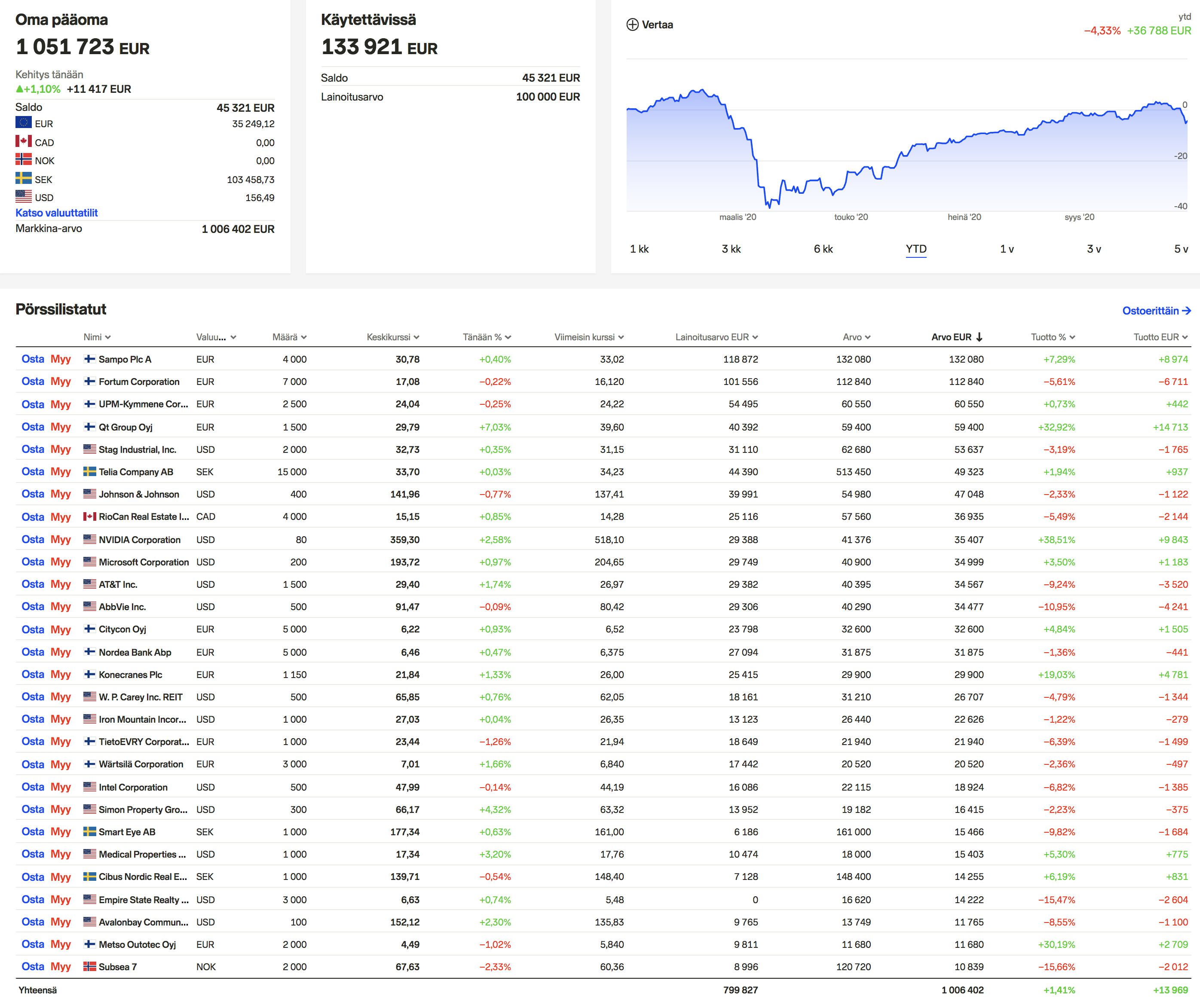
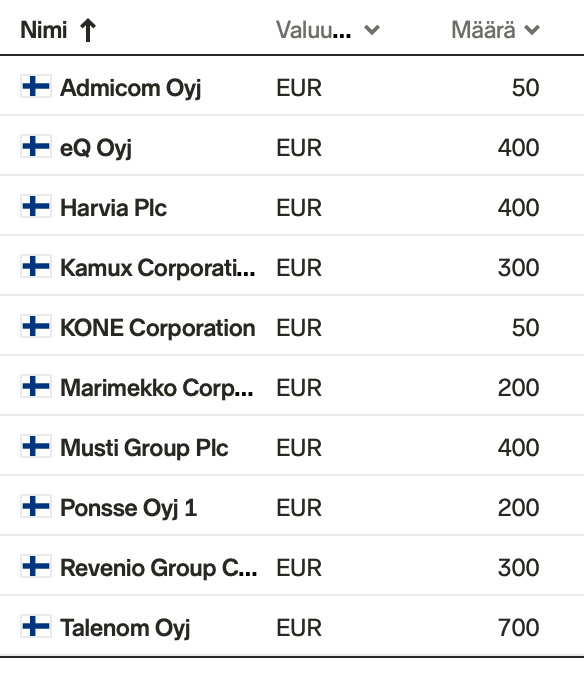
Now that the market has dropped, I’ve bought more, so my portfolio’s market value is finally 7-digits. The estimated dividend yield next year is about 55,000 euros. Previously, my cash share was over 300,000 euros. If the market drops another ~10% from current levels, I’ll also put my 100,000 euro Supercredit into stocks.
The value of my non-listed investments is over 250,000 euros. Among these, PYN Elite is especially noteworthy, as it has performed exceptionally well since the beginning of August.
Now the portfolio is starting to look good to my eye Future acquisitions still include at least Qt, which I’ve been watching for too long without buying any
I started this hobby in May.
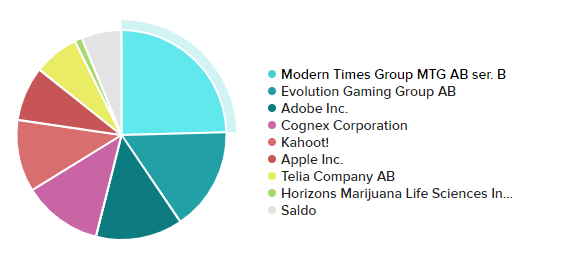
Efecte 15%
Kahoot 7%
Fortum 12%
Metso Outotec 18%
**Smart eye 26%
Kamux 11%
The rest is cash
The intention is to gradually increase holdings in Kahoot, at least, and should I also invest in hydrogen? Now would be a good time to open positions.
**Smart eye’s share is so large because it went from 125->160.
When dividends alone start to be +50k /year, maintaining a dividend portfolio starts to make sense. With less capital, it’s better to take more risk and invest in growth companies and megatrends to someday reach that 7-figure mark and be able to drink piña coladas in billabongs for the rest of your life
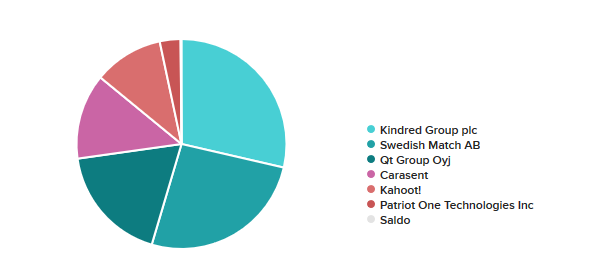
This is what my own portfolio looks like at the moment. I’m reasonably satisfied with my portfolio and have confidence in the companies. The intention is to keep the portfolio relatively small in terms of the number of companies, and so far, I’ve stuck to that goal. The next purchases will be outside the domestic stock exchange, probably some US-focused ETF.
That’s how it is here. There’s a slight overweight in a couple of Swedish companies and the cash position has decreased significantly over the month (approx. 40% → 6%). In hindsight, I could have waited a bit with last week’s purchases. On the other hand, the goal is to hold the investments for a longer period.
The plan is to add at least MSFT and Alibaba as new holdings. Possibly, Bittium, SE, Zaptec, and a Lithium & Battery tech ETF will also be acquired for the portfolio. Telia is on the trigger.
Pat & Carasent are likely to be sold off by the end of the year if I don’t find a reason to continue holding. The first one was tuition fees, and the latter was pure bandwagoning. Lightening up on Swedish companies would surely be a valid idea, in terms of diversification, but it would be foolish to sell good companies (?).
I have a somewhat similar situation, but with some cash and dividends around 15k EUR.
The transformation to dividend payment should come from the dividend growth of Qt, Talenom, Kamux, IT services, and of course I still have Sampo and Fortum in my portfolio, but I didn’t put them there to sit on them; I bought about 100k positions in both in the spring, and now they are worth a total of 130k…
Renewables don’t really generate any dividends.
But hopefully in about 2-3 years, the dividends will be naturally higher. Waiting for Qt dividends!
However, now I’m watching Sampo’s share price with a magnifying glass, and Fortum too, I guess that 1.1 EUR dividend is on solid ground.
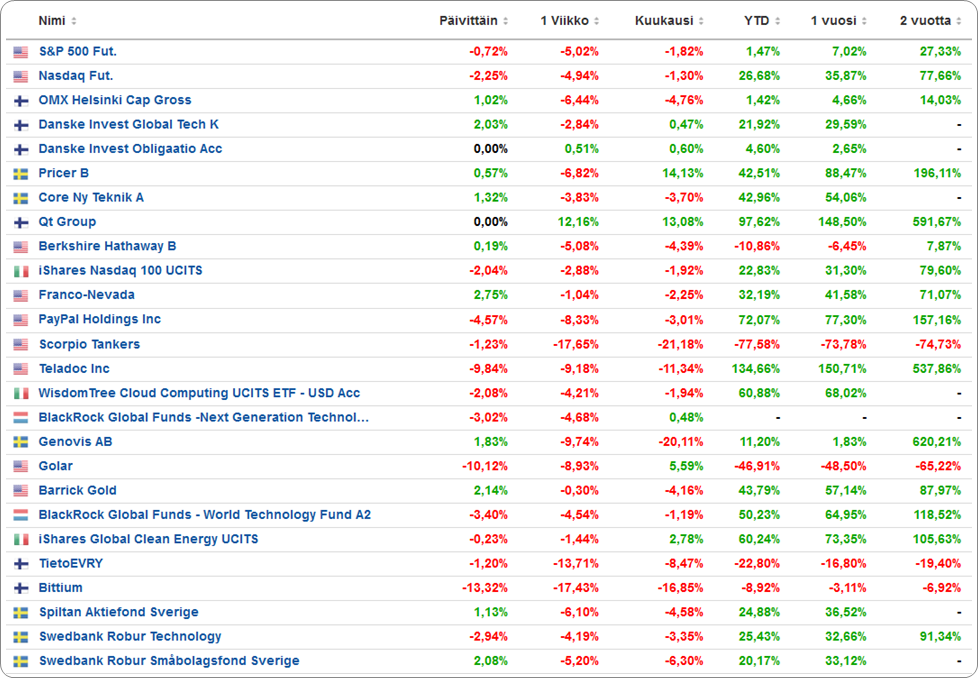
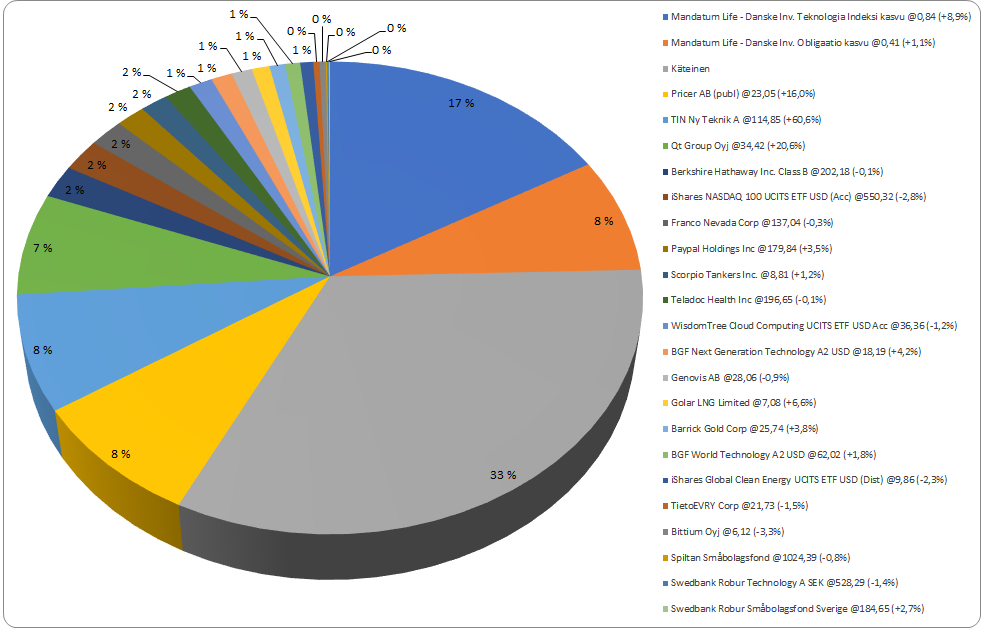
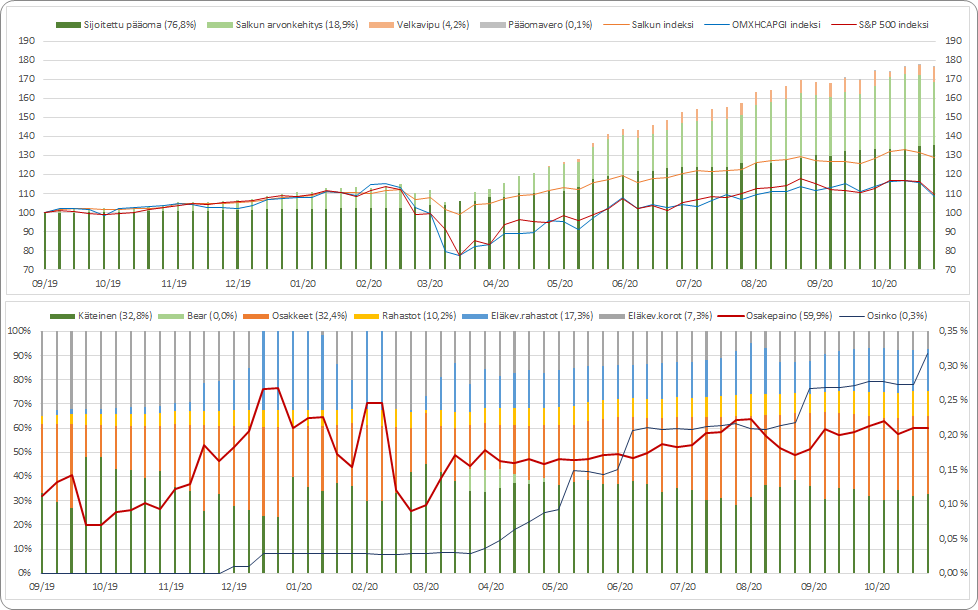
September is over, and that’s a good reason to push a portfolio report out. The weeks of September would have been excellent given the circumstances, but I just had to trade Nokia with leverage before the earnings report… hopefully, I learned my lesson!
Pricer and Qt, the top names in the portfolio, performed well in their Q3 reviews, and I increased my holdings in both as they dipped along with others in the last days of the month. Kamux, the third larger holding, was sold, in hindsight, perhaps too lightly. The Bitcoin ETF, which accounted for about 3% of the portfolio, also exited the portfolio after its stop-loss was triggered following the latest ATH (All-Time High) figure. The funds released from Kamux and Bitcoin were invested in small increments into the American section of the portfolio, as well as into funds. The equity weighting of the portfolio thus remained at similar levels, around 60%.
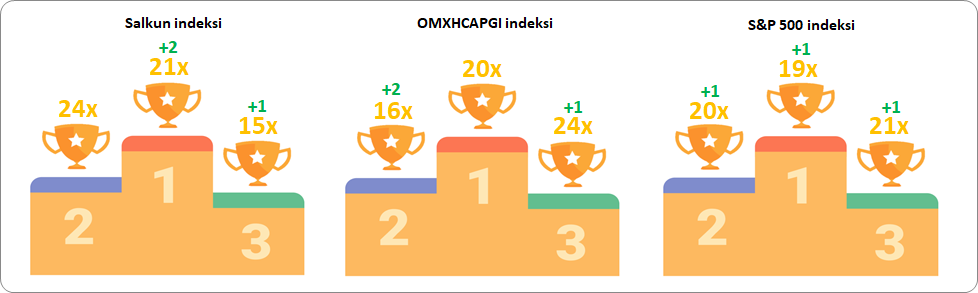
In the weekly index competition, my portfolio index wiped the floor with the benchmark indices. Although these weeks of decline feel mentally challenging, there is comfort in outperforming the benchmark indices. In three weeks, my portfolio’s index score decreased by -3.07 points. OMXHCAPGI decreased by -8.10, and S&P 500 by -6.96 points.
Edit: A fun observation: currently, Mandatum Life holdings + Cash is almost exactly the same sum as the total portfolio value since the start of tracking (09/2019).


 Future acquisitions still include at least Qt, which I’ve been watching for too long without buying any