What do you have in your portfolio?

First post on this forum.
This was a good game in that it sparked thoughts about the contents of my own portfolio and led to the conclusion that there might be too much diversification in my stock portfolio. The plan going forward is to gradually add all mentioned stocks and sell at least Super Norja from the portfolio.

The entire investment portfolio currently includes:

Real Estate 22.9%
CapMan 9.7%
Metsäliitto A-shares 8.4%
Superfund Denmark 7.6%
Revenio 6.7%
Superfund Finland 6.7%
Superfund Sweden 6.2%
Superfund Norway 4.1%
is3n ETF 3.5%
Automation & robotics ETF 2.5%
Nasdaq 100 ETF 2.5%
Small cap Europe ETF 2.4%
Qt 2.3%
Seligson Europe 2.2%
Eurostoxx 50 ETF 1.9%
Smart eye 1.7%
Upm 1.7%
S&P 500 ETF 1.7%
Small cap USA ETF 1.1%
Neste 0.8%
Sampo 0.7%
Global x robotics & AI ETF 0.5%
Harvia 0.5%

In addition, there is approximately 18% cash relative to the portfolio size, which is “in the pipeline” ready when new opportunities arise, perhaps next time in real estate, and of course, diversifying into the stock market over time. However, I don’t find it meaningful to include cash in the portfolio calculation because that money doesn’t yield anything in the account.

Edit: a few typos.

6 Likes

If one has a very strong view that oil companies have been thoroughly hammered and valuation levels are only temporarily at rock bottom, then this is essentially the opportunity of a lifetime if one believes in oil.

Of course, this requires nerves of steel and guts. Many things can go wrong in such a move. Nerves might fail, leading to panic decisions, oil might be permanently beaten down and in decline, or one might exit the position too early, resulting in a modest return despite the incredibly high risk.

I wouldn’t dare to act this way, but if I did, I would vow to myself not to touch the position for five years.

1 Like

I understand the rules (this is a what’s in my portfolio thread), but I’ve received so many questions.

As mentioned, most of my investments are tied up in apartments. In addition, I always have a relatively large “safety net” of cash.

So, if my entire investment portfolio and cash are taken into account, oil companies probably make up 5%. Even though it’s 100% of my loose stocks.

It’s really important for me to “get on the pulse” – to follow for half a year/a year and read everything possible about the industry. You’re right that it would be almost the same to invest everything in one company as to diversify in similar ones. I did consider doing this with Shell, but by diversifying, I get a little time if, for example, an earnings report goes wrong for one. I get reaction time.

I would buy other companies, but I haven’t gotten comfortable with dividend taxation in any other countries besides the Netherlands, GB, and the USA. I would need help with this? Any other oil companies where dividend taxation might work?

It might sound like a crazy waiting game, but in 2008, I promised myself that the next time Carnival collapses, I’d be all in. News articles after that collapse were about how everyone didn’t invest when the company’s entire value was a fraction of its ships (though few are buying them). Well, half a year ago, it went exactly like 2008, and I waited for the offering, bought, waited two weeks, and sold.

Nearly 0% stock growth would be enough for me if the dividend stays above 5%. When enough dividends have accumulated, the company can drop quite a bit before I’ve made a loss overall.

Oil companies perfectly met my needs. They are likely to drop from this situation or stay flat, but with a 7% dividend, if they don’t just collapse, it’s in line with my investment plan.

I’m usually where no one else would be with a long stick; I’ve operated this way for 10 years. It’s worth noting that my opinion on stocks can change very quickly, and I make relatively large moves if I sense an opportunity or a threat.

What worries me most is the exchange rate of the pound and dollar, more than the stock price of oil companies. Brexit and the stimulus package could drop values. I prefer the Shell Netherlands euro stock the most.

5 Likes

In this case, there’s no need to worry. If stocks are just diversification from the housing market, then all except real estate stocks offer that. If the short-term development of oil companies doesn’t keep you up at night, this could be an excellent target. At some point, oil consumption is likely to recover. I’d guess that oil companies largely follow the dollar, as oil prices are determined by it. They might also have currency hedges, but that would need to be investigated. Many people diversify a small portion (1-5%) into gold and/or Bitcoin if the worst-case scenario of banknote printing collapses fiat currencies.
I have one percent in Bitcoin in an interest account that yields about 4% annual interest. I haven’t acquired gold yet.

Shell has cut its dividend by 66%, have you noticed this? Otherwise, the high dividend yield of oil companies is currently questionable and not necessarily on a sustainable basis unless demand recovers soon.

Has anyone done a comparison of how much the global oil giants have realized they are energy companies that get the best profits from renewable energy? Cf. e.g. Neste & Fortum.

At the turn of the millennium, a Mr. Raimo Ollila was on Shell’s board preparing the company for a green transition. Did that not produce results?

Juurikki is asking silly questions again, as he hasn’t had time to follow things for a few decades.

2 Likes

You should ask that here Energia-alan teknologinen kehitys ja sijoitusmahdollisuudet - #338 käyttäjältä viljo - Talous & markkinat - Inderes forum

or here Energia-alan ja vetysektorin Q&A - #22 käyttäjältä Pohjolan_Eka - Sijoittaminen - Inderes forum

1 Like

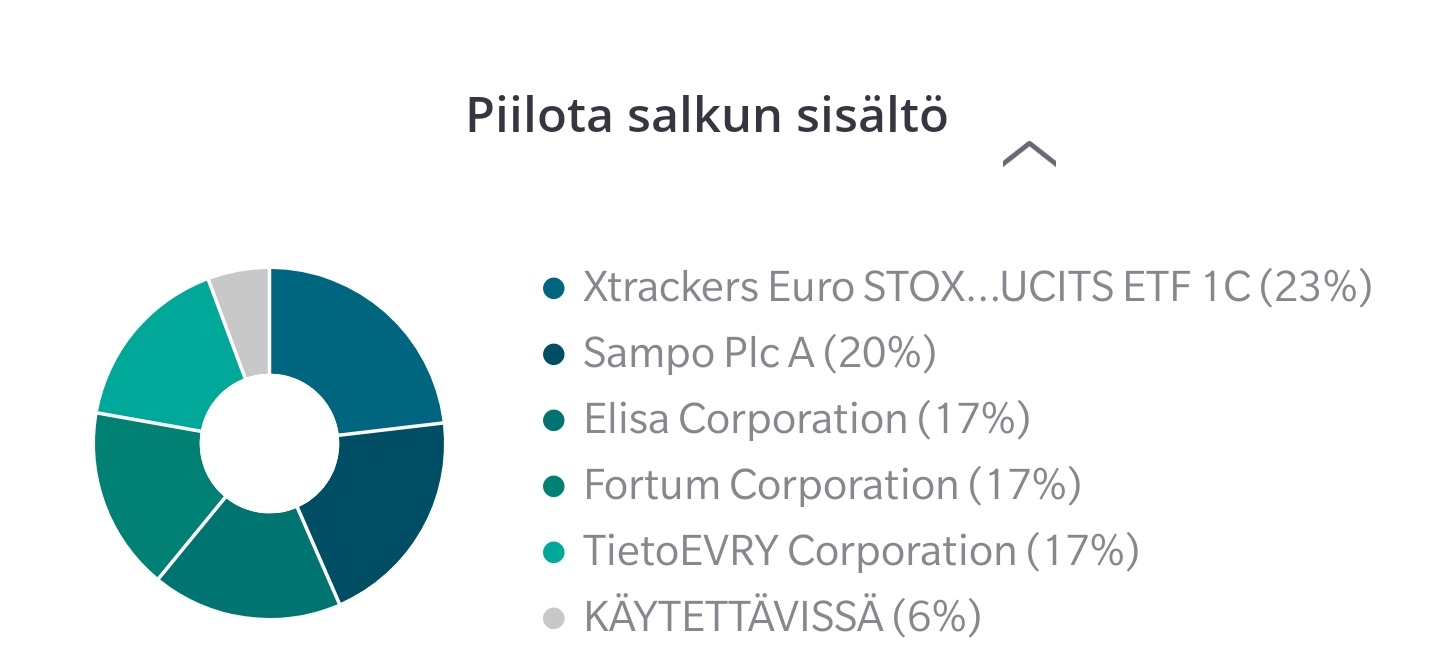
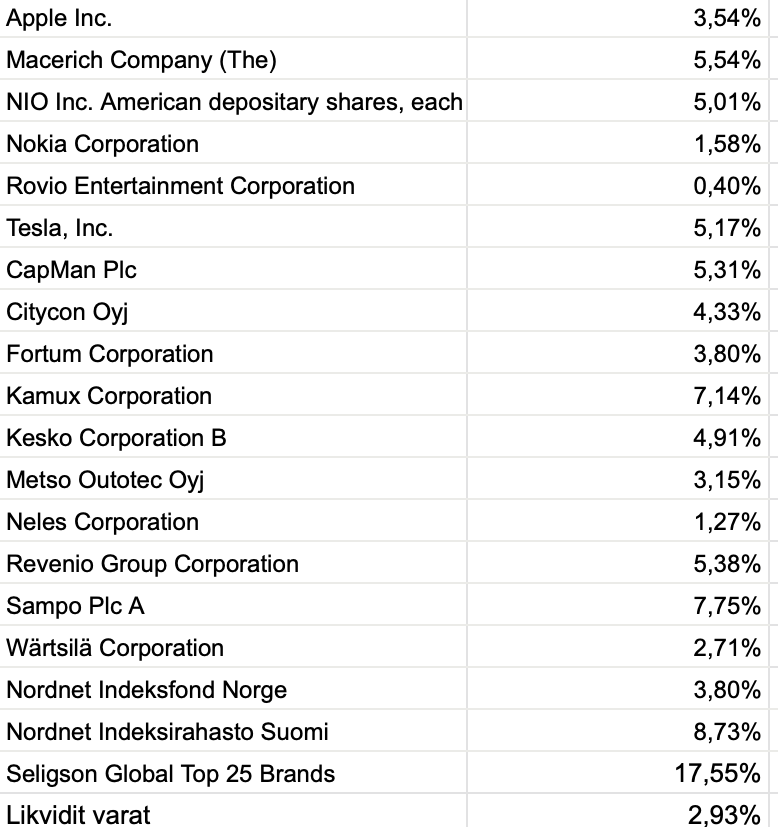
Greetings! The distribution of my own portfolios looks like this. Cash is admittedly quite low right now, which is a bad thing. More geographical diversification is also needed.

13 Likes

@Pohjolan_Eka just took the words out of my mouth and managed to describe my investment strategy and its current phase word for word, so I won’t go into more detail.

However, my strategy only follows this part; after that, our paths diverge :smiley:. Of course, current valuations raise my eyebrows a bit, but I’m not going to try to guess the market’s direction in the short term. I’ve noticed that mistakes made by acting completely against one’s own strategy hurt the most. I can live with it if prices dip, for example, 20%, but it would be much harder if I acted against my own strategy, sold everything with the idea that I would buy back cheaper, but prices rise 20% while I’m sitting on cash.

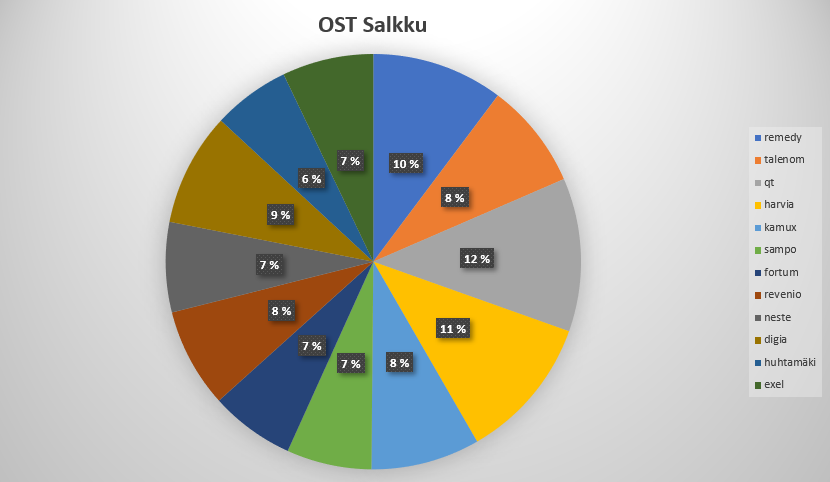
For the past few months, I’ve had an almost obsessive goal of fully funding the equity savings account opened during the March dip. Today that day came, as the account was fully deposited down to the last cent. With today’s dip, I made the last planned purchases into Sampo and Fortum, and this is how we’ll proceed. The intention is to hold this portfolio through the upcoming years’ (hopefully decades’) rises and falls. No changes are expected in the portfolio, other than adding with dividends or if the company’s story significantly changes over the years, and the grounds for long-term holding are no longer the same. The portfolio’s content is a mix of growth and value companies, stable dividend payers, and growth rockets.

The portfolio’s content is relatively evenly distributed; it remains to be seen how the coming years will shape the portfolio’s structure. Now that I no longer need to save for the OST (equity savings account), I plan to do something I’ve never done before in my investment history: start accumulating cash. My equity weighting has always been 100% from day 1, but now the intention is to really start increasing the cash weighting so that the same thing doesn’t happen as, for example, last March, when I had nothing to buy with.

A slight relief came today when the last pennies were put into the OST, and I no longer need to waste thoughts on filling it as quickly as possible. In the future, saving will take place at a relaxed pace into the AOT (traditional brokerage account), but I’m not tying up money in stocks for a while, unless we take such a deep dip at the end of the year that my fingers start itching too much. My goal for the next few years is to acquire a similar portfolio in the AOT as I currently have in the OST, meaning precisely the same stocks there, which I will then gradually add to over the coming decades. I will also adjust the portfolio’s weightings by adding to the AOT in the future; selling is not part of my strategy.

AOT also has the plus that sometime in the distant future, it can be used to leverage a superloan. Even if that loan doesn’t go into stocks, it still provides the security that cheap money is always available. An equity saver’s benefits, financial peace of mind, are guaranteed without even having to sell holdings. Even if the equity weighting were 100%, thanks to that superloan, one can maneuver if, for example, a car change or a similar project is planned.

My really long-term goal is to retire from working life and start living on dividend income, but the next 23 years (until I turn 50) will tell more about the success of this goal.

38 Likes

The justifications were good (as one might expect :smiley:) I was mainly wondering, remembering what was in your portfolio, if it was a bit of a radical move to go completely to zero. :slightly_smiling_face:

Otherwise, I definitely recommend trying a large cash weighting (I’ve had 60-70% for a long time) mainly because it forces you to fight perhaps the most difficult area of investing, namely FOMO. I think this will be beneficial in the long run.

10 Likes
  1. The biggest problem with election forecasts is that one of the underlying assumptions, fair play, may not necessarily hold true.

  2. A price drop is never evenly distributed. Instead, in at least the medium term, we will see interest shift from high-growth companies experiencing massive collapses to boringly safe value companies. Their prices will, of course, rise, because even if their prices increased 3–5-fold, they would still offer a better return than interest-bearing investments.

5 Likes

There’s more cash available, but that’s for potential bills this week. I’m looking into adding more Fortum, among other things. :nerd_face: This is the plan for now, we’ll see where the future takes us :thinking:

7 Likes

First of all, hats off for the bold move, but I would like to ask a few questions, if only to raise the level of criticism on the general forum. Nothing is better for an investor than challenging questions, and nothing is as destructive as numerous likes that reinforce one’s own views. :wink:

Yep, none of us do, and that’s why one might ask, why sell everything at once instead of “diversifying” over time?

A rather bold assumption at this stage. Usually, the outcome of elections hasn’t been that precise, as long as some clarity emerges regarding the political situation. The economy is wanted to be kept on track regardless of whether Trump or Biden wins, one way or another.

Why should states “save” if a) the entire rest of the national economy (households and businesses) is saving due to the recession and b) central banks are firing on all cylinders? Developed economies have massive arsenals to inject more debt stimulus (=create more wealth for the private sector) if only the political will exists. The market lends at a low interest rate, so the decision is in the hands of politicians. That is likely the biggest risk…

I’m not saying the vaccine would be an instant miracle cure, but the market seems to have the patience to wait for it even a couple of years from now, given the lack of alternatives. The near-term pitfalls are covered by stimulus packages: we can march over them.

I’m not very bullish myself anymore, quite the opposite: the current market doesn’t entice me to buy anything! :smiley: But on the other hand, a radical move to sell everything at once also feels wrong: there needs to be a 30-40% correction for that to be somewhat alright from a tax perspective, depending of course on one’s recent returns. Such a correction seems rather unlikely, at least in the current light, unless politicians really go on an austerity drive and central banks reverse course. Politics, institutions, etc. are always part of the market, and most often their decisions have been favorable for the market globally over the past decades, even if in Finland people like to shout about such anti-business sentiment. :roll_eyes:

As a 30-year saver, I still hope that your move is correct and that the stock market valuation would decrease: these are admittedly not optimal times to save in stocks. :frowning:

80 Likes

I personally sold my entire stock portfolio (for the first time ever) last December because I thought the valuation was too high at the time. I started repurchasing during the COVID-19 dip. At the moment, I would absolutely not sell my portfolio empty because money is being printed at an unprecedented rate, and I believe that a large portion of that printed money will eventually flow into stocks.

23 Likes

A commendable thought, but you’re still talking about the consequence, not the cause. What if it was worth changing the perspective and stopping buying/selling stocks motivated by the hope of a rise or the fear of a fall? So what should buying and selling decisions be based on?

Simple and easy: the desire to buy a share in a company that is sure to have both good and bad ahead. The username’s trader reference, of course, reminds us that this is exactly how Juurikki once thought.

2 Likes

Hydrogen and other energy economies are strongly represented in the portfolio. Especially PLUG, but I believe in it strongly, so I won’t significantly reduce it. Of course, profits are harvested during large spikes.
Plug Power 49.14%
NEL 16.63%
Siemens Energy 3.59%
Handels Kestävä Energia (Sustainable Energy) 0.42%

In the pharmaceutical industry, Geno is the oldest stock in my portfolio. The average price is around 6 SEK. The others are newer acquaintances. I will likely only increase Revenio.
Genovis 2.94%
Revenio 4.24%
Arctic Zymes 2.65%

I intend to exit this position as soon as we make some profit. Hopefully soon.
SPAQ 5.30%

Potentially profitable, at least for a medium-term hold.
Evo Gaming 2.08%

Valmet is a strong player. I will acquire more at good entry points.
Valmet 2.33%

I intend to invest more in REITs in the future, aiming for around a 20% weighting in the portfolio.
Riocan REIT 4.24%
SmartCentres REIT 2.12%
WP. Carey REIT 1.86%
Federal Realty REIT 1.97%
I have been considering the overlap of the first two Canadian REITs; I might sell one and replace it with something else for better REIT diversification.

6 Likes

Good points.

It’s undeniable that investors are leaning exceptionally heavily on central banks and politicians to keep the economy afloat through the coronavirus crisis.

I don’t doubt central banks’ will to keep the system standing. Politicians’ motivations, ideologies, etc., vary, but if stock markets and the economy start to slump sharply again, I’m sure the motivation for new stimulus packages will emerge from Washington D.C. to Berlin and Beijing.

I don’t believe that financing deficits is a problem because the private sector is currently saving so much, and thus funding for states is available (except perhaps for the riskiest players in developing countries). Here, it’s important to understand that by stimulating and incurring large deficits, the public sector actually “creates” wealth for the private sector and enables households and businesses to stay afloat and strengthen their balance sheets during the crisis. Not everyone understands this dynamic (many seem to have a great passion for entering a negative deflationary spiral by immediately closing public sector deficits, not realizing the terrible impact this would have on the rest of the economy…). However, the coronavirus is an external enemy, and in a dire situation, there seems to be enough political will to prevent a recession if the situation worsens significantly.

So, fiscal policy is a bit of a question mark, but if stimulus continues, the situation will be tolerable for the entire economy, and thus for the stock market as well. Of course, stimulus is never perfect, and there are also many losers, as there should be in such a semi-market economy. But in aggregate, the current state of affairs adequately protects company earnings.

In theory, the entire economy could be shut down for five years, and GDP could still nominally grow if there’s enough stimulus. :smiley: In practice, of course, that would be more complex, and we’d have many winners and losers. But it’s good to ponder that scenario while waiting for a vaccine…

Well, that’s enough about the high-level macro picture. :smiley:


I agree that it’s difficult to find drivers for growth in the stock market currently. The factors I mentioned above are keeping the economy together, but without further stimulus (which seems to be constantly delayed), there’s a lack of drivers for further upside. On the other hand, since I invest with a 5-10 year horizon, it’s not that crucial to me whether the stock market lacks drivers in the 2-3 year range, as long as there’s no major crash in sight (of course, I can’t predict, so crashes will always come as a surprise to me :D).

It’s important to remember that crashes usually occur when everyone has positioned themselves for “eternal growth” and then the rug is pulled out from under them (à la 2000, 2008). To top it all off, it takes a long time to initiate stimulus measures, as crises hit full force before they appear in statistics and sufficient consensus is reached to start stimulus. Now, despite occasional over-enthusiasm, investors seem quite timid and more forced to stay in the game. At the same time, we are very aware of the nature of the crisis at hand, and therefore stimulus measures are relatively ready and waiting around the corner.

We all have our own time horizons, but you’re planning to return to the market fairly soon if the idea is to return for next spring’s dividends. :smiley:

In addition, let me just say that I’m also challenging my own thinking by discussing your theses. :wink: I accept your points, and we agree that there are not many drivers for upward movement in the near future. Still, it’s a very drastic move to sell everything. I’m much more skeptical about my own timing skills. :smiley:

Addendum 2: when I gloat about public sector deficits, I primarily mean large economies and economic blocs such as the United States, China, the Eurozone, etc. Finland’s deficits combat recession in Finland, but the profits of Finnish listed companies mainly come from elsewhere, so Finland’s economic policy is not so “just so.” Of course, for domestic market companies like NoHo, Kesko, etc., a few nails would be hammered into the coffin if tomorrow Marin announced that the budget deficit would be closed next year. That might also indirectly hit the incomes of several savers on this forum, but for our larger international listed companies, the Finnish economy is a drop in the ocean among others.
19 Likes

I think there’s a small mistake here. According to my calculations, this example represents the maximum possible capital gains tax one would have to pay in any situation.

  • Stock A.
  • Ownership period less than 10 years.
  • Value increase over 400%.

So, the acquisition cost presumption can be set at 20%. The tax amount is 80% * 30-34% = 24-27.2%. This is also the threshold for how much the stock market would have to dip for the trade to be profitable.
In no case can the capital gains tax be higher than this, but it will almost always be lower.

2 Likes

Warren Buffett did the opposite in 2012:

He had bet a million dollars against hedge funds in 2007, and the million dollars was financed with a U.S. Treasury bond with an interest rate of 4.56% per year. In 2012, the value of the bond had risen so much that its future interest yield was only 0.88% per year. At that time, the S&P500 index’s dividend yield was 2.5%. According to Buffett, this was an “extraordinary valuation mismatch between bonds and equities.” The solution: the bonds were sold and the money was invested in the stock market (Berkshire shares). The result was that instead of one million, 2.2 million dollars were given to charity.

Buffett’s point was that if a guaranteed 0.88% annual return is offered for the next five years, it doesn’t take much genius to beat it. I see that you are now making a similar move but in the opposite direction. Interesting thinking!

PS. This reply can also be moved to another thread if Pohjolan Eka’s comment is moved :slight_smile:

2 Likes

And further, from a risk perspective, Buffett considered that 0.88% annual return risky, not risk-free. Even 1% inflation would have made the real return negative. More precisely, he wrote:

“By that standard, purportedly “risk-free” long-term bonds in 2012 were a far riskier investment than a long term investment in common stocks. At that time, even a 1% annual rate of inflation between 2012 and 2017 would have decreased the purchasing-power of the government bond that Protégé and I sold. I want to quickly acknowledge that in any upcoming day, week or even year, stocks will be riskier – far riskier – than short-term U.S. bonds. As an investor’s investment horizon lengthens, however, a diversified portfolio of U.S. equities becomes progressively less risky than bonds, assuming that the stocks are purchased at a sensible multiple of earnings relative to then-prevailing interest rates.”

5 Likes