What do you have in your portfolio?

France
Airbus SE
OSE Immunotherapeutics SA
Peugeot Invest Société anonyme

Netherlands
Akzo Nobel N.V.
BE Semiconductor Industries N.V.
Fugro N.V.

Canada
Altius Minerals Corporation
Amerigo Resources Ltd.
ARC Resources Ltd.
Dynacor Group Inc.
McCoy Global Inc.
Methanex Corporation
Orezone Gold Corporation
Pembina Pipeline Corporation
Suncor Energy Inc.

USA
Amazon.com, Inc.

Finland
Atria Oyj
Kemira Oyj

Sweden
Concejo AB (publ)
Softronic AB (publ)

Germany
Deutsche Beteiligungs AG
Francotyp-Postalia Holding AG
Henkel AG & Co. KGaA
Kontron AG
M1 Kliniken AG
TUI AG

Italy
Italian Wine Brands S.p.A.
Stellantis N.V.

Denmark
Novo Nordisk A/S

Portugal
Semapa - Sociedade de Investimento e Gestão, SGPS, S.A.

Belgium
Sofina Société Anonyme

Spain
Tubos Reunidos, S.A.

Here is my current portfolio regarding direct stock investments. In addition to this, I also have ETF funds, but I’m not really sure what to do with them. It’s possible that I will build this investment portfolio into one purely focused on value stocks.

Each company has its own target price already set, and when it’s met, I sell. Then I invest the money + profit from the sale into a new investment, and off we go again. There are a total of 32 companies currently.

14 Likes

Portfolio Review 25H1: Excellent Start to the Year

The investment year has progressed well so far, despite a lot of political turmoil and fluctuation. Nordnet’s YTD shows +14.2%.

Sales from the portfolio: Neste, Berkshire, Markel
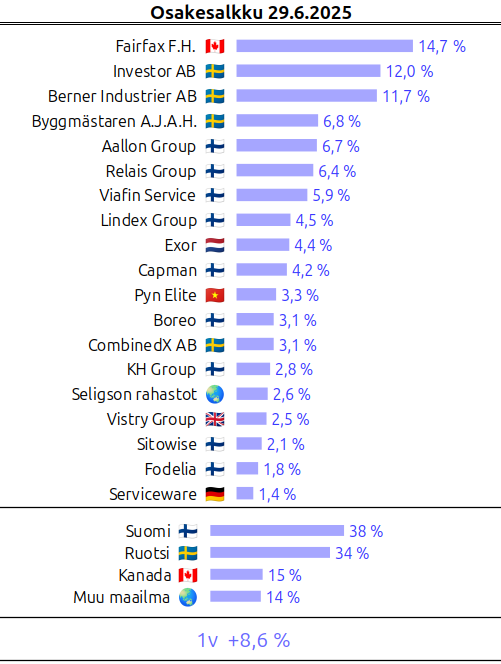
Purchases: Exor (new), Fairfax (addition), Investor (addition), Byggmästare (addition), Boreo (addition), Relais (addition)

In Neste’s case, I decided to invest the funds elsewhere. Berkshire and Markel, on the other hand, are excellent companies. Due to political uncertainty, the dollar’s decline, and high valuations, I decided to divest all US investments, i.e., the aforementioned companies. I bought Exor as a new addition to the portfolio. Exor’s automotive business is currently suffering somewhat from Trump’s tariff decisions. Let’s see where the tariffs eventually settle. Exor’s NAV discount is significant, around 50% at the time of my share purchase. The company sold Ferrari shares worth 3 billion and bought back its own shares for one billion, which corresponded to 5.5% of the share capital. 2 billion is still available for investment, for which the company is looking for a new investment target.

I made small additions to Investor, Fairfax, Byggmästare, and Relais because I thought the shares were cheap. If Relais isn’t at rock-bottom prices, it’s at least affordable when looking at the valuation after the pending acquisitions are completed. Debt has accumulated a bit more due to the acquisitions. In investments, low indebtedness is always more comfortable than high. In Relais’s case, the situation is understandable, as the business is based on continuous acquisitions, and the latest purchase is not small. Due to the low valuation of the stock, it is not attractive to use a lot of its own shares to finance the deals. Byggmästare’s investment company discount was over 20%, and I thought it was a very attractive opportunity to buy more. Byggmästare received a significant amount of cash when selling part of its largest investment (Safe Life) to another investor. Now there is a lot of money to put into new investments. So, a somewhat similar situation to Exor. Boreo’s situation has also improved, and the company’s earning power is recovering, which justified a moderate addition to myself.

Diversification ideas have changed during the spring. New investments are currently largely going to Europe or Canada. The USA is not a must for me in this situation. Valuations are high. Previously, one was willing to pay for a stable and efficiently operating investment market. Now the situation has changed for the worse. In Europe and Finland, the valuations of several companies are attractive, and there’s no need to bear dollar risk either. I don’t have new investments in sight, but I might make small additions if shares fall again at some point.

e: Neste removed from portfolio graph

image

57 Likes

With those returns, one would probably dare to put the portfolio on Shareville too. Surprisingly few dare to :slight_smile:
Banks and insurance companies have also performed well this year, but I don’t have them in my portfolio. So, I’ve underperformed YTD once again. Many older investors probably have traumas from them from back in the day (1992), and the fact is that their balance sheets are difficult to read. In the US, they also collapsed in 2008.
Indeed, I don’t have any of the same stocks as the previous ones. It’s interesting how people’s brains end up with completely different stocks. Among my top 6 investments (all from Shareville), as many as four are the same as in Inderes’ model portfolio. Given the recent returns of the model portfolio, it’s perhaps not surprising that no one would want to advertise owning them. I have still tried to include both clear value stocks and growth companies in my portfolio; they work well perhaps at slightly different times. Nokian Renkaat and Rapala have a very low P/B. Tietoevry is a value stock that also has a growth option in software, while QT Group (though not in the top 6) is probably the most convincing growth company in light of recent years’ figures, even though its share price has fallen.

US small cap value ETFs don’t feel expensive at all, perhaps on par with Finland. The stocks that are talked about the most are then expensive in terms of figures. However, that doesn’t tell you anything about where you should invest. Stocks are a strange hobby (compare it to tennis, for example); the time spent doesn’t necessarily correlate with skill at all. A complete amateur who bought Apple 15 years ago because they liked their Apple phone has beaten most professionals, or probably all of them :slight_smile:

14 Likes

A quick 2025 Q2 portfolio update would be timely again, even though the US stock market is still open for a couple of hours.

Evolution gaming 9.9 %
Qt 5.5 %
Puuilo 5.5 %
Svenska Handelsbanken 5.5 %
Revenio 5.3 %
Talenom 4.9 %
Sampo 3.6 %
Tractor Supply 3.6 %
Harvia 3.5 %
Gofore 3.2%
Atlas Copco 2.5%
Nokian Renkaat 2.5 %
Sandvik 2.5 %
Tieto 2.3 %
Berkshire Hathaway 1.3 %
Fastenal 1.0 %
Vaisala 0.7%
ADP 0.4 %
Graco 0.3 %
Nordea 0.3 %

Cash/fixed income investments 12.2%.
Funds and ETFs (Seligson, Pyn Elite, Splitan, EUNL, EUNK, IUSN, Seligson & Co OMX Helsinki 25, XACT Norden) 21.3%

New investments in portfolio: XACT Norden
Additions: Atlas Copco, Sandvik, Qt, Evolution
Sold: -
Reductions: -
Short-term trades: -

The portfolio’s cash/fixed income position has slightly decreased during the quarter to 12.2%. The intention is to gradually put more cash to work. One new investment, XACT Norden, entered my portfolio during the quarter. The idea for this new ETF came to mind when I was following Novo Nordisk’s recent development and its share price drop. I didn’t want to invest in it directly, but the thought occurred to me that I could invest in it through a new ETF suitable for my portfolio. Novo Nordisk’s share in XACT Norden’s portfolio is 12.55%. I added Atlas Copco and Qt to my portfolio in several tranches. I also picked up a bit of Sandvik from the April dip. Evolution’s share price dropped enough that I decided to catch the falling knife one more time.

The theme for the rest of the year in the portfolio will continue to be the gradual increase in the share of ETFs and funds. At this rate, their share in my portfolio would be approximately 24% at the turn of the year. I will continue with the same theme next year as well.

I am currently monitoring the development of 3-5 companies a bit more closely. Not all of them will necessarily still be in my portfolio a year from now when I write the next portfolio update. However, I am not in any great hurry with them. The appearance of new positions, on the other hand, is not as likely, as my goal is to reduce the number of direct investments in my portfolio. Of course, if share prices in the USA drop a bit more, quality company/companies might find their way into my portfolio.

Let’s also note here that the median P/B 2025 for Finnish companies followed by Inderes, calculated from Inderes’ website, is 1.75 (P/B 2026 median 1.66). Inderes has 16 buy recommendations and 7 sell recommendations. CNN’s Fear & Greed index was 65 (Greed) at the turn of the quarter.

19 Likes

Portfolio Review H1 2025

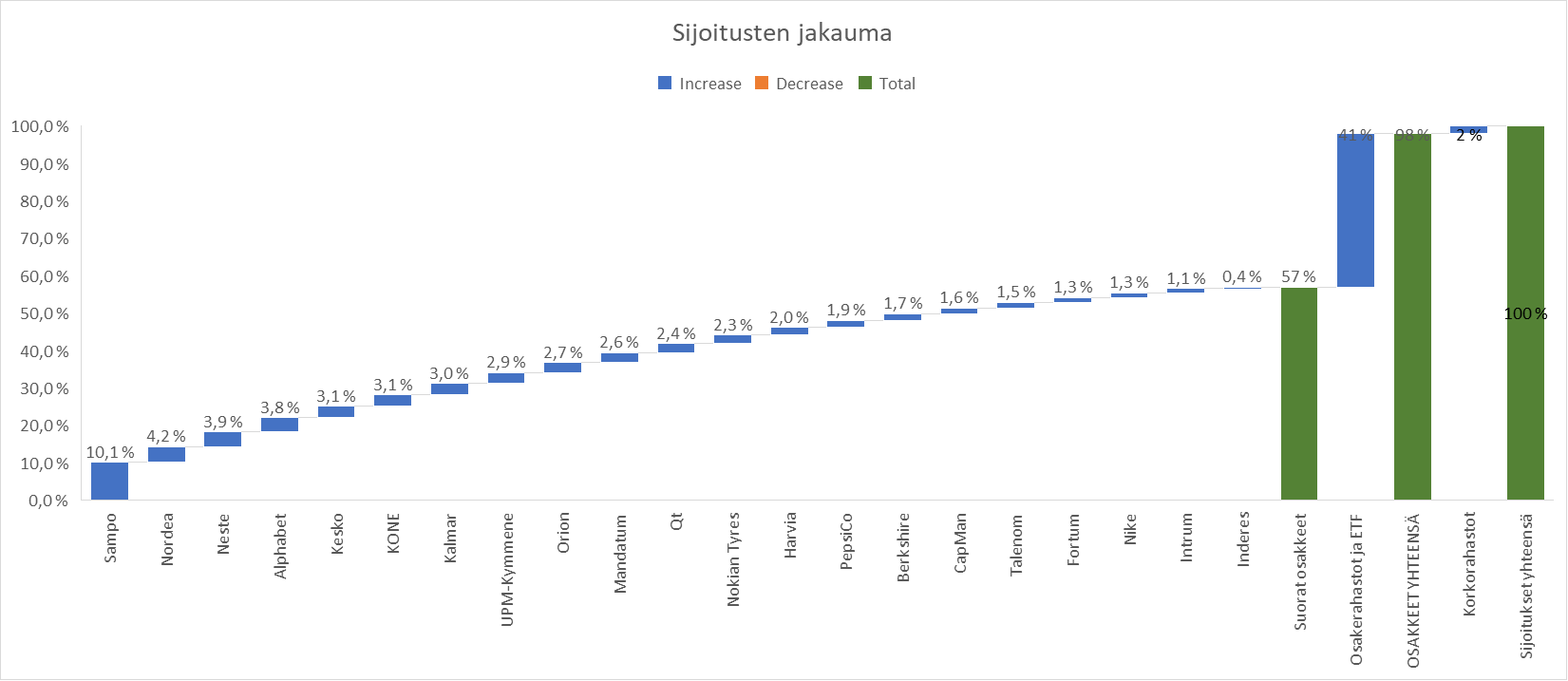
During the beginning of the year, many purchases have been made, especially in the Finnish stock market, but also in the US. Fund and ETF purchases have also continued as usual monthly + a few extra purchases when the market dipped in April. I reduced bond funds and shifted weighting to stocks.

New to the portfolio:

  • QT, Pepsico, Nike

Additions:

  • Alphabet, Nokian Tyres, UPM, Kalmar, Talenom, Capman, Neste, Inderes

Reductions:

  • Kesko and bond funds

image

Return has been approx. +9.5% in the beginning of the year.
A personal annual record has been broken in received dividends, and a few more dividends are coming during H2.
During H1, the Private Banking doors also opened at Nordnet.

25 Likes
Company Share
Fairfax Financial 41.4 %
Linamar 11.4 %
International General Insurance 7.9 %
AerCap 4.9 %
Investor B 1.6 %
- -
Canadian oil companies 6.8 %
Nicotine companies 6.6 %
- -
Cash 19.5 %
Total 100.0 %

YTD +2.88 %

Q2/2025 was a different kind of quarter. I spent by far the least amount of time on stock picking and pondering it in years – simultaneously both an excellent and a terrible quarter for such a change. It’s a minor miracle that with this much effort and decision-making, we managed to end the quarter in the black, but the age of miracles is not over yet.

Sales, Q2:

Last year, I implemented strict stop losses as part of my investment strategy. Well, as a result, the portfolio experienced an absolute hellish storm when Trump started to stir things up – almost all newer positions (Exor, NewtekOne, a few additions made to AOT in the spring) hit their stop-losses. In addition, in the same turmoil, I manually sold off some companies (Secure, Valeura). Why? The reasoning I wrote in a private conversation at the beginning of April is shown in the quote below.

I left the first group of my previous portfolio allocation in the portfolio (Fairfax-IGIC-PMI-Investor), and sold everything else. […] now, from a sleep-policy perspective, the only right option was to sell everything that wouldn’t withstand time and Trump excellently. Was it an optimal move? Hell no. Did it feel like the right move? Yes.

I already knew then that perhaps I shouldn’t have made the sales. But in the investment strategy – as erratic as it has been – it is unequivocally stated that if stock positions disproportionately affect daily life, relationships, or mood, then the stock weighting should be reduced, regardless of whether returns are achievable in some corner of the market. It’s all the same: I wasn’t going to sleep poorly because of oil company stock prices.


Brief comments on portfolio companies:

Fairfax: Q1 was a strong defensive victory even after the California fires. Operational performance remains at a high level, and I added to the stock a couple of times on dips. The position size is starting to be comical, but when the company’s performance and share price development are of this magnitude, let it grow. It is no longer blatantly undervalued, but the long-term value creation components are so well in place that there is no reason to start selling yet. Including dividends, my initial purchases have approximately quadrupled in three years.

Linamar: One solid success also occurred on the buying side when I managed to fish Linamar back into the portfolio almost from the bottom. In Q1, operations were in slowing markets, which varied from soft to utter destruction depending on the segment, but the company defended its profitability and ended up growing its earnings compared to a year ago. Looking at the Industrial segment’s figures, it’s hard to understand how this company can trade at the cost of fixed equity and 6x this year’s earnings estimates.

I’ve said this before, but I see similarities here with Fairfax’s investment story – an unpopular company, profitability under pressure, a long-term approach, an aim to expand business into different sectors. And when the initial valuation is this low (from my purchases P/E 5, P/B 0.55), the position is deservedly larger. The company’s buybacks have been on hold, which is a big change compared to the brisk pace at the beginning of the year – hopefully, this foreshadows acquisitions, as the balance sheet is strong and there would be enough liquidity for acquisitions that develop the investment story. If the development continues to be promising, the position will grow significantly from its current level.

IGIC: Q1 was slightly soft due to increased catastrophe losses, but almost every company in the sector reported that story. That’s the main thing. The stock price has remained stable, I added a little to the stock from current levels. P/E 9, huge net cash, capital returned – no problems.

AerCap: During the quarter, the British court ordered AerCap to be paid a billion dollars in insurance compensation for equipment lost in Russia in 2022. That gives the company more firepower for buybacks. Otherwise, nothing particularly new to say about the company. Still the best in its field, still cheap, still superbly managed.

Investor AB: This is still in the portfolio. Nothing more to say about it.

Then, different reporting.

Nicotine companies: Philip Morris got a friend in its portfolio – surprise, surprise – BTI, as I wanted to increase exposure to nicotine pouches. The company had previously been in the portfolio with good success – hopefully, round number two goes just as well. BTI’s valuation is deservedly about half of PMI’s due to its product portfolio, but a 10 percent free cash flow yield is a rather cheap price tag for Velo and the company’s other pricing-power brands. Dividend people should also like it.

Since there are unlikely to be huge changes in the investment thesis for either company, I will write about them together in the future. I have also been researching a third company in the sector, which will join the group later – if it is to join. Perhaps more on that someday.

Canadian oil companies: Canada’s well-managed, long-term, and lowly valued energy companies will be found here in the future (Valeura, Strathcona, IPCO). There are plenty of affordable names available in the sector, so owning just one name is not necessarily the most sensible solution. Free cash flow yields are at best around 15-20 percent, and even for higher-quality companies, we are talking about double-digit figures – not a bad deal in the current market, even if commodity prices fluctuate.

By the way, selling IPCO last year has proven to be a mistake, but fortunately, Valeura’s strong performance before April somewhat compensated for the damages.


At the beginning of the year, I expressed a cautious wish for about 5-10 percent positive development for this year. That can still be achieved quite well, but it’s no secret that the year could have gone better. However, I don’t know if anything other than a faster recovery from the April turmoil could have been achieved with this effort – who knows.

Valuation levels in the market are sky-high, but fortunately, they are still very moderate in my own portfolio (weighted 2025e P/E approx. 10.4). If I owned hype companies, I would be watching the situation with excitement, but fortunately, I don’t have to. :grin:

Let’s revisit this in September – hopefully with profitable results.

35 Likes

Salkku 1.7.

After years, another portfolio update here; here’s the situation this morning, July 1st.

Over the past year, I’ve finally bought stocks from the big US, which has proven to be an absolutely excellent decision. Previously, I already made good profits with HIMS, and although the timing of the sale was frankly terrible, that money has been successfully put to work in AMD, SoFi, and Evolution. Among fintech firms, NU also ended up in the portfolio with a relatively small weighting earlier, and together with SoFi, I had thought of these as an “ETF” since I couldn’t choose between the two.

Among companies from our western neighbor, I still have strong confidence in Verve, even though a small reduction was made in the spring. Further west, Magnora and Elliptic Labs have, frankly, been somewhat of forum speculations, whose business I understand too little about, but then again, the weightings aren’t very large either.

Among Finnish companies, I could mention NoHo, whose performance seems to be consistently good, even though it hasn’t been reflected in a rocket-like surge in its stock price. Is it a good investment or not? I don’t know. My thoughts on LapWall are very similar.

The portfolio is quite small, just over €40,000 right now, and returns from recent years (3-5 years) would certainly have been better with index investing. OP’s return curves are what they are, but intuitively, the development over the last year has been clearly better than before, and as a hobby and a tool for self-development, this is truly unparalleled activity.

Thanks to the forum and happy summer to all!

26 Likes

It’s been a good six months since the last portfolio update, so for fun, I punched the updated portfolio review into Excel again. The contents of the portfolio currently look like this, in descending order:

Stock Portfolio Share Return
Handelsbanken USA Index 27.1 % 48.7 %
Hims & Hers Health Inc A 8.1 % 98.4 %
Games Workshop Group 4.5 % 10.7 %
Harvia Oyj 3.9 % 69.8 %
Puuilo Oyj 3.2 % 58.6 %
Texas Roadhouse 3.2 % -3.5 %
Applied Materials 3.1 % 9.1 %
Vaisala Oyj A 3.0 % 8.6 %
Qt Group Oyj 2.9 % -15.9 %
Olvi Oyj A 2.9 % 8.6 %
Revenio Group Oyj 2.8 % 4.0 %
Remedy Entertainment Oyj 2.8 % -18.8 %
ASML Holding 2.7 % 4.9 %
Mettler-Toledo International 2.6 % -19.3 %
Paradox Interactive 2.5 % 8.7 %
LapWall Oyj 2.5 % 6.5 %
Marimekko Oyj 2.4 % 16.8 %
Visa 2.4 % 10.9 %
S&P Global 2.4 % -8.8 %
Uber Technologies Inc 2.3 % 26.5 %
eQ Oyj 2.2 % -27.6 %
Evolution 2.0 % -6.5 %
Titanium Oyj 1.9 % -43.3 %
MSCI 1.9 % -9.5 %
Applied Nutrition 1.7 % 1.7 %
Medpace Holdings Inc 1.1 % -4.0 %
Canatu Oyj A 0.7 % -13.4 %
Betsson B 0.5 % 25.8 %
Nordnet 0.4 % 0.0 %
Cash 0.2 %

I’m still going with a very strong growth and quality angle. The portfolio’s YTD is around 5%, which I think is a good situation because my benchmark index (iShares Core S&P 500 ETF USD Acc i.e. SXR8) has returned -6.8% since the beginning of the year, and a large portion of the investments are in dollar-denominated securities, which has caused quite a nasty headwind for the portfolio’s returns this year. I actually have about 11% in cash, but this is sitting in a buffer fund waiting for a “rainy day” and I don’t intend to invest it in stocks, so I left it out of this portfolio review.

I currently have 28 direct stocks. Compared to the previous review, the following stocks have left the portfolio:

  • Admicom
  • Orthex
  • F-Secure
  • Nike
  • Fenix Outdoor
  • Björn Borg

Orthex, F-Secure, and Admicom left the portfolio due to uncertain growth prospects as I tried to clear out companies I considered to be the “weakest”. Similarly, Nike, Fenix Outdoor, and Björn Borg also left partly for the same reason, and partly because after long consideration, I came to the conclusion that brand value is, in my opinion, one of the weakest moats for a company. For example, network effects or switching costs (embedded systems or similar) are much stronger moats in my opinion, so I have tried to invest in these types of companies. Also, fundamentally, I consider data services to be a more attractive business than “selling goods”; a clothing retailer has to sell more junk to grow revenue, but a data service provider does not. However, I still left Marimekko in the portfolio, partly because it’s a good domestic company, and partly because I believe its business is on a slightly better footing than, for example, Nike’s.

The following stocks are new additions to the portfolio:

  • ASML Holding
  • Applied Materials
  • Evolution
  • Applied Nutrition
  • Medpace Holdings (monitoring position)
  • Canatu Oyj (monitoring position)
  • Betsson B (monitoring position)
  • Nordnet (monitoring position)

I somehow always manage to find interesting things to buy as I decide to part ways with stocks. Here are a few thoughts on the new additions:

I started exploring Canatu, which then led me to explore the semiconductor industry. I believe the semiconductor industry has a good future and growing demand. Artificial intelligence and, on the other hand, various embedded systems coming into all electronic devices are certainly driving up the demand for the semiconductor industry. After studying various companies in the field for a while, I found 2 companies suitable for my portfolio that have strong competitive advantages and, in my opinion, a tolerable valuation level, and thus I ended up buying ASML and Applied Materials.

Applied Nutrition is a lesser-known, small British dietary supplement manufacturer that went public late last year. I believe that even though the supplement side is a fiercely competitive industry, the underlying market will grow for years to come, and such a small and agile player with a good historical growth and profitability is quite a potential investment in my opinion. If this sparked your interest, it’s worth reading the following article, where Pentti Jokinen reviews the company quite well in my opinion: Applied Nutrition - Kasvuhakuinen lisäravinnebrändi Briteistä | Sijoitustieto.fi

Evolution and Betsson came into the portfolio because I wanted to get in on the gambling industry, which I believe will be a strongly growing market in the future as well. Evolution has had problems in the recent past, but I believe they are temporary and that’s why I bought a bigger chunk around 800 SEK. Betsson and Nordnet came into the portfolio as a very small slice because I don’t think they have been particularly attractively priced, so I’m waiting for a better entry point or will gradually increase the position with dollar-cost averaging. Same situation with Medpace, even though the stock has recently been available cheaply in my opinion, I still thought I’d start with a small slice and calmly monitor the situation, especially since the business is showing small weaknesses.I am quite satisfied with the portfolio’s composition and the number of holdings at the moment. Although new holdings have been added, these have primarily been funded with new money, which I haven’t added to the portfolio all that much because my buffer fund needed replenishing. I have tried to allocate the money from sales into the portfolio’s “winners,” i.e., older holdings whose businesses (and share prices) have moved in the right direction (Hims, Games Workshop, Harvia, Vaisala, Puuilo, etc.). Naturally, it’s tempting to add money to the portfolio’s “losers” or “falling knives,” such as Remedy, Titanium, and eQ, based on valuation, but I won’t be adding more than small sums to those positions until their businesses turn around in the right direction and earnings return to a growth trajectory.

I quickly calculated that over half a year, I have sold 12% of the portfolio as a whole, meaning that based on that, the portfolio’s annual “churn rate” is around 24%, which means the average holding period is 4 years. I’m quite happy with this, considering how eventful the beginning of the year has been in the market. I didn’t really sell anything during the tariff panic, and I believe that things will be quieter on the sales front in the portfolio over the next six months anyway.

Here are a few more thoughts on some of the stocks I own:

Hims has grown to a fairly heavy overweight compared to other stocks, but on the other hand, I consider it one of the most potential stocks in my portfolio. Strong profitability and growth, huge total addressable market. During the tariff dip, I added to the stock on a couple of occasions, once at around $33 and once at around $26. Even though I occasionally feel like trimming after price surges, I have decided to let the winners run as long as their business is heading in the right direction and I believe in the company’s future. A slightly tightened valuation is not a reason to sell the stock, in my opinion. If the valuation skyrockets to some completely absurd level (like a P/S of 100), then I will start considering selling the stock based on valuation. You can’t get 10-baggers or 100-baggers in your portfolio any other way than by sitting on your winners.

Special mention also goes to Games Workshop, whose business has chugged along excellently over the past year. The future also looks good, demand exceeds supply, and a new factory is possibly being completed next year. Astartes 2 and the series made by Henry Cavill will certainly bring a lot of attention to Warhammer, and even though it’s quite a niche, I don’t think this company is anywhere near the point where it won’t be able to acquire new fans for Warhammer.

One of the most interesting stories on the Helsinki Stock Exchange in recent years is definitely Puuilo. This company is a fun example of the fact that to achieve good growth and profitability, a company doesn’t need to ride the crest of the wave of high technology or AI. It is enough to have a well-thought-out concept, know your customer base, and execute the strategy well.

Uber is an interesting stock. It has performed really well for me over the past six months, but it carries a really high “disruption risk” through autonomous driving. Owning Uber is also a kind of bet against Tesla, which historically hasn’t perhaps been very sensible. However, I believe that the most probable scenario is that Tesla will not get autonomous driving to work in the time and scale that is currently believed. I believe there won’t be a single winner in the industry, and I believe that Uber’s network effects and platform will have a place in the future of autonomous driving as well. On the other hand, I would still like to sell this stock because this disruption risk is quite realistic and possible and could erode Uber’s entire business, but since the company’s business has historically moved in a good direction, I probably won’t sell this until there are real signs of the company’s business eroding. As long as the company delivers growing free cash flow every quarter, there’s no point in jumping off.

I have always considered the asset management sector to be the most attractive industry on the Helsinki Stock Exchange: high profitability; on the other hand, revenue growth can come from two avenues: either through sales growth or through the growth of AUM (assets under management). How many companies can grow their revenue without selling a single thing more? Titanium and eQ have, in my opinion, been the highest quality and most interesting companies in the asset management sector on the Helsinki Stock Exchange, but the risen interest rate level and Finland’s real estate sector problems have not treated these stars of past years well. My own belief is that we are very close to the bottom for these businesses (and share prices), and a return to earnings growth will happen next year at the latest. Somehow it feels like now one should buy these in a big way, but I have come to the conclusion that a much more sensible strategy is to wait for the business to turn around before starting to put new money into them. Let’s put new money now into those companies in the portfolio whose businesses are already heading in the right direction.

I just thought I’d quickly write a few lines of text about the portfolio’s contents, but this kind of accidentally turned into a really long post again. At one point I thought I could go through all the companies in the portfolio one by one, but that would probably turn into a novel that no one would bother to read. Maybe I’ll leave that for December when I review this year, if I do my next portfolio review then and can’t think of anything else to write.

The strategy for the rest of the year will probably be to continue along the old familiar lines: for the most part, sit on my hands and do nothing. If anything is sold, it will be companies whose business is not heading in the right direction. A tightened valuation is not a reason to sell, and on the other hand, I am not willing to compromise on quality for a cheap valuation. Fortunately, the buffer fund is now in a shape where I don’t need to put money into it, but the irritation and lesson from the tariff panic was that it would be good to have 5-10% of the portfolio in cash waiting for good buying opportunities, so for the rest of the year I will only make small periodic allocations, and I will leave the rest of the money saved from salary income as cash until at least 5% of the portfolio is in cash.

28 Likes

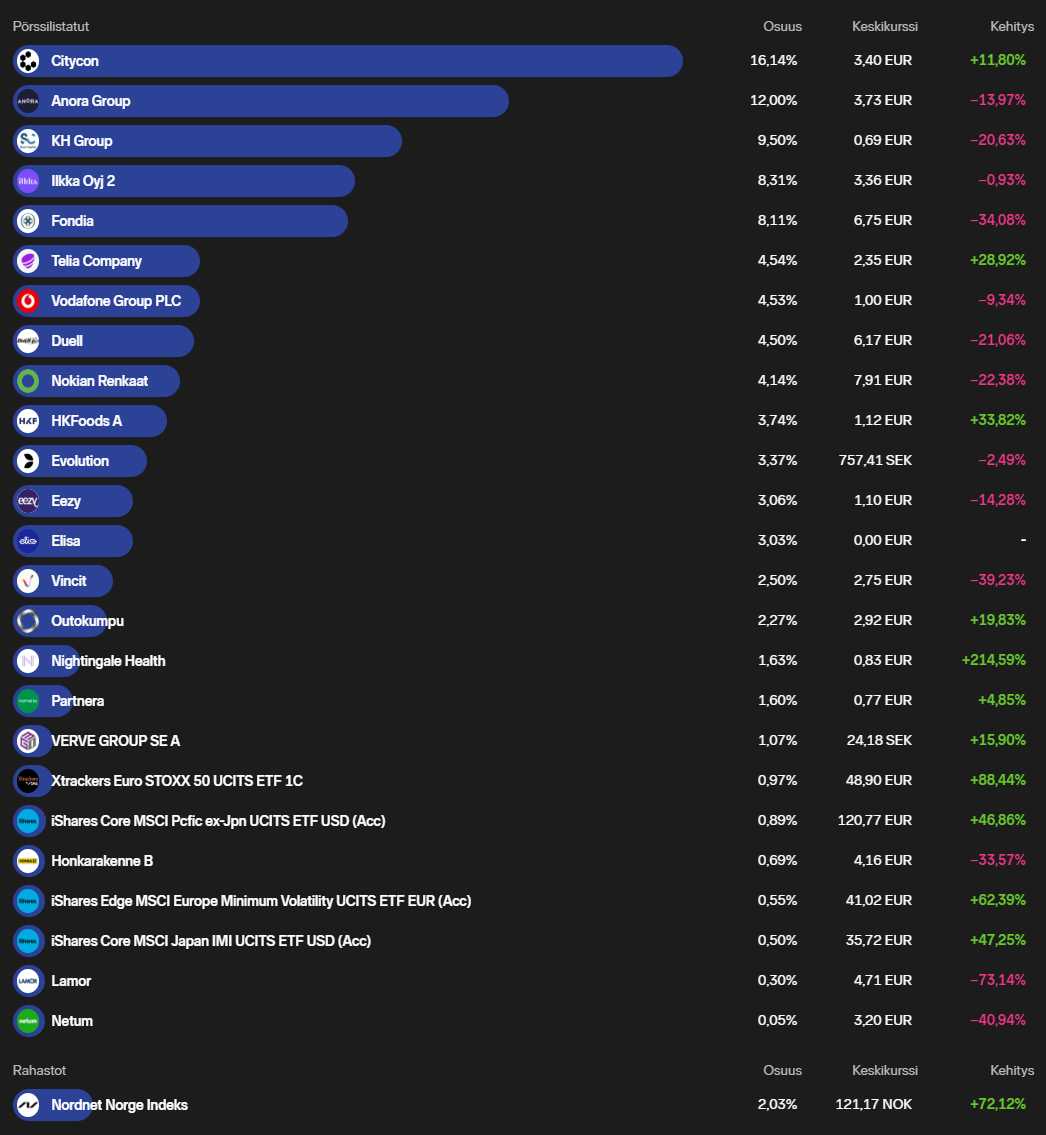
Traditionally, here’s the easiest quarterly update: the current portfolio content. The biggest changes, such as Duell’s collapse (due to the share price collapse), and the trades can be found on Sijoitustieto’s blog (I’ve also posted in the buy/sell thread).

salkunsisältö01072025

19 Likes

Salkku
Let’s start the forum thread with my own portfolio. Many investment years still ahead, so I’m going with a relatively high risk. Over the years, the intention is to shift more towards indices.

Faron: I still have faith, even though it’s a bit stressful to have this in the portfolio.

Nebius: A dark horse bought during the spring dip (avg. price 20.15 USD). My data center + AI bet.

Evolution: A company that has been beaten down. The numbers speak for themselves + insider purchases.

Verve: A great business that has captured the market well + insider purchases.

Nexstim: An industry with high demand in the future (and currently as well).

Zaptec: Electric car sales are growing in Europe, and the company has embarked on conquering Europe.

Denison mines & Uranium Energy: I have faith in the future of nuclear power. These were selected from other uranium stocks due to their good financial situations.

Optomed: A complete lottery ticket. There’s been good buzz around the company this year, so I’ve joined in with a small amount.

ETFs bring some diversification to the portfolio, and the intention is to hold them forever. Currently, I’m saving occasionally into NASDAQ. The portfolio’s line count is now full, and the plan is to monitor these at least until the end of the year while also looking for good buying opportunities.

37 Likes

Updating portfolio status. Most notable things since the last review:

  • BBS went bankrupt, but still shows up on the securities account.
  • A share savings account has been opened alongside the securities account, where I buy equal-value share lots (in euros), each lot always 1/20th of the initial capital.
  • Currently, there is more cash than usual, but some of it should always remain as cash for various acquisition needs and life’s surprises.

Overall, the portfolio’s content is certainly very familiar domestic basic fare for forum members, so I won’t elaborate further this time either.

Fri 30.06.2025 closing:

Securities Account
Valmet 12.6 %
Wärtsilä 9.6 %
Faron 9.4 %
Orion 7.6 %
Outokumpu 6.7 %
UPM-Kymmene 6.7 %
Optomed 6.4 %
Kemira 6.3 %
Metsä Board 6.0 %
Vaisala 5.9 %
Metso 5.3 %
Apetit 4.6 %
Ponsse 3.3 %
Kempower 3.1 %
Raisio 2.4 %
Revenio 2.2 %
Herantis 1.6 %
BBS 0.3 %

Share Savings Account
Faron 4.6 %
Huhtamäki 4.7 %
Optomed 5.4 %
Outokumpu 5.3 %
Valmet 4.8 %
Cash 75.4 %

Small unlisted holdings:
Aina
Applagon
HPK

16 Likes

:memo: Portfolio Report - Q2 - 2025 :memo:

Introduction to the Report

Hi there!

I follow the development of my portfolio, established about five years ago, on a quarterly basis in a slightly more thoroughly written format. The content of a piece intended as a forum post can easily become a superficial scratch of the surface or a couple of sentences of shouting, which is why I aim to delve as deeply as possible into my own thoughts and topics of interest alongside the portfolio review. This helps me, and hopefully others too, to develop as an investor and find new perspectives on old ideas.

As a stock investor, I favor high-quality publicly traded companies that pay growing and sustainable dividends, broadly diversified. Preferably, a company should have a good return on equity and be financially sound. I prefer defensive businesses, and the more boring the business, the better. Of these, sustainable dividend-paying capacity is perhaps the most significant single characteristic of a publicly traded company for me.

For a long-term owner, a dividend is the only way to generate cash flow from their investment activities without unnecessary tricks. Mere price appreciation can be an uncertain return if you intend to hold, or are forced to hold, your ownership for, say, 5-10 years. In such a case, the total return of your investment is entirely at the mercy of market sentiment and the mood of other investors. This is not a researched fact, but I believe that the valuation of a non-dividend-paying public company is not as firmly anchored to any concrete fundamental, which makes such a company a more volatile investment target. The amount of a dividend paid also cannot be distorted in accounting, as the expected dividend is either paid to the account or it isn’t. Thus, there is no accounting version of dividends anywhere other than in analysts’ forecasts. This simplifies the perception of a reasonable valuation level.

Naturally, a growing dividend is a better option than one that stagnates. A company capable of growing its dividend annually is more likely doing something right regarding business growth or development, so it serves as an excellent filter when an investor tries to find promising candidates among thousands of publicly traded companies. However, a growing dividend cannot be unequivocally considered a sign of a high-quality company, just like no other single characteristic or key figure.

A good return on equity combined with a strong balance sheet may be a sign of a business generating strong cash flow. Strong cash flow, in turn, provides good prerequisites for business growth through acquisitions or other investments. Good cash flow also enables generous profit distribution if the market, according to the company’s strategy, does not currently offer clear sources of growth.

As I mentioned, I like defensive and boring companies. The revenue growth and results of these companies are not as dependent on economic cycles, which means bear markets can open up good opportunities for successful investment decisions. Boring companies typically do something that investors do not consider a very high-growth business, which keeps valuation multiples low. For these companies, future growth opportunities are underestimated, and the ingredients for growth can be found deeper than the surface. Most often, however, only in hindsight.

I also believe in the benefits of broad diversification. For me, broad diversification means owning at least 20 different companies. This eases the psychological challenges associated with investing and probably reveals the functionality of one’s own investment processes more readily from behind the veil of randomness. In my opinion, the marginal benefit of following a company is met fairly quickly, and too close monitoring can even negatively affect the outcome. However, diversification does not preclude making additional investments in the most promising targets, but rather allows for the inclusion of many different interesting cases.

I myself do not spend much time determining the fair value of companies. It is more interesting and generally more useful to examine how companies actually make their profits and what kind of products and services they truly offer. I reflect this against past and current valuation multiples, which gives me a rough idea of whether a company is undervalued or not. However, I believe that a more thorough valuation has its own benefits and certainly helps find various good investment targets that do not fall into my net. It’s about what methods help each individual find promising opportunities.

I generally focus on a company’s future opportunities and do not particularly emphasize existing risks when making company selections. I think that the essence of an investment lies precisely in opportunities, so emphasizing risks does not lead to a good outcome for me.

The mentioned characteristics are mostly features observed in hindsight, found in my own operations and portfolio. Naturally, I myself do not follow my own principles 100%, nor should one follow one’s own principles so slavishly. Locking oneself into one’s own processes and principles easily limits potential new investment targets and learning opportunities, which is not very useful for an investor. For this reason, I also do not categorize myself as an investor in any way, e.g., as a dividend investor, growth investor, etc.

Q2 - Report

Figure 1. My portfolio's 5-year return history.

Figure 1. My portfolio’s 5-year return history.

The portfolio has recovered reasonably well after the turmoil of March and April, as seen on the right side of Figure 1. The tariff panic spread from US companies to Finnish stocks as well, which offered good buying opportunities. However, a weak cash situation hindered progress. I am not yet entirely sure, however, whether long-term hoarding of cash for dips is wise. The 5-year return has been approximately 95%.

Figure 2-1. Holdings

Figure 2-2. Holdings

Figure 2. Portfolio holdings.

New acquisitions to the portfolio included:

  • Nokian Panimo
  • Nordea
  • Kesko A
  • Lassila & Tikanoja

I made additions to:

  • Inderes
  • Sampo
  • Scanfil

My portfolio’s 5 largest holdings are Inderes, Viafin Service, Fortum, Marimekko, and Relais Group. Inderes’ weight in my portfolio has gradually climbed higher as the stock price continues to crawl under the pressure of a gloomy market, and Viafin’s earnings development has also been reflected in the share price. Marimekko’s and Relais’ good performance continues. I bought Fortum from the discount created by electricity price depression to yield a nice 7-9% dividend return. However, Fortum’s result has been better than expected, mainly due to an optimization premium. At a dividend yield of approximately 5%, however, I do not consider this to be at buying prices, so I have not planned any additional investments for now.

49 Likes

Salkku 3.7.2025

Small changes in the portfolio since March, so let’s update again.

Revenio is on standby due to possible tariffs. No one seems to know how they will ultimately turn out, as they are constantly changing. Whatever comes, the company will surely adapt to it.

I ended up selling 10% of Visa, as my faith in the dollar and the US is starting to crumble. Investment debts have now been paid off with that money, and I can calmly wait to see what exciting things happen next in the world.

I bought more Atlas Copco. I would have bought even more, but other life commitments prevented me from being at the computer on the biggest down day. Bah. Such things happen.

I don’t really know what to do at the moment, so I haven’t done anything for a couple of months. All extra money has gone into a fixed-term account for lack of a better option; at least it grows roughly as much as inflation while waiting.

21 Likes

H1 2025 is behind us, and it’s time to take a peek at what has happened in the portfolio during the second quarter of the year. Volatility increased significantly when Trump announced tariffs. The increased uncertainty was a good time to make small changes to the portfolio, but I assumed the uncertainty would last longer, so I ended up selling companies without managing to put all the freed-up cash back into the market. This raised the question once again during the quarter: does market timing pay off? :laughing:

However, the biggest annoyance for the portfolio has been currencies. The euro has strengthened so much against the dollar that even though the share prices of many companies have recovered or are even higher than before, currencies have wiped out the capital appreciation. In fact, the EUR/USD trend is +12% since the beginning of the year. Such a trend already has a significant impact on my own portfolio, as 19% of investments are in USD. The strengthening of the Swedish krona against the euro has also stalled, and the benefit has been only about 2%. I expect that in the long run, the impact of currencies will even out; in the short run, their effect is mostly blood pressure-raising.

Domestic stock picks have performed moderately, yielding returns almost matching the index (OMXHGI25) over the year. Foreign stock picks, on the other hand, have yielded 0% YTD, precisely because of currencies. Total YTD is +7.2%. One cannot be satisfied with this when Hesuli (the Helsinki Stock Exchange) has wiped the floor with us coming and going.

Quite a few moves were made during the quarter.
A buyout offer was announced for Fortnox, so a good return was made from this position in a short time. Of course, this was an isolated case, but it raised the thought once again that even though multiples are high, it doesn’t necessarily mean the company is expensive. The main owners apparently see that there is still significant value creation potential in the company.

Alphabet and Berkshire were also dropped from the portfolio. Their combined result was roughly +/- 0. I re-read the book Berkshire Beyond Buffett, and I got a strong feeling that there are a lot of mediocre companies inside Berkshire that, in my opinion, have no competitive advantage. Buffett is and always will be a role model for me, but that doesn’t mean I have to own Berkshire.

I made a mistake in selling Alphabet, but once again, after selling, I realized how wonderful it is not to own companies that make big headlines every single day. The amount of noise an Alphabet owner has to endure is painful to me. The same pattern repeated when I owned Novo. You can’t always just think about the company’s competitive advantage; you also have to consider the investor’s competitive advantage. I noticed yet another weakness in my own behavior, and this is something that must be taken into account in future company selections.

Atlas Copco also briefly visited my portfolio. I fished it into my portfolio for a few percent during the tariff jitters. The thesis was Europe’s new rise, and Atlas is also an excellent company in its industry. However, I had second thoughts when I wanted to free up space for new companies in the portfolio, and a significant amount of Atlas is held in Investor, which is already the portfolio’s largest holding. These out with a small profit.

I also bought Norbit, and it managed to be in the portfolio for a couple of months. The company seems like a high-quality firm operating in interesting niche industries. Strong performance was rewarded with a fairly strong price rise, and with a two-month hold, a 45% return had to suffice. Although the company seems high-quality, the short visibility of the Oceans segment in particular and deliveries to the defense sector made me a bit cautious.

New positions: Cellavision, Lagercrantz.

Cellavision: Several of my investment cases, especially in medtech companies, are based on the company having market leadership in its own niche. Cellavision is precisely such a company. Growth has fallen short for a couple of years now, but I am cautiously positive about new products, and the small-lab market could wake this company from its sleep. In many ways, the company is Sweden’s equivalent to Revenio, but in blood analysis.

Lagercrantz: There is a group of excellent serial acquirers in Sweden, and Lagercrantz belongs to this expensive and valued group. During the tariff jitters, the company could be bought a bit cheaper, so I started buying. Lagercrantz is accelerating its acquisition pace because the division setup enables more M&A and integration of companies. The company also does continuous work to improve its gross margin, and organic growth is finally waking up again.

The company focuses on high technology and all kinds of other hype, as e.g. ORAX AB acquired early in the year shows. (may contain sarcasm)

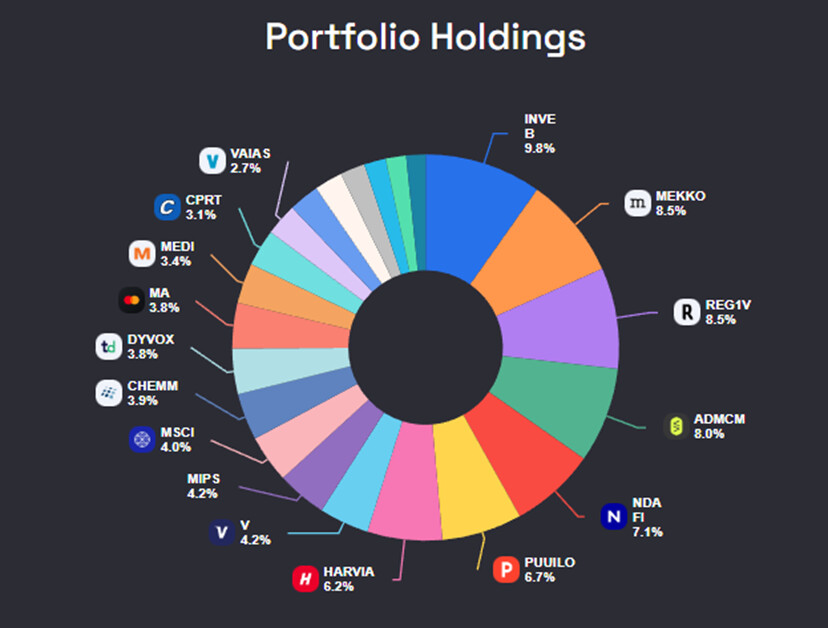
image

In the big picture, the portfolio looks familiar. I added to Copart when earnings were a minor disappointment and the price had been falling. I also bought more of: Harvia, Investor, MIPS, Shopify, Moody´s, Visa.
Valuations are elevated, and I believe this will curb the biggest price rises in the near future. This year, I will make a wish to Santa Claus that I get to buy Vaisala at a suitable price during the year. The company’s operations and development have pleasantly surprised me and at the same time ensured that I didn’t have time to build a sufficiently large position.

In the last portfolio review, I highlighted two companies. Medistim and Marimekko.

Medistim[quote="Tyhjatasku, post:4063, topic:1246"]
The company has invested in new products and grown its organization to support direct sales. This has been reflected in rising costs, but not yet in the bottom line. However, the market has shown small signs of recovery for higher-margin products, and the company’s newest device version is ready for sale. Certain efficiency measures have also been implemented. This was pleasing to notice last quarter. Am I sure about a turnaround now? Absolutely not, this could just be one slightly better quarter after many weakening ones. In any case, positive signals have been received as the EBIT% improved in Q4-24 vs Q4-23. So it is interesting to continue owning the company and let’s see if the improvement in profitability continues next quarter.
[/quote]Medistim reported an extremely strong Q1 result. In the conference call, the company even tempered investors’ expectations by noting that this was an exceptionally strong quarter and such results should not be expected on an ongoing basis. The company performed excellently in every area, which builds confidence that its products are high-quality and competitive.

I do have a slight concern that there might have been some pre-emptive demand in the medtech sector due to tariffs, given how strong the Q1 results were. However, companies in the sector broadly spoke about demand normalizing, so it will be interesting to see how Q2 results turn out.

Marimekko

Marimekko, on the other hand, fell short of my own expectations, but slightly beat market expectations. Marimekko’s earnings naturally fluctuate significantly depending on which quarter the larger wholesale deliveries fall into, which makes quarter-on-quarter comparisons difficult; therefore, it is more meaningful to look at the full-year results. However, I expected a stronger performance from Asia, given how actively new stores are being opened there. This needs to be monitored.

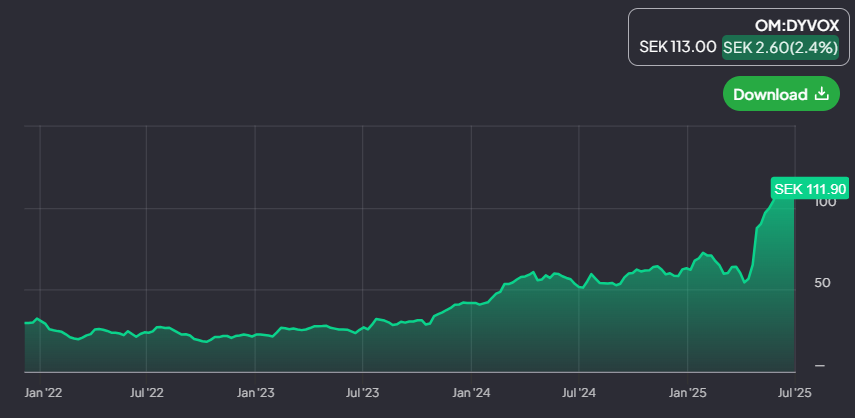
This time, I thought I would highlight a company called Dynavox.

Dynavox was spun off from a company called Tobii in 2022. For a brief period, it was listed on the stock exchange as Tobii Dynavox, but today it is simply Dynavox Group.

Dynavox enables communication for individuals who are unable to speak with their own voice or need assistance in doing so. The company is the market leader in its field and apparently the only one offering a comprehensive solution. The company sells both software and assistive devices for mobility, among other things. Its products are sold in 65 countries, and the company has 500 partners in both the public and private sectors.

The market in which the company operates is underserved. According to the company, only 2% of individuals who are diagnosed with communication difficulties each year receive the help they need. The company’s products are sold to the end-user through physicians, so one of the most important tasks is for the company to raise awareness among industry professionals. Its stock market history as an independent company has been a success so far.

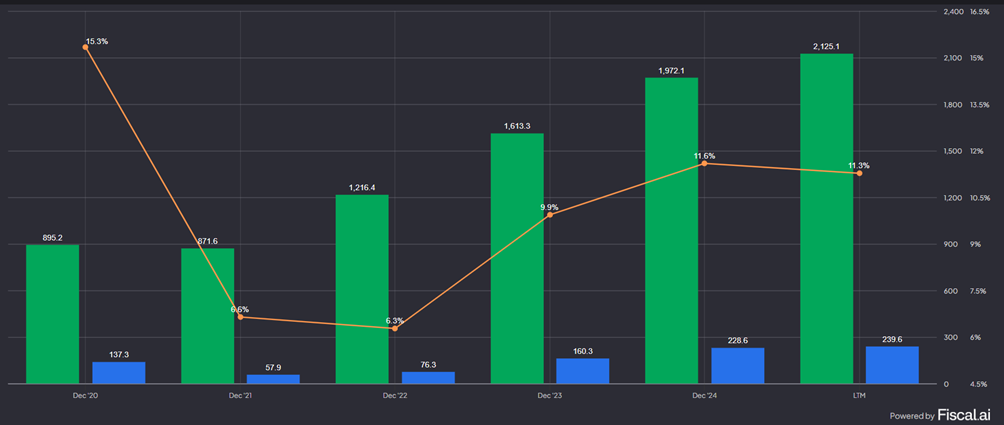
There are reasons for this positive development: revenue has grown strongly, and profitability has as well.

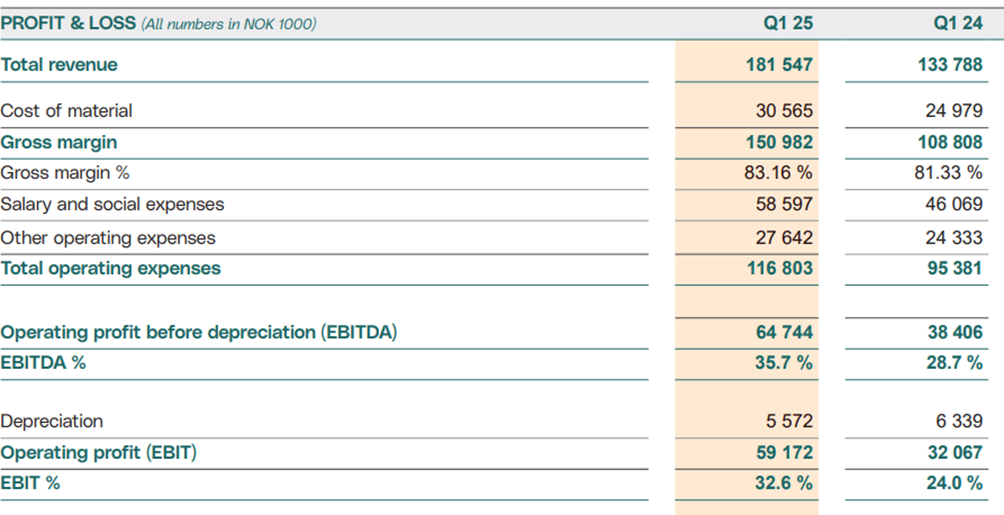
Q1 revenue grew by as much as 36% and EBIT by 38%. Excluding one-off costs, the EBIT margin would have improved from 7.6% to 11.3% compared to the first quarter of the previous year. I expect EBIT to move toward the 15% level in the long term.

Such strong growth always raises concerns for me, and I am moderately skeptical that the market will receive the Q2 results with the same enthusiasm.

What fascinates me about this company is the large underserved market, strong growth, and apparently good products that are eligible for reimbursement in many markets. Perhaps the biggest question mark for me is how the market will attract competitors. In my opinion, the company does not have extremely strong competitive advantages; rather, the competitive factors are partnerships and the end-to-end solution.

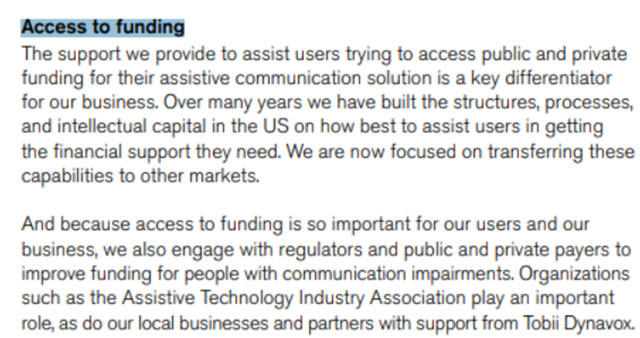
The company believes that the networks they have built to secure customer financing constitute a competitive advantage. Since customers’ ability to purchase the company’s products and services is tied to subsidies, one must also note the risk that the company may find it difficult to raise prices. So far, however, the gross margin has been well protected and is rising towards 70%.

There has also been plenty of speculation around the company being bought out from the stock exchange. The high valuation is certainly an obstacle to this now.

Portfolio

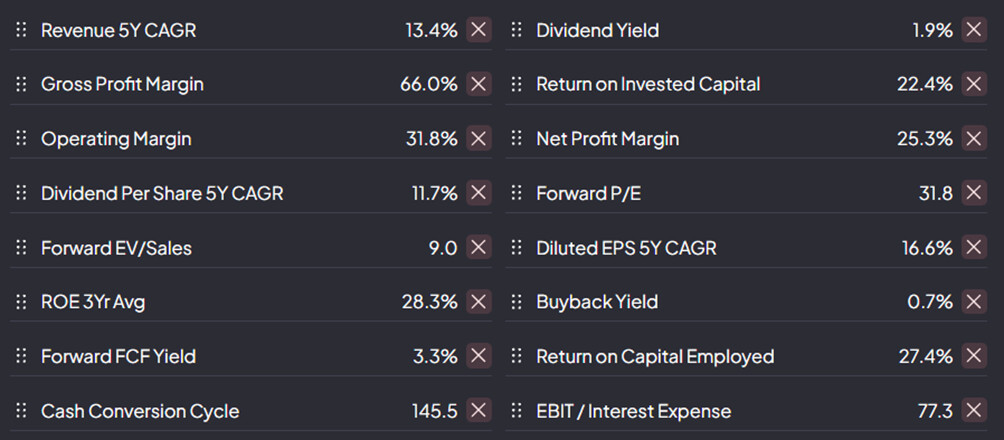
I am still satisfied with the portfolio review. The companies I own are highly profitable and generate a strong return on invested capital. Valuation levels are high.

On the other hand, when considering valuation multiples, they should be weighed against growth. Sir Chris Hohn highlighted an excellent point about Moody’s in a recently published interview. Over the past hundred years, Moody’s has grown by an average of 10% per year, and its growth has always been underestimated. You can pay a higher price for such companies, but it is important to keep in mind that such companies are extremely rare, and growth can hit a brick wall. I am certain that many of my portfolio companies will have ceased to exist over the next hundred years, but unfortunately, I do not know which ones. As John Wanamaker famously said: “I know half my advertising budget is wasted; the trouble is I don´t know which half.” This applies to investing as well.

This anecdote leads to the fact that it is difficult for an investor to know which companies will turn out to be the best in the portfolio. I often realize that my small positions perform exceptionally well, while the large and, in my view, “sure” positions deliver mediocre returns. My own conclusion is that there are many things we, as investors, do not know and cannot control. Therefore, a certain degree of humility is good, and it is wise for me to hold about 25 companies in my portfolio. That way, I can also include companies that feel like good investments but would never fit into my portfolio if I had to choose only 5-10 companies. This increases optionality in the sense that I can only lose 100%, but one of the smaller positions could grow into a significant position.

The overall mood in the portfolio remains somewhat wait-and-see. Few companies worth owning look attractive to me right now. Investment ideas have been a bit scarce, and a couple of ideas slipped through my fingers… (Nexstim). It will be exciting to see how companies have coped with currencies when the Q2 results are published. Quite a few of the companies I own have significant sales in US dollars.{“content”:“There are 22 companies in the portfolio. Three slots are open, but with these multiples, it feels difficult to add new companies. Heading into the Q2 reports with these sentiments.\n\nHappy summer everyone! :)”}
56 Likes

Perhaps I could update the portfolio’s contents, and at the same time (again) try to become more active in writing, since I spend a lot of time reading content. That would surely also improve my own company monitoring.

From largest to smallest (without listing individual ETFs, whose share I aim to increase somewhat further). In itself, percentages don’t have great significance, because (being lazy) I haven’t developed a proper investment strategy, but rather bought “random” amounts based on a) available money and b) gut feeling.

In the name of transparency, I must mention that I have also received some shares as gifts from older generations (which also originally got me interested in investing). This is because, if the reader is interested in what I myself have ended up buying, and not what others have decided for me. However, I have since familiarized myself with these companies and made the decision myself to keep them in the portfolio at least for now, partly also because I believe my relatives are better investors than me.

1. Various ETFs - 20.1% - Monthly savings go into ETFs, at least for now.
2. Kesko, 15.4% - All of these were received as gifts, a mix of A and B series. I probably wouldn’t want the weighting to be any larger than this, even though I have a pretty good overall feeling about Kesko’s operations. So, I haven’t bought more myself.
3. Konecranes, 9.0 % - All of these were also received as gifts.
4. Sampo, 7.9% - A (very small) part of these was received as a gift. As an If client myself, I have always been satisfied; in my opinion, operations have run smoothly, and the insurance business “should” be mathematically profitable. Everyone surely knows Sampo, so there’s no need to explain further.
5. Nordea, 7.7% - Finland’s best bank stock. Probably falls into the same category as Sampo in that it doesn’t need explaining.
6. Neste, 6.9% - Some were received as gifts, but I myself bought a good amount for under ten euros. Although climate policy globally is very variable, I believe there will be enough demand for Neste’s products in the future, and the share price shouldn’t be as low as it was.
7. Relais, 6.7% - A sector whose demand will certainly not decrease, and a stock that many, for some reason, don’t seem to know. Strong performance for some time now, and in my opinion, a low valuation. It will be interesting to see how the upcoming CEO change works out, and if there will be changes afterwards. I haven’t hesitated to add more of this.
8. Mandatum, 5.8% - I bought it around the time of the split, but honestly, I don’t quite understand the company well enough. Perhaps I should spend more time getting to know it. Thus, for me, it’s a generally perceived “safe” lottery ticket. At least the famous dividend is coming, even though I don’t want to join the dividend party.
9. Terveystalo, 4.7% - I acquired this around the time of the last elections, and I’ve considered adding more. However, I haven’t yet had time to update my knowledge on the latest topics in social and health care (sote) policy. However, there is demand for healthcare in this country, and I don’t believe in the current regional social and health care (sote) model in the long run unless changes occur.
10. Valmet, 4.4% - These were received as gifts. It has shown consistently solid performance during the time I’ve been an owner.
11. Revenio, 4.3% - Some were received as gifts, but I bought more myself. I myself have had the opportunity to witness the ease of use of Revenio’s devices multiple times.
12. Admicom, 3.1% - I bought this some time ago, back when my investment decisions were much less well-justified. It will probably be sold soon. I don’t know the industry very well, and the experiences I’ve heard about the software are not such that I could rely on them in the long term. I should also reduce the number of holdings anyway.
13. Nightingale Health, 3.1% - I myself underwent Nightingale’s tests through occupational health, and I liked the reports I received. Some deals have been published recently; hopefully, more will come. I am considering adding more.

I would indeed like to reduce the number of holdings. I probably need to draw up a proper investment plan.

30 Likes

finchat-chart-export (2)

WISE (35.8%)
Core holding, strong view that it has the potential to 10x in ten years. The size of the position reflects this view - I’ve been adding to it with every paycheck for two years now. As a customer for 10 years, I’ve followed how the product and service have developed into excellent ones. Scalable business, good culture, and an excellent founder-CEO. The company also just announced it will move its primary listing from London to New York by Q2/2026.

HOOD (14.3%)
I bought Robinhood in the spring with two theses: 1) The market is not pricing Robinhood correctly as it chugs along towards an international all-in-one finance platform. 2) The company provides sensible exposure to the crypto market. Now, after a +100% price increase, I still don’t feel that the stock has been loaded with excessively high expectations - my gut feeling says this is at least a 120 billion-dollar company. I will calmly observe the Robinhood banking launch in the autumn and re-evaluate after that.

EVO (11.1%)
A quality company that prints cash flow. Regulatory risks and growing competition threaten, but at these prices, a lot of bad news is already baked into the stock.

MEKKO (10.0%)
A trusted brand and a national icon. For years, dividends have been put back into Marimekko in the form of various products. I’ve been involved more with emotion than reason for a long time.

CROX (8.4%)
I believe in Crocs’ second coming. With these numbers, it even looks too cheap to be true; it would be a miracle if a PE firm doesn’t buy it off the stock market. During the spring, I’ve done my part and bought seven pairs of Crocs (including some Marimekko Crocs :grin:) from their online store - most of them as gifts.

TOKMAN (8.0%)
A classic speculative stock for me for a long time. Buy from the earnings report dip and sell before the next earnings report. This generated good returns during the COVID era, with a “Mr. Tokmanni” painting in the office to remind me :tokmanni:

NESTE (6.2%)
For me, a classic few-week swing trade gone wrong. The position was in the portfolio for a long time, among the worst losses of my career. Brainless average price reduction and recent rally have brought it almost to break-even :face_with_peeking_eye:

LVMH (MC) (6.2%)
Luxury and pricing power. No strong personal thesis, bought when it was strongly recommended.

I aim to keep the number of positions in my portfolio between 5-10; any more than that, and in my book, it would be the same as switching to an index investor :smile:

32 Likes

Summer portfolio update. The content has changed somewhat from the previous one. The number of Finnish stocks has decreased, and, surprise, surprise, the portfolio value has risen significantly. There’s no point in banging one’s head against a brick wall trying to scrape by with Finnish companies when things are going better elsewhere.

image

The portfolio has risen by approximately 50% from its April lows, especially thanks to Blacksky (+253%) and Intrum (+182%). I expect both to at least double within the next year or two. Blacksky manufactures and operates imaging/spy/reconnaissance satellites. Everyone knows Intrum.

Recent additions Intellego Tech and Verve are up +30% and +20% in 8 and 6 days, respectively. It’s a shame that the positions are so small. I don’t understand Intellego’s operations enough to dare to add more at this point, but the numbers are impressive. I will add more Verve when possible.

I have added Evo on dips. I consider it an investment comparable to big tobacco companies, where funds and ESG-minded investors discriminate against the company due to its industry. However, the company prints money, buys back its own shares, and distributes a generous dividend. My position is at a 22.5% loss (-6065€) with an average cost of 1030 SEK, but my faith in the company is strong. The industry is growing, and this is its best company.

Nordea, Puuilo, and Valmet. Nordea is a buy-and-forget for dividend yield. Puuilo has performed really well, and the position is up +120% + dividends. Valmet has been a disappointment in recent years, but it’s worth buying engineering companies during a downturn. One just needs to be patient. The company is, however, one of the global market leaders in its field.

I bought Lindex due to Stockmann’s divestment. Waiting can sometimes be long. I haven’t yet decided whether to sell the shares afterward or hold them. It depends a lot on how Lindex performs. If they can get back on a growth path + operational efficiency from the sheet metal hall, then it can stay in the portfolio.

CD Projekt Red. I’m a Witcher fanboy, which is why I bought the stock back in the day. Before Cyberpunk’s release, the stock rose to absolutely ridiculous levels, from which it then came down 80%. I expect a similar overreaction when Witcher 4 is released, at which point I will sell the shares. :smiley:

The smallest position in the portfolio is Neste, which is shown in blue in the picture, but the text has somehow been left out. I just sold a larger portion of it from my taxable investment account (AOT) at about a 45% loss (-5000e). Another batch of 5000, currently at a loss (-55%), remained in my tax-deferred investment account (OST). I bought it on the recommendation of analysts and added more on dips many times. Once again, the best time to buy would have been when the analysts told me to sell. So ironic.

30 Likes

Probably not many are interested in such a hobbyist-tinkerer-beginner’s portfolio under 10,000€, but I’ll open it up here anyway. Today marks exactly three years since I started this hobby :slightly_smiling_face:

INDEXES.

Their share is still too small, 39%. The goal is to raise these to at least 50% of the entire set, preferably even more. 50€/month goes into all three. Once I pay off that car loan, I will probably also start an Asia index for diversification. It is too Europe-heavy.

A quick word about each.

Name Current Return Share of Portfolio

OP- FINLAND +13% 14%
Surprisingly, the much-maligned Helsinki Stock Exchange is in the lead. Depends, of course, when one started. But good this way. Acceptable.

OP- NORDICS +4% 14%
This lives and breathes according to Novo. Denmark’s and Novo’s share is absolutely insane. Stupid, but what can you do.

OP- EUROPE +2% 11%
In the spring, I sold off the Americas and exchanged them for this and the defense sector for a very strong matter of principle. As long as that one lunatic is messing around there, I won’t put my money there.

STOCKS

SAAB +38% 15%
Yes, it’s good and satisfying to invest in defense. The company is also doing excellently. If they could still sell a couple of submarines and twenty fighter jets, oh my goodness. I should realize a little profit and lighten up. Since I’m greedy, I haven’t done so yet. And the alarm bells aren’t ringing regarding selling.

FODELIA +27% 14%
Nice to own. I believe there’s still a lot of growth potential. Hopefully, it will expand to the Nordics as well. If not, then more contracts in Finland, tack. I still haven’t ordered the company’s products for my own use as an emergency supply in the fridge. Maybe I’ll get around to it this year. At least I’ve kept my ‘standard of living’ belly in presentable condition with Oikia Chips.

KONGSBERG GRUPPEN +8% 9%
Same tune as with Saab. And there’s nothing wrong with the outlook either.

KEMPOWER -30% 8%
I’m probably one of the most Kempo-faithful on the forum. Been so throughout my three-year “career”. My faith in the company hasn’t wavered once, but the share price development has just been painful to watch. This was at its best 50 percent of the portfolio, now eight. It will turn out well as the months and years roll by. That’s for sure.

FARON ±0% 6%
Everyone knows what it’s about. All or nothing. Waiting for the day when I upgrade my Saab with a Mitsubishi turbo and program it so I can burn rubber. I’ll shout obscenities from the windows at passers-by and quit my job and get rid of the rat race. I won’t greet anyone anymore and I’ll enjoy listening to the poor whine.

ASSA ABLOY ±0% 5%
My latest purchase. For diversification. No big expectations, hopefully moderate growth.

NORDEA +8% 4%
Boomer. Diversification and some tens in dividends. You have to have a little of this.

The biggest changes were the sales of the America Index and Duolingo, for the aforementioned reasons. I put this money into Saab, Kongsberg, and the Europe Index. I realized some profits from Kongsberg and diversified them into Abloy.

Likewise, I’ve had to sell a bit of Faron, Fodelia, and Nordea just for living expenses, food, car repairs, etc. It’s been really frustrating, but this is what the life of a regular practical nurse is like. I tried to “trade” with the sum a couple of times. Once I managed to win a few hundred, and once I got badly beaten.

Well, that’s it. Let’s continue the hobby and try to break that magical 10,000€ barrier someday.

-Small-time trading since 2022-

Suppis

95 Likes

After a longer period, an update on the portfolio situation again. The previous update was from December, which is already over half a year ago.

There have been some changes to the portfolio, and additionally, some companies have been in the portfolio between updates. The employee fund has not been taken into account in the table below. If it were included, its share would be almost exactly 40% of the combined sum of the portfolio below and the employee fund.

There haven’t been very big changes in the portfolio’s largest holdings. I still save monthly into Seligson Global Brands, but the saved amount gets lost in daily price fluctuations. I trimmed my position in Inderes a little while ago, as I believe I can get better returns elsewhere. Novo has fallen from the sharpest edge due to a price drop, and its valuation already feels attractive, even though the company has faced headwinds. However, in my opinion, there is nothing acutely concerning in Novo’s situation. Hims & Hers was also trimmed due to short-term uncertainties. I will probably return the company to the portfolio at some point.

New quality companies, such as Fairfax and Stryker, have been added to the portfolio. Stryker operates in hospital equipment and devices, such as artificial joints, endoscopy equipment, surgical robots, etc. The company holds a leading position in the operating room equipment market.

Stock and Fund Portfolios % of portfolio
PYN Elite 7.96 %
Seligson & Co Global Brands 6.38 %
Revenio Group Oyj 6.23 %
Investor A 4.76 %
Microsoft 4.41 %
Alphabet C 4.38 %
BNPP Circular Economy ETF 4.26 %
Novo Nordisk B 4.14 %
Intuitive Surgical 3.69 %
Inderes 3.64 %
Nordea 3.21 %
Apple 3.05 %
Fairfax Financial Holdings 3.03 %
Air Liquide 2.71 %
Brookfield Asset Management 2.29 %
iShares Core MSCI EM IMI UCITS ETF 2.28 %
RWE 2.25 %
Huhtamäki 2.20 %
Visa 2.09 %
Meta Platforms 2.07 %
iShares Global Semiconductors ETF 2.04 %
Automatic Data Processing 2.01 %
Eli Lilly 2.00 %
Costco Wholesale 1.98 %
Veolia Environnement 1.82 %
Lifco B 1.82 %
Fastenal 1.77 %
Rightmove 1.73 %
Synopsys 1.36 %
Intellego Technologies 1.18 %
West Pharmaseutical Services 1.16 %
Spotify 0.95 %
Stryker 0.94 %
Tractor Supply 0.89 %
Canadian National Railway 0.89 %
Seligson & Co Aasia Indeksirahasto 0.68 %
SPDR USA SC Value Weighted ETF 0.60 %
JPM Global Equity Multi-Factor ETF 0.46 %
Harvia 0.35 %
Tomra Systems 0.32 %
Cash 0.03 %
Total 100.00 %

The portfolio (excluding the employee fund) has unfortunately stagnated for the past 3 years, but periods of weak returns are part of the nature of investing. The 3-year return has remained a dismal 3.9%, whereas in 2020-2021, returns significantly outperformed the global index.

Outside of equity-heavy portfolios, there is a small peer-to-peer lending portfolio on Mintos (0.22% of investment assets). Nowadays, however, it is starting to be more of a “bond portfolio”; it has yielded 4.5% per year after credit losses and 10.7% over three years, with returns flattening due to loans in collection, for which (if paid) the principal is paid first and only then the interest.

On the crypto side, I make occasional purchases with “small change”. The intention is to buy these (mainly Bitcoin) every 1-2 months.

Additionally, I joined the gold cycle by acquiring “physical” gold through a domestic service. Its share is negligibly small, but for the sake of interest, I am also building a small “gold portfolio” to maintain interest with occasional purchases.

27 Likes

I don’t recall ever opening up my portfolio content here, even though I always ask guests about their stock picks in, for example, the Portfolio Review. So, here’s my portfolio. :smile:

My stock portfolio has quite a few lines, and at the beginning of the year, there were even more, but I cleaned out a few lines, as the benefit of diversification has largely been achieved with these stocks. I also started to notice that in the daily life with a baby, there isn’t enough time to properly follow all companies, so a small spring cleaning was in order in that sense as well.

Holdings below from largest to smallest, but I’m not including Inderes shares in this.

Stocks (59%):
Nordea
Investor
Harvia
Microsoft
NVIDIA
SoFi Technologies
Qt Group
Novo Nordisk
Viafin Service
Revenio Group
Hims & Hers Health
Berkshire Hathaway
CrowdStrike
Valmet
CapMan

I am reasonably satisfied with the current lines. Many stable pillars (e.g., Nordea, Investor, Harvia, Microsoft, and Berkshire Hathaway) with which one can sleep quite peacefully, but also spiced with fast-growing and market-disrupting companies (e.g., SoFi Technologies and Hims & Hers Health). However, these are considerably more binary, so they should primarily serve as a spice in the portfolio. :sweat_smile:

Since I’m not very risk-seeking, I’ve also bought quite a few index funds and ETFs into the portfolio to bring even broader diversification. Someone might argue that wouldn’t buying some global ETF or similar achieve the same thing, and that’s true, but it’s fun to play around with these lines and think about when to buy what. Buying just a global index would be too boring for me, even though spinning these lines doesn’t create any major excitement either. :grinning: I do intend to reduce the lines and remove unnecessary overlaps.

Lines from largest to smallest:

Index Funds & ETFs (41%)
Amundi Nasdaq-100 ETF
iShares Core S&P 500 ETF
Nordnet Global Index
Handelsbanken USA Index
Nordnet Denmark Index
Nordnet Sweden Index
Nordnet Finland Index
Nordnet Europe Index
Nordnet Norway Index
iShares Automation & Robotics ETF

The main role of the fund portfolio is to bring peace of mind to stock picking, as a part of the portfolio will in any case achieve index returns. And that in itself is quite nice.

Overall, the portfolio has so far managed to stay on the better side of index returns, but I doubt this tailwind will continue so strongly forever; it will probably slowly drift towards index returns.

IMG_2686

Hopefully not below it, or else I’ve made poor stock picks. :grinning:

105 Likes