What do you have in your portfolio?

2024 Q1 portfolio update:

Evolution gaming 9.9 %
Kamux 7.3 %
QT 6.5 %
Talenom 5.2 %
Revenio 5.0 %
Svenska Handelsbanken 4.7 %
Fortum 4.0 %
Tractor Supply 4.0 %
Puuilo 3.9 %
Gofore 3.9%
Tieto 3.2 %
Sampo 3.2 %
Harvia 3.2 %
Mandatum 2.6%
eQ 2.4 %
Admicom 1.4 %
Nokian Tyres (Nokian Renkaat) 1.2 %
Berkshire Hathaway 1.2 %
Exel 1.0 %
Fastenal 1.0 %
Sandvik 0.4 %
Graco 0.4 %
ADP 0.4 %
Noho Partners 0.3 %
Nordea 0.3 %

Cash/fixed income investments 10.1%
The rest are funds and ETFs (Seligson, Pyn Elite, Splitan, EUNL, Seligson & Co OMX Helsinki 25)

New companies in the portfolio: Nokian Tyres, Noho Partners
Additions: Gofore, Fortum, Tieto, Puuilo
Sold: Efecte
Trimmings: Qt, Harvia
Quick trades: Kamux

The share of cash in my portfolio (10.1%) could perhaps be even smaller. Let’s see what kind of opportunities the upcoming quarter brings regarding the cash position.

The goal of reducing the number of holdings progressed with Efecte in the form of an acquisition offer. However, an old acquaintance, Nokian Tyres, made a return to the portfolio. Since the company has lost part of its competitive advantage since the beginning of 2022, the position size will not be as large as before. The change of CEO also adds more uncertainty. It may be that the company will not be a long-term investment in my portfolio. Time will tell. However, the intention is to grow the position size slightly during potential dips. The other new company in my portfolio, Noho Partners, will not be parked in my portfolio for years. The company is slightly too indebted for a long-term portfolio, and the return on capital is not quite sufficient. I trimmed the positions in Qt and Harvia a bit thinner as a result of the risen valuation levels. However, both companies still have a place in the portfolio.

The valuation level of US companies is so challenging that I didn’t get to make additional purchases to my current mini-positions (ADP, Graco, Fastenal). At these valuation levels, I will mainly buy direct stocks from Finland. However, I will still continue small monthly investments in foreign ETFs and funds.

I added two new companies to my watchlist: Mettler Toledo and Teqnion. Both are interesting in their own way, but the price is not inspiring at the moment. So, I will continue to follow these from the sidelines for now.

Let’s also note here for the record that the median P/B 2024 for companies followed by Inderes, calculated from Inderes’ website, is 1.52; Inderes has 24 “buy” recommendations and 8 “sell” recommendations. CNN’s Fear & Greed index is currently 71 (Greed).

33 Likes

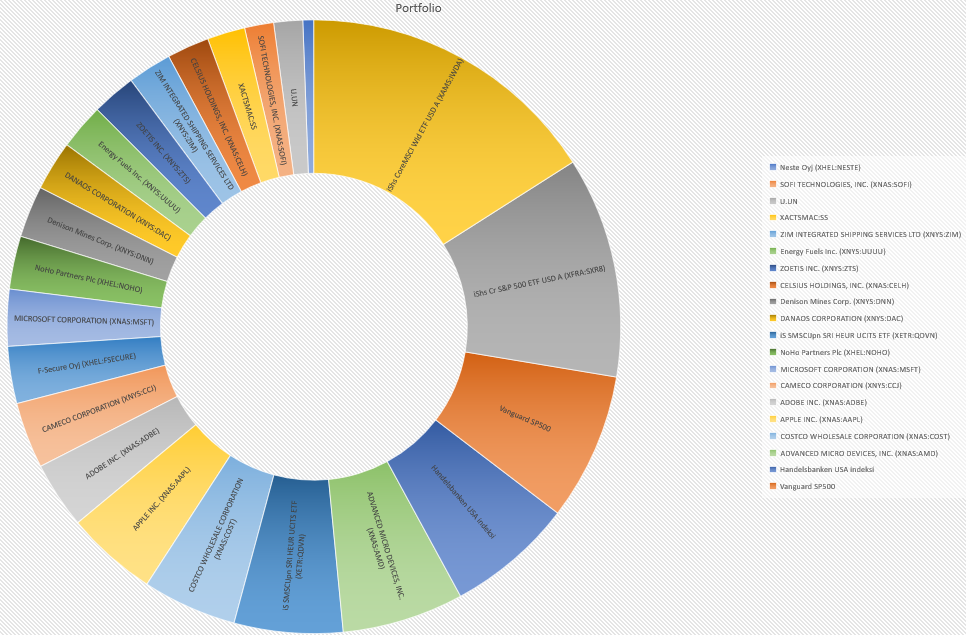
Portfolio

Maybe it’s time to start tracking Finland again; the portfolio has actually performed quite well compared to it. The ETF/Fund portion has been kept around the 50% mark. I might gradually trim Apple and Adobe (AI threats to business / AI exposure is already significant), and possibly look for some value plays (from Finland). Otherwise, I’m satisfied with the portfolio as a whole.

Let’s break down the philosophy a bit more:

When adding quality companies to the portfolio, I don’t follow their price changes much afterwards. As a rule of thumb, if it drops approx. 20% based on news, it gets kicked out; there is no upper limit. About 105% of my wealth is tied up in stocks / still some cryptos, etc.

About a third/quarter of the portfolio is reserved for 1-5 year trades/value investments. Currently, uranium/shipping are the only sector plays.

For growth/quality companies, I usually sell 25-60% of the initial investment if it rises enough, and after that, I don’t follow the company much unless the business changes radically.

Nothing really in the crosshairs right now; Visa is interesting, though there’s a bit of regulatory risk.

11 Likes

portfolio-chart

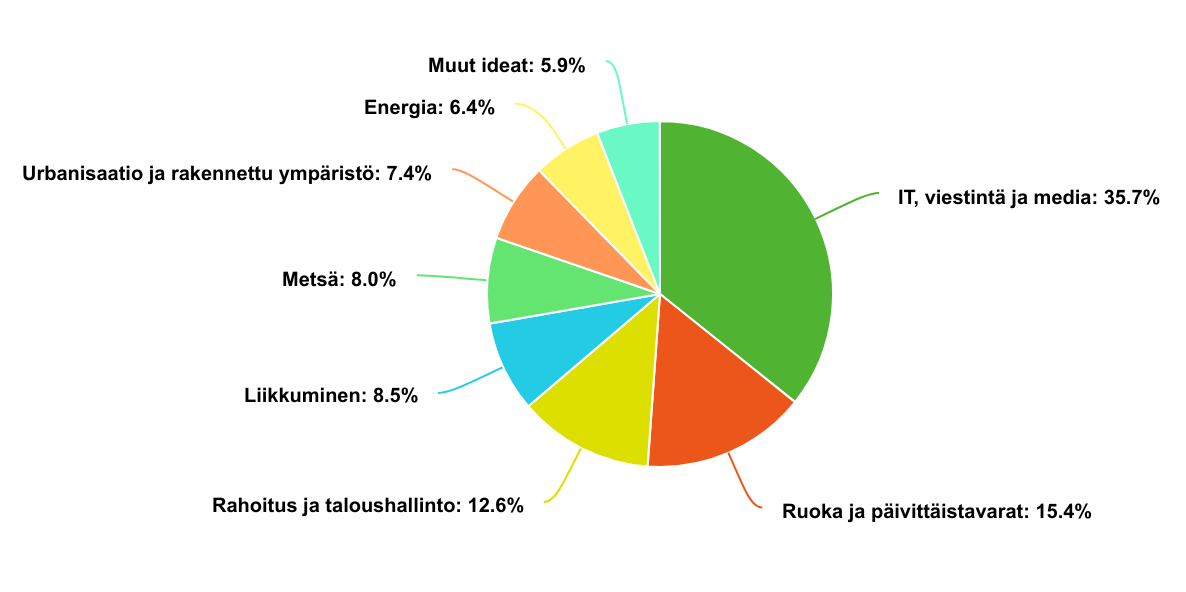
The pie chart shows the current status of my stock portfolio from the perspective of themes I have defined myself. There is quite a bit of diversification.
Of course, not all companies are strictly related only to the theme in question, but here is a list of which stocks are in each group right now:

IT, Communications, and Media:

  • Accenture
  • Alphabet
  • Amazon
  • American Tower Corporation
  • Crown Castle International
  • Elisa

Food and Consumer Goods

  • Archer Daniels Midland
  • Coca-Cola Company
  • Essity
  • Huhtamäki
  • Kesko
  • NoHo Partners
  • Nutrien
  • Starbucks

Finance and Financial Management

  • CapMan
  • Enento Group
  • Inderes
  • Mandatum
  • Nordea
  • Sampo
  • Talenom

Mobility

  • Aena
  • Airbus
  • Tesla

Forestry

  • Kemira
  • UPM-Kymmene
  • Valmet
  • Weyerhaeuser

Urbanization and the Built Environment

  • KONE
  • Lassila & Tikanoja
  • Lindab International
  • Sweco

Energy

  • Consolidated Edison
  • E.on
  • Fortum
  • NextEra Energy

Other ideas

  • AkzoNobel
  • Getinge
  • Investor
  • Orion
  • Outokumpu
  • Terveystalo

I’m bad at investing in funds because whenever I look at the holdings of an ETF or similar, I think, “yuck, I don’t want to own that, or that, or…”

28 Likes

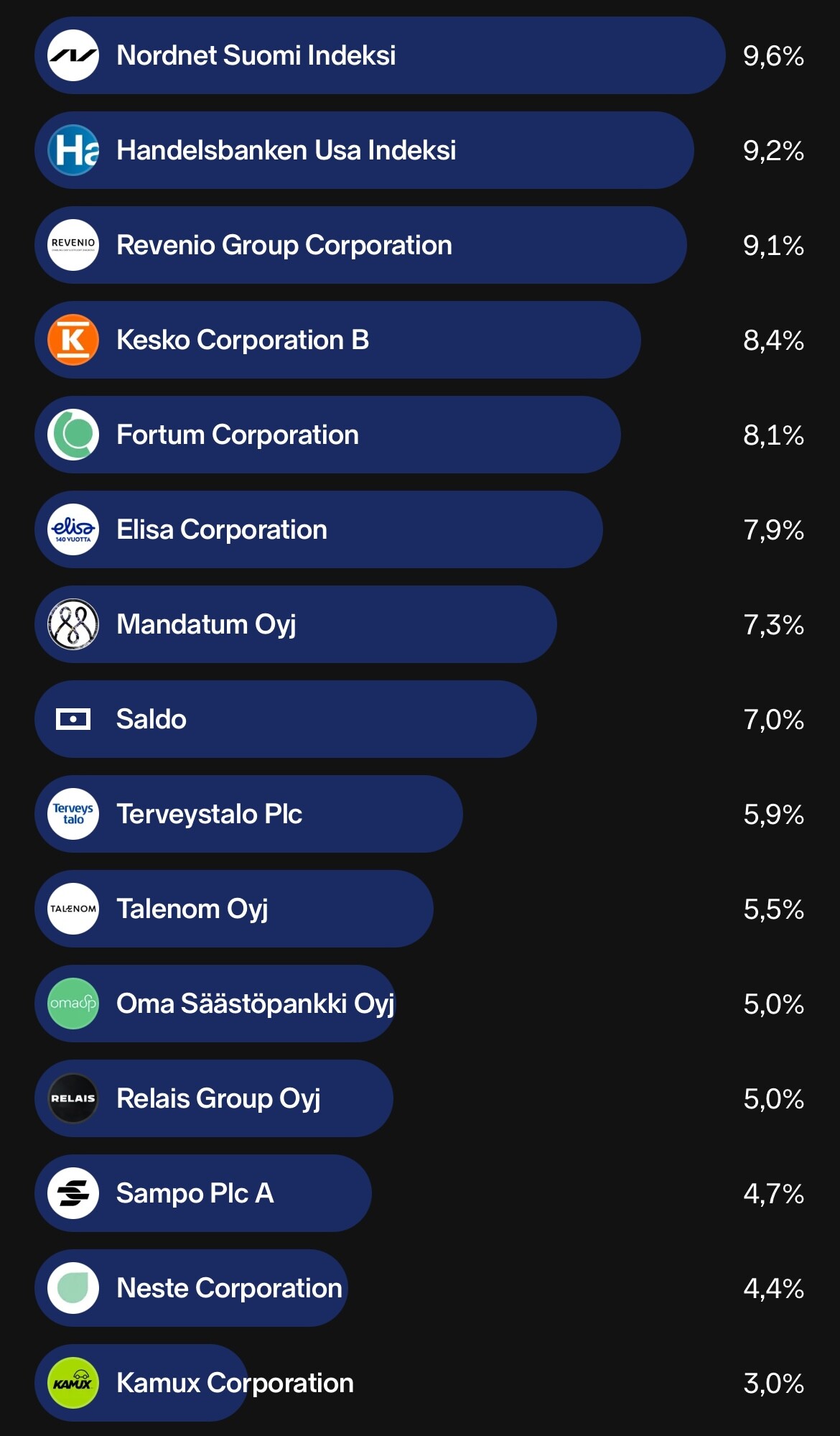
What are the companies in your portfolio today? Have there been many changes?

The sluggish granny portfolio looks like this today:
image

Since the Hesuli (Helsinki) exchange is so cheap across the board, I’ve decided to invest my pennies in larger companies instead of “hot dog stands” (small caps). 53% of my assets are in direct stocks through Nordnet.

Other investments include PYN Elite €140,086 (+€50,086), fixed income and loan investments €532,317 (+€92,281), residential property funds €108,731 (+€10,559), and investments in unlisted companies €197,562. In total, the value of the investments is about €2.45 million, with €275,000 in leverage. Including the home and mortgage, debt accounts for 17% of my assets—I’d say that’s moderate :thinking:

During the next year, the share of fixed income investments will likely decrease, and I’ll put more money into unlisted companies. Hopefully, capital will also start to be returned from those investments over the next two years.

102 Likes

I last did a portfolio review in early November, and there have been enough changes since then that I thought I’d go through my holdings again.

The composition of my portfolio feels quite good at the moment, and I haven’t felt the need to reduce or sell anything. On the other hand, there aren’t any specific holdings I’d want to add to more than others. I have a decent amount of all the stocks in my portfolio—meaning no “mini-slices”—and no single holding represents an especially large portion.

Last time there were fifteen rows, and now there are thirteen.

  • Marimekko left my portfolio; a great company with great management, but at the time of sale, I thought the stock was expensive and didn’t see much upside. Then Konecranes left my portfolio, which also gave me good returns, but I felt the stock was expensive and didn’t see more upside… rather downside risk, though after I sold, the stock actually rose quite well. I also sold my shares in the highly risky Optomed because I saw significantly more risks than opportunities—even though if everything goes perfectly and ideally, there is plenty of upside.
  • LeadDesk entered my portfolio, now making up over five percent of it. I’ve owned it before, so it’s a familiar company. I see upside in the stock, driven by good products in a growing market and the groundwork previously laid. My detailed investment thesis can be found here.

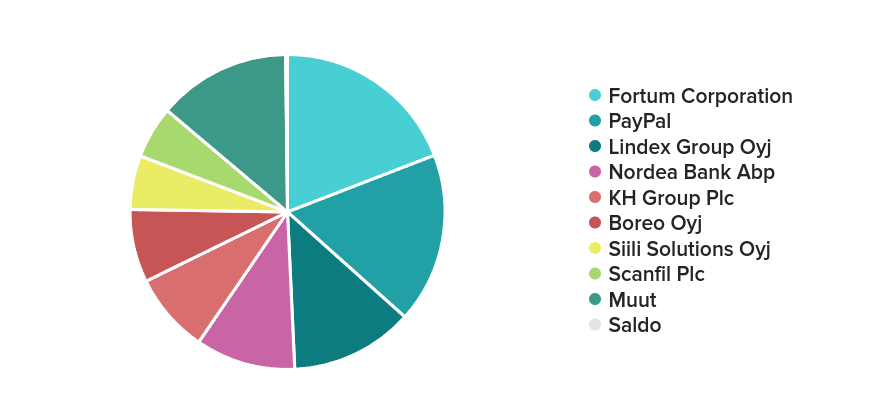
EQUITY ACCOUNT

image

Fortum is a bit of a bedrock. A company that has a knack for surprising negatively, but I find the company itself and its foundations to be quite credible.

PayPal is easy in one way and difficult in another. Cheap or “cheap”. I’ve heard many good arguments for why it won’t succeed in the future. Others say that all the horror scenarios are already priced into the stock and the company is quite good + the stock is cheap.

Lindex, because Lindex. It’s not as attractive as it was before, but on the other hand, it’s lower risk than before, and I can’t find a good justification to sell it yet.

Nordea has constantly surprised me positively, and the pieces are in place. Safe and steady progress, one of the strongest in its sector, as long as they don’t mess up or some unexpected banking crisis occurs.

KH Group is still cheap. The company’s sectors have possibly bottomed out, and overall the stock was beaten down way too low… well, it’s still too low. New developments and new strategies bring extra momentum for growth.

Boreo… the numbers have been disappointments, but the company is being built on a very strong foundation for the long term. The management is convincing, as are their own holdings in the company. The CEO is very impressive; it’s worth watching the CEO ROAST and this interview I did.

Siili has caused disappointments with its numbers and performance. As an IT services company, it belongs to the group whose customers and “sectors” aren’t so hot (=cool). I see the company as fundamentally good, and with the significant price drop, the valuation is moderate. I assume that Siili’s customers’ business has also bottomed out and the direction is more likely upwards.

Scanfil is a company I have immense trust in, and thus also in its operations. The company takes stylish and moderate steps. The management and their holdings are convincing; I interviewed the company’s CEO. A plus is the excellent Director of Investor Relations and Communications, @Pasi_Hiedanpaa. :slight_smile:

Gofore is a joy to own for many reasons, but the employees there are satisfied and competent. The company’s performance is staggering, and I admire the company’s communication and openness regarding things like risks. The much-praised IR lead @Emmi_Berlin1 has received accolades for good reason, and I’ve interviewed her too.

Valmet ex-Neles, i.e., the Flow Control business, brings security. The company is open to development, and I’ve heard many good things from the company’s employees; additionally, students have been hyping this firm, which is a good sign.

Neste is a Hyzon substitute. Well, maybe not; I probably bought it at a high price, but the stock feels cheap now—on the other hand, it might just be “cheap,” and the company’s main operations might be perceived as a sunset industry in the near future. Either way, the company has performed strongly and is seen as one that can identify risks and look to the future, just like… Hyzon. :wink:

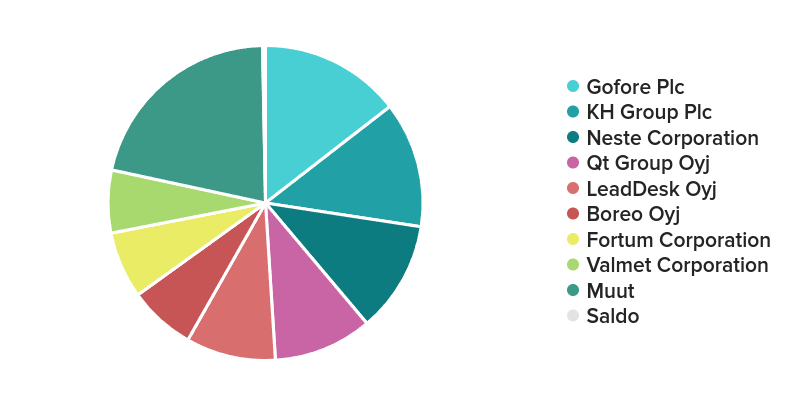
EQUITY SAVINGS ACCOUNT

image

Otherwise the same as the Equity Account, with these exceptions:

Qt Group Plc is a good investment, especially if you want to reward the management. There is still enormous growth potential here and there, e.g., in profitability and the “multi-product company” model. The company and its products and services just need to remain attractive in the future—nothing more than that. :smiley:

LeadDesk and the reasoning are up above, where I mentioned the new additions.

CRYPTO PORTFOLIO

Cryptos represent less than one percent of my debt-free assets.

image

PYN ELITE

I’ve put in 14,000 euros, and the value is currently hovering around 13,000 euros.

APARTMENT

About 70 percent tied up in debt-free assets.

OTHER RAMBLINGS

I am a beginner-level investor, meaning there is a lot to learn in the basics taught in places like Inderes’ Investment and Analysis Schools.

I’ve had more good luck than bad. In recent months, my portfolio has risen a lot, and I am no longer in the red for my entire investment history.

I have two jobs that I work as much as possible; additionally, I’ve always had a very high savings rate relative to my income throughout my life, and I’m engaged in the investment world in various ways for several hours a day, especially on my days off. :sweat_smile:

I also shared some of my thoughts in the FIRE thread.

I think that as an old man, I’ll have a few million in wealth, and I don’t think I’ll regret having done a lot of what I like and lived the way I wanted. If I start a family, priorities will change, and then there will be a few million less.

I’m not a great investor, and if I were only after returns, certain low-cost index funds and ETFs would very likely be the best solution.

One can be ahead of the index for five or ten years, but how things go over decades—that’s a whole different story.

image

Thanks to everyone for the encouragement and for your high-quality, content-rich, and value-adding investment posts!

:pray: :slight_smile:

129 Likes

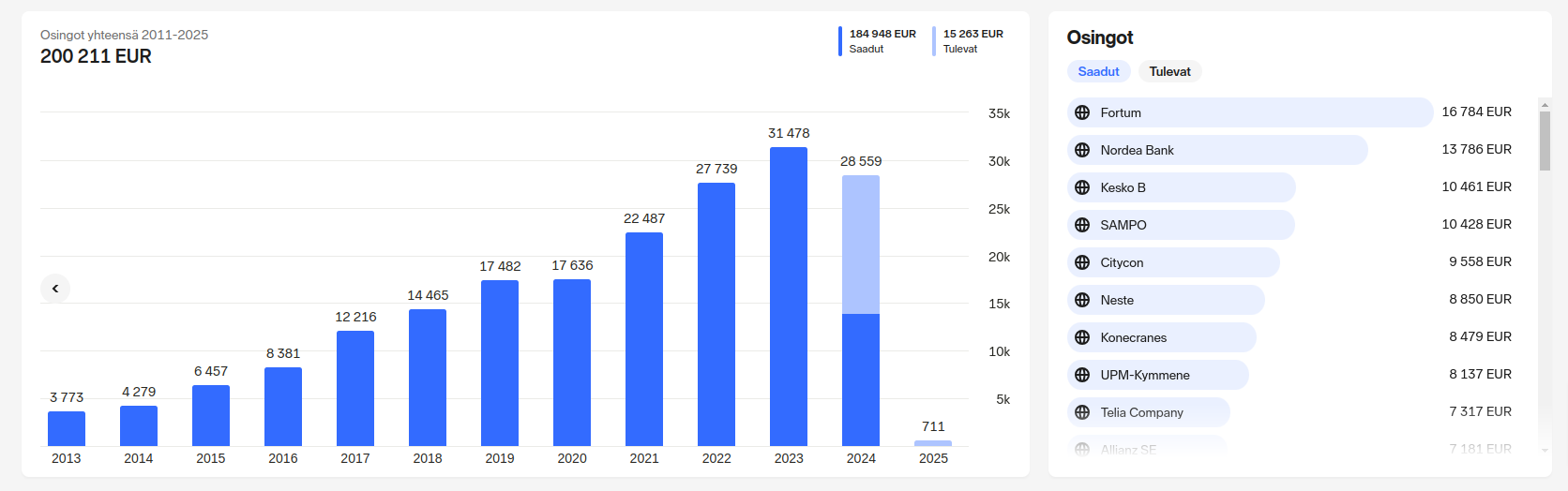
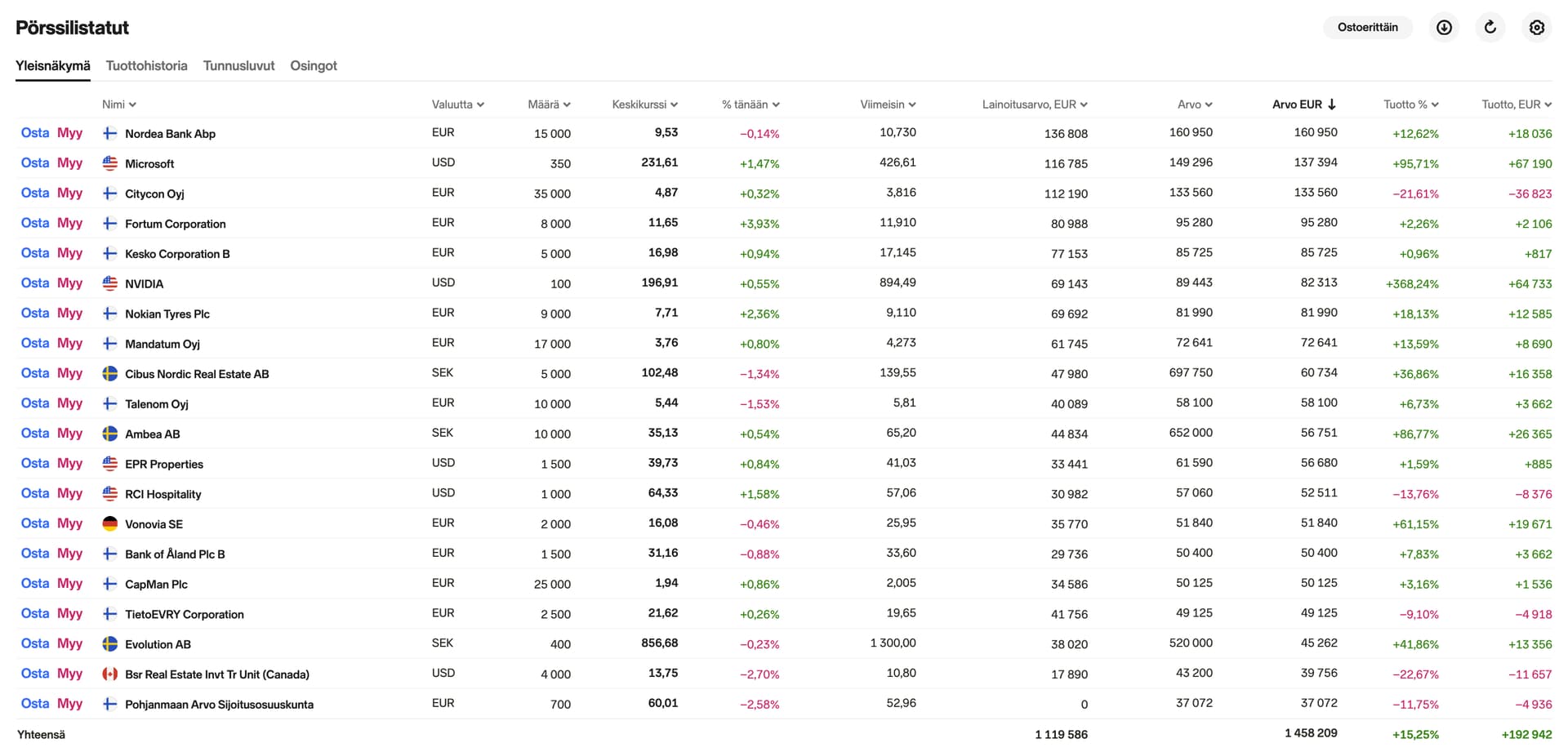
Now that last year’s tax return has arrived and been checked, it’s time for another portfolio review. The previous one was on 02.12.2023, and so this is the portfolio review as of 12.04.2023 with portfolio values.

AOT (Book-entry account) at Nordnet (12.04.2023):
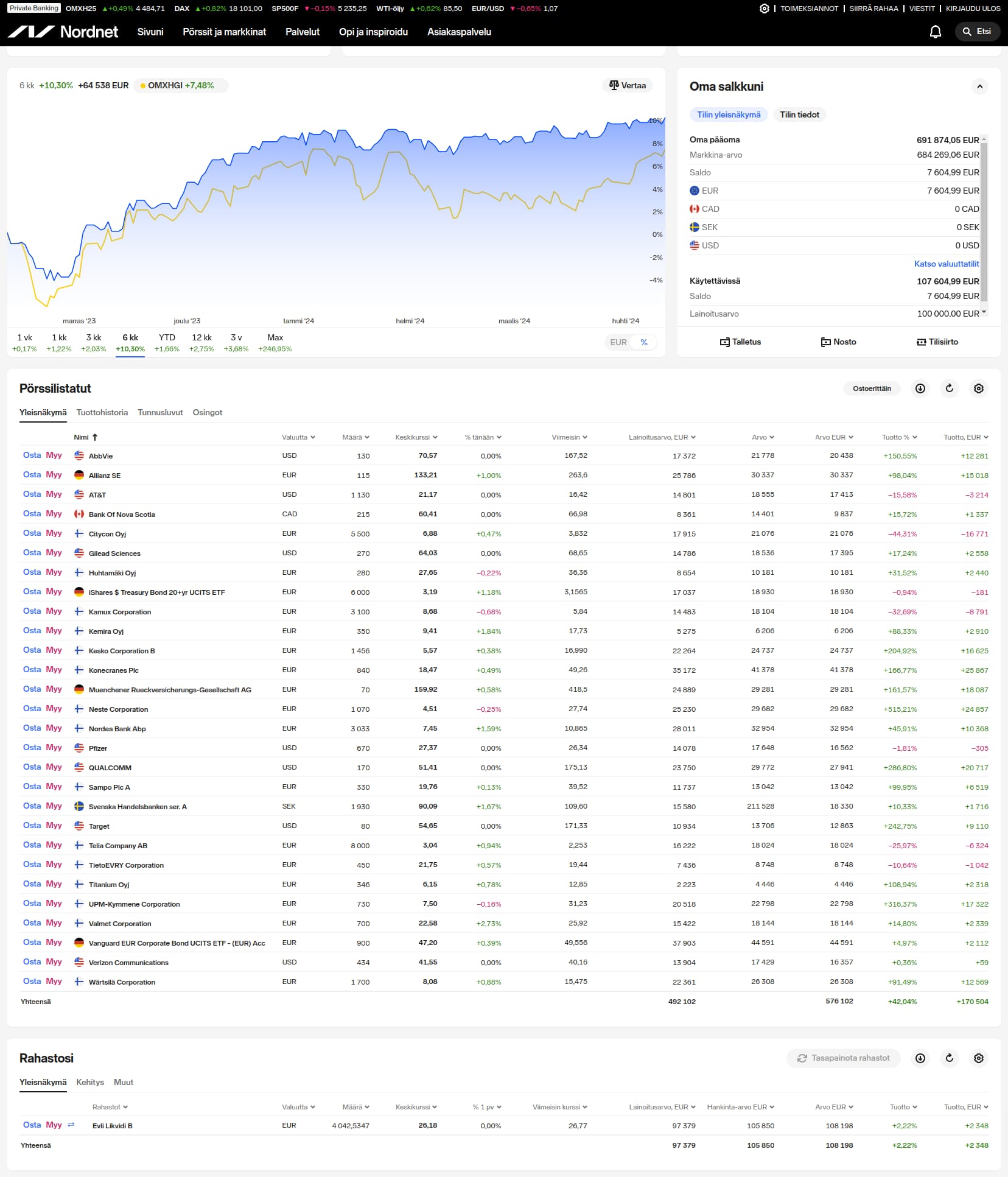
aot

OST (Equity savings account) at Nordnet (12.04.2023):
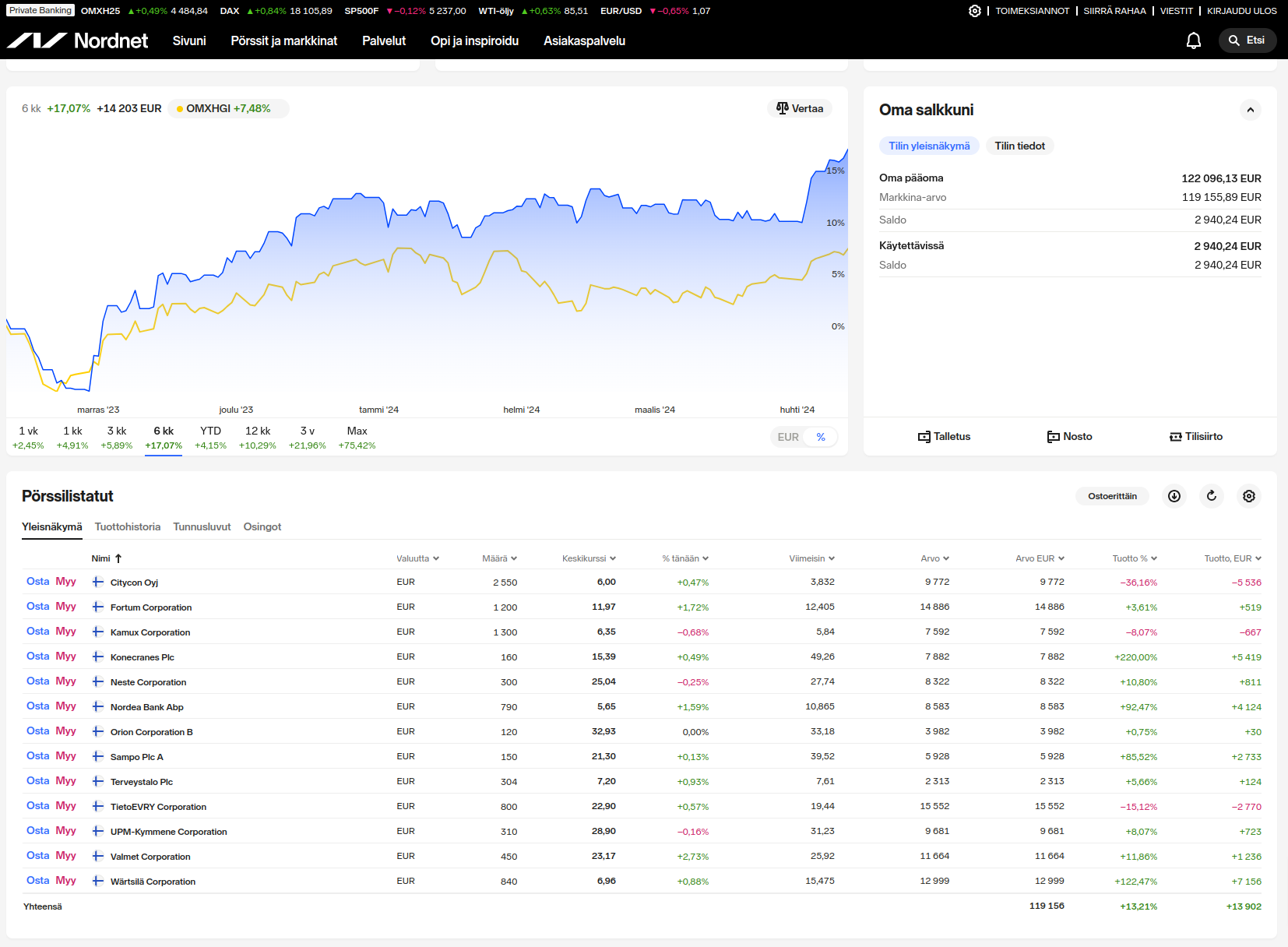
ost

Dividends at Nordnet (12.04.2023):
osingot

New at the top is Nordnet’s dividend view, which works really well nowadays. At least in my own portfolio, I’ve reviewed it and it seems to be completely accurate now, even regarding history. Previously there were problems with foreign dividends, but apparently not anymore.

Transactions and views since the beginning of the year:

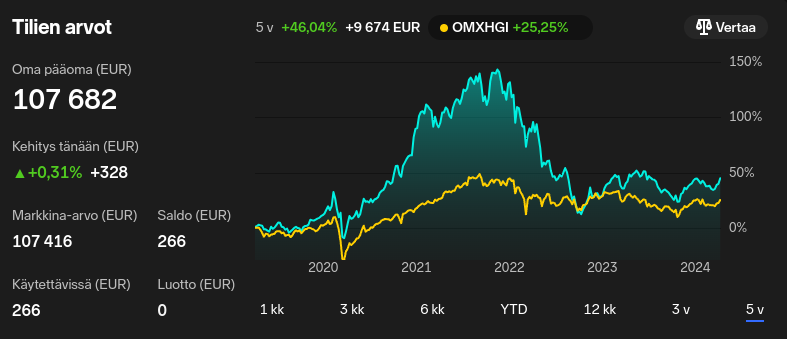
The portfolio has continued to perform slightly better than the benchmark index OMXHGI, although the performance of the Helsinki exchange (Hesuli) has been so miserable that this isn’t much of a merit. OST YTD return is +4.15% and AOT +1.66%. Some dividends are still unpaid even though they have already gone ex-dividend, so I suppose all dividends aren’t showing in the returns yet.

Even though I am mostly a member of the “dividend party” with a buy-and-hold strategy, I’ve made a surprising amount of buys and sells during the early part of the year, partly because I’ve been cleaning out crap positions and other unnecessary positions and reinvesting them. I believe the rest of the year will be much more serene in terms of activity. Below are the most important portfolio events since the beginning of the year:

Buys:

  • Fortum OST
  • UPM OST
  • Neste OST
  • Terveystalo OST
  • TietoEvry OST
  • Orion B OST
  • Citycon OST
  • Pfizer AOT
  • Evli Likvidi B AOT
  • iShares $ Treasury Bond 20+yr UCITS ETF AOT

Sells:

  • Intrum
  • Cargotec
  • Mandatum
  • Harvia
  • Konecranes
  • Bayer
  • Siemens
  • BASF

Short-term swing trades:

  • Noho
  • Nokian Renkaat
  • Volkswagen

So, the portfolio contained the infamous Intrum, which I decided to get rid of about a month ago because my faith and trust in the management ran out. I’ve justified these sales on the Intrum channel, so no more on that. The final loss from Intrum was approx. -19,000 EUR, but including dividends received over the years, “only” about -16,000 EUR—roughly the same class of loss I once took from Lehto. I covered the losses by selling some overvalued stocks (e.g., Harvia) and some engineering companies (Cargotec, which is likely to demerge) and small positions (Mandatum, Siemens). Additionally, I got rid of a couple of underperforming German stocks where I also lost faith, such as BASF and Bayer—at least the German tax bear won’t be able to wrongly pinch too much in excess withheld taxes from their dividends anymore.

To learn something from Intrum, I updated my investment plan, for example, regarding looking more closely at company indebtedness (e.g., Net Debt-to-EBITDA Ratio) and updated my rules on how many times I can buy and with what amount into falling prices. I also went through the debt levels and credit ratings of all the stocks in my portfolio. However, I don’t believe it’s possible to completely avoid these “bombs” in the future, as I thought Intrum’s business was otherwise quite okay, so I might still fall into the same trap even with my current investment plan—but at least I minimize the impact so that the loss is not so significant for the portfolio as a whole. This is just part of investing; sometimes these blunders happen.

The new buys were mainly good dividend payers for the OST (Equity savings account) now that the OST deposit limit rose from 50k → 100k at the turn of the year. There is still 15k of room to deposit more money into the OST. Additionally, I increased my fixed-income positions slightly by buying Evli Likvidi B and a bit of longer-term interest rate exposure with iShares $ Treasury Bond 20+yr UCITS ETF. I also bought Pfizer back into the portfolio, even though I think I swore in the previous post that I wouldn’t buy it anymore. But the price has come down so much that it started to become too tempting. Furthermore, I don’t believe Pfizer will get into trouble over its COVID vaccines; instead, all possible problems will be swept under the rug, and they are quite well protected from all accusations by the contracts made during the COVID era. I like pharma companies in the portfolio because even though they are criticized as money-hungry due to high drug prices, they do valuable work for humanity in the long run and the profits scale well. Additionally, investing in pharma companies is truly a game for the patient, as developing new drugs takes years.

I have now shoveled almost all cash into either stocks or fixed income; there are still some dividends on the Nordnet account that haven’t been invested yet. I liquidated Seligson’s money market fund entirely and transferred money from there to Evli Likvidi B and 20,000 EUR to a Bank Norwegian Savings Account Plus. Since the beginning of the year, there have been sales worth approx. 128,000 EUR and buys worth 168,000 EUR, meaning I’ve put about 40,000 EUR of new money into the portfolio, though some of this is dividends. The high turnover is mainly due to selling Intrum and other crap positions and covering those losses, as well as reinvesting the sales proceeds.

Some short swing trades were also made. I bought Noho but decided to sell when the CEO changed. Nokian Renkaat and VW were slightly shorter trades where I took home some small quick profits.

The combined market value of my stock portfolios (AOT + OST) has now stayed slightly above the 800,000 EUR mark, being 803,420 EUR today, though it must be noted that I now include the fixed-income funds at Nordnet, which now amount to just over 172,000 EUR. About 21% of the portfolio value is now in fixed income, which sounds very sensible to me at the moment. I aim to keep this around the 10-20% range as long as one can get a reasonable return from fixed income. However, I will likely not buy more fixed income anymore.

Fixed income is now roughly:

  • 20k cash in Bank Norwegian Savings Account Plus at 3.75% interest
  • 108k in short-term fixed income Evli Likvidi B, approx. 4.8% YTM
  • 44k in semi-long fixed income Eur Corporate Bond, approx. 3.7% YTM + positive leverage if interest rates fall
  • 19k in very long-term fixed income iShares $ Treasury Bond 20+yr, approx. 4.7% YTM + large positive leverage if interest rates fall - currency risk USD/EUR

Instead of the portfolio’s price development, I follow the development of dividends with greater interest, as I can influence that more than the price curve by buying more companies that pay growing dividends. Dividend flow for this year should be approx. 32,867 EUR gross (26,200 EUR net) with relatively certain forecasts. A positive thing in 2024 will also be that interest income will increase passive income considerably: passive income from dividends + interest will almost certainly be slightly over 40,000 EUR gross in 2024. The next goal could be, for example, to get dividend income over 30,000 EUR net, which could perhaps be achieved in a couple of years.

What will I do for the rest of the year then? Likely at least much fewer trades. The plan is to only sell Kamux if it rises a bit and I can break even. Otherwise, I will likely buy some of these for the OST if I can get them at a suitable price so that the 100k limit is reached: UPM, Neste, Terveystalo, Orion, and Fortum. KONE and Kemira would also be interesting, but they are still a bit too expensive. Otherwise, I’m waiting for a slow decline in interest rates and hope that, for example, Citycon’s share price would pick up a bit and the drop in rates would boost the returns on longer-term fixed income. If some big crash comes, I’ll start slowly liquidating Evli Likvidi B and move money from there into stocks and maybe some index ETFs.

Below is the traditional development of the portfolio, dividends, and interest income from the start:

Development of the portfolio’s market value:
01.03.2011: 0 e
01.04.2011: 21 000 e
01.12.2011: 40 000 e
01.01.2012: 50 000 e
01.12.2012: 74 000 e
01.04.2014: 100 000 e
01.12.2014: 140 000 e
01.11.2015: 174 000 e
01.08.2016: 211 000 e
01.12.2016: 256 000 e
01.12.2017: 308 000 e
01.12.2018: 330 000 e
23.03.2019: 355 833 e
28.11.2020: 503 148 e
01.01.2021: 502 015 e
02.07.2021: 601 904 e
31.12.2021: 609 729 e
04.06.2022: 596 525 e
31.12.2022: 593 880 e
04.08.2023: 627 523 e
02.12.2023: 731 735 e
12.04.2024: 803 420 eGross dividend development:
2011: 1,370 e
2012: 3,170 e
2013: 3,770 e
2014: 4,270 e
2015: 6,450 e
2016: 9,320 e
2017: 11,260 e
2018: 13,920 e
2019: 17,150 e
2020: 17,600 e
2021: 22,650 e
2022: 27,740 e
2023: 31,477 e
2024: 32,867 e (forecast)

Gross interest income development:
2011: 434 e
2012: 149 e
2013: 161 e
2014: 0 e
2015: 0 e
2016: 0 e
2017: 732 e
2018: 773 e
2019: 402 e
2020: 461 e
2021: 553 e
2022: 832 e
2023: 4,725 e
2024: 7,000 - 9,000 e (forecast)
152 Likes

AOT

ISHR MSCI WrldA 9.50%
iShs Core SP500 21.95%
iShs MSCI EM USD 2.45%
SeligsonOMXH 25 6.57%
iShs Glb Water 6.09%

CapMan 8.84%
Dovre 4.53%
Evolution 5.62%
Incap 3.78%
Innofactor 2.66%
Kemira 3.59%
Mandatum 0.90%
Nordea 9.51%
Sampo 8.08%
Scanfil 5.93%

OST

Innofactor 3.27%
Huhtamäki 11.59%
Dovre 5.45%
KH Group 5.58%
Marimekko 6.42%
Nordea 14.17%
Oma SP 4.69%
Optomed 4.46%
Puuilo 21.40%
Qt 4.44%
Tecnotree 14.00%
Vincit 3.94%

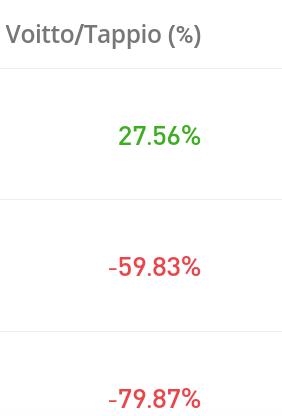
On the AOT side, the problem is Dovre, which is heavily in the red at -31.77%; the portfolio as a whole is in the green.
The OST is a trouble spot; there, Tecnotree is heavily at a loss of -55.15%. With this stock, I committed an investment error, meaning I bought a falling knife, and to top it all off, Tecnotree makes up a very large portion of the portfolio’s total value. Now Tecnotree has improved its performance; we’ll see where this company’s path leads. If no improvement occurs, I will clear it out of the portfolio for “tax planning” during this year and harness new horses to the wagon.
Vincit is another trouble spot; it is at a loss of -58.73% with a 3.94% weight. Fortunately, this stock has a small weight in the portfolio, but it also awaits a cleanup this year if things don’t improve.
The third problem is Dovre, -37.69% with a 5.45% weight. A cleanup is ahead unless its performance improves.
The fourth problem is KH Group, -40.17% with a 5.58% weight—time for a cleanup if results do not improve during this year.
The OST portfolio as a whole is at a loss of approximately -19%.
Selling those loss-making companies seems to be difficult for me; that is a clear investment mistake—not selling losing stocks in time, but even buying a falling knife. There is definitely room for improvement here.

24 Likes

This passive portfolio is now put together and ready to be forgotten. The ease of index investing is appealing. An even more important reason is the goal to further reduce the time spent on investment activities. Psychologically, it’s easier for me with a portfolio like this, where you “can’t do anything.” Selling funds and paying taxes on them is much harder than with an individual stock, where it is much easier to see company and valuation risks than in diversified indices within which sectors rotate.

A large number of partially overlapping positions to enable the best collateral value. Lately, I have been growing the size of the portfolio by adding positions within the gold level of the Super Loan (Superluotto), and then paying off that loan before the next purchases. In the future, I might take advantage of it, for example, in property deals, if credit is still available cheaper than a mortgage then.

  1. iShares MSCI World (EUNL)
  2. Xtrackers World Materials (XDWM)
  3. Invesco Nasdaq 100 (N1ES)
  4. SPDR US Small Cap Value (ZPRV)
  5. XACT Norden ETF
  6. Franklin MSCI India (FLXI)
  7. iShares Edge World Momentum (IS3R)
  8. Invesco S&P500 Equal Weight (SP2Q)
  9. Seligson OMXH25 ETF
  10. iShares Core Emerging Markets (IS3N)
31 Likes

Thank you for the interesting, educational, and thorough portfolio disclosure!

One thing left me wondering, though. You’ve also presented your respectable annual income in dividends and interest. But have you intentionally excluded the share buybacks of the companies you own from your income calculation?

From your list of companies, at least Sampo, Pfizer, and Nordea engage in share buybacks. For Sampo, they were most recently around 2% of the share value (buybacks of €400 million, company market cap just under 20 billion) and for Nordea, 2.5%.

Do you not count share buyback programs as “income” at all, or do you rather consider your slice of each respective company to have grown by the amount of the buyback program? Or how?

4 Likes

Share buybacks are not direct income. They have a boosting effect on the company’s per-share KPIs (e.g. EPS), which can increase dividends or share price performance.

2 Likes

If share buybacks increase dividends, it is a good thing, but the share price fluctuates for many reasons, and therefore buybacks do not affect the share price that much; the timing of selling the shares is more important.

Share buybacks are always a controversial topic; theoretically, I understand it if it increases the dividend amount in the future and the company has bought its own undervalued shares. Of course, the amount paid is out of the cash reserves, so the benefit is mainly a small tax advantage compared to dividend payments.

1 Like

They are direct income for some, and dividends are direct income for all shareholders. Personally, I would count them in the annual profit distribution column. They are, if desired, an identical thing anyway, minus taxes/costs.

4 Likes

The portfolio has evolved over the past few weeks, so here is a status update.

I exited Applied Materials in the tech sector because sector valuations are high, and the correction will be sharp to the downside if the market dives.

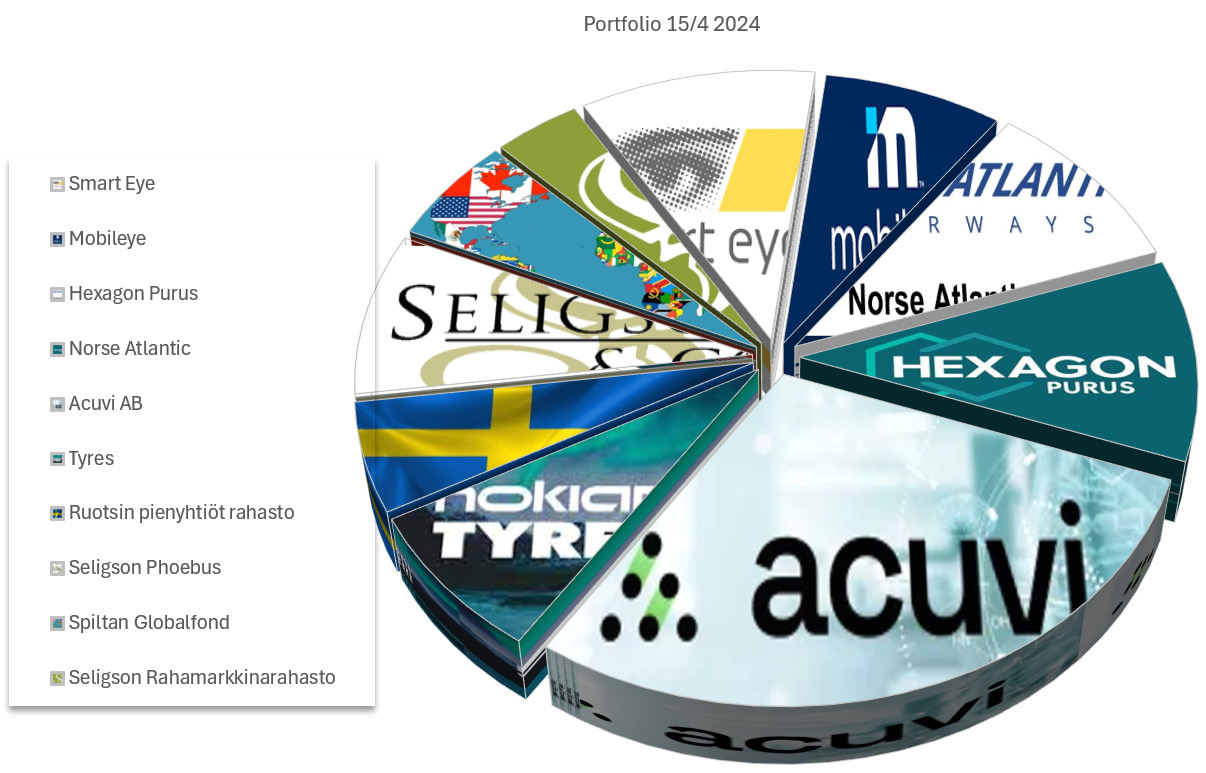
Acuvi finally saw a step-up (up 18% today), and I had prepared for it by accumulating it in the portfolio several times over a longer period.

Opened a Seligson money market fund, and 6% cash is currently parked there earning interest, waiting for a bigger dip. Half of the monthly savings are directed there. The other half goes to the Phoebus fund.

I will rebalance the portfolio again as soon as I believe Acuvi’s best upside potential has been realized. I intend to acquire a bit more Nokian Tyres, but I’m waiting for a better moment.

IMG_2558

Edit: The portfolio has had leverage, but I am getting rid of it this week, so after that, the portfolio will be debt-free.

13 Likes
Company Share
Fairfax Financial 24.7 %
International Petroleum 13.9 %
Vistry Group 12.8 %
Evolution AB 9.3 %
Gofore 2.8 %
Investor B 2.1 %
- -
Cash 34.5 %
Total 100.0 %

YTD +10.93 %

Q1 is in the books, and there is no complaining about the momentum and mood of the early year. Permanent positions in the portfolio have performed nicely, but returns have also been boosted by a few successful swings (e.g., AerCap and a few other firms that temporarily visited the portfolio). Sales were also made at good times (excl. selling the Mandatum rounding error at a weak price and selling Atkore at stop losses at one of the lowest price levels of the entire trading year :roll_eyes:). I don’t believe that everything will hit the mark for the rest of the year in the same way as it has so far.

Quick comments on portfolio positions:

Fairfax: +22 % YTD. The beginning of the year has been colored by Muddy Waters’ abysmal short report, and I increased the position during the dip it caused. Otherwise, I’ve been looking into the company’s Indian investments, which could be a significant jackpot as the country’s economy develops. Buybacks seem to be accelerating based on the start of the year.

International Petroleum: +11 % YTD. Nothing special. Investments are being carried out and capital is being returned at an annual rate of 7 percent. You’ll never guess in what way. :grin: I’ve added to this twice early in the year with a ~15 percent free cash flow yield.
Vistry Group: A relatively pure copy-trade following @lazyway and the Twitter crowd. A low-valued homebuilder focusing on capital-light and profitable growth (as well as carpet-bombing its share count in the coming years, because why not). The shareholder base seems to be in good shape for this kind of tactic. It’s probably stupid to invest like this, but it fits the portfolio and the valuation is reasonable.

Evolution: +9% YTD. No actions regarding the world’s best gaming company. Reporting and data on player count growth look promising. More buybacks, please.

Gofore: YTD +5 %. No actions. It is slowly diluting, as I have no plans to add Finnish stocks to the portfolio at this time.

Investor: YTD +13 %. All quiet on the Western Front. Diluting like Gofore. The company’s valuation has otherwise risen +115 % in four years + dividends on top. They likely haven’t made more than five trades regarding listed companies during that time. Let’s see everyone else try to do the same.

Sales: The gifts from Hesuli (Helsinki), i.e., Sampo (expensive), Mandatum (insignificant position), and Lindex (name hype), left the portfolio mostly as planned. I could have still held onto Lindex, but since the swings worked out as well as they did, I haven’t brooded over this too much. I even had time to add to IDT, but then the company announced spinoff delays — and on top of that, dividends started, which didn’t quite make sense to me given that the sum of the parts is significantly higher than the current price. Not a good recipe, especially since the price had already risen — so IDT vanished from the portfolio for now to wait for a better moment.

25 Likes

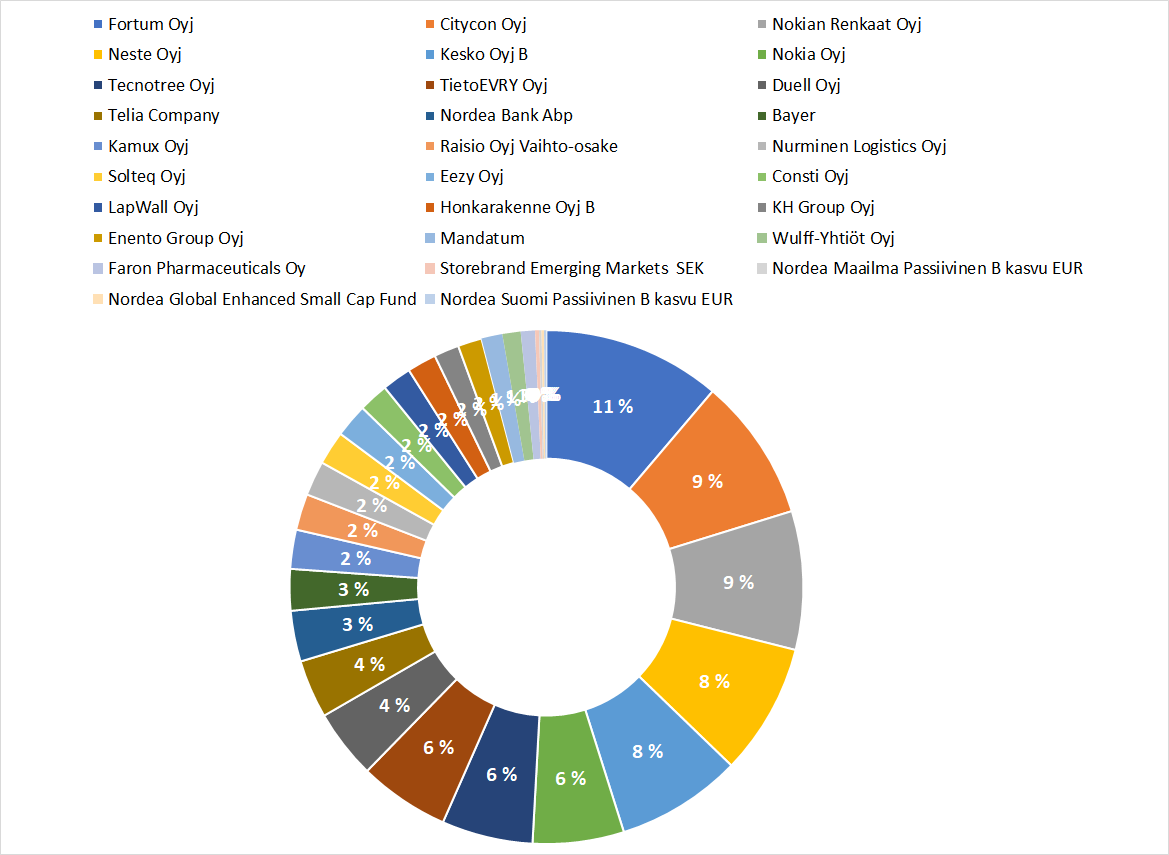
About three months have passed since the last OST (Equity Savings Account) portfolio update, so I’ll create a pie chart again.
Quite a few moves, meaning I have sold:

  • Revenio
  • Sampo
  • Disney

New ones have apparently been added:

  • Consti
  • Enento
  • Faron
  • Kamux
  • KH Goup
  • Nurminen Logistics
  • Wulff

I’m still going with a heavy HEX and dividend weight, but I believe I’ve added growth, although in my view, low-risk ones. The intention is to increase smaller slices into larger ones and invest in growth; even though big dividend positions like Citycon and Neste/Nokia are somewhat in the red for me, I’m not going to force-buy them to “break even”—they’ll rise when they rise, if they rise.
I intend to possibly add a few direct foreign positions to the OST, potentially with a 20-year horizon. It’s easy to add Finnish stocks with low trading costs, so buying foreign positions has been neglected. (Nordea Investor 1% trading fee)

The portfolio size has grown by maybe 10-15% in a couple of months. Partly through returns, partly with new capital.

image

18 Likes

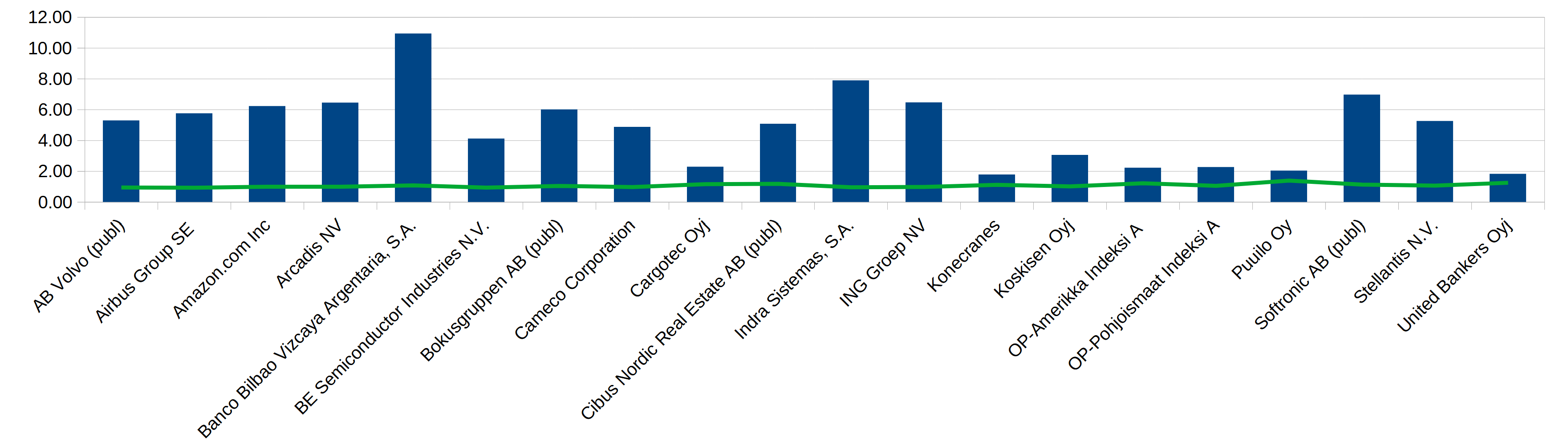
I adopted a core-satellite model for my portfolio, and it seems to suit me perfectly. I finally finished my core portfolio, so I’m posting a picture of it.

ydinsalkku

The blue bar is the investment’s share of the total portfolio. The green line is the investment’s performance.
Performance is calculated as Market value + dividend + sales result / Acquisition cost. 1.0 means the investment is neutral, no loss or profit. Because I have been so actively rebuilding the portfolio, the line is pretty much around 1.0.

I’m starting to be quite happy with my core portfolio; the satellite side is a completely different story… :slight_smile:

I am especially pleased that the portfolio isn’t just Finland and that it contains investments that suit me. The goal is a bit of dividends and a lot of growth.

AB Volvo (publ)
-Swedish machinery manufacturing company.

Airbus Group SE
-European aircraft manufacturing company. Headquartered in the Netherlands.

Amazon.com Inc
-E-commerce and cloud services.

Arcadis NV
-Dutch construction design & execution (engineering) company.

Banco Bilbao Vizcaya Argentaria, S.A.
-Spanish bank.

BE Semiconductor Industries N.V.
-Dutch semiconductor design and manufacturing company.

Bokusgruppen AB (publ)
-Swedish bookstore.

Cameco Corporation
-Uranium producer from Canada.

Cargotec Oyj
-Cargo and load handling. Finland.

Cibus Nordic Real Estate AB (publ)
-Swedish real estate company, customers include Kesko.

Indra Sistemas, S.A.
-Spanish IT consultancy and defense firm.

ING Groep NV
-Bank from the Netherlands.

Konecranes
-Finnish crane company.

Koskisen Oyj
-Finnish. Sells wood.

OP-Amerikka Indeksi A
(OP America Index A)

OP-Pohjoismaat Indeksi A
(OP Nordic Index A)

Puuilo Oy
-Finnish. You can’t get wood here. Cost-effective hardware retail.

Softronic AB (publ)
-Swedish IT consultancy firm.

Stellantis N.V.
-Car manufacturer. Headquartered in the Netherlands with 14 different car brands.

United Bankers Oyj
-Asset management from Finland.

16 Likes

IMG_5210

The portfolio has seen some reduction in risk level, securing of dividend flow, and increased diversification over the last few months.

In August '21, I rode Harvia down from €64 with a 38% weighting. That was also somewhat reflected in the portfolio’s performance. Eventually, the time came when I decided to sell all my Harvia shares; hopefully, I can get back into this great Central Finnish story again at some reasonable price.

29 Likes

May I ask which app/service provider was used to record this?

If you’re talking about the upper image, it looks like it’s Nordnet.

2 Likes