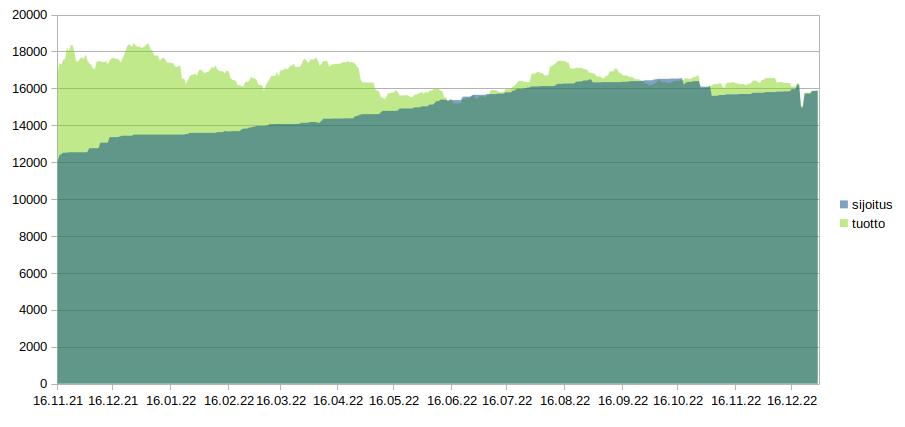
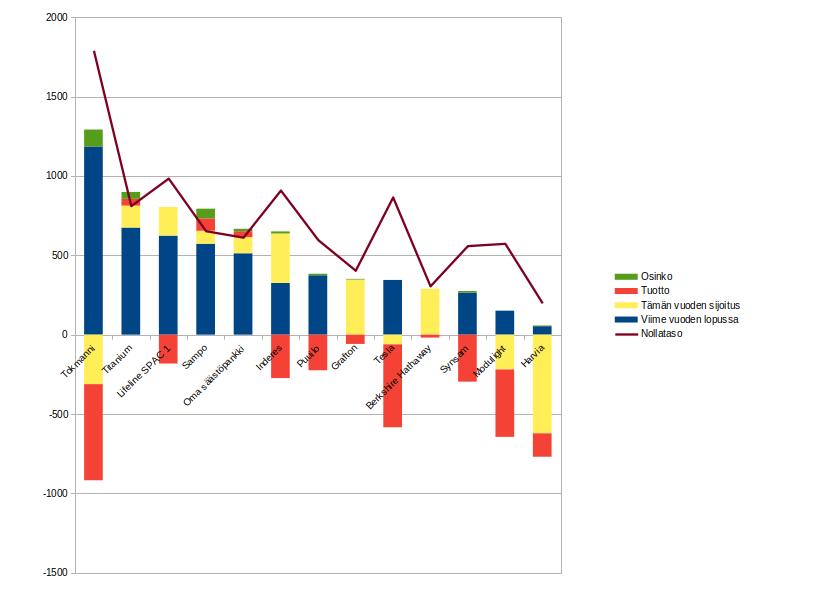
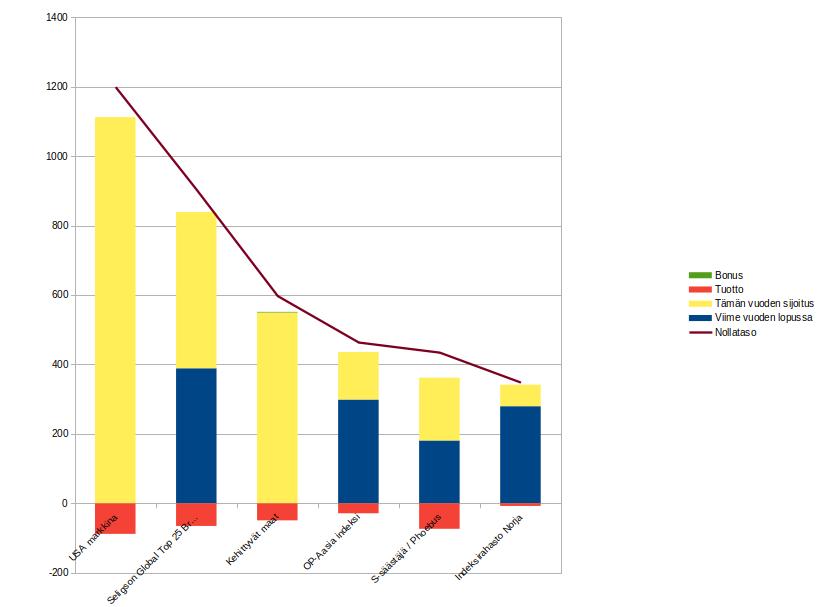
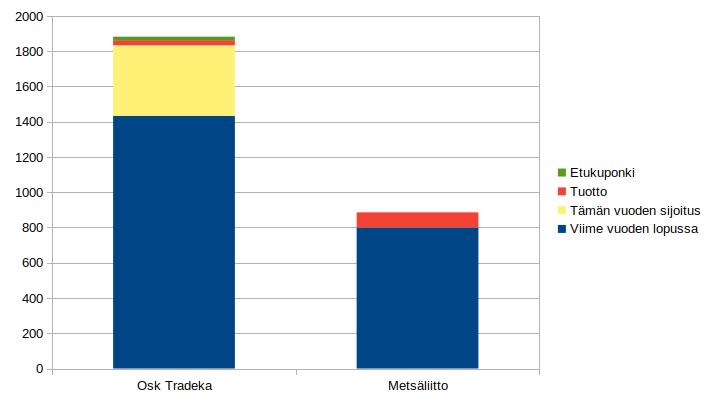
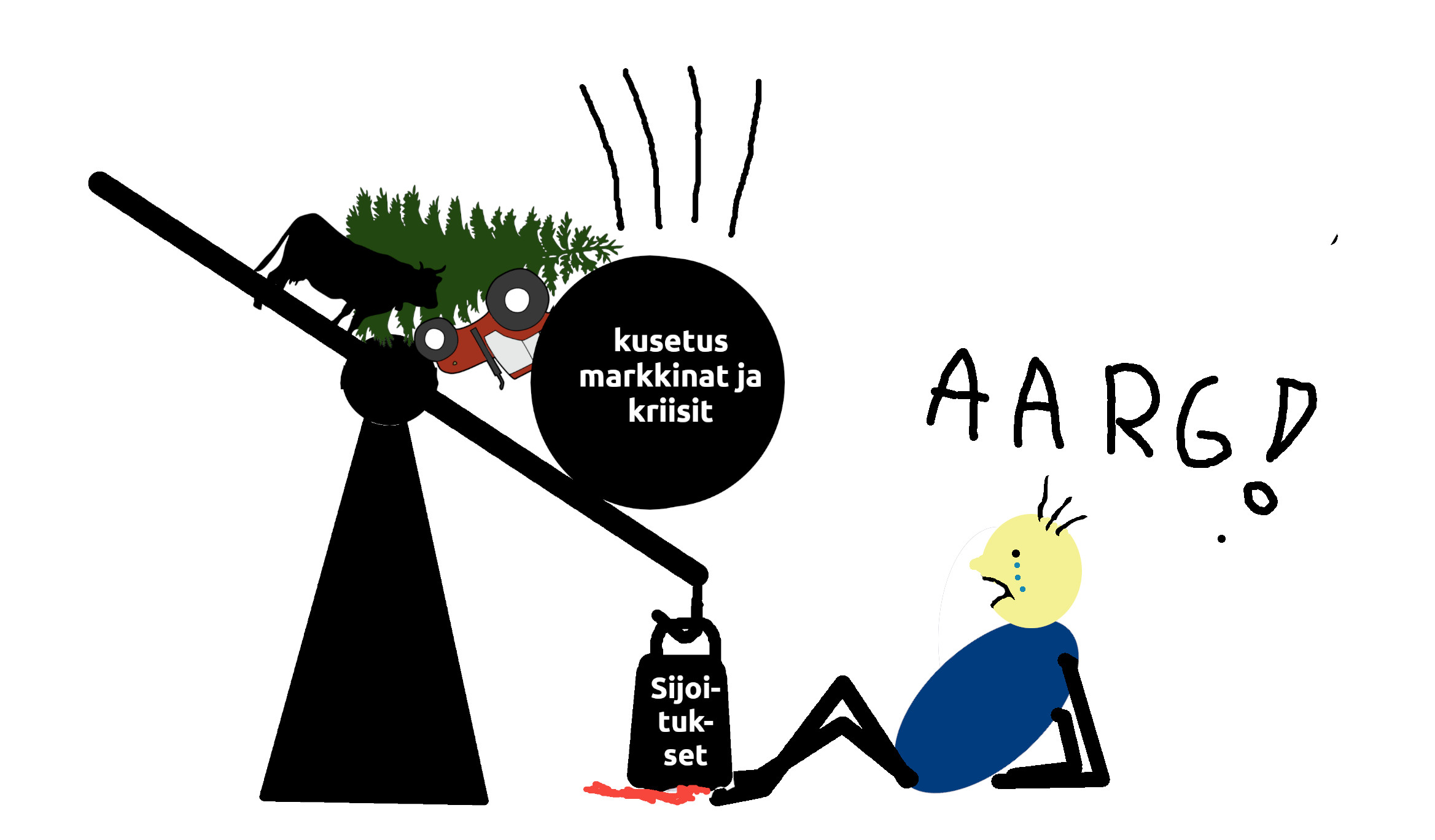
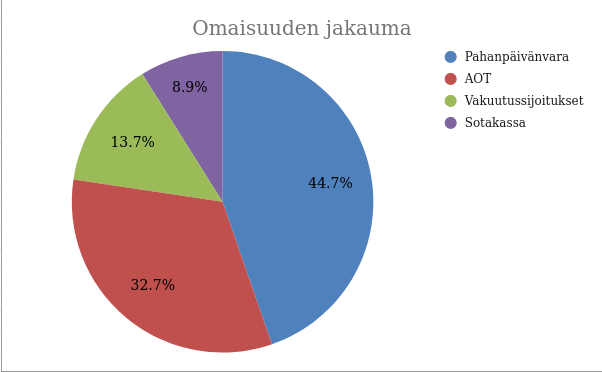
The final portfolio update of an eventful 2022, which ended up slipping into 2023. There have been plenty of twists and turns, especially since I decided to change my strategy earlier in the autumn—not necessarily the smartest move during such a volatile year  The desire for change stemmed from Fortum’s previously highly uncertain situation, where even dividend payments seemed jeopardized. At the same time, I realized that an oversized position in Tokmanni was causing excessive portfolio swings, especially when the direction was steeply southward. As I previously mentioned in the “bought/sold” thread, my new strategy is more focused on growth and special situations, with dividends taking a back seat. I am also paying more attention to diversification than before, strongly preferring companies whose business actually interests me. While this doesn’t necessarily go hand in hand with returns, perhaps the groundwork will be done better. The human mind is quite adaptable, and at this stage, I am certainly not convinced that the strategy shift was successful or justified; I didn’t experience any sudden enlightenment, so this will likely be a process of trial and error. As I already revealed in the bought/sold thread, my main portfolio lagged behind its benchmark, the OMXHGI, by 5.26% in 2022, finishing at -17.39%. Had I stubbornly stuck to my dividend strategy to the end, my return would actually have been 5.82% better than what I achieved—I just failed to anticipate Fortum’s recovery in particular. The negative returns were therefore mainly down to my own poor moves, and doing nothing would have yielded index returns. At the end of this post, I added a section on my Top 3 mistakes. My smaller trading portfolio, almost unnoticed, ended up with returns of +20.96%; whether the secret was a “dart-throwing monkey” strategy, who knows
Now, onto the current state of the portfolio:
Bittium, 2.40%: Shaken investor confidence due to prolonged poor performance, along with potential tax-loss selling toward the end of the year, opened up an excellent entry point here. There are no guarantees that better days are ahead, but the recent news flow has been positive. With a new CEO and a completed product portfolio, the stars may finally be aligned for Bittium. The heavy and costly investment phase and the transition from a service company to a product company are complete, and now should be harvest time. Successfully commercializing high-tech equipment in Defense and Medical and achieving sufficient production volumes will be key, though component shortages could still throw a wrench in the works this year for the latter. With the war in Ukraine, defense budgets have grown, especially in Europe, and the previously typical 4–5 year planning and bidding cycle has accelerated to the point where equipment is purchased from wherever it is immediately available. In addition, the “buy domestic” principle that plagued the industry and led to inefficiency is fading, and I believe Finland’s upcoming NATO membership will also open new opportunities. On the Medical side, the partnership with Preventice in the US has proven fruitful, and I expect similar partnerships to be actively sought, as broader shoulders are needed for commercialization. The segment-level reporting starting in early 2024 may also hint at a divestment of some business line when the right moment comes, which would mean cash for shareholders. The plan is to hold this for at least two years, adjusting the position size as needed.
Consti, 3.37%: The renovation contractor remains a permanent fixture in my portfolio, with the main thesis being concentrated ownership and a potential takeover bid—after all, Lujatalo, for instance, holds nearly a 10% stake. There is no real rush to get rid of this; the business is less cyclical than new construction. A successful turnaround also encourages holding, as long as project-specific issues do not start surfacing. Consti is also shaping up to be quite a decent dividend payer. Over at Inderes, @Olli_Koponen, who covers the company, has done a great job, and his expert analysis is a pleasure to read.
Fiskars, 4.66%: Great, world-renowned consumer product brands, well-diversified production, global sales channels, and a long corporate history with strong Ehrnrooth ownership form the basis of this investment. Granted, the strong earnings level of the past couple of years raises the same doubts as with other consumer goods companies: was it driven by a consumption boom that is now hitting the rocks due to radically weakening purchasing power, or have various restructuring programs and their completion finally permanently lifted profitability? That’s the million-dollar question! It’s also unclear to me what multiples the market will want to price this at going forward—at a 2022 P/E of 10, or a P/E of 13 for the year just started. The market environment is undeniably difficult, but on the other hand, that may well be a temporary state, and we live in a world of constant change. A strong dividend provides at least some support to the share price.
Inderes, 3.14%: Well, as an active community member, you simply have to be in on this one, no question Even with a fairly small holding, it seems I rank among the top 300 largest owners; maybe I should step it up this year and aim for the top 100 The Nordic expansion kicked off in earnest with a couple of acquisitions in Sweden and the purchase of a minority stake in Denmark. Once the economic cycle turns for the better and IPO activity starts to recover, I view the future quite positively for this well-run company. Profit warnings are just part of the game right now in a rapidly deteriorating market, and the reception wasn’t overly negative. Hats off to the Inderes staff, by the way: even though lock-up restrictions on one-third of the holdings ended in October, no noticeable selling pressure was observed, as proven by the shareholder list. The temptation to trim holdings, especially for long-time shareholders, must have been present during such a gloomy year. This further reinforces my confidence in the investment.
Lamor, 2.72%: The spark for this came at the Investor Fair, where I had the opportunity to speak with the CEO. An insightful Twitter thread by @Aili also helped a lot in my further research. The company has a 40-year history behind it, but it is a newcomer to the stock exchange and still has to earn its stripes. However, the stock has held up well during its first year, and I managed to optimize my position nicely just below the employee offering price of €4.35. Paying attention to such details might be slightly irrelevant, but then again, no company should have an interest in marketing overpriced shares to its own staff (Terveystalo being an obvious exception ). Strong international expansion naturally involves risks, especially since customers are mainly located in South America and the Arab world. However, the CEO emphasized that risk anticipation and ethical guidelines are high on the company’s priority list, and I have no reason to doubt that. The world simply isn’t a perfect place, and one must prepare for unpleasant surprises mainly through position sizing.
Lassila & Tikanoja, 5.14%: The perennial underperformer returned to my portfolio as the spring dividends approach, and who knows what fun Eero Hautaniemi has come up with for shareholders in the financial statement release. Weather conditions were likely challenging in early winter, and low-margin snow removal contracts were on offer. Perhaps the L&T board has finally decided to divest facility services; the real crown jewel, after all, is the environmental services business. Serious efforts are being made across the board to eliminate the carbon footprint of individuals and companies. The “carbon handprint,” a term Hautaniemi loves to use, is the company’s overarching theme—aiming to reduce carbon dioxide emissions through various measures at client companies. In any case, the business is relatively defensive and generates good cash flow, even if labor shortages and sick leaves pose challenges, especially in the facility services segment. The Evald and Hilda Nissi Foundation is doing a commendable job taking care of insider buying, with their stake already at 8.63%.
Martela, 1.48%: I got interested in this in the wake of @Pohjolan_Eka. I’ve had an on-and-off relationship with this stock, but since bottom fishing worked out over the turn of the year, I’m back on the shareholder list. The proceeds from the sale of the production and logistics center cleaned up the balance sheet, and while a large part of the cash pile goes toward working capital needs, in this market environment, “cash is king.” Granted, stalling sales and the company’s generally poor performance in past years can be an unpleasant combination; on the other hand, Ville Taipale, who has been CEO for just over a year, shows signs of better things to come. Isku’s 10% stake is also interesting—in the most optimistic scenarios, some corporate restructuring could be on the horizon, though it would require the blessing of the main owner, about which we have zero visibility.
Marimekko, 4.24%: It’s just nice to be involved here—a great Finnish corporate success story, and my average price already offers an expected dividend yield of nearly 5%. With ownership, I’ve naturally also become a regular customer; one has to make support purchases, after all. I should have jumped on this back during the COVID spring, but there were too many other interesting things to buy, and the stock seemed to run away quickly—though it was available cheaper than now for over six months. Last September, the company announced ambitious targets for the 2023–25 strategy period, with Asia spearheading growth as before. New partnerships are certainly being sought there, and the easing of China’s COVID lockdowns allows for shifting into a higher gear. The start of the year will remain sluggish, given that revenue has so far been heavily weighted toward Finland, where people take headlines about declining purchasing power very seriously, even when it doesn’t affect them personally Better buying opportunities may well emerge in the spring. Household investors account for as much as 52% of ownership, and I’d wager many are long-term holders like me. Let’s at least buy out the nominee-registered shares from the company This is, by the way, my second Top 3 pick for 2023.
Nightingale, 2.45%: This was an impulse buy around the turn of the year. The stock has taken quite a beating since its overpriced IPO (IPO price €6.75), and when Inderes downgraded its view as well, the tailspin deepened; it’s now trading at the €1.016 level. On the flip side, the balance sheet value, based mainly on net cash, is down to 0.56, meaning there would be pure cash on offer in addition to the business if someone could buy this at the current price—though the main owners likely wouldn’t agree to that There is plenty of cash left to burn, and plenty of burning is expected in the coming years. The core question, of course, is whether the company’s blood analysis platform can be commercialized. In Japan, as I understand it, significant efforts are underway, and dozens of clinics have already signed agreements. Investors currently lack visibility into the terms of these contracts, so not many conclusions can be drawn; many would gladly accept a free product for trial use. An update from Inderes is likely due soon; the recommendation and target price don’t really match the current share price, though one option is always to lower the target price while ignoring the fat cash pile
NoHo Partners, 9.74%: For some strange reason, my faith in this remains fairly unshaken, even though the market is clearly already pricing in a weak outlook for 2023. The company is strongly personified by CEO Aku Vikström, whose communication and style I like immensely. Things are told straight and honestly to shareholders, without the unnecessary jargon that is unfortunately common among many public company CEOs. Vikström also owns a substantial block of company shares. Battling through the COVID crisis was a defensive victory at the very least, though the company paid for it in the form of elevated indebtedness, and interest rates have unfortunately begun to rise—which is likely another reason the market doesn’t fully trust the company right now. On the other hand, strong cash flow in 2022 has significantly improved the situation, and it may soon be time for new acquisitions for its extensive restaurant portfolio, as many smaller operators struggle with the tough economic climate. During COVID, NoHo gained valuable experience operating under extreme conditions: turnover-based leases, flexible opening hours, and reallocating staff between venues as needed are measures that are still useful now that customers aren’t reaching for the restaurant door handle as often as during boom times. I believe NoHo will emerge victorious from these challenging times and that its business model will prove its strength against smaller operators. My mouth is already watering at the thought of checking out Nokia Arena for the AGM this spring; don’t you dare change the venue
Nokian Tyres (Nokian Rinkulat—that’s how it’s written and pronounced ), 7.53%: A perpetual favorite of mine that I have traded with varying success since 2018 and from prices of €37. Believe it or not, I’m practically at breakeven right now, but in the green when including dividends received. It has provided more than enough entertainment along the way In the short term, repatriating funds from the Russian factory is the primary point of interest. The long and heavy €600 million investment phase in the Romanian factory is only just beginning, and we got a taste of subcontracting when an agreement was signed with a Chinese tire manufacturer—trading one dependency for another. They were likely caught between a rock and a hard place, as manufacturing capacity wasn’t readily available and customer demand for tires must be met to avoid losing market share. CEO Jukka Moisio had an eventful past year, but going forward he should be able to focus on the core business, and his track record at Huhtamäki is quite solid. As a side note, Chairman Jukka Hienonen’s €100,000 insider purchase on February 21, 2022, was quite something—the unit price was €24.74, so the timing wasn’t exactly spot on At the risk of repeating myself, it’s always nice to travel to Tampere for the AGM
Oriola B, 5.89%: The pharmaceutical wholesaler is hanging on in my portfolio, temporarily with slightly too large a position; half of the current size would be plenty. This is probably best categorized as a turnaround play, flying steadily under the radar of the broader investing public. The Herlins, however, have been adding regularly, led by Niklas’s heir Heikki as the main owner, and the Phoebus fund also increased its stake over the past year. The joint venture pharmacy arrangement in Sweden is interesting—perhaps the intention is to exit it at some point—and the Doktor.se holding also carries value. In any case, focusing on wholesale and optimizing it to a more profitable level is likely the most important share price driver. Hoping for the best, preparing for the worst
Qt Group, 3.23%: This is somewhat of an odd bird in my portfolio. At least the P/E ratio can be calculated on current earnings, and with an average price of €43.91, it can stay for now, even though I’m not entirely convinced the margin of safety is sufficient. My understanding of the industry is lacking. If the growth projected for the coming years materializes, this could certainly be a lucrative case. Additionally, the rate-hiking cycle will peak at some point, and a more accommodative monetary policy may enter the picture, which would give valuation multiples another boost. Does this belong in my portfolio at all? Then again, I allow myself some creative freedom to wander off the beaten path; after all, I’m only accountable to myself for my portfolio’s performance. If I were forced to give up a stock, this would very likely be the one. I’ll probably never become a true growth investor
Rapala, 1.51%: The CEO’s resignation (firing!?), was a cold shower. The Frenchman took the helm again—whether it’s a Napoleon complex or something else, history doesn’t tell. H2/2022 figures will likely be modest, as the company is by no means sheltered from the squeeze on consumers. Semi-annual reporting leaves investors hanging, lacking proper visibility. However, the strong brand offers downside protection even in a bad scenario, not to mention that Sycamore’s nearly 20% stake strongly hints at a potential buyout offer down the road. Naturally, no one can see into the minds of the French. Still, it’s fine to hold a small position.
Remedy, 1.32%: The gaming industry is somewhat unfamiliar to me, but the sheer pace of consolidation in the sector suggests that a larger player will eventually swallow this up. The timing is anyone’s guess, of course. Tencent’s stake recently crossed 5%, and current owners also show confidence—Österlund, for one, has been buying this through his company whenever he can. However, actual bottom-line results will have to wait until 2024–2025 with new game releases. Successful trades in the past justify holding a small slice of this one, too.
Rovio, 7.35%: Here, too, the position is temporarily on the larger side, but on the other hand, I consider the risk profile exceptionally low. Overall, the stock has been quite profitable for me, even though the price seems to mostly tread water. The balance sheet is extremely strong, the P/E ratio is modest for the gaming sector, and share buybacks are carried out regularly—the company currently holds over 8% of its own shares. Studio operations are now well-diversified, older Angry Birds games continue to generate steady cash flow, and new concepts are in development across studios, with hopes for that new hit game that could break the bank and send the angry birds soaring to the moon The stock actually outperformed the broader index during the “annus horribilis” of 2022, dropping only -7.67%.
Sievi, 3.98%: The journey from an investment company to an industrial conglomerate has begun. Target companies will continue to be developed until all except KH-Koneet are divested, around which the business will eventually center. In short, that is the strategy Sievi recently unveiled. Payday for shareholders should arrive when holdings are exited, given that they are currently valued quite conservatively. This will require patience, so I’m allocating 2–3 years for the plan to materialize. Strong value creation is expected in any case if everything goes according to plan.
Spinnova, 3.29%: I have high expectations for this one. I managed to pick up a decent-sized position below four euros, which I have scaled up further, aided by recent price volatility. An update on the spinning mill project was supposed to come before the end of the year; nothing was heard, but I can’t say I’m too worried, even though punctuality is a virtue. Production will start at the Muurame plant, and plans for a new, higher-capacity facility will be announced at some point during the year. This “miracle fiber” is exactly what the textile industry needs to clean up its image, and the list of partners is already impressive: Adidas, Ecco, and our own Marimekko, among others. More announcements are sure to come throughout the year. Awareness of Spinnova grew further with its inclusion in Time magazine’s list of best inventions. In any case, it’s a feel-good stock whose financial rewards we may have to wait on for quite a while; this is my top pick on the Top 3 list for 2023.
Stockmann, 4.77%: The heated discussions in the forum’s Stockmann thread reinforce my view that there is a lot of hidden value in Lindex. Stakebuilding by larger players also supports the idea that some corporate restructuring is in the cards before long. Owning the stock also feels natural to me, as I’ve been visiting Stockmann’s flagship department store several times a week for decades. For the first time since the pandemic began, I seemed to notice some revival in foot traffic during the autumn and leading up to Christmas; let’s hope for the best. I last owned the stock in spring 2018 and attended the AGM back then. Insiders had sold shares the previous autumn, led by Kaj-Gustaf “Kobbe” Bergh and Jukka Hienonen—bathroom renovations, as I recall The Book House (Kirjatalo) was up for sale, negotiations were underway for the Nevsky Centre in St. Petersburg, and the Moscow department stores, the Academic Bookstore, and Stockmann Delicatessen had already been sold earlier. The atmosphere at the meeting was quite depressing; hardly anyone asked critical questions, and shareholders looked like sheep led to slaughter. The share price was hovering around four euros at the time, and Inderes had an “Accumulate” recommendation with a €4.50 target. I sold my shares quickly after the AGM; rarely do you get such a strong feeling that things aren’t quite right. Now, with a new narrative, I’m back in—specifically, I started buying a little over a year ago in October
Terveystalo, 7.56%: I jumped into this with too much capital when a stock perceived as “safe” was hit hard following an autumn profit warning. Naturally, I kept catching the falling knife, imagining the price would recover at least a little, but selling pressure continued through the end of the year. The write-down related to IT systems also sounds quite alarming, though assurances were given that critical systems remain fully functional. The end of COVID testing shouldn’t crater profitability to this extent either; labor shortages are admittedly a more credible explanation, as is the poor conversion of remote appointments into higher-margin examinations. However, a cost-savings program has been initiated, and at least the Inderes analyst viewed it favorably. The entire healthcare sector is grappling with the same issues, of course; it remains to be seen what flavor the new wellbeing services counties launching at the start of the year will add to the mix. I simply will not sell my position at six-euro prices; the company has a strong market position in Finland and growth potential in Sweden, plus pension funds were buying large blocks around the six-euro mark. In the worst-case scenario, I suppose this ends up back in private equity hands well below the IPO price. Still, my average price is €7.80, so over the long run, I might break even. Whether I want to keep such a large sum tied up in a company where my trust has taken a beating is an entirely different matter. On the other hand, the main owners will certainly replace the CEO if the crisis is down to his lack of skill.
Tokmanni, 4.09%: This returned to my portfolio on the final trading day of the year, just as fireworks were practically already bursting in the sky and the brass band was tuning its instruments for the New Year’s greeting. The investment thesis remains unchanged: modest valuation, experienced and competent operational management and board, new store openings, the Miny concept, and adding more private labels to the assortment will drive growth, with Nordic expansion via M&A also a possibility. The discount chain already has a loyal customer base, and tightening economic conditions alongside dwindling purchasing power will bring in new shoppers as well. For 2023, I don’t expect miracles—just steady execution and solid dividend capacity. The new logistics center will be completed in 2024, with plans to sell and lease it back, which bodes well for cash flow that year. A couple of months off the shareholder list only increased my appetite to own it; I also got lucky dodging the latest profit warning, and now is a good time to load up the portfolio with Tokmanni shares again, perhaps even to an overweight position. Some stubborn heads just never learn the first time around On the other hand, I can’t see much downside in the share price right now.
Wärtsilä, 4.76%: This is my third Top 3 pick for 2023. Versatile energy solutions and energy storage systems fit the current macro landscape perfectly. Once legacy orders are delivered and higher-margin contracts take over, cash should start rolling in, though a recovery in cruise ship orders remains on the wish list. Independent portfolio manager Mika “Value” Heikkilä has also been praising this recently, though one must always take these with a grain of salt—stock picking is no easy discipline
YIT, 2.97%: Heavily owned by the Ehrnrooths, Antti Herlin, and the Pentti family, this construction company has drifted surprisingly low. The cycle is undeniably weakening, and there is a risk of finished and under-construction apartments getting stuck on the balance sheet. The company’s performance hasn’t been stellar in recent years, and the CEO’s office has seen a revolving door; on the bright side, it’s good that owners react when results fall short. It will be interesting to see what incoming CEO Vuorenmaa does to tackle the additional challenges brought by the downturn. Fortunately, foot traffic at Mall of Tripla has trended well, even though divesting the stake isn’t on the table for 2023. In the YIT thread, I floated the idea of participating in Ukraine’s reconstruction once the war eventually ends. OP’s equity research shot this down, arguing that YIT would mostly suffer due to labor shortages and rising building material costs. The company already operates in Ukraine’s neighbors, Poland and Slovakia. However, I find it hard to believe the path is that straightforward, and we may well see YIT among the rebuilders of Ukraine. This won’t be a long-term investment, as I already have exposure to the construction sector through my go-to holding, Consti.
Cash 2.37%: Within normal limits; 0–5% is my typical cash position. A larger position would have been justified over the past year, but that is unlikely to change—cash doesn’t keep my back pocket warm
A few words on my investment mistakes in 2022:
-
Kamux: In hindsight, it’s hard to understand why I hitched a ride with a used car dealer; the company doesn’t particularly interest me, nor does it fit my investment profile. I underestimated the severity of the cycle, and there were plenty of company-specific red flags that I failed to heed through half-hearted monitoring: a blunder in Germany indicating operational processes aren’t up to par, a last-minute profit warning issued just before the Q3 report earlier in the autumn, and an ambitious international expansion plan led by someone whose background is mainly in the domestic market, with police training and a commercial technician qualification. When you aren’t even selling a proprietary branded product, specialized expertise in internationalization is essential. Well, that will be addressed with the change of CEO, but what about the heavily touted IT systems? They were supposed to drive everything from inventory management to providing real-time data, yet sales figures seem to reach management remarkably late, even if the CEO claims to review them daily. In my assessment, the stock is in for more rough weather. For the sake of remaining shareholders, I hope Inderes bites the bullet and changes its view on the company to prevent further losses. This one will be booted from the Inderes and @Verneri_Pulkkinen portfolio the moment the recommendation allows, or so I suspect Personally, I took a loss of over 20% on this.
-
Buying programs that were too loose or started too early, especially concerning Harvia and Tokmanni. I was adding Harvia every euro down from €22 onwards, and while the cash held out below €14, the position simply grew too large for my liking. A 10% interval between purchases would have saved a lot of pain here; thankfully, I managed to break even thanks to the stock’s miraculous recovery, with dividends as a bonus. Tokmanni: I began scooping up shares aggressively around the €18–19 mark and didn’t manage to trade around the position because the slide was surprisingly steep. At its peak, my portfolio was nearly 50% Mr. Tokmanni alone.
-
With some reservations, selling Nordea and Sampo can also be counted as a mistake. There’s certainly a strong dose of hindsight bias here based on their price performance post-exit, though strong dividend payers in the spring are also worth their weight in gold. In any case, I broke an old stock market rule: never sell your winners. Some comfort comes from the price appreciation and generous dividends enjoyed prior to exiting. Still, I am seriously considering re-entering Nordea, even at a slightly higher price.
What else stands out from 2022? The war in Ukraine, of course, which forced European generations accustomed to peace to confront a new reality when conflict erupted nearby, orchestrated by Finland’s own neighbor. I remember following news feeds and Twitter intensely during the first weeks of the war, trying to form a clear view of how events would unfold and their ramifications. It triggered flashbacks to the Gulf War in 1991, which I followed almost around the clock on CNN. The war continues, and a certain numbness sets in easily; experts say peace talks are still a long way off. The potential for escalation is always present. Still, there is no need to worry excessively; we have civil servants and politicians handling these matters, and the Finnish societal model has proven its resilience, even if there are always pain points. Things aren’t better elsewhere, though anyone is free to think otherwise if they wish.
On the other hand, the pandemic finally began showing signs of waning thanks to the vaccination rollout and the coronavirus running its course through the population. I don’t know if I noticed a massive shift in human behavior—masks certainly disappeared from streetscapes and social activity rebounded. News emerging from China is worrying again: is the leadership now prepared for millions of COVID deaths after previously enforcing a near-zero tolerance policy? There is also some risk of variants spreading as travel for Chinese citizens opens up. This will need to be monitored as well.
 I know it can go even worse, terribly much worse - as the Lapparit sang, and I believe this. Considering my mindset, perhaps a somewhat high degree of investment.