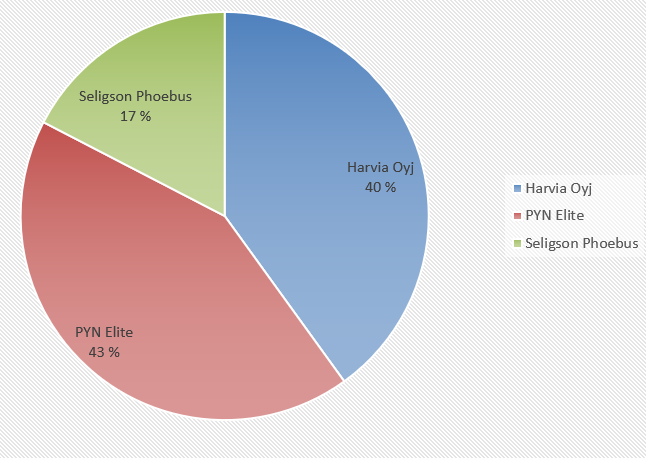
I haven’t traded at all, but the changes in share price dropped Harvia from the top spot to the second-largest investment in my portfolio.
22 Likes
OST:
Next games 17.42 %
Outokumpu 39.54 %
SSAB, B 42,82 %
11 Likes
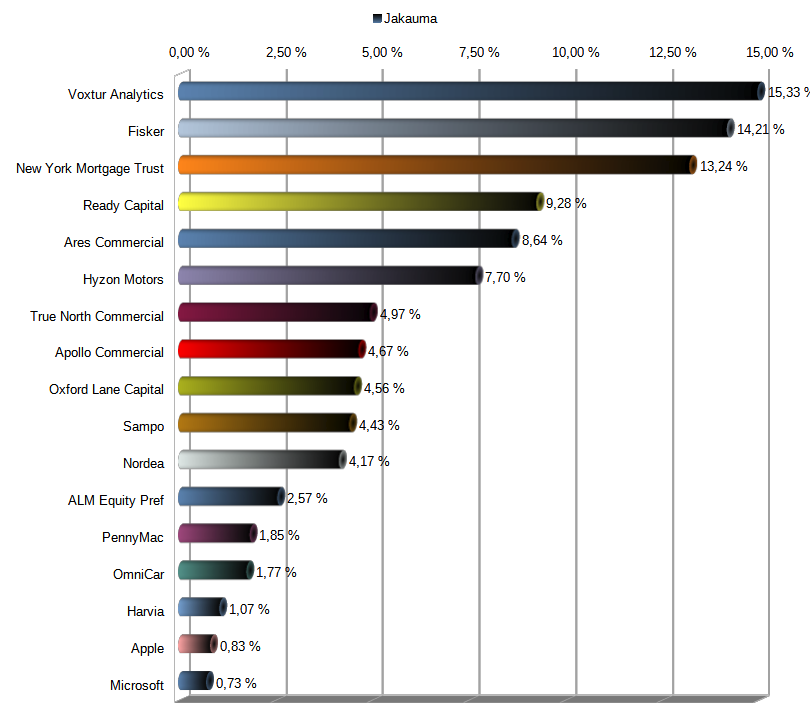
It’s been quite a wild ride, and this is certainly not a long-term goal collection. But for now, we’re going with this set towards more stable times  This has mainly been a kind of spring cleaning and a tighter focus, an example of which is the consolidation of Citycon+ALM to just ALM.
| Stock | Market | Distribution | Plan |
|---|---|---|---|
| Voxtur Analytics |  |
15.33% | Let’s get this in starting condition at once, so no need to hesitate |
| Fisker |  |
14.21% | Strong confidence continues, towards Q4 2022 and probably mostly on hold until 2024 |
| New York Mortgage Trust | |
13.24% | Strong quarterly dividends |
| Ready Capital | |
9.28% | Another strong dividend payer, quarterly |
| Ares Commercial | |
8.64% | More than certain quarterly dividends |
| Hyzon Motors | |
7.70% | A small buying program for this one during this year, and we’ll see how it goes in 2024 |
| True North Commercial | |
4.97% | Monthly dividends from the Canadian government |
| Apollo Commercial | |
4.67% | A bit riskier and higher quarterly dividends |
| Oxford Lane Capital | |
4.56% | Monthly dividends as well, strong global confidence in the company |
| Sampo |  |
4.43% | Continues as a cornerstone, gradually increasing position |
| Nordea | |
4.17% | Diversification of dividends and papers |
| ALM Equity Pref |  |
2.57% | Sweden’s “Citycon”, on which I’ve decided to focus for now |
| PennyMac | |
1.85% | I lightened up just in time before the “collapse” and will see how it progresses before further purchases (quarterly dividend) |
| OmniCar | |
1.77% | Hmm, let’s see when things start to happen. In a short-term hold until approx. 10 kr |
| Harvia | |
1.07% | Then we’ll make it from sheet steel, gradually increasing |
| Apple | |
0.83% | Continues as a cornerstone, gradually increasing position |
| Microsoft | |
0.73% | Continues as a cornerstone, gradually increasing position |
And a chart as well.
40 Likes
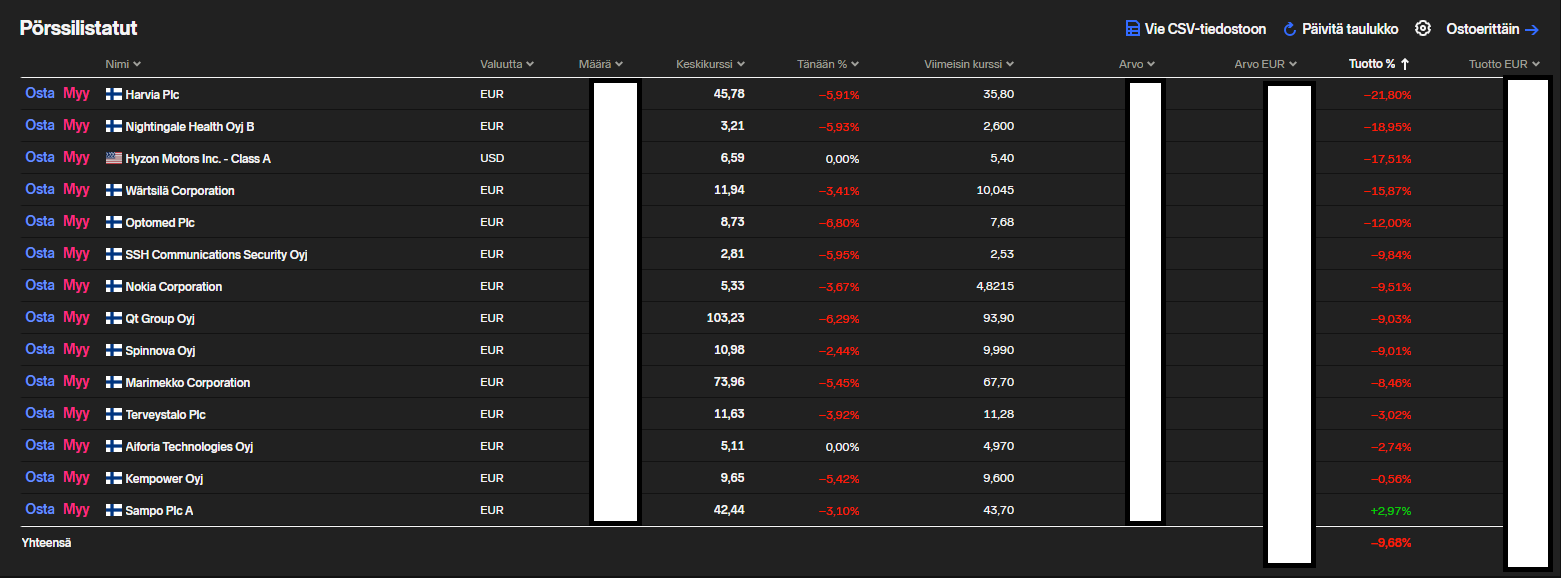
I started investing in stocks in December. So far it has been quite a downhill ride Well, luckily the investment horizon is long! At least the portfolio is Valentine’s Day colored!
72 Likes
The beginning of the year has been a celebration for value investors, with a YTD return of 12%. I’ve highlighted the story of these shunned companies here before. I divested from Norwegian salmon, and I also sold a few m-REIT properties. I might buy the latter back. The m-REIT sales on January 3rd were a salvation for the portfolio’s performance; my mental stop-losses for them were at their purchase prices, with dividends still running at 8-12% per property. Now, the core group in the portfolio is fighting inflation – with a dividend yield of 9% per year:
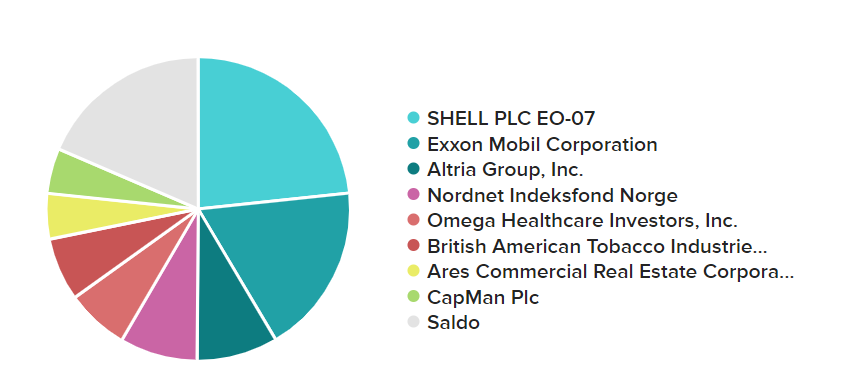
Somehow, I believe that tobacco stocks will be on fire these days. BTI has been a really strong holding since Black Friday 2021. However, I’m trying to offset my “sinful” investments by focusing on elderly care, or the buildings that enable it, i.e., OHI.
Regards, Shareville JanneBoy83
20 Likes

This year has been quite a downhill slide. Hopefully, Harvia will pick up from this…
Fortunately, my time horizon is long, and as a net buyer, I should be pleased with the quality stocks getting cheaper. Unfortunately, I don’t have a huge amount of cash stashed away; a large part has already been spent on falling knives 
57 Likes
New short ETF, with ticker “MORA”
9 Likes
Wouldn’t it be wise to apply for the maximum loan limit for your portfolio? With your current portfolio, it’s hovering close to the portfolio’s actual value, and didn’t Nordnet (NN) foolishly determine gold and silver tiers based on the applied limit, rather than the portfolio’s actual loan value? So, for you, it’s currently at the gold tier of 3000€, even though 15000€ is closer to the truth. Or am I remembering this wrong? You don’t have to use the leverage, but it’s certainly nicer to have the option to strike at a good opportunity with a slightly larger sum at the gold loan interest rate if needed.
3 Likes
That’s not how it works; the gold tier limit is 20% of the collateral value, even if the collateral value is higher than the limit.
6 Likes
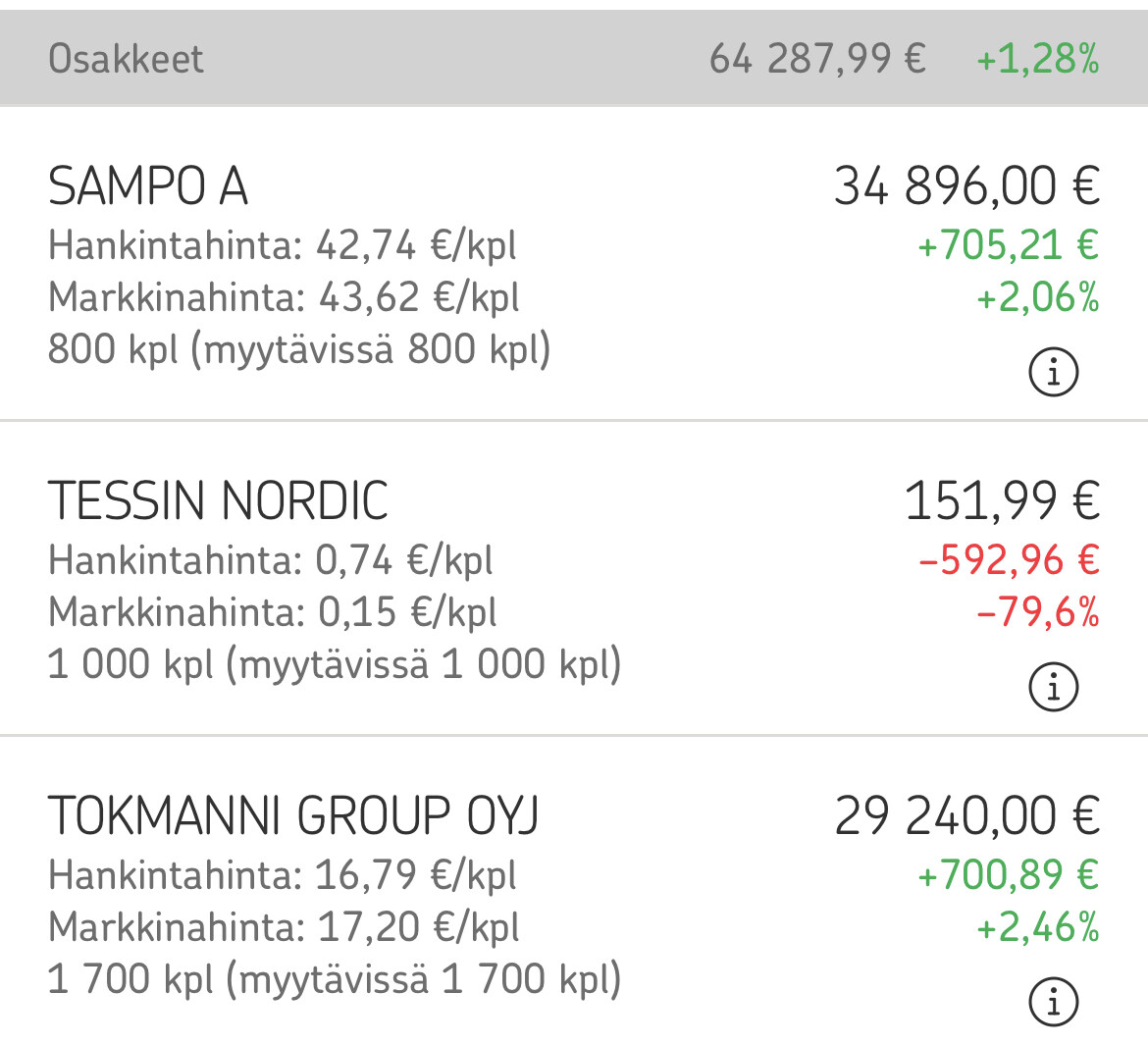
11/2019 I made my first stock purchases. The initial capital was around €20,000. Many different stocks have been in the portfolio, but the ones that have stayed the longest are QT, Tokmanni, and OmaSP.
I made the biggest profits with QT (bought at around €26, sold at €132).
The QT money has now gone into Sampo to generate steady returns (DIVIDENDS), and Tokmanni has also been consistently added to generate more DIVIDENDS
Nowadays, I don’t even need to check the portfolio every day. I reinvest the dividends back into these two (compound interest).
Towards retirement in 2046, something…
43 Likes
Out of curiosity, I’m asking, do you keep Tessin Nordic as a kind of reminder to yourself or why is it still hanging around? If I understood your message correctly, you have nevertheless realized capital gains and have taxes to pay on them?
2 Likes
Nice to see that other forum members also have larger Tokmanni positions . In my opinion, you have done exactly what you should: after making good profits with a growth stock (Qt), you have, after selling it, transferred the increased capital to good dividend payers, instead of moving the money to yet another growth stock, which would entail a certain risk, especially in the current market situation. This is, of course, a matter of taste; someone else might completely disagree on how one should have acted This is a comment on @KanaTaco’s portfolio.
17 Likes
Yes, last year I paid about €16,000 in taxes just from QT and EVO (over €10,000 in profit).
Tessin is still hanging in there  I don’t think it will drop any lower
1 Like
A picture of Palsen’s (Palsen) portfolio after a long time, although there isn’t much to see here. Investing started last year didn’t go quite as planned; buying growth stocks at presumably high prices didn’t really work out. I’d rather do it this way, through dividends and by watching for a decline…
The cash portion is 83%, which I didn’t draw in the pie chart for clarity. That’s why the percentages are so small.

14 Likes
OST
Digia
Dovre
Harvia
Nightingale
Nordea
Qt
Remedy
Sampo
Talenom
Tecnotree
Vincit
Taaleri (new)
(Etteplan and UPM sold)
AOT
Revenio
CapMan
Cipus
Digia
Incap
Sampo
Outokumpu (new)
Titanium
Fortum (sold)
Exchange-traded funds
ISHR MSCI Wrld A
iShs Aut ETF USD
iShs Elec Ve USD
iShs Glb Water
3 Likes
Stocks 25%
Nokia
Harvia
Revenio
Konecranes
Musti
Caverion
KONE
Sampo
Tokmanni
Pihlajalinna
Equity funds 11%
USA Index
Europe Index
Other
Commodity fund 12%
Personnel fund 14%
Cash 38%
3 Likes
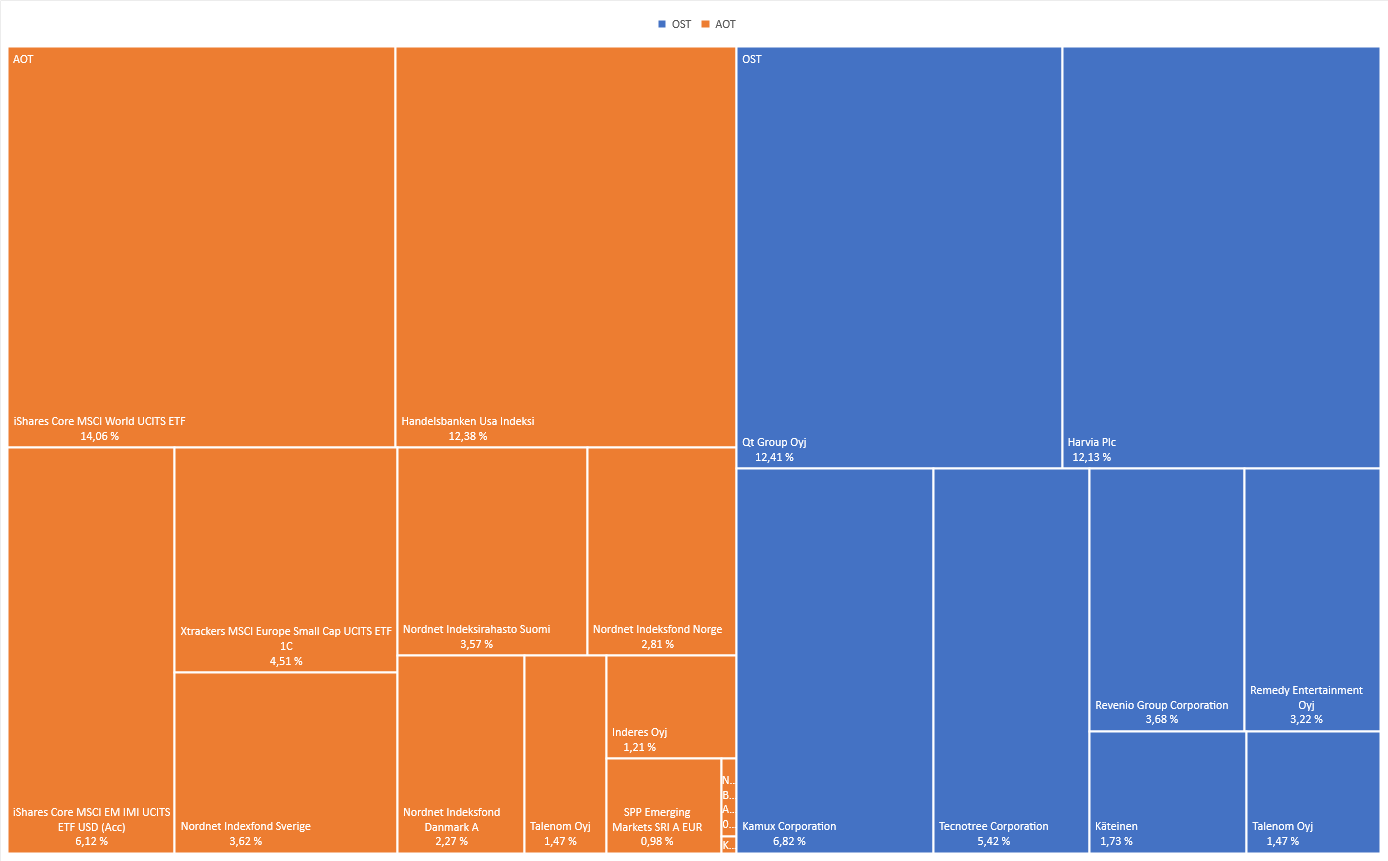
I am mostly quite satisfied with the portfolio’s contents. Of course, there could be more cash. (Leverage can be used if needed.)
On the AOT (Arvopaperien Ostojärjestelmä/Securities Trading System) side, the intention is to increase the share of the USA index.
On the OST (Osakesäästötili/Share Savings Account) side, Harvia and QT are slightly overweight, but when both portfolios are considered, we are still well under 20%. I have made additions to both of these during this dip. On the OST side, I will likely add other smaller positions.
12 Likes
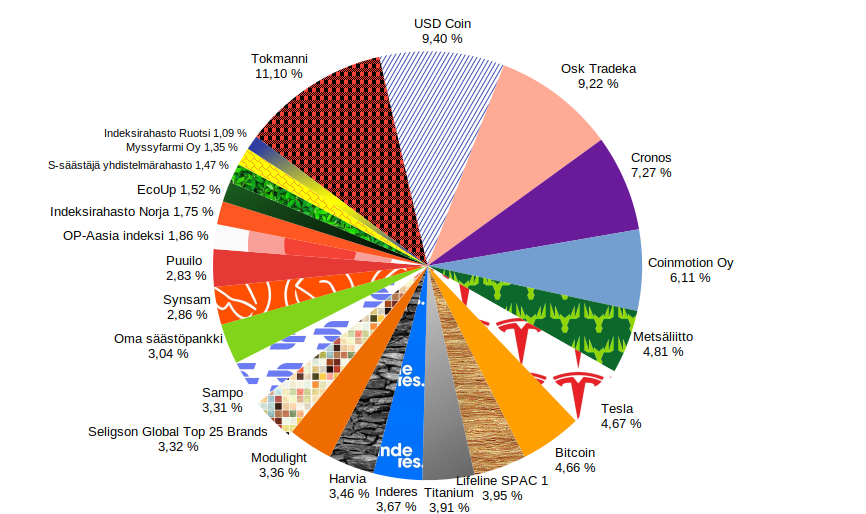
In this review, I will cover my portfolio’s movements in January and February. I have added shares in Tokmanni, Harvia, EcoUp, and Titanium. Additionally, I acquired more units of Seligson’s Global Top 25 Brands fund and Tradeka’s profit shares. I sold off a small amount of the Swedish index fund.
Despite everything, the size of my portfolio decreased and is now approximately 16.5 thousand euros.
In this review, I will also briefly discuss country-specific diversification. I am publishing this review mainly so that I do not abandon the management of my portfolio even during worse times.
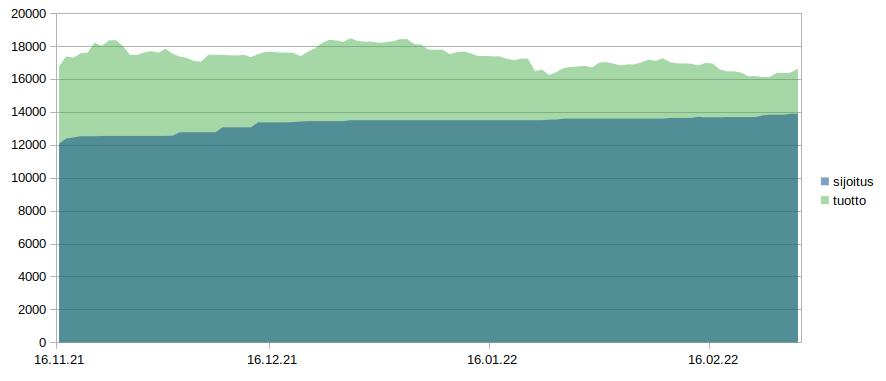
The curve clearly shows a trend where the green area of profit narrows, even as the number of investments increases.
My portfolio’s diversification by region

Finland dominates my portfolio with a 60 percent share. Diversification primarily comes from cryptocurrencies, which I divided between “other” and USD Coin, as I consider USD Coin to be quite a different product compared to my other cryptocurrencies. North America at 7% and Sweden at 4% peek in slightly, but other regions remain very small.
Equities 48% (51)
Equities mostly consist of Finnish companies. I must say that I cannot hide very well behind the common argument of “companies doing international business.” My companies operate and generate their profits mainly domestically. Sampo has business in all Nordic countries, and Harvia has a more global business. Modulight aims for the United States. When Russia launched its war of aggression in Ukraine, I realized that there was hardly any Russia risk in my portfolio.
Funds 9% (9)
In funds, I aim to exit the Swedish index fund and focus on Seligson’s brand fund. I have sometimes considered switching the Norwegian fund to a Russian fund, but fortunately, I have not implemented it. After a difficult spring, the plan is to start adding to the Op-Asia index as well.
Unlisted Companies 7% (7)
Both unlisted companies generate most of their revenue from Finland, but they have ambitions for further internationalization.
Cooperatives 14% (12)
Metsäliitto, or Metsä Group, is a global forest giant. It operates in 30 countries.
Tradeka’s investments also have diversification outside Finland.
Cryptocurrencies 21% (22)
Cryptocurrencies are beyond understanding. Cro coin was rebranded as Cronos.

The intention is to improve regional diversification mainly through funds, although it is slow for me, especially when the urge to add equities at falling prices arises.
My portfolio’s equity weight is slightly elevated
Liquidation percentage 79%
Dividend-paying companies 76%
Unhedged value 13%
13 Likes
February 28, 2022
Previous month’s review: In February, OPO decreased by -10.5%, including withdrawals and deposits, with exactly 51 trades and a leverage of 18.2%.
The portfolio was left completely untouched for two months without any trades. At the end of February, I made some trades to maintain Nordnet’s top tier status for the next three months. I also exchanged some Solteq shares for Kamux; otherwise, the portfolio has remained intact.
Russia invaded Ukraine. I did not anticipate this happening. Perhaps I feared it, but I did not consider it likely at all. Stock markets responded to the war and uncertainty with steep declines. Passive ownership has taken a toll on my wallet, and Nordnet’s YTD shows -18.5%.
In February, Q4 results for all my portfolio companies were published. Performance was, on average, stable, perhaps slightly subdued. Tecnotree and Lindex were exceptions, showing pleasing growth.
Expectations for the coming months: In March, the Stockmann property deal should finally be finalized, and with the removal of associated uncertainty, I believe the share price will rise, and I will be able to reduce my overweight position. I expect markets to remain volatile, and share prices to continue their erratic fluctuations up and down. For this, more aggressive and faster swing trading works, so I’ll allocate time for trading in Q2.
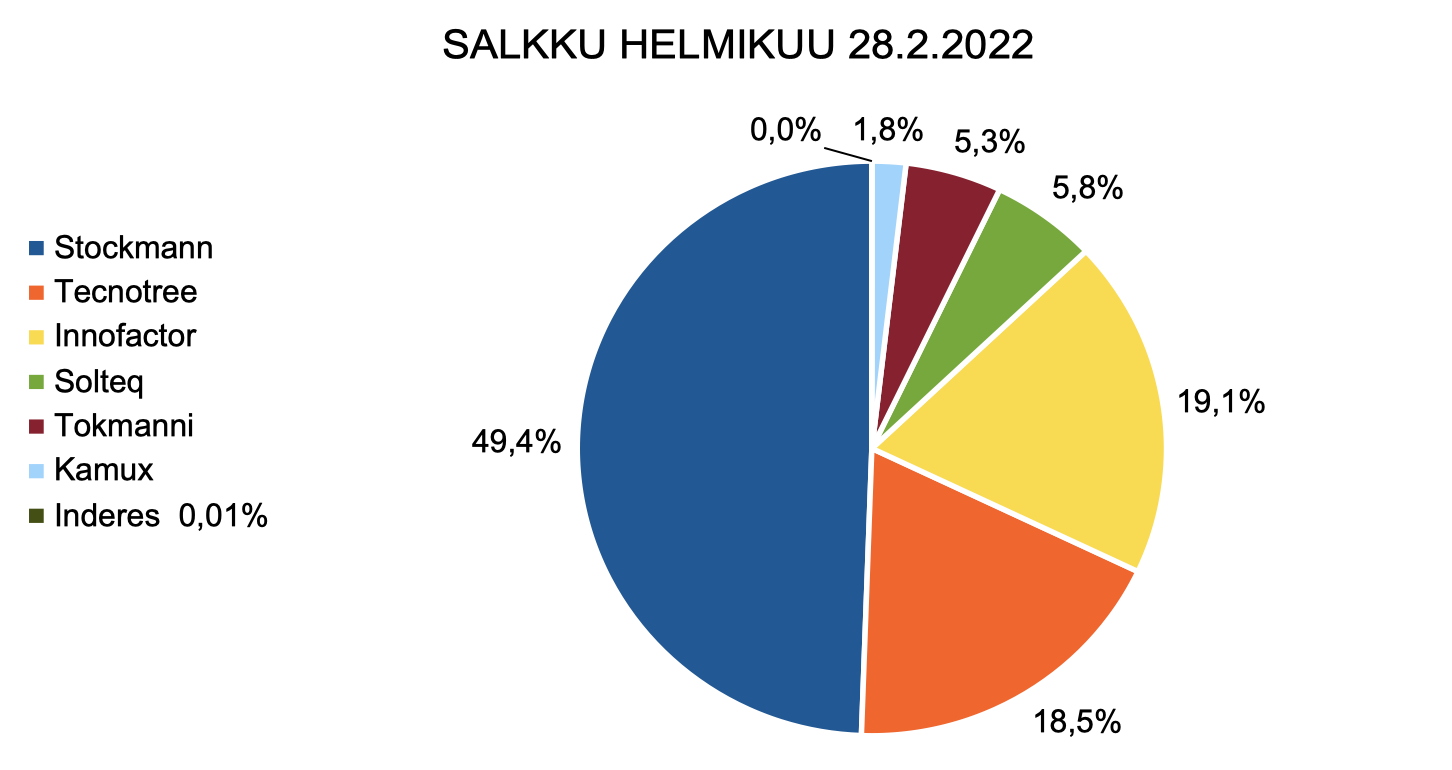
Stockmann: In March, the Helsinki property will be sold unless there are last-minute surprises. Stockmann’s Q4 results were good. Retail revenue +8% and Lindex revenue +27%. Lindex’s online sales grew by 12%, but retail sales decreased by 16%, which is somewhat concerning. Cost-cutting will continue next year, and कोरोना (Covid-19) restrictions are easing, so retail has good prerequisites for further improvement. Lindex is growing with good profitability and has ambitious plans.
Tecnotree: Q4 revenue +28% and EBIT 32.6%. Moments platform initiation with MTN operator and DSC non-operator. EBIT is high, and there’s an option to accelerate revenue growth by momentarily giving some slack on EBIT. Strong order book, remote deliveries, new verticals Moments and Spark intelligent wallet, partner network. Growth appears to be continuing.
Innofactor: Q4 all countries’ operating margin in positive territory. Strong order book, revenue per employee growing, share of recurring contracts increasing. Personnel turnover was sharp in H2 due to organizational restructuring but has now started to pick up. Measures related to improving operating margin are clear and known. Downsides include competition for skilled workers, and stagnant revenue in Sweden.
Solteq: Q4 showed good revenue growth of 11.4%, but expectations were significantly higher. Software grew by only 13%. In H1, deferred projects will be delivered, but profitability is burdened by product development investments. The internationalization of software is concerning as no announcements have been made. How is the Swedish data hub progressing? Nevertheless, the outlook for software and digital is good. Foreign markets, especially Denmark, are growing. Robotics spin-off in 2022.
Tokmanni: Q4 revenue +3.2%, but comparable growth -0.3%. Guidance for revenue and operating profit growth. Store network expansion to 220 stores and 10 larger stores. Margins are under pressure, and performance in purchasing operations must be strong.
Mäntsälä is being built, direct imports are growing, supply chain and logistics are well managed, we survived during the Covid period and can now return to improving efficiency, e-commerce is growing, Tokmanni club is growing.
17 Likes
It’s been a couple of months since the last post, so it’s time to take a look at the portfolio. However, there haven’t been very big changes since the last update. I started new monthly savings agreements for Handelsbanken’s USA Index Fund and Seligson’s Asia Index Fund. These are within the margin of error, but additional purchases will gradually increase their share.
I sold some smaller holdings (such as Kahoot and Cerence) and also made a small rearrangement between the AOT (Brokerage Account) and OST (Share Savings Account), as the maximum deposit for the OST is full.
| Stock and Fund Portfolios | % of Portfolio |
|---|---|
| Revenio Group Oyj | 9.46 % |
| PYN Elite | 8.61 % |
| Incap | 7.30 % |
| Inderes | 5.91 % |
| Seligson & Co Global Brands | 5.34 % |
| Zaptec | 5.18 % |
| Novo Nordisk B | 3.48 % |
| Harvia | 3.43 % |
| Lamor | 3.40 % |
| Investor A | 3.29 % |
| iShares MSCI Core World SRI ETF | 3.22 % |
| Qt Group | 3.20 % |
| Remedy Entertainment | 3.08 % |
| Alphabet C | 2.88 % |
| BNPP Circular Economy ETF | 2.42 % |
| Microsoft | 2.39 % |
| iShares MSCI Core EM ETF | 2.22 % |
| Neste | 2.16 % |
| Kamux | 2.11 % |
| NextEra Energy | 2.09 % |
| Sampo Plc A | 2.07 % |
| DSV Panalpina | 1.95 % |
| Linde | 1.92 % |
| Orthex | 1.90 % |
| Talenom | 1.84 % |
| Apple | 1.78 % |
| Boreo | 1.71 % |
| Cibus Nordic | 1.60 % |
| Huhtamäki | 1.41 % |
| Handelsbanken Kestävä Energia | 1.37 % |
| Kempower | 1.15 % |
| Handelsbanken USA Indeksi | 0.01 % |
| Seligson & Co Aasia Indeksirahasto | 0.01 % |
| Cash | 0.11 % |
| Total | 100.00 % |
In addition, the employee fund holds approximately 22% of the combined value of the above portfolio and the employee fund (or approximately 28% of the size of the above portfolio).
I have almost completely divested from peer-to-peer (P2P) loans and am not making new investments in them for now. However, exiting them will take a long time, as not all loans have a secondary market option. P2P loans now account for approximately 0.97% of investment assets.
Cryptocurrencies still make up a small portion (0.29%) of investment assets. This amount is unlikely to increase or decrease significantly in the coming months.
22 Likes