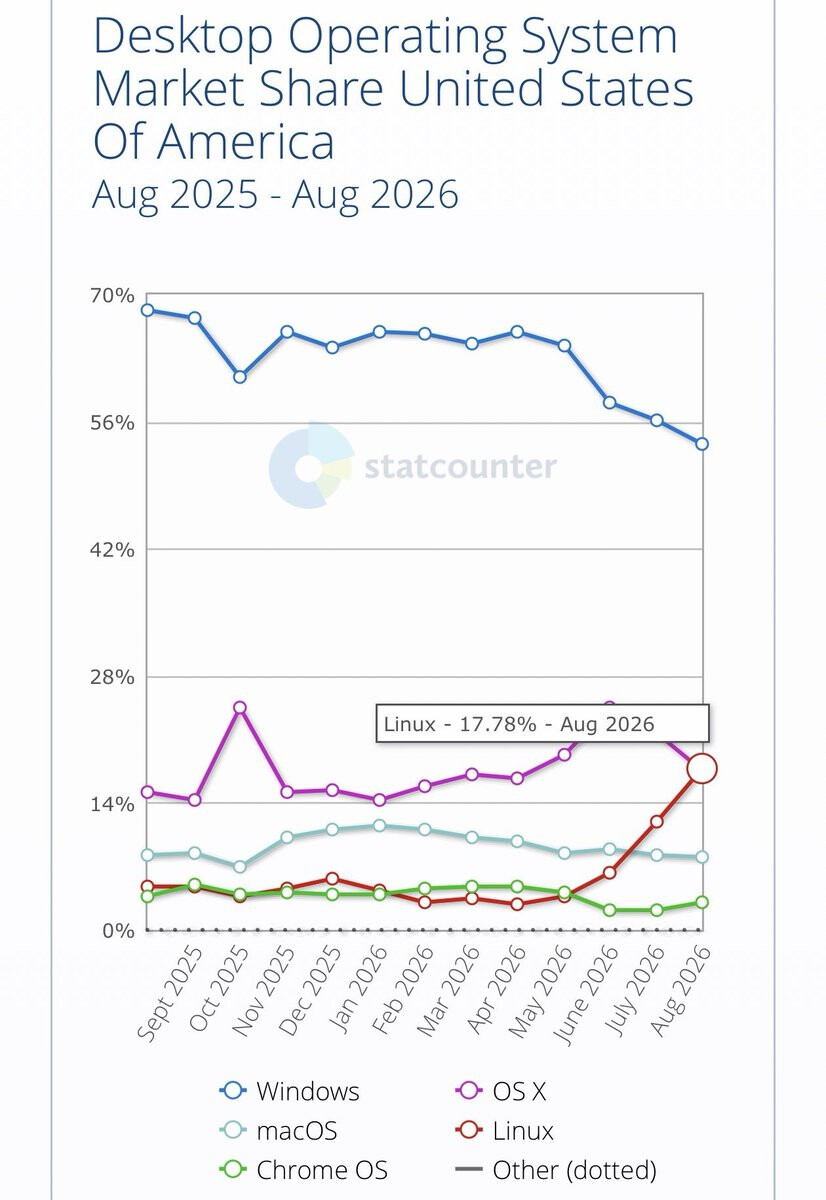
Significant change: AI bots have finally made it possible to use Linux on the desktop without major pain. As a result, user numbers are rising.
As is well known, Linux bends to almost anything, and “as long as you just know how,” it’s a great OS. Historically, the problem has been that the average computer user doesn’t know how, and even if they did, that knowledge is very Windows-centric. Unless you happened to have a familiar Linux guru in your back pocket to ask for help, troubleshooting with Linux has historically meant browsing Reddit and niche forums, digging for a solution with Google through a pile of crap (where that pile of crap consists of the surrounding “are you a total moron for not knowing this” discussions, alongside ten bad solutions, or ones conjured for the wrong distro / outdated solutions to the problem).
But now, problems can routinely be solved by asking ChatGPT / Claude / Grok / Gemini, and as long as you understand how prompts need to be written to get the desired result, they get solved with a very high success rate. Granted, the same trick nowadays works for many mystical Windows problems as well, but still, I think the significance of this effect could be quite substantial in Linux’s favor. Previously, there was a huge hurdle to making some Linux distro the main operating system of a home computer—often just choosing the distro caused a headache—but now there is a tireless champion of stupid questions (AI chatbot) available to help, offering support for as long as it’s needed. Commercial operating systems really only have one major advantage left—support for the absolute newest hardware components tends to be better, because hardware can’t be sold without Windows support, whereas Linux support can be of the “yeah, whenever we get around to it” or “couldn’t care less” variety. And even this really only applies to brand-new hardware or really obscure issues with individual device models, and those same chatbots can usually tell you quite accurately about known compatibility issues if you ask about them before making a purchase.
Along the way, this chatbot effect also causes another interesting change in the world: the need for technical support from software and hardware manufacturers is plummeting. Finding solutions to problems on the internet among the garbage via Google always required just enough extra effort that many people preferred to contact support directly. Now, chatbots are able to solve, conservatively estimated, well over half of users’ problems—practically everything that can be attributed to errors between the keyboard and the chair, as well as issues caused by obscure configurations that can be fixed by tweaking environment settings. In other words, technical support is left mostly with actual hardware failures and brand-new problems for which no solutions can yet be found online, and which are of such a nature that chatbots cannot directly deduce the fault from logs/error messages. Previously, Linux didn’t really have technical support—excluding mostly paid support services offered to businesses. And device vendors themselves routinely took the stance: “Linux? And problems? Reinstall the Windows that came with the computer first, and if the problems persist, then contact us again.” People were too easily left in a situation that could be resolved in five minutes if there was a place to ask. Now there is.
AI is the biggest threat to Microsoft’s operating system monopoly in years