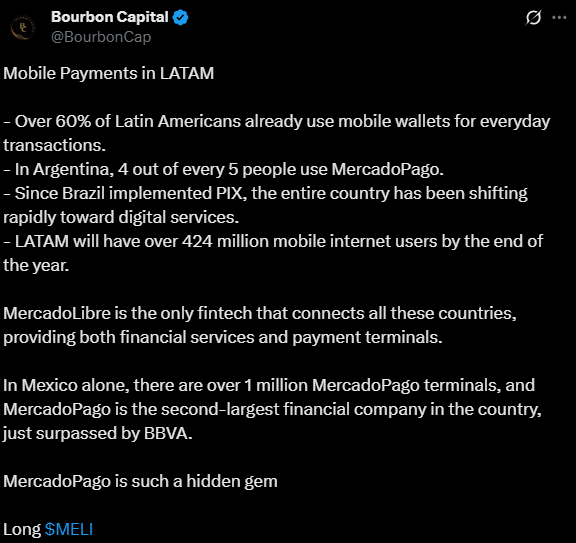
In Latin America, mobile payments are growing rapidly, and MeLi benefits the most from this.
The company’s service, MercadoPago, is a market leader in Argentina and Mexico, and it is also expanding rapidly throughout the region. The company’s fintech business looks strong as a long-term investment.
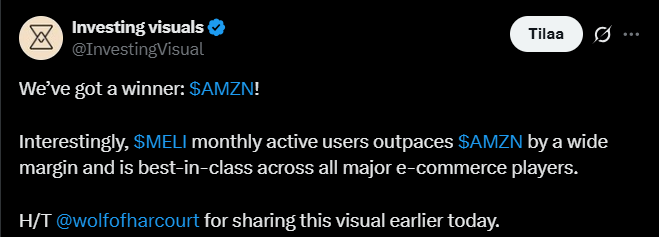
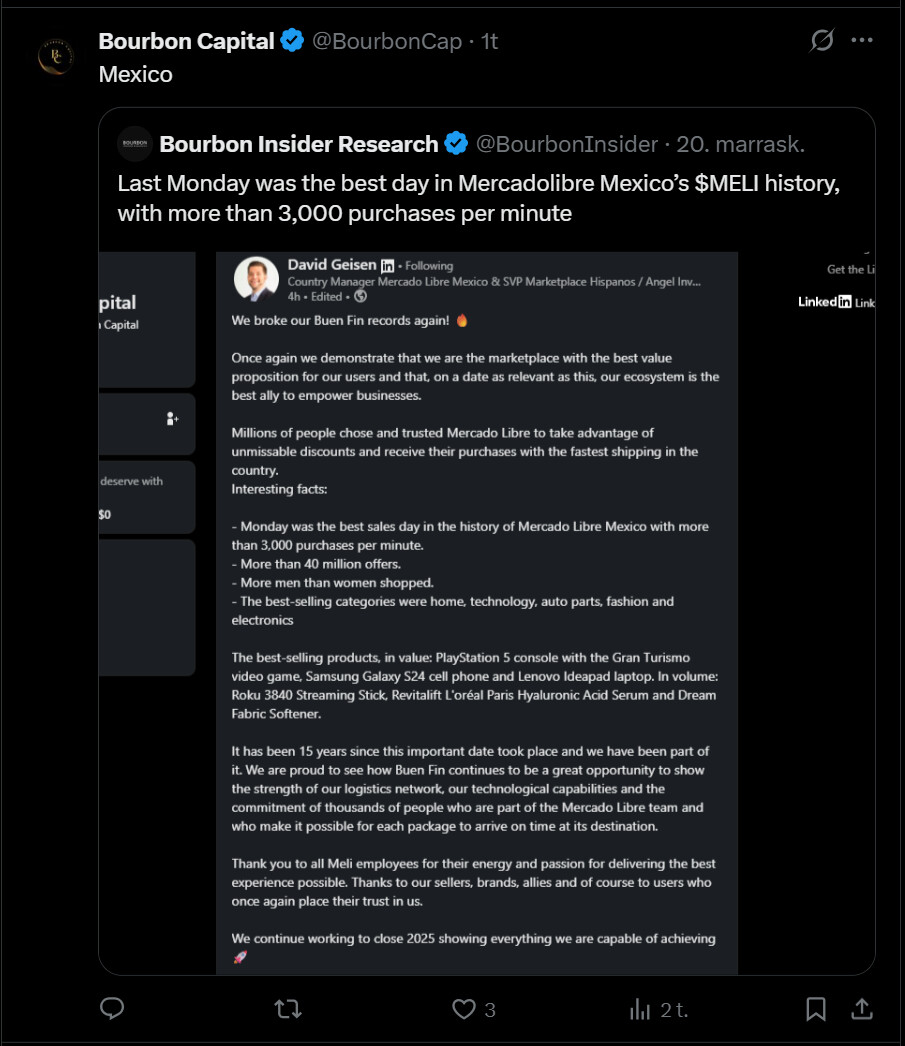
To clarify, according to the original tweet, it’s a statistic on the development of e-commerce in Mexico.
As can be seen, Meli is seizing market share from other companies, and this suits the owner well, as currently less than 25% of the revenue comes from Mexico.
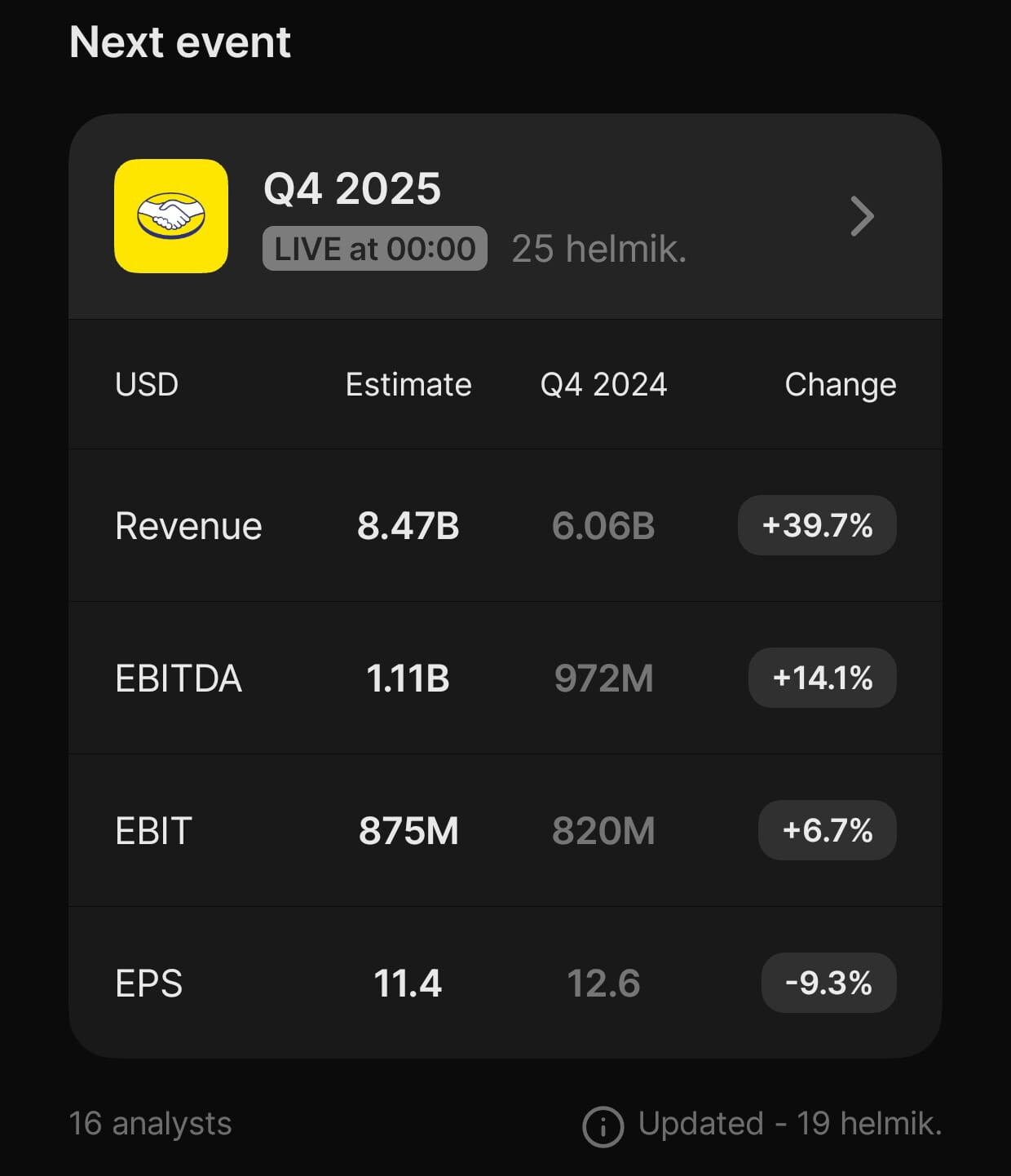
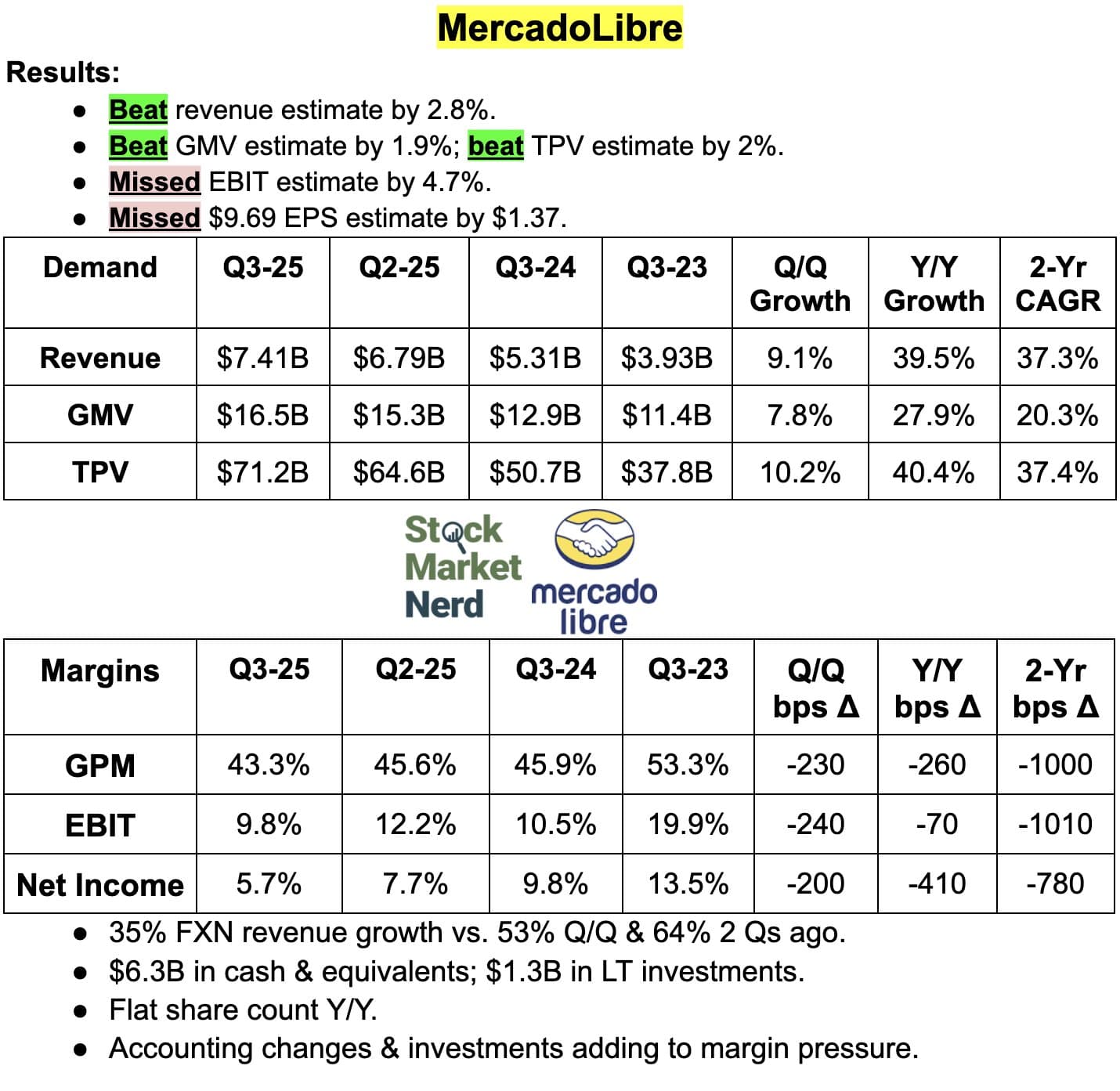
Tomorrow, MercadoLibre will release its Q3 earnings report around 11 PM! Again, tremendous growth is expected for a company of this size. If past trends hold true, revenue might slightly exceed expectations, while earnings per share could fall short. The reasoning for this is larger-than-anticipated investments in future growth.
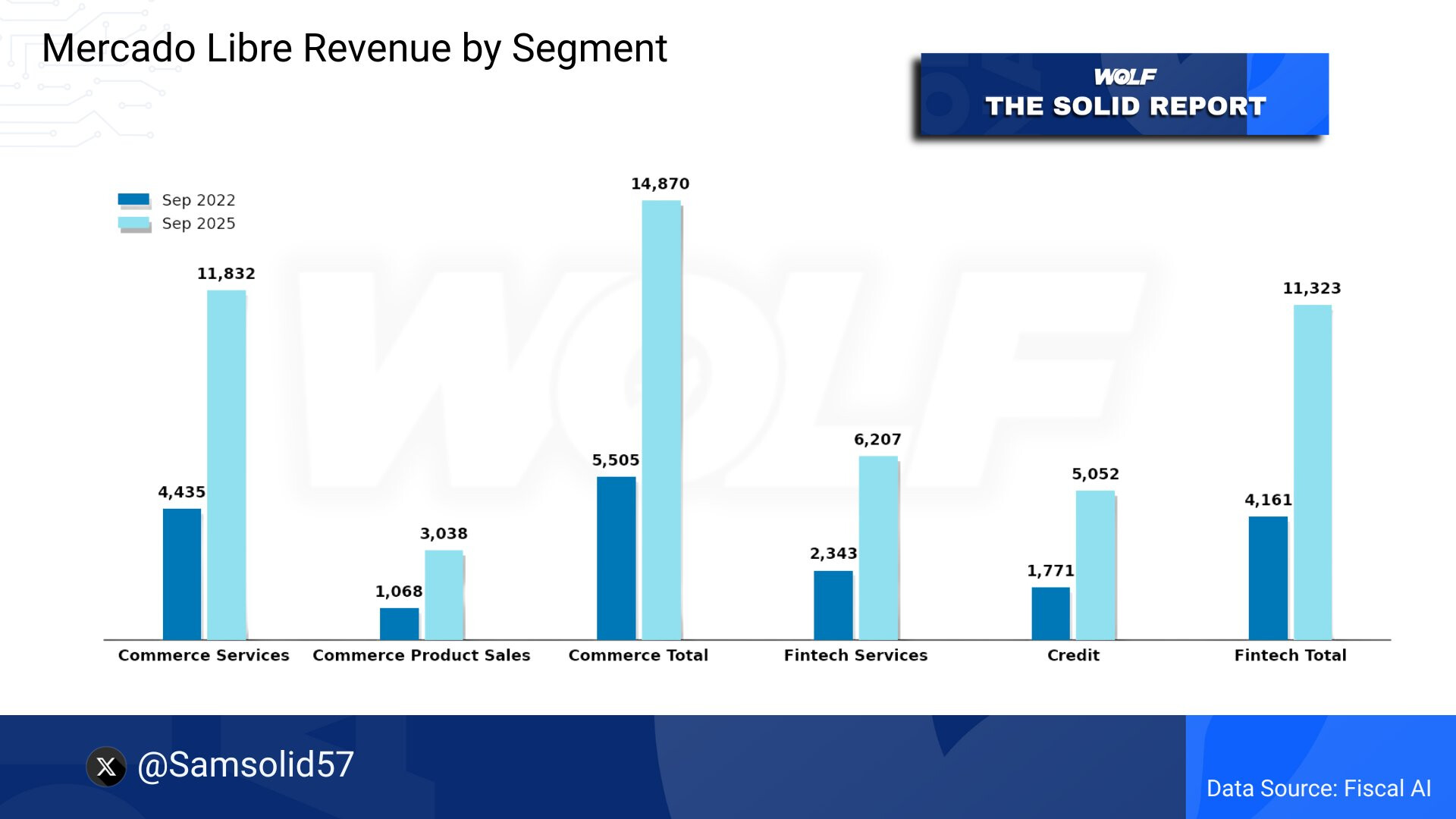
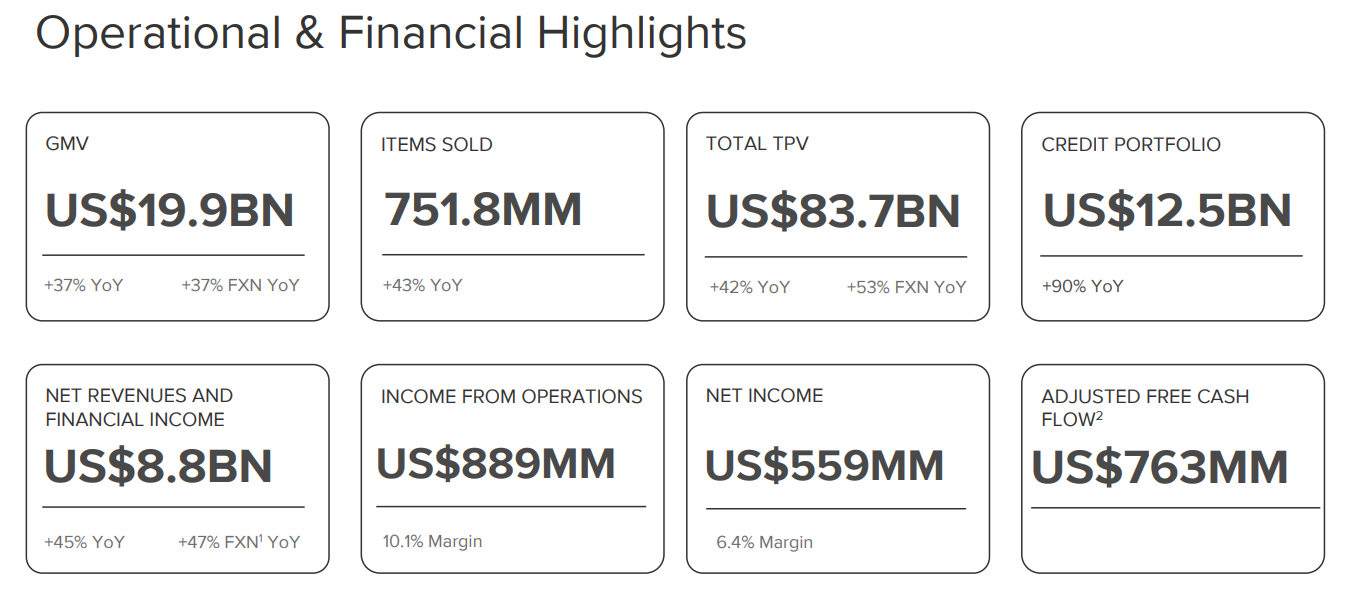
MeLi continued its strong growth momentum; for example, revenue, payment operations, and platform volume clearly increased, and profitability remained at a good level. The company has successfully expanded both payment services and lending at the same time as its market position in Latin America strengthens.
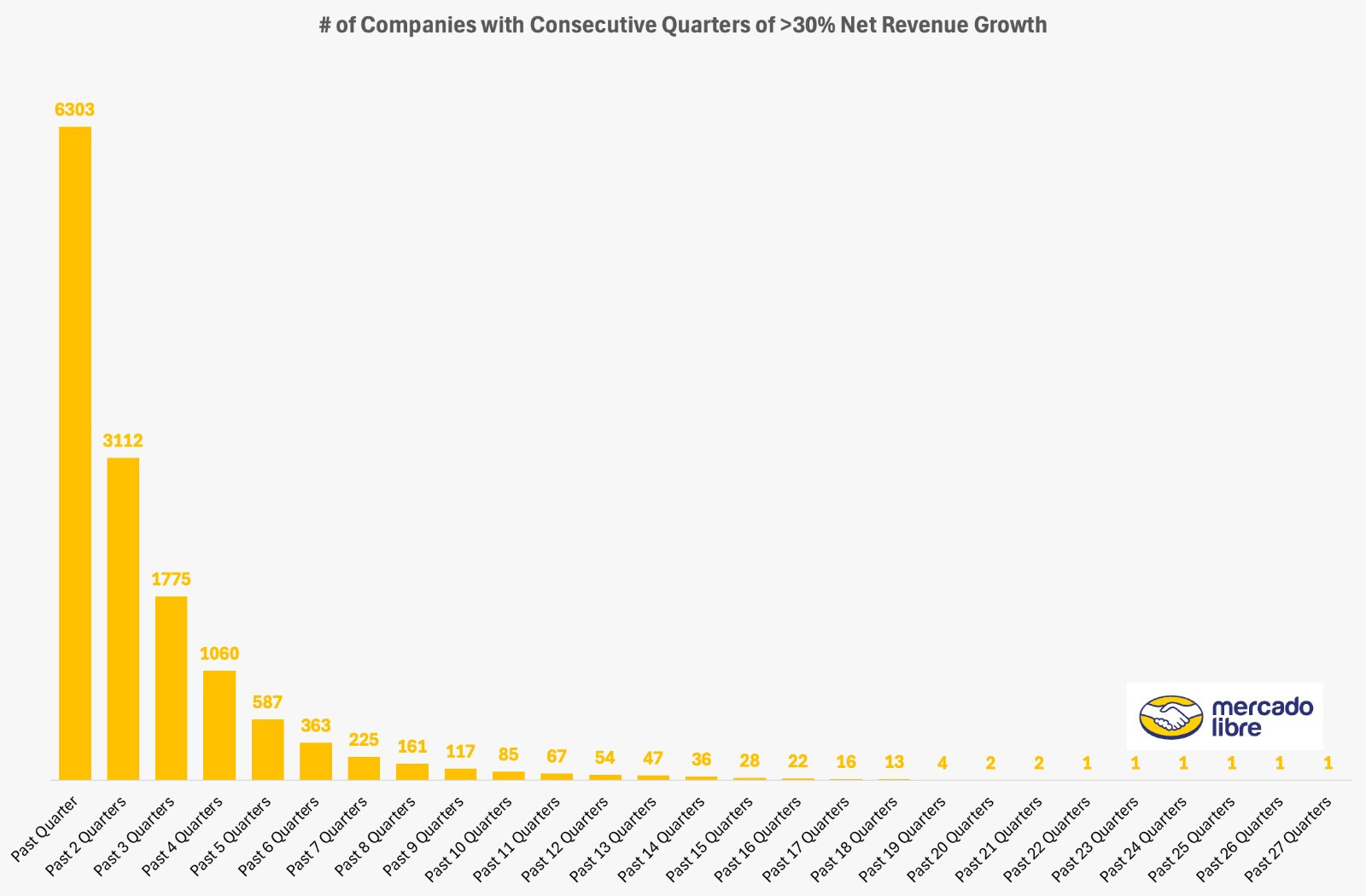
The management emphasized in their remarks that long-term investments are yielding results, as the company has grown over 30 percent for 27 consecutive quarters, an annual growth rate.
The company still sees great potential in expanding financial services and e-commerce, and it plans to continue its growth investments from a strong financial base.
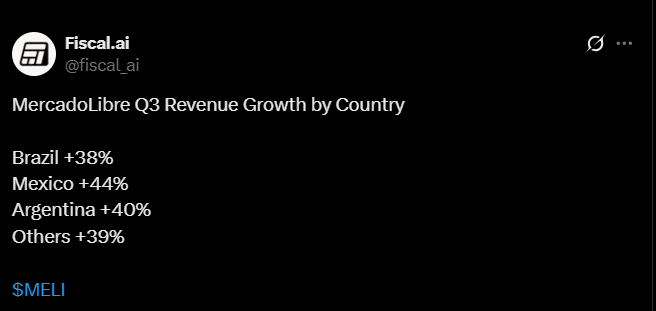
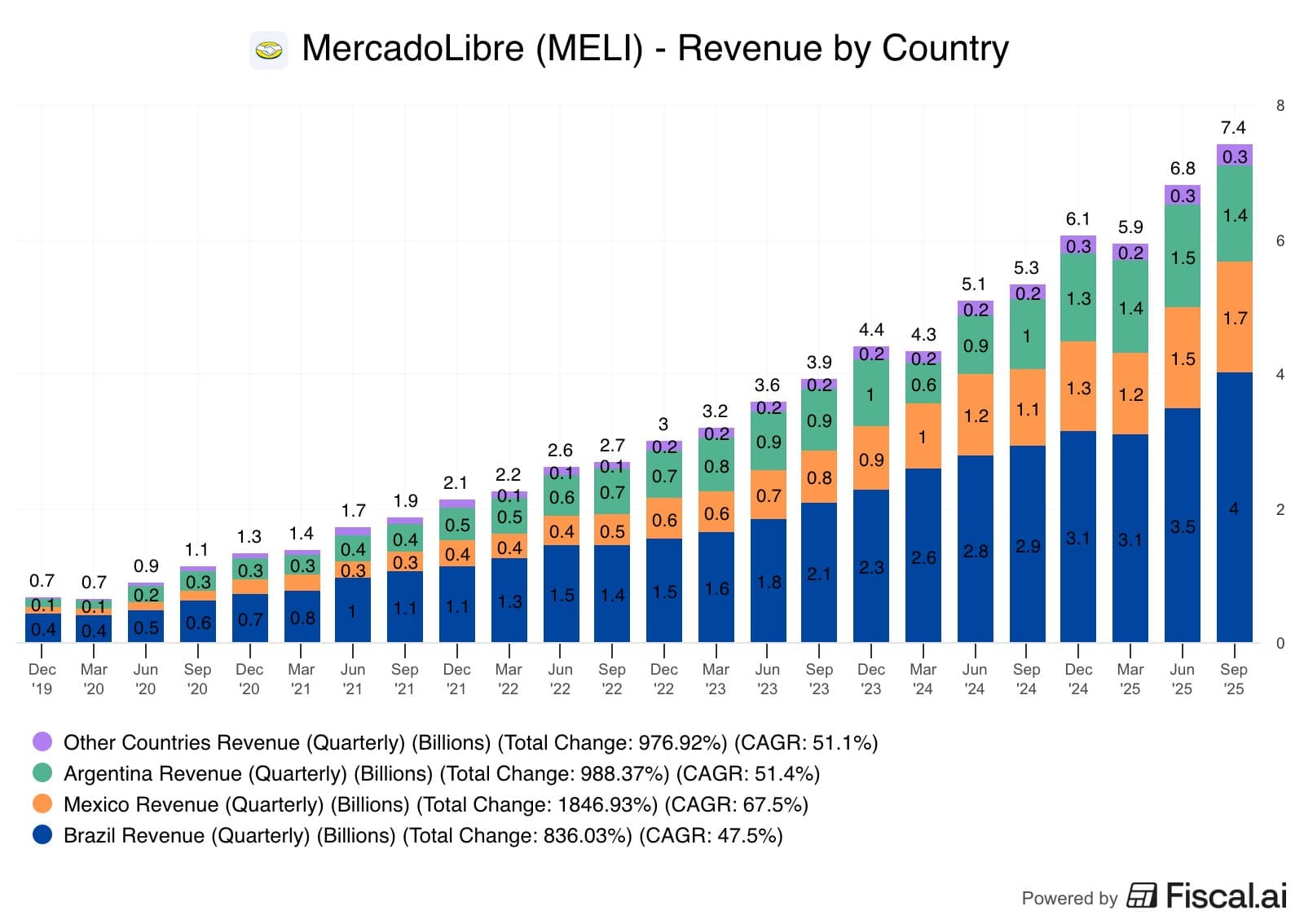
He’s a tough man if he’s not satisfied that a company that has grown its revenue by over 30% YoY for 27 consecutive quarters is now growing by 39%. (And we’re not talking about a micro-cap company, but a behemoth with 7.4 billion USD in quarterly revenue!)
I personally loved the earnings report! Revenue grew significantly, as the company’s goal has been: to capture market share, make competition difficult, and make this one-stop-shop work seamlessly. Yes, in the short term, this shows in weaker profitability, but a company growing so incredibly profitably should be devouring the market, and not worrying too much about the level of profitability (it was mentioned several times in the conference call that there is a lot of market available now, it just needs to be grabbed. In Finnish: it’s good that we’re not hitting the brakes now). The fundamentals strengthen quarter by quarter as more distribution centers and other operations-strengthening factors are developed. Growth is by no means being achieved at any cost; the cash register is also ringing all the time.
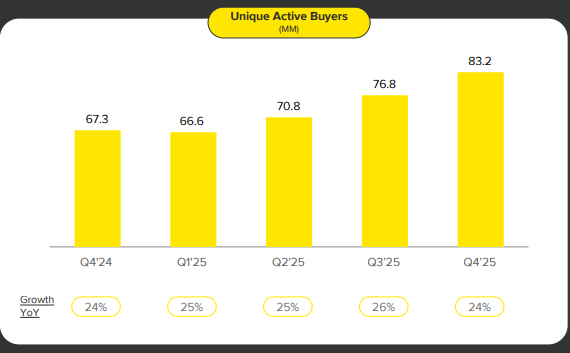
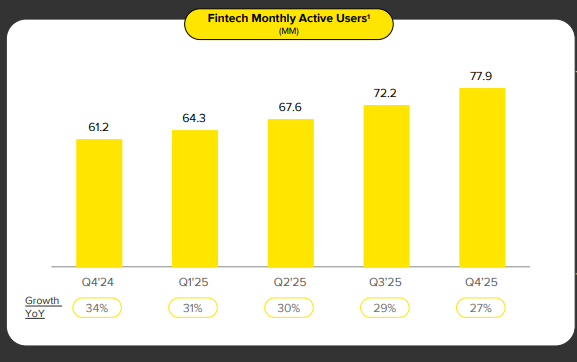
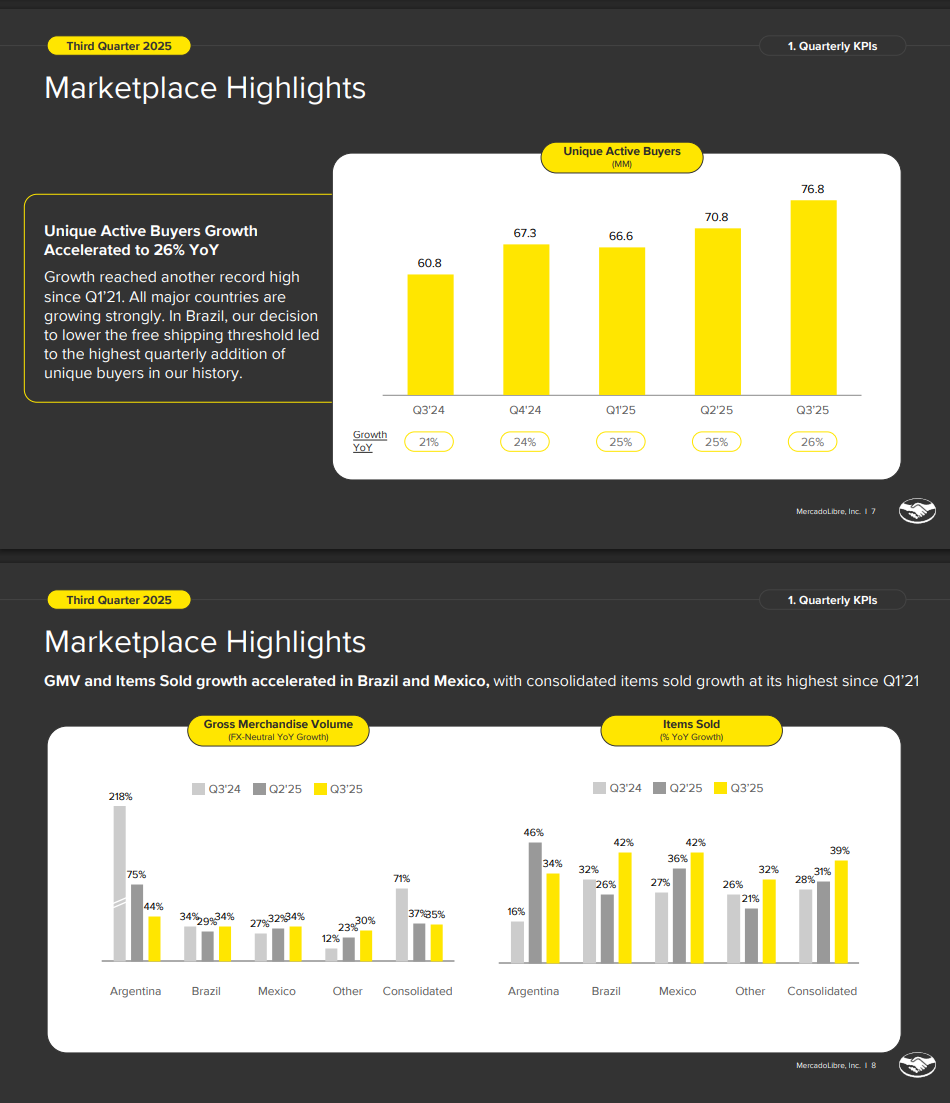
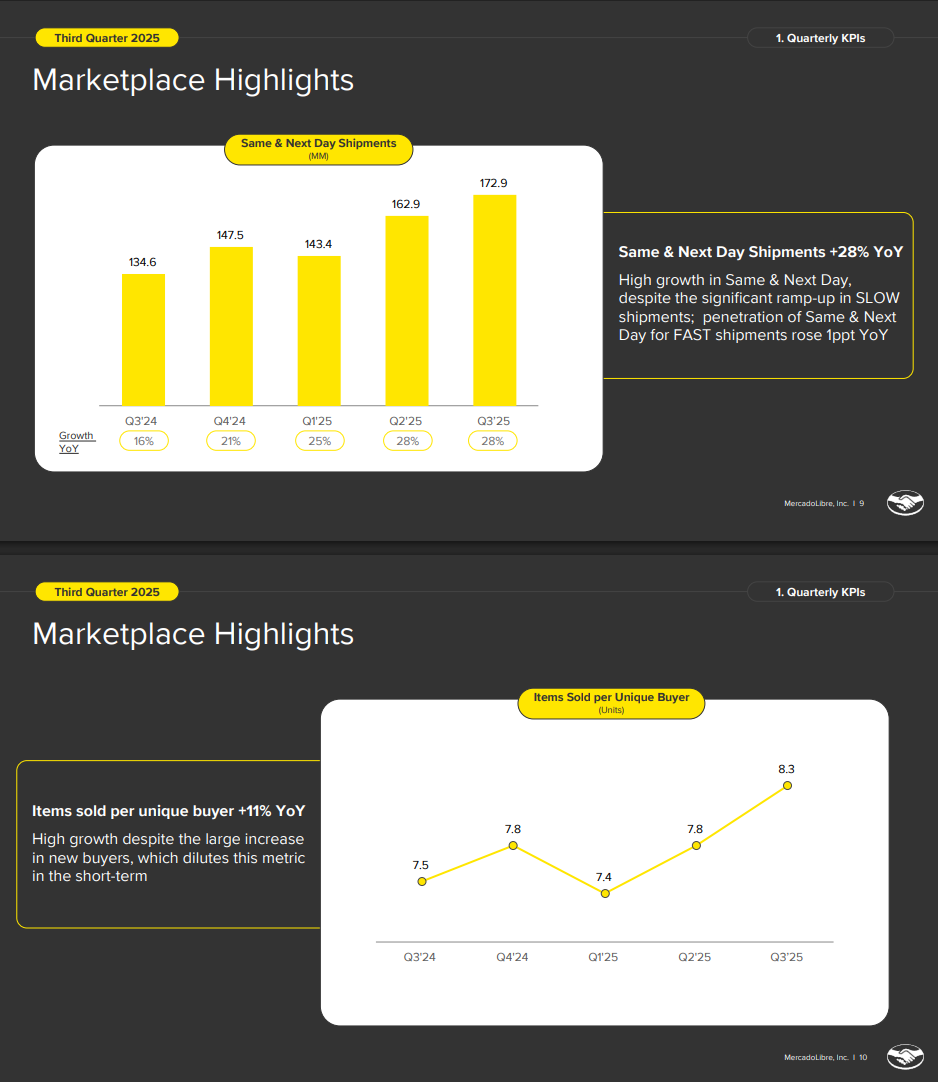
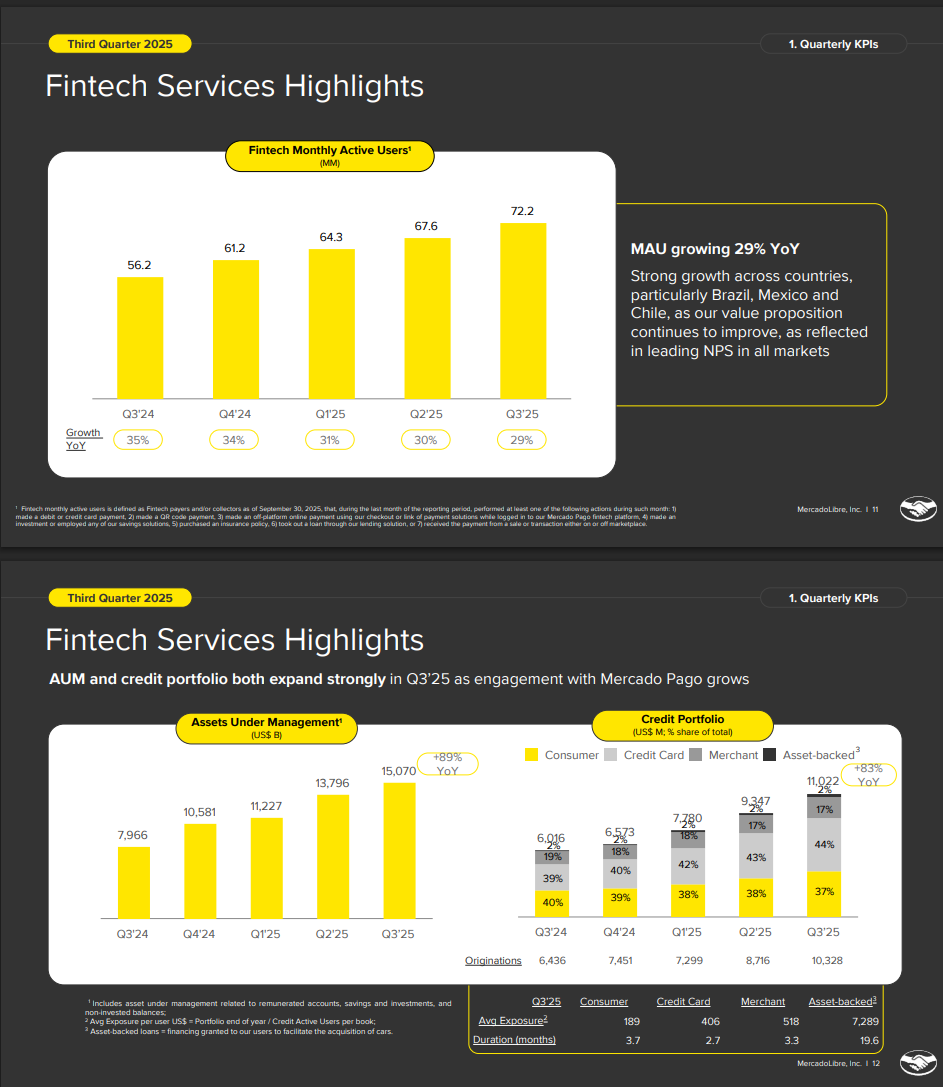
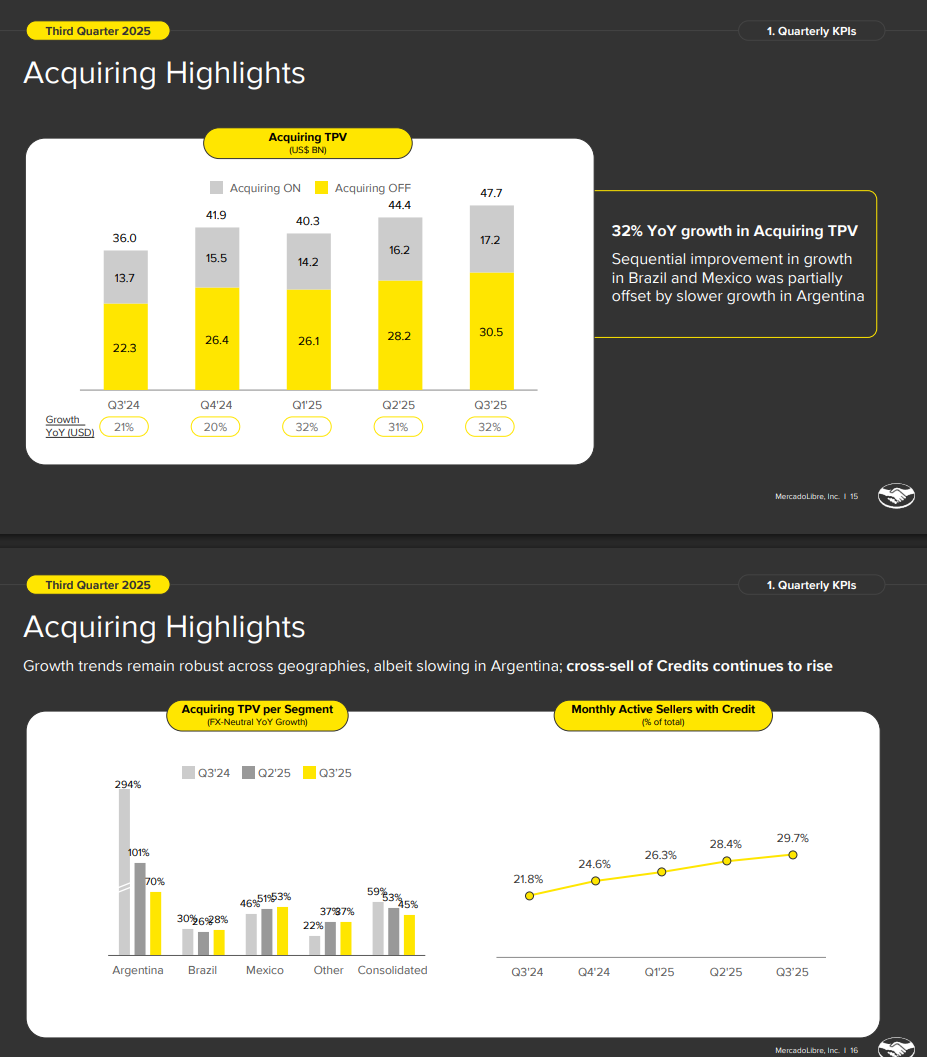
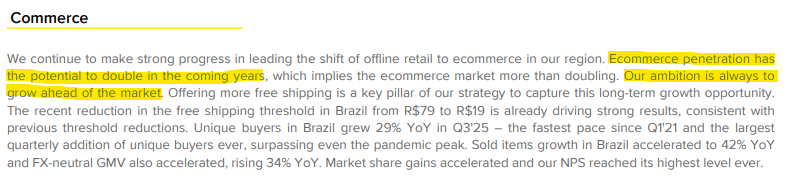
The Commerce side is pulling (+28% GMV, unique active buyers +26% YoY) and fintech is performing wonderfully, monthly active users rose 29% YoY (plus MercadoPago bank applications are underway in Mexico and Argentina).
Profitability took a hit when Meli lowered the minimum purchase amount in Brazil from 79 reais to 19 reais. This led to a 29% increase in the number of unique buyers YoY.
Markets have typically punished Meli for playing the long game, but today it seems that won’t be the case. Interesting.
E.2. If only all companies were managed with this mentality. Quarterly economics are nice, but I’m leaning towards the idea that companies managed well for a long time will flourish even later.
“We are not managing the business for short-term margin. We are managing for long-term value creation. And we think that if we continue to sustain the levels of growth that we are delivering, we are in the right track. As we said in the past, we are not going to hesitate to invest behind that even if we put some short-term margin pressure. But in the long term, we continue to be very optimistic about the margin profile of our business as we continue to scale the business and as some of the investments that we’re making continue to mature…”
Martin de Los Santos, CFO (conference call Q&A section)
I haven’t fact-checked this, but it’s quite an achievement if it’s true.
Meli would be the world’s only publicly listed company that has grown over 30% for more than 22 quarters (revenue). Not bad. One would think that says something about its quality.
I also got caught up in wondering about this Latin American trend, which is admittedly very interesting.
The competitive situation is interesting in that MELI has, as I understand it, been able to operate relatively unchallenged in a somewhat virgin market, into which these two partners have now entered as challengers. At first glance, one might think this would mean difficult times for MELI, at least in terms of margins, but on the other hand, such an oligopoly situation could act as an accelerating driver for market transformation.
A couple of factors immediately come to my mind:
Smartphone penetration in Latin America is apparently around 75% [1], but a similar proportion of the market still relies on the power of cash [2].
Two (insanely) large players raise the barrier to entry for the market.
Would the forum’s resident economic historian @Verneri_Pulkkinen like to come and give a lecture on oligopolies? I recall you’ve talked about them in some other context?
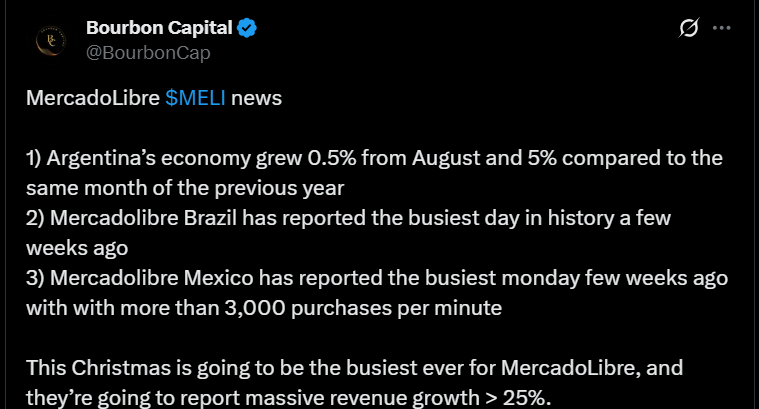
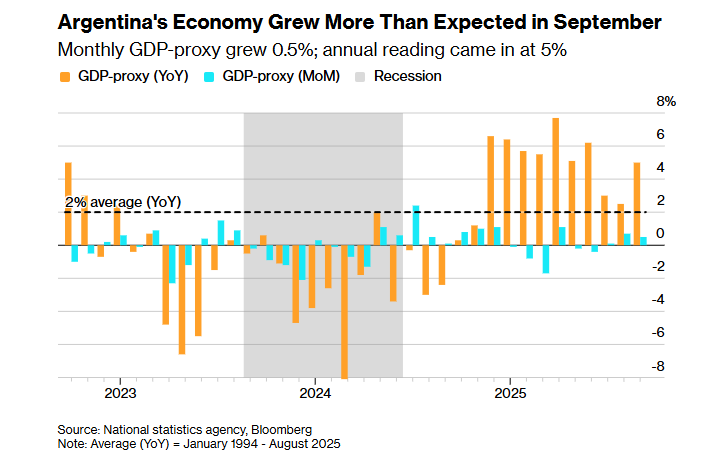
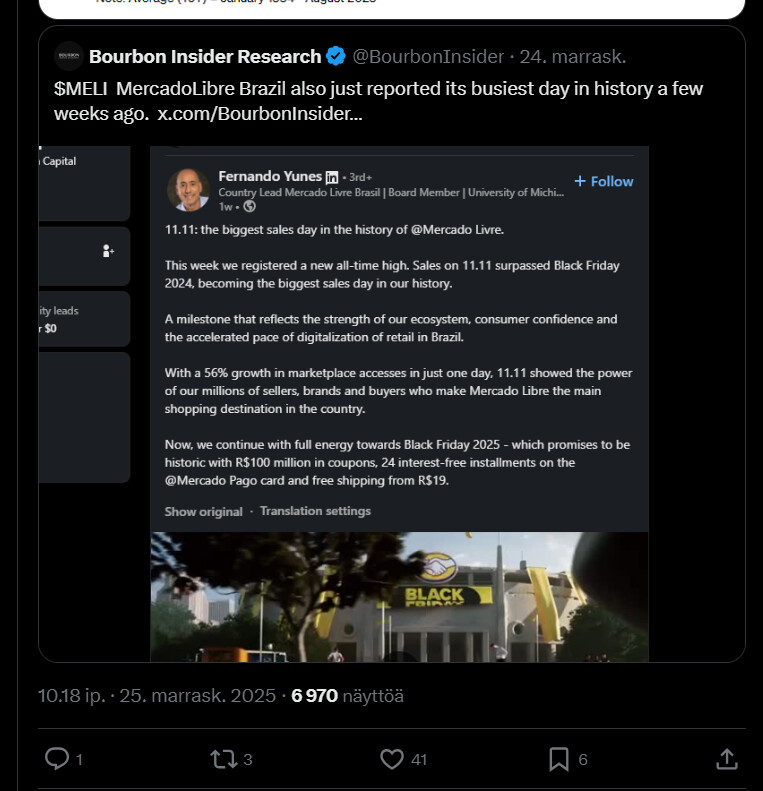
MercadoLibre is doing strong; in its areas, the economy has picked up, for example, in Argentina, where the company has had record days, and it hasn’t gone badly in Brazil and Mexico either.
Christmas reportedly looks to be the busiest ever, which promises clear sales and profit growth.
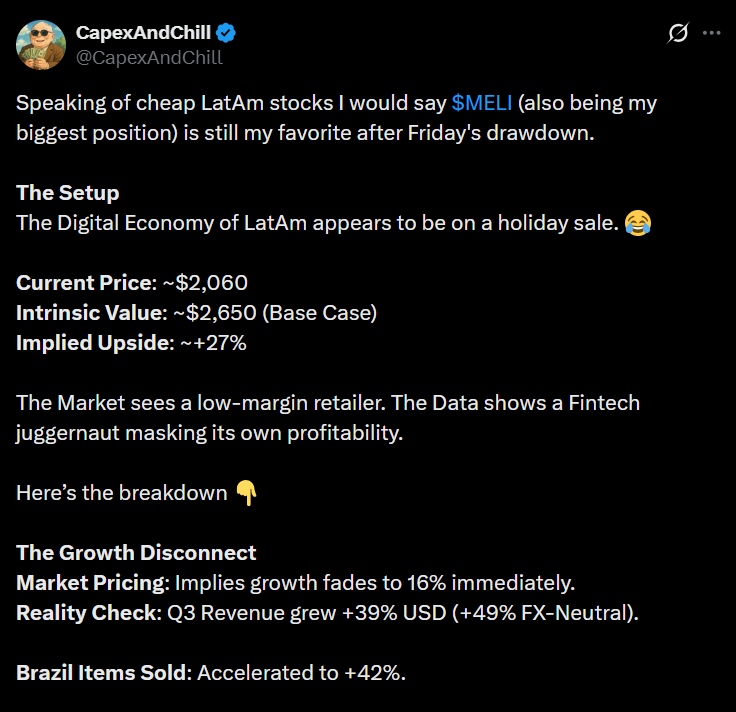
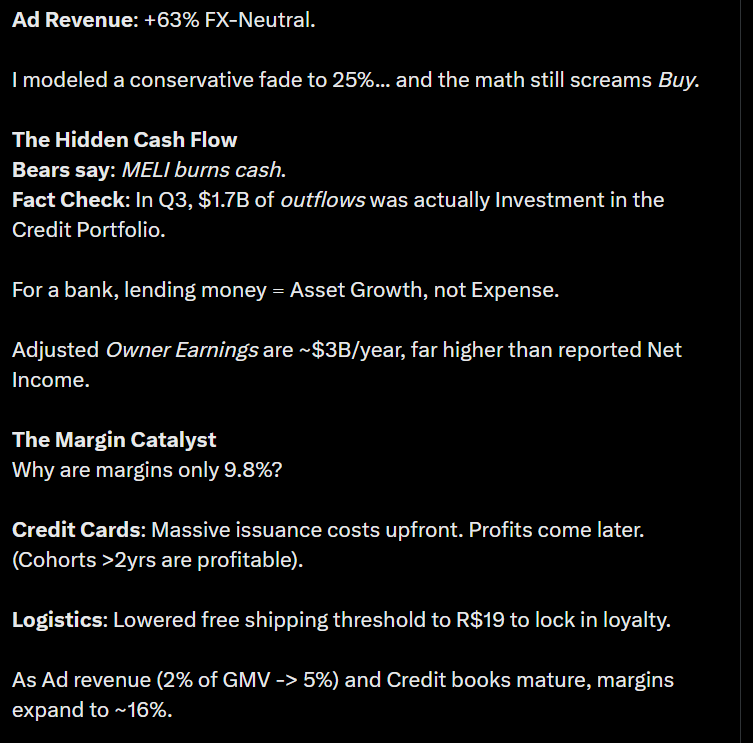
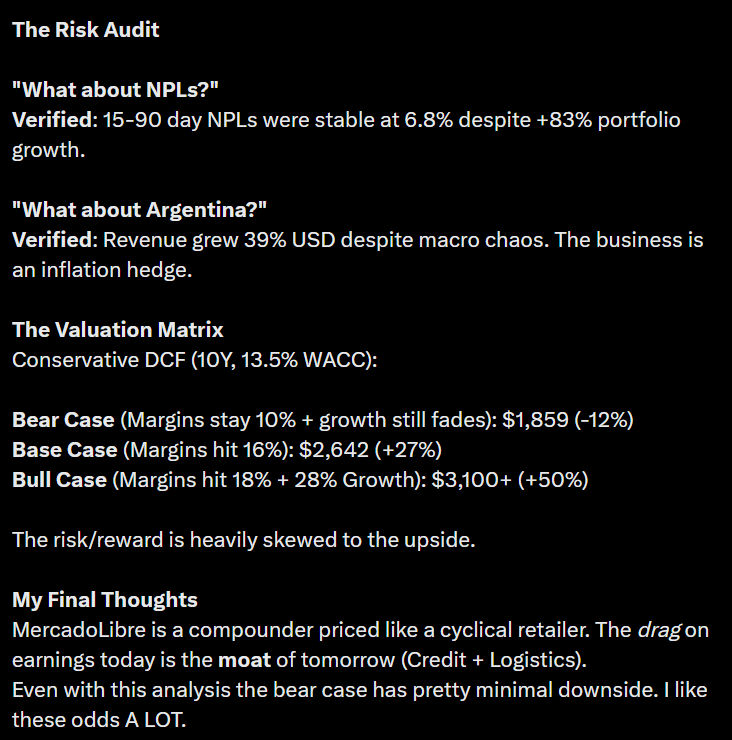
In the tweet below, the author expresses that MeLi is considered undervalued and this “digital giant” might not be understood.
In reality, the tweeter believes it is a fast-growing company whose revenue has indeed grown quite significantly for a long time, and its so-called hidden cash flows are very strong.
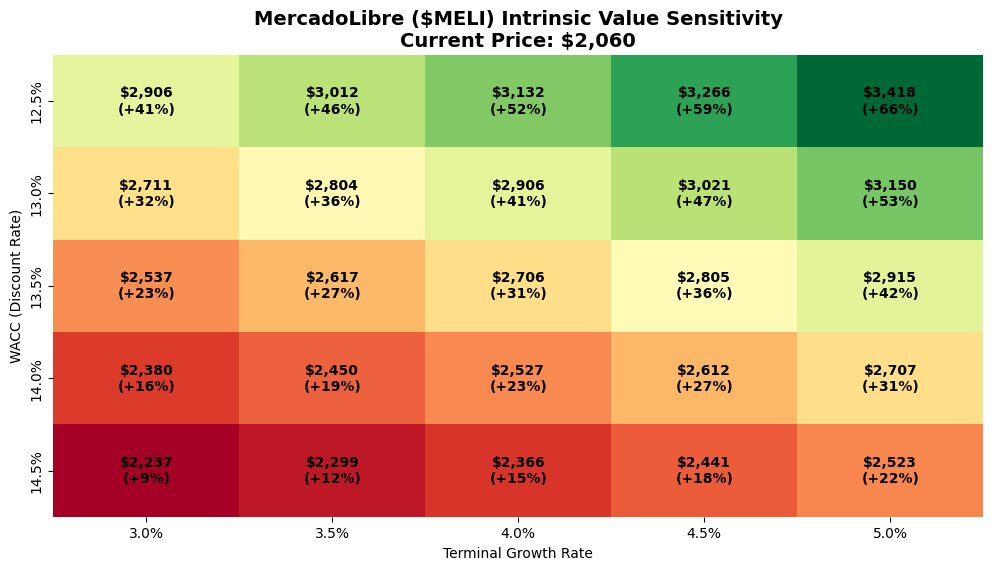
The tweeter states that, according to the analysis, the true value would be clearly higher than the current price, and additionally, risks such as credit losses and challenges in Argentina are, according to him, well under control.
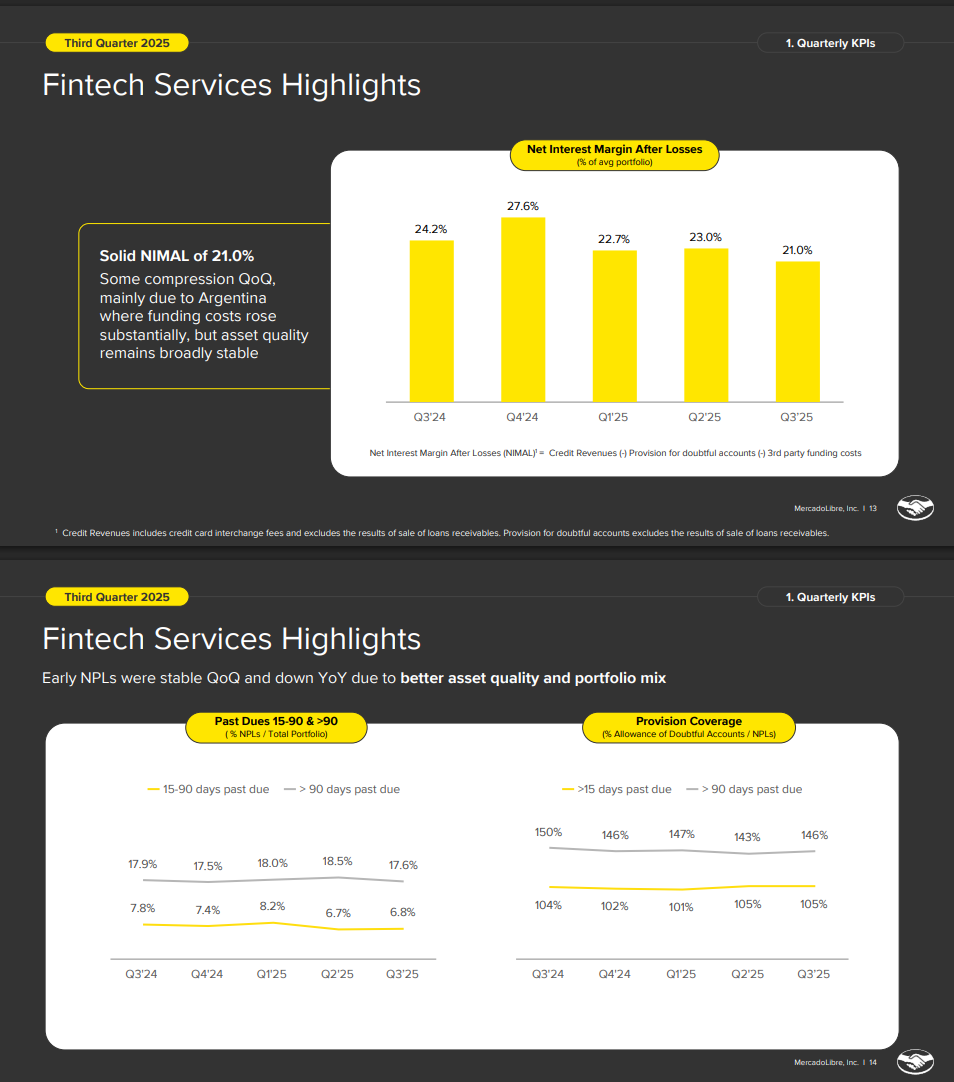
Profitability is expected to improve as the advertising and financial businesses grow.
MeLi’s management believes there is still enormous growth potential in Latin America, both in e-commerce and financial services… especially since a large portion of the population doesn’t even have a credit card yet.
The company invests heavily in technology, such as artificial intelligence and robotics, to make buying and paying even easier. Even in challenging economic conditions, the company has remained strong, and according to management, trust in their company and the ability to learn from mistakes have reportedly been key factors. MeLi intends to continue agile growth and be at the forefront of development.
The company’s culture emphasizes trust and openness – mistakes are not punished , but learned from together . Management considers it important that the team dares to try new things and make bold decisions quickly - great if this company has a good work culture.
The goal is for the company’s offerings to remain a part of the customer’s life and to build services that genuinely make everyday life easier. This way, the company believes it can maintain its position as the market leader in the region and create value for investors far into the future, or something like that.
In this podcast, Motley Fool analyst Asit Sharma talks with MercadoLibre executive Leandro Cuccioli about opportunity, volatility, and the business of MercadoLibre.
Asit Sharma: Crazy side question. Are you all keeping an eye on the development of quantum computation as a possible solution for route optimization?
Leandro Cuccioli: Well, more than one eye, probably two. Yes, we are quantum computing. We spent a little of time in China and we see the team Jessica came from, the shipping team. And quantum computing and robotics are areas in which we are extremely invested in terms of understanding, following, adopting. There is a potential in the next few years of radical changes in productivity. And I think for us is how much of that with the realities of the region, we adapt, we tropicalize in a way, at the right pace, but we’re very excited about those things. And I think, again, I can only see that allowing players like us to have more resources to keep removing the frictions to mean more people to the markets. I’m very optimistic on that side.
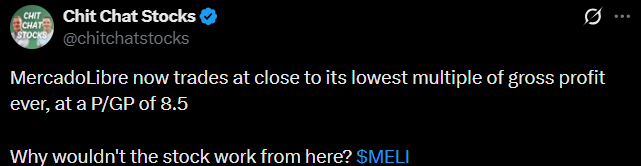
The point of the tweet is that MeLi is now being priced at historical lows relative to its gross margin.
If growth continues even somewhat at previous rates and risks are managed (if they can be), the expected return certainly looks attractive, but there are quite a few geographical risks involved on their own.
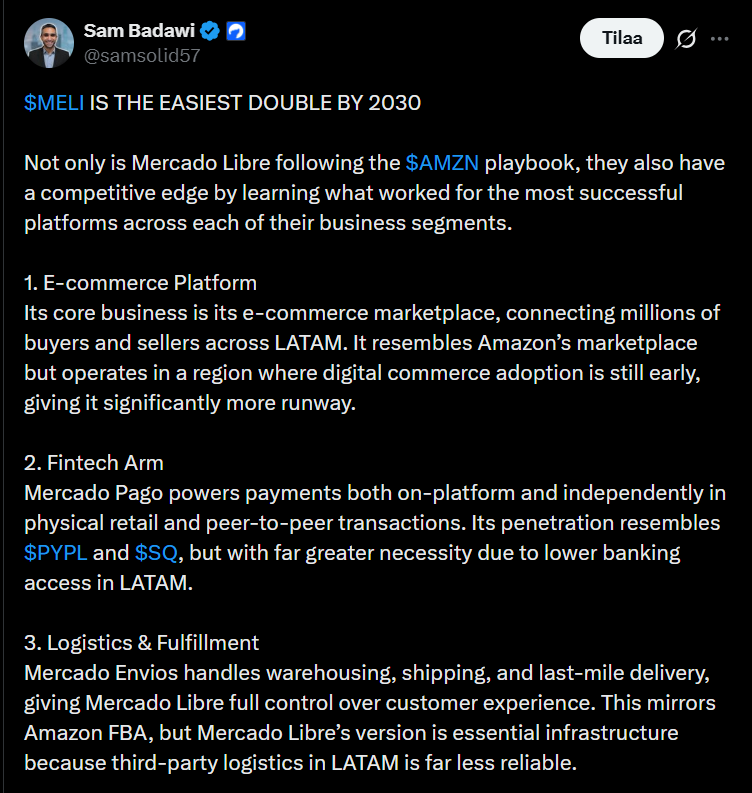
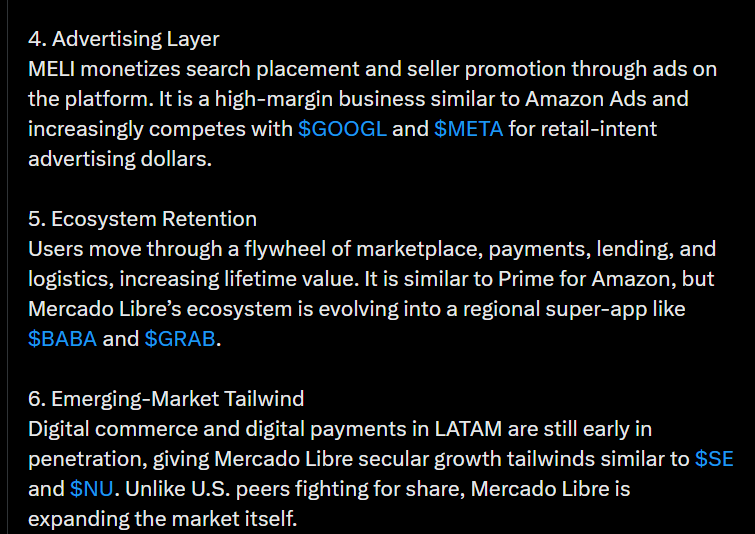
The tweet states that MeLi is considered an easy doubler by 2030.
The tweet also notes that the company is building an Amazon-like ecosystem in Latin America, but in a region where e-commerce and digital payments are still in their early stages.
The marketplace, fintech services, proprietary logistics, and advertising business create a positive cumulative effect. Unlike in more mature markets, this company is not just competing for market share, but is also growing the entire market at the same time.
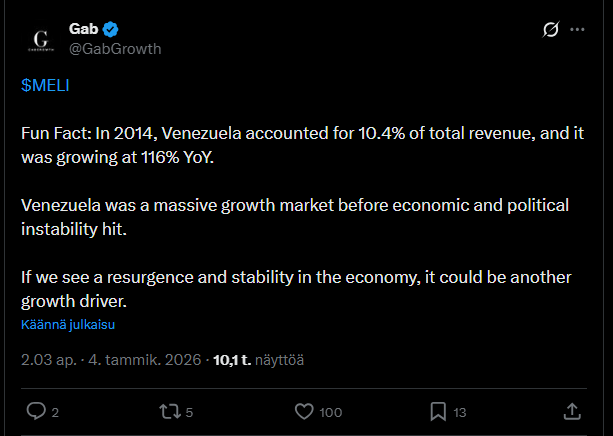
As far as I know, there is no precise public information on Meli’s revenue in Venezuela, but it falls into the “other countries” category (accounting for approx. 4% of total revenue in 2024). This group includes many other countries, and I would imagine Venezuela’s share to be on the smaller side (vs. Chile, Colombia, Peru, etc.). So, a direct hit avoided!
On the other hand, a crisis in that region is naturally not a good thing; it increases uncertainty in neighboring countries as well.
In the short term, I can’t think of anything mega-negative for Meli, but in the long run, if the stars align and Venezuela gets a proper government that moves the country forward, Meli could have room for additional growth in that region in later years. In the short term, however, I would still see the situation as primarily negative (additional uncertainty in the region).
The goals feature the familiar and steady, (soon) 28 consecutive quarters of 30%+ revenue growth. Interesting report coming up. Eyes are turning toward profitability, as well as the company’s comments on the year already underway.
The thread is quiet enough that I’ll post something a bit lighter.
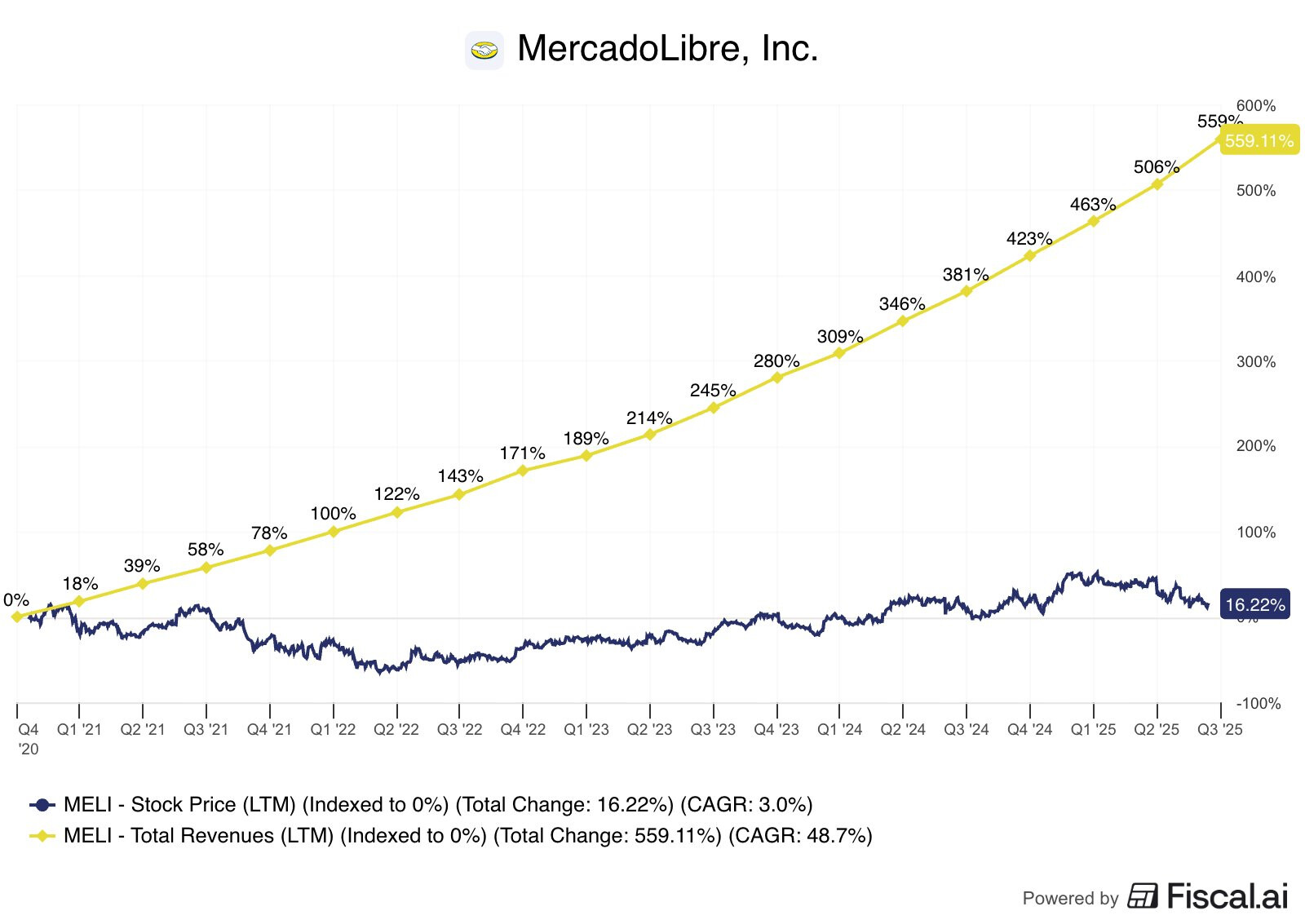
Meli is a good example of how valuation matters. The stock’s five-year return is approximately 5%, which is frankly miserable. Is the business really at this level?
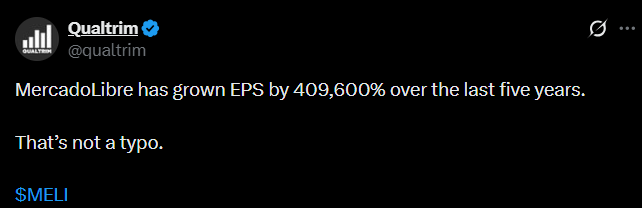
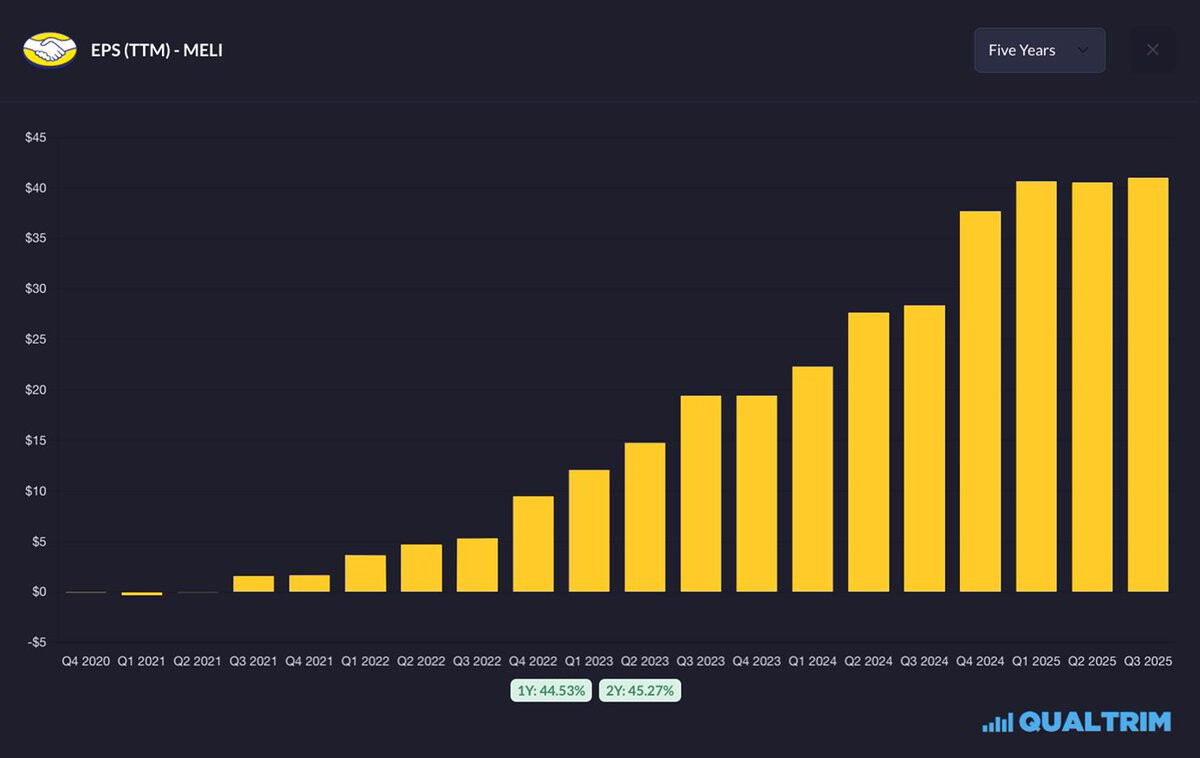
Looking deeper, compared to five years ago (2021), revenue has nearly quadrupled (4x) and net profit has increased over twenty-fold (20x). Meanwhile, the NTM P/E has dropped from around the 300x level to the current 40x level. So, if you want to get on board with a giant like this, in hindsight, now is a much better time than five years ago.
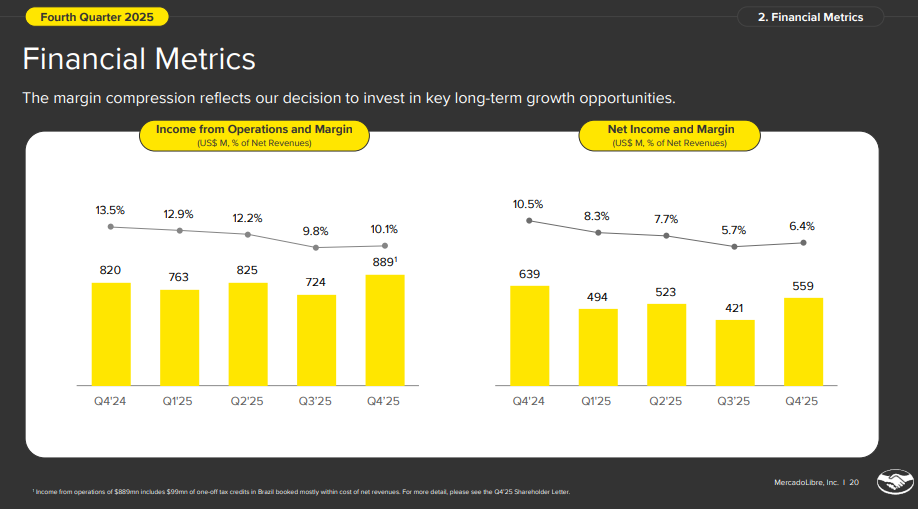
Pretty solid performance again for Q4. Revenue exceeded expectations, EPS miss. It seems to be more the rule than the exception that analysts expect margins to improve, even though Meli is using a lot of cash to grow and maintain its moat. I’ll dive into it later.
In the aftermarket, it first went +11% up, then it hit -6%. A coin flip opening, I’d guess downwards.
An update now that I’ve had a chance to digest the earnings report.
This slide is Meli’s make it or break it. If “The margin compression reflects our decision to invest in key long-term growth opportunities” holds true, today’s market reaction is completely insane. This is just an observation for now, as the fruits will only be harvested later. It remains to be seen whether anything other than leaves will grow on that tree.
I don’t understand today’s stock price reaction. I’ve gone through the earnings report a few times now, and I’m very surprised that the market doesn’t seem to believe in Meli’s vision. I’m seriously considering adding to my position.
@Iikka_Numminen conducted a high-quality interview with Pasi Havia regarding the megatrend fund.
United Bankers’ recent fund has also picked up a slice of MELI.
Nothing new was mentioned about MELI in the interview that a diligent follower of this thread wouldn’t already know: MELI is the Amazon of Latin America, which still has room to swell like bread dough.
The Fintech side has risen alongside E-commerce and will soon account for half of the revenue.






 (And we’re not talking about a micro-cap company, but a behemoth with 7.4 billion USD in quarterly revenue!)



 , but learned from together
 . Management considers it important that the team dares to try new things and make bold decisions quickly - great if this company has a good work culture.