Manchester United's stock as an investment

I wrote the first message in the thread in English (as a tribute to the club’s roots in England) but we can continue the conversation in each of our native languages! I believe you’ll be able to translate this and any upcoming messages into your preferred language directly here on the Inderes forum later in 2025, as Inderes’ AI project related to this has been launched in May 2025. :slight_smile:

Why Manchester United deserves its own thread on the Inderes forum?

:soccer: I believe there are many followers of the English Premier League in the Inderes investor community.

United has built a global fan base — with strong support also in the Nordic countries. In the 1990s and 2000s, United dominated the Premier League under Sir Alex Ferguson. The club’s golden era coincided with the growing international popularity of the league. Legendary Nordic players who represented the club — such as Peter Schmeichel (Denmark), Jesper Blomqvist (Sweden), and Ole Gunnar Solskjær (Norway) — helped create a strong emotional bond between the club and fans across the Nordics.

Manchester United Supporters Club Scandinavia (MUSS) is Manchester United’s largest supporters’ club. United will next play in the Nordics on July 19, 2025, when they face Leeds United in a friendly match in Stockholm.

:tornado: Manchester United’s finances in turmoil – followers and retail investors need more transparency

  1. Manchester United’s men’s first team will not participate in UEFA competitions during the 2025/26 season — for the first time since 2014/15. This results in significant revenue losses: UEFA prize money, matchday income, and international visibility will all be absent. As a result, financial pressure is mounting.

  2. Change in ownership structure.
    Sir Jim Ratcliffe’s INEOS now holds a substantial minority stake (28.94%). This brings a new layer of strategic thinking and potentially more efficient cost management — but also raises expectations for quick and effectice outcomes.

  3. While the men’s first team prepares for a season without UEFA competitions, the club’s major owners are planning to replace Old Trafford with a new stadium. The cost of Manchester United’s new stadium is estimated at around £2 billion. It is expected to hold up to 100,000 spectators, which would make it the largest football stadium in England.

Is this financially sustainable and value-creating for the stock?

:man_shrugging: Lack of stock analysis for retail investors

Manchester United has 1.1 billion followers worldwide and thousands of retail shareholders — yet there is virtually no stock analysis tailored specifically to them. While the stock is listed on the New York Stock Exchange and currently covered by four analysts, these analyses are not easily accessible to retail investors.

This could change in the future if we begin submitting requests to MU’s Investor Relations to commission analyst coverage from Inderes. If you’re interested, please contact ir@manutd.co.uk.

:pencil2: Are Sir Jim Ratcliffe’s and INEOS’ actions simply rearranging the deck chairs on the Titanic? Can United return to the top of world football?

Can a match or transfer be discussed? I think so, as long as it’s significant and offers an investor perspective.

34 Likes

Nice initial.

Abt 10 years back I happened to be a small-steak sports betser. Which gave a great boost to watch (any sports) game as I had ‘invested’ at least something, like 10 euros. I had a ‘position’, and ‘seriously’ like my party to win.

Ok this thread is about ManU. But are there some other teams/sports you can invest in - straight to the team? I’m not after domestic sports. But something international for which you can buy the stream to watch for.

Not Liverpool as one scumbag I know is backing it.

Dortmund is listed in Germany and Juventus seems to be listed as well

1 Like

As are Sporting (Portugal), Benfica (Portugal) and Ajax (Netherlands) as well.

1 Like

As a big fan of football and working at Inderes I would love it if we covered Manchester United. :smiley:

I have not really thought about how the stock is going on, more focusing (and enjoying) how bad United have performed lately. Isn’t it quite surprisingly that the stock has performed ok over last 5 years? With all the talks about how they have tried to reduct the costs with less food options for the players and not paying for traveling costs for some of the staff.

Well, maybe the fan base is big enough and its not like its the most traded stock in the world :wink:

Would like to add that AIK Fotboll (team in Sweden) is listed as well.

Do we have anyone hear owning any sport connected stock like these?

9 Likes

I have made investments in many football clubs.

I bought some shares of Tampere United, when club was on it’s prime form and (ofc) not making enough money to pay the bills. This cost me probably 200-300 euros or something. I spent more on match tickets, beer etc per year during those years. It was really fun and I made a lot of good memories & met interesting people. The supporters’ group managed to build the club again starting from lower levels and I am still paying yearly membership fee to support the cause.

I have also spend thousands of euros to support my local football clubs JS Hercules and Tervarit Juniorit, where in latter I have also worked for many years. Good hobbies for kids, sometimes someone makes a career and it is nice to see people having passion towards something, here it has been football, but it could have been anything else.

I have also bought football club stocks from stock market. I wanted to be owner of Bayer Leverkusen. Mostly because their performance on the field and Lukas Hradécky being part of that marvellous story, but also to tell my friends I have won Bundesliga as a club owner.

So I spend around 1 000 euros to buy Bayer stocks and used hours and hours to analyse the company. I decided not to buy more, because even medical side is doing quite okay business, they have managed to mess everything up by buying Monsanto years back. And in their yearly report you can find probably one or two sentences, where the football club is mentioned. “The company also owns a football club called Bayer Leverkusen.” or something like that.

During covid-19 I spent also hours analysing different football clubs and I was very close to buy FC Kobenhavn stocks. The club is owned by NASDAQ Copenhagen company: Parken Sport & Entertainment. I missed the opportunity and didn’t buy the stock even after serious analysing. It has come up from 70 DKK to 155 DKK and is paying really good dividend to owners…

They also own Lalandia holiday center, Fitness DK gym chain, Telia Park stadium and ofc the football club, which knows how to develop players and sell them to oil sheikhs.

In Inderes Raharadio @Mikael_Maijala and @Sauli_Vilen missed this club, but maybe next time you have wider analysis on this Danish diamond or the German Cancer-Machine (Bayer Leverkusen) I mentioned before.

10 Likes

For basketball & hockey there is also :basketball::ice_hockey:https://www.msgsports.com/

1 Like

Hi @Sauli_Vilen , in the Raharadio podcast (June 13), you mentioned that you don’t consider European football clubs to be good investments, partly because there’s no salary cap in Europe like there is in the NHL. Did you have a specific investment time frame in mind? I’ve been wondering whether financial regulations in European football are, perhaps slowly, becoming stricter. For example, UEFA revised its rules in 2022 and replaced the former FFP framework with the new Financial Sustainability Regulations. Additionally, national leagues may have their own financial rules—like the Premier League’s Profitability and Sustainability (PSR) rules, which, at least for the 2025/26 season, remain in place in their current form.

Edit. Just in case you ever run out of topics for Inderespod… it would be awesome if you could have a discussion about football clubs’ finances and financial regulations, especially at the UEFA level. Suggested guests: Mikko Aitkoski, Aki Riihilahti, or Ari Lahti. Even better if there were some Manchester United–themed questions in the episode too. Ping @Mikael_Maijala

1 Like

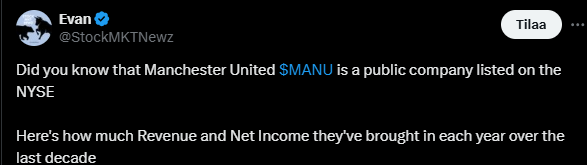
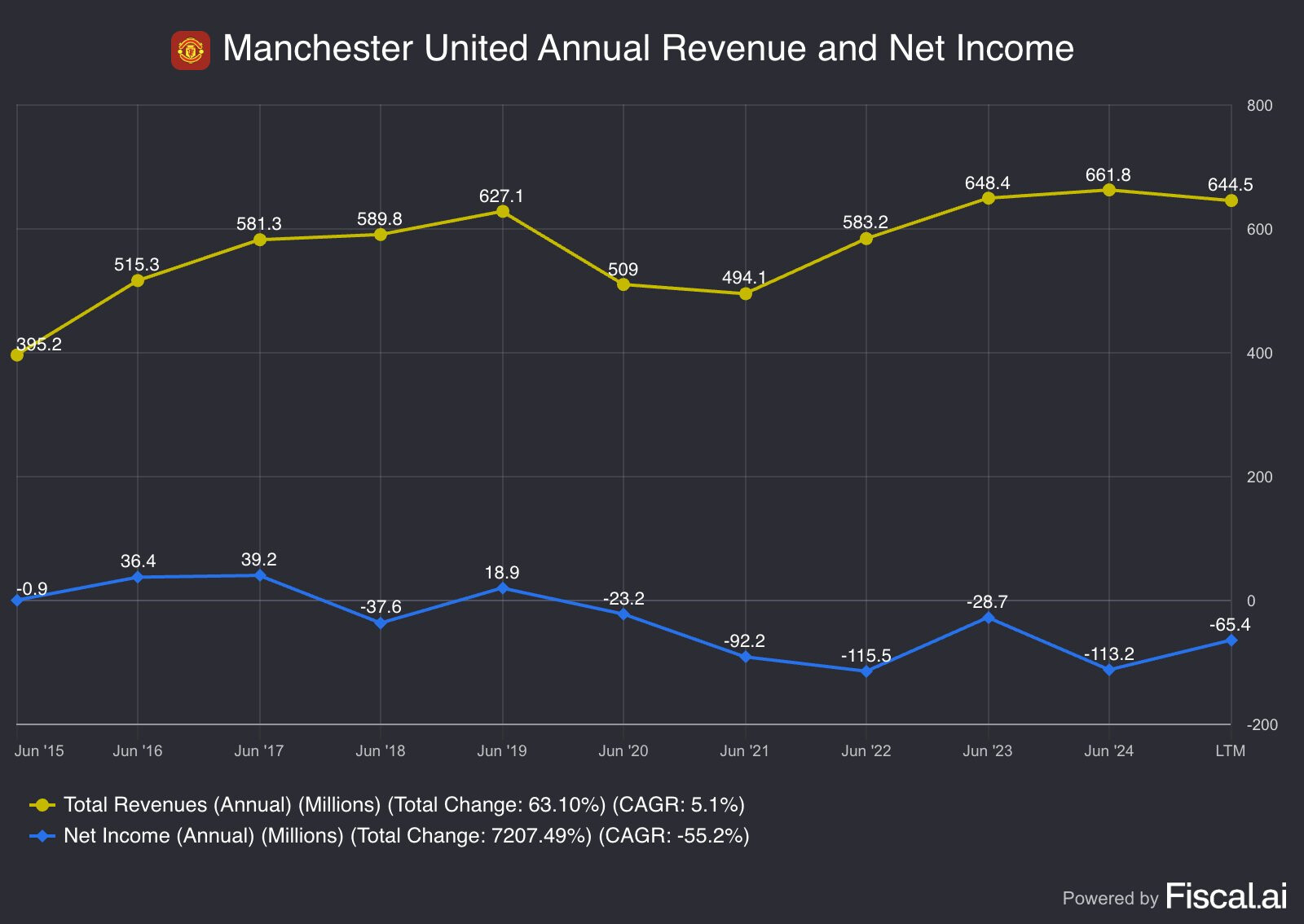
I happened to come across this by chance, so I thought I’d share it here. It seemed fitting for the overall theme of the thread, or at least somewhat related. :slight_smile:

https://x.com/StockMKTNewz/status/1939390218190086489

image

1 Like

I almost forgot this episode. @Heikki_Keskivali and Sijoituskästi talked about Manchester United and some Italian club about a year ago. In my opinion, it’s an excellent episode about investing in football clubs.

3 Likes

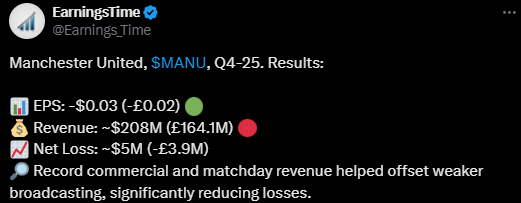
Manchester United’s commercial success was quite strong, especially with new sponsorship deals and e-commerce. United’s revenues were record-breaking, and profitability had also improved.

The new management had initiated a cost-saving program, which will support future earnings. Investments in infrastructure have also been made, such as the renovation of the training center.

How has football fared then… In the Premier League, the team finished in 15th place and will not qualify for, for example, the Europa League, etc. These will cause a significant drop in broadcasting rights revenue and will weigh on future earnings. Without success on the football field, financial growth remains uncertain.

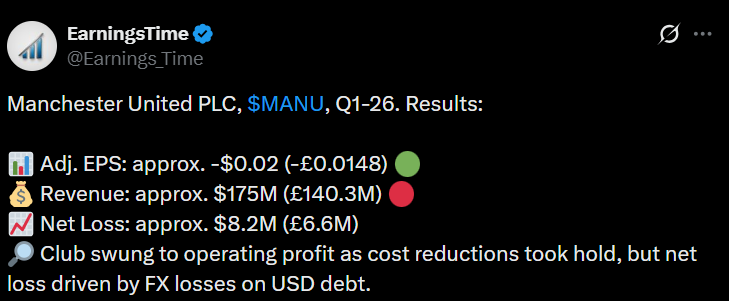
https://x.com/Earnings_Time/status/1968271740318187628


United’s IR pages

9 Likes

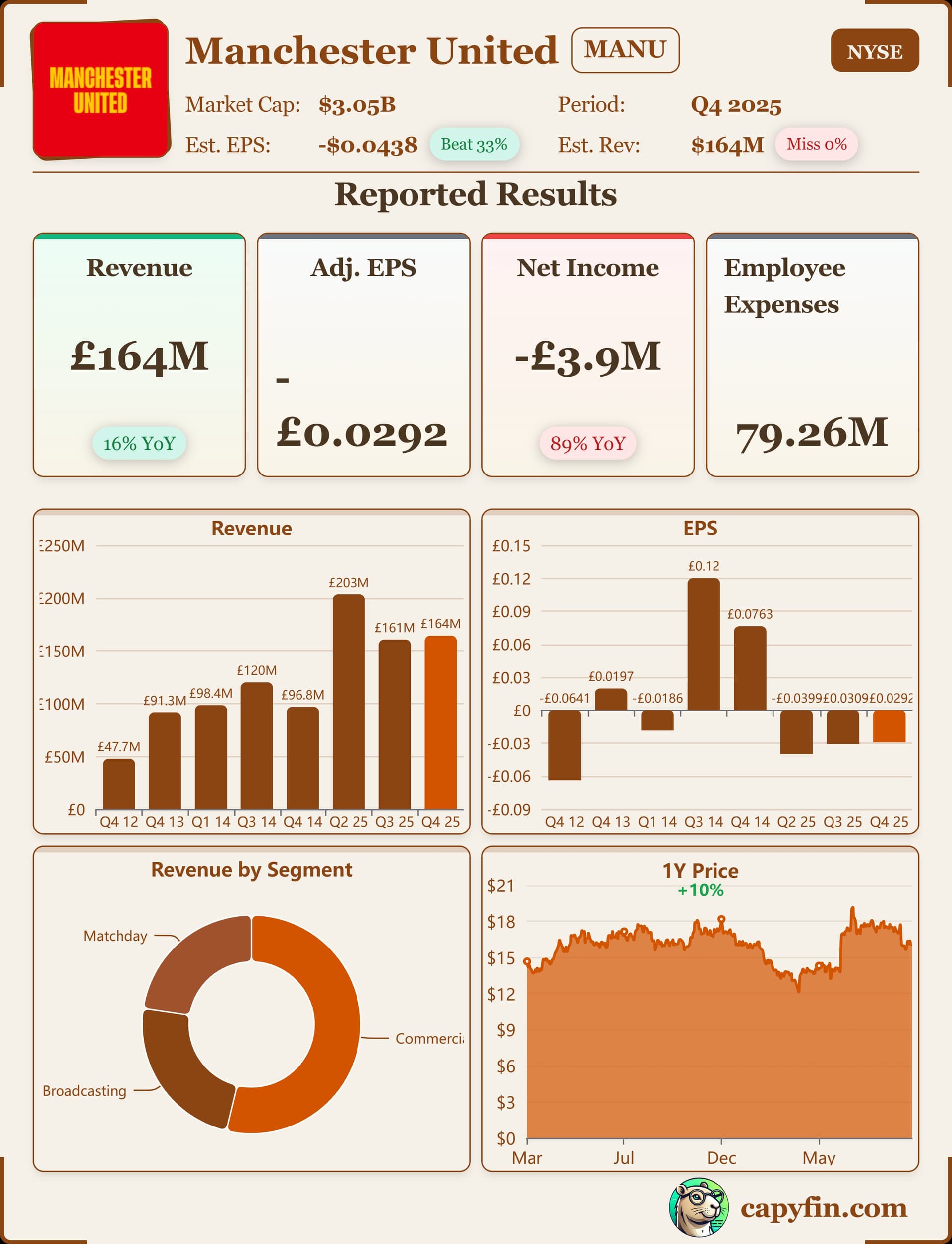
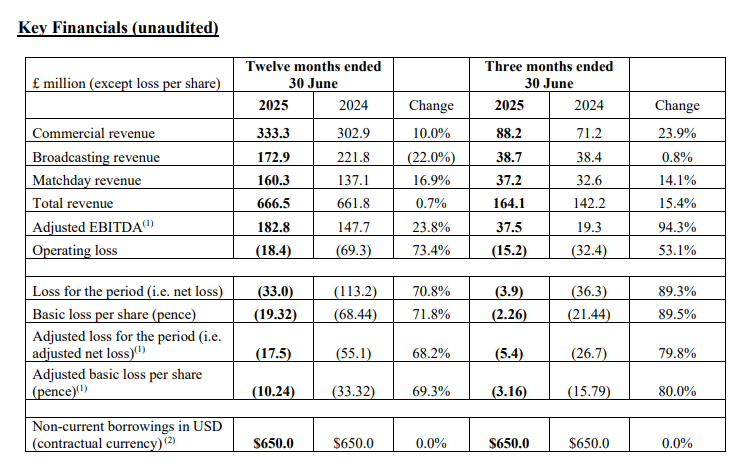
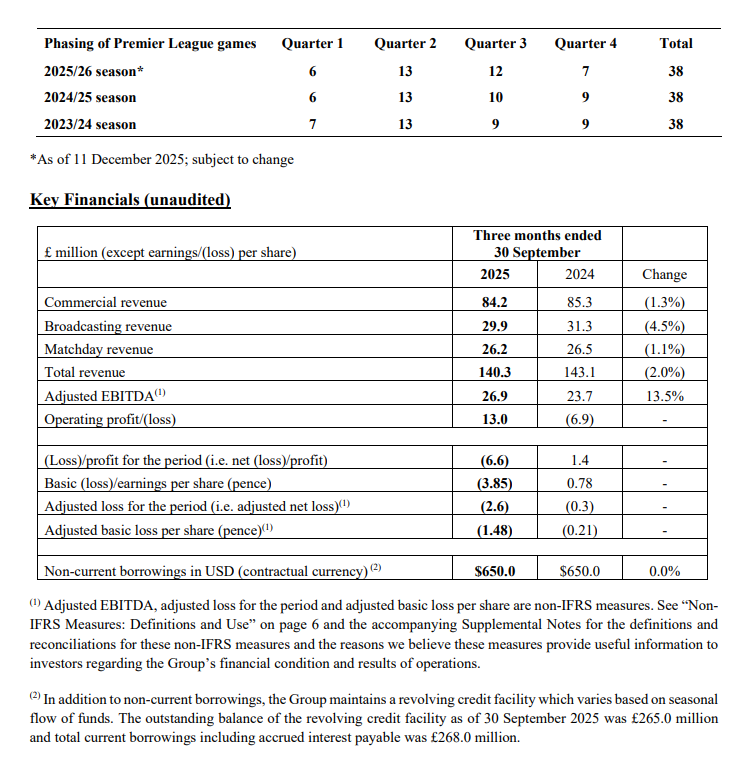
The figures are surprisingly positive (“Key Financials”). Only broadcasting rights revenues were clearly worse in the already reported period in a 12-month comparison: 221 million => 172.9 million. The reason for this development is likely that Manu (Manchester United) was not in the Champions League but in the lower-tier Europa League, where they lost the final to Tottenham. This season, Manu is not participating in any international competition, so the drop in this regard will certainly continue. Sporting-wise, the current season has not started well. Over the weekend, there was a 3-0 loss in the local derby against City.

6 Likes

Manu switched to savings mode instead of growth, and it showed.

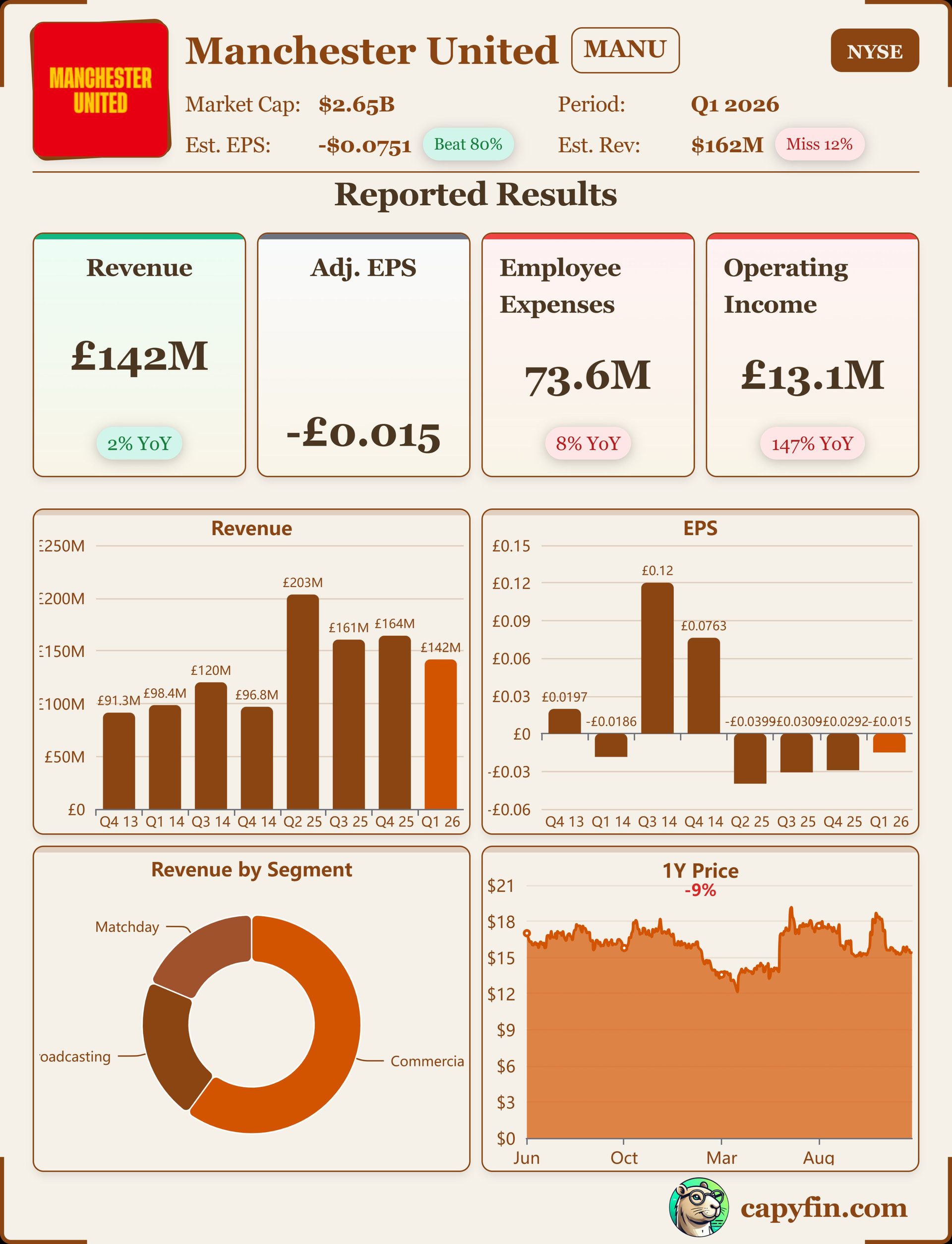
Revenue suffered from missing out on European games, but by drastically cutting salaries and other cost structures, operations clearly turned profitable. The financial statements are reportedly complicated mainly by exchange rates, but not really by the club’s everyday realities.

The positive aspects were the lightened cost base and the still well-functioning fan merchandise and online store business, which create strong leverage if a return to European fields succeeds.

Not so great were the dwindling sponsorship money, a thinner cash reserve, a large debt burden, and recent investments in the training center. Investors are wondering if this room for maneuver is enough when the team needs to be strengthened again or something like that.

https://x.com/Earnings_Time/status/1999091992249475550
image
image


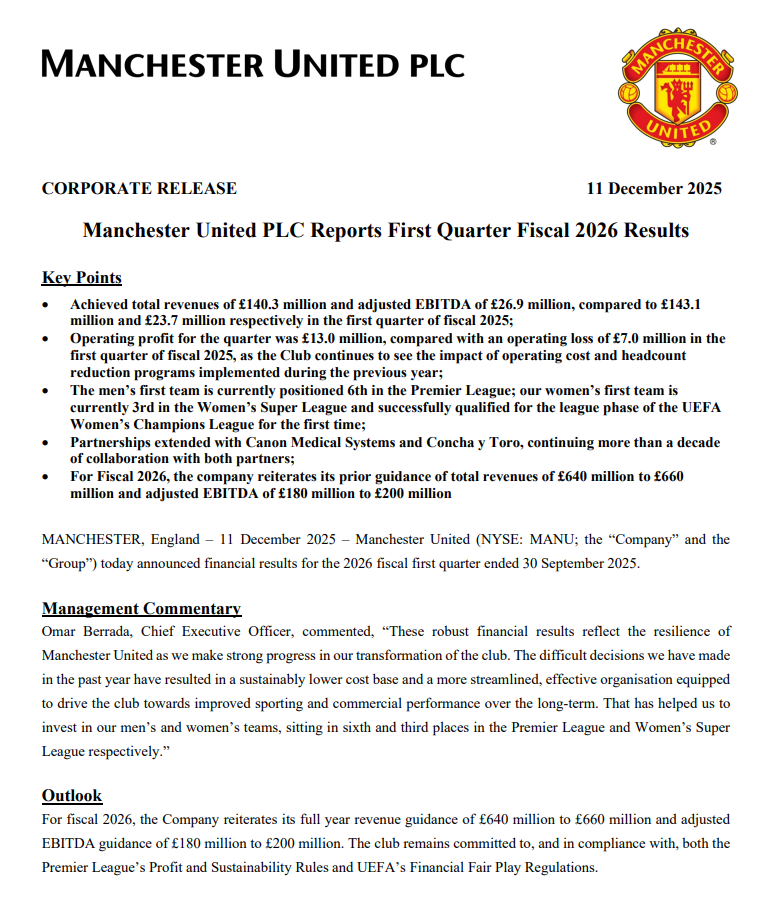
Company’s own materials

image
image

3 Likes

Manchester United announced today that Ruben Amorim, who served as head coach for 14 months, is leaving the club. I couldn’t find a press release regarding this on Man United’s IR pages. :face_with_raised_eyebrow: Amorim was United’s tenth head coach since Sir Alex Ferguson’s retirement 13 years ago.

Amorim’s sacking is dividing fans’ opinions: some would have given the man 1–2 more transfer windows, while others do not believe his abilities are sufficient for the role. There are estimates that sacking Amorim will cost United 25–30 million pounds. I would appreciate it if you share any better estimates.

5 Likes