Over what timeframe does this mentioned zero-sum game turn into investing?
Ping @Juha_Kinnunen
" - Trading is comparable to poker. There are winners, but the winnings in a zero-sum game come from other investors."
Over what timeframe does this mentioned zero-sum game turn into investing?
Ping @Juha_Kinnunen
" - Trading is comparable to poker. There are winners, but the winnings in a zero-sum game come from other investors."
If investing were only based on fundamentals and company value, portfolio values wouldn’t be what they are now. There has never been, nor will there ever be, a time when trading and speculation are strongly present in the markets.
On dividend payment day, the rest of the yield seems to be more or less speculative price/value guessing – which comes from other investors, whether the holding period was 20 minutes or years.
Well, I can’t say for sure. The terminology regarding trading and investing contains a lot of grey areas and everyone’s own interpretations. At what point can one consider themselves to be participating in a company’s increase in value? I’m referring to a comment in the same article: “Kinnunen reminds that in long-term stock saving, returns usually come from the increase in the value of companies.”
This comment seems to tighten some people’s nerves, but I don’t really understand why. I have a lot of respect for both successful traders and poker players. I’ve had the pleasure of knowing both. To me, both are skill games where luck has a significant impact in the short term. In the long term, however, the role of luck is zero, and skills decide. A good trader/player has a better expected value because they have an “edge” due to their own skills. I also have personal experience with both, although from quite a distant past.
Of course, I understand that in that article, trading was painted in a very negative light. However, that tone did not come from my comments. For me, the investment style doesn’t matter; everyone should choose what suits them. And for me, trading or poker is not gambling when done by the right experts. Of course, both can also lead to gambling in the wrong hands.
I probably need to write my own text about the whole topic, so there won’t be any misunderstandings because of this at least 
Does “big buy walls” (or sell) mean there’s a lot of buying pressure, or that there’s been a lot of selling pressure and now you only see people’s bids on the buy wall and the sell wall hasn’t been filled yet, because we just went through the buy wall there?
You can’t really tell much from the order book at any single moment. I’ve been following the order book for the past few days and there have clearly been sellers, but now it looks like there are more buyers than sellers in the order book, which, together with TA, indicates to me that the short-term correction is about to be over.
Which publications keep a list of insider trades?
As part of our Premium service, we also have Insider trades, all of which can be found here: Pohjoismaiden sisäpiirin kaupat | Reaaliaikaiset johdon kaupat - Inderes
Companies also report on their trades, so you can easily see trades from the companies’ news feeds. Trades are also reacted to in several threads on the forum.
No, not unless you close the entire OST.
What kind of stocks should I primarily choose for an OST? Thanks.
This has probably been asked about N times in the last month alone. The forum search is your friend. Here’s a starting point:
“If your equity savings account generates a loss, you can only deduct the loss from your capital income in the year you close the equity savings account. The loss is not deducted when you withdraw funds from the account.”
So basically, if your equity savings account is at a loss, it might be worth closing the account and opening a new one immediately. Smartly lined by the tax authority 
If you add to that the fact that you get fined per day for a double purchase (meaning you can’t open it to another broker on the fly), and that closing and reopening a purchase can take anywhere between 2 days and 2 weeks, then it’s indeed wonderfully designed
Hi,
Apologies for the silly questions, there are several new elements for me here.
This is probably the right place to ask this. I’ve tried to find data through traditional means, and basically found it, but since I don’t speak Swedish at all, I gave up.
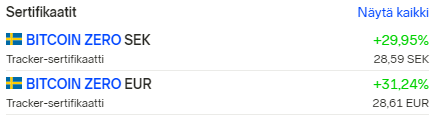
What is Bitcoin Zero vs. normal Bitcoin? Is it its own currency or somehow the same but different? I’m wondering if it has as stable a position as Bitcoin or if it’s a completely new thing from scratch 
That ZERO certificate has no management fees. It’s probably not charity, so what’s the catch? Or does it just live off of subscription fees? 
How big a risk do you consider investing in such a low-cost certificate vs. direct purchase of Bitcoin? The intention is to hold, so weekend trading etc. is not a necessity. How likely is the issuer to a) go bankrupt, and b) money gone, company vanished? 
@JepJou This question probably belongs here
“Free” certificates usually make their money on the spread.
That is, there’s a gap between the buy and sell prices. A hypothetical example: the underlying asset’s true value is 100. A tracker certificate is offered at 101 and bought back at 99. The counterparty gained a percentage in both directions. So much for “free.”
In addition, during times of large movements in the underlying asset, the bids and asks can disappear completely. If you touch something like that, you must first carefully read the prospectus associated with it to understand how it works. You can be 100% sure that the entity that issued the certificate, which is your counterparty in these trades, is making a profit from this activity. There’s no such thing as a free lunch. And that profit is extracted from those dealing with the certificate.
{“content”:“I’m replying to myself here. There is no such thing as Bitcoin Zero. It’s just the name of a new certificate.\nWell anyway, an interesting way to invest in Bitcoin. I found this link in Swedish material that explains things in English → Valour”}
There must be a lot of entrepreneurs here as well. Could someone tell me which bank would be best when setting up one’s own investment company?
The Finnish Securities Foundation has published an Investor’s Tax Guide 2021 for free 
I recommend saving it. There is certainly a demand and use for this 
I think I’ve pondered this before, but let’s try again:
Why is a high operating profit margin a virtue for a company? If a company is approved for PE10, does it matter if it comes from 25 or 100 in revenue? Having learned from the inflation discussion, high margins can indicate good pricing power, but one would think that smaller margins would be easier to raise than already high ones, e.g., through traditional efficiency measures, such as cost-cutting/layoffs.
Kamux manages to raise its margin from 4% → 5% over a long period, as they get more and more integrated services sold in Germany and Sweden, meaning profit increases by 25%. What should Admicom do to raise its own from 40% → 50% (the same 25% growth)?
Good question! It can be considered a virtue (from an investor’s perspective) for these reasons:
-Every euro of revenue becomes more valuable. For example, a euro of Admicom’s revenue brings in 30 cents of net profit, and roughly 40 cents of operating profit. For Kamux, it’s 4 cents.
-This depends a lot on the flexibility of costs (for Kamux, they are reasonably flexible due to, for example, commission-based salaries), but thin margins threaten to shrink faster if revenue dwindles.
Imagine that the costs of companies A and K are inflexible and they achieve the profitability mentioned above. Company A’s revenue drops to 95 cents, costs (60 cents) remain the same, so operating profit falls to 35 cents. For Company K, the same change causes the profit to drop by a cent into a loss.
-One might think that higher profitability would be harder to improve, but this is affected by the company’s business model, industry, competition, etc. If Admicom were to switch to “cash cow mode,” it should be able to achieve 50% EBIT. In contrast, Kamux’s 5% EBIT, well, that’s a struggle.
-High profitability indicates competitive advantages, and competitive advantages bring predictability and security, which in turn allows for higher pricing for the stock as well.
These are a few things that came to mind this morning.
Lower profitability usually requires massive volume and scale, which are not necessarily easy to achieve in themselves.