What does this oversubscription mean in practice? With Nordnet, I can no longer see my own subscription anywhere. Does this mean I’m already out, or will it be clear on Friday whether Kreate will appear in my portfolio or not?
1 Like
It was possible to interrupt both the institutional and public offering today at 4 PM. Apparently, institutions want more subscriptions, as it was not interrupted. The institutional side may continue until February 18th, or it may close “anytime” now that the earliest moment of February 15th at 4 PM has passed.
There are probably some promised subscriptions that haven’t been made yet, as the offering was supposed to continue for longer. They are waiting for those. Of course, in this offering, small investors could not make institutional subscriptions, so the oversubscription on that side is clearly smaller and shares will probably be transferred from there to the public offering to some extent.
Intera’s goal is to clearly strengthen the strategic position of its targets, which often happens through internationalization. For example, under Intera’s guidance, Silmäasema expanded its operations into a new market area in Estonia through an acquisition.
However, Kreate’s listed peer, Consti, has kept its feet firmly in Finland.
I would say that Intera still has the opportunity to increase the value of the target, considering that Kreate’s story is still relatively fresh, at 5 years. The life cycle of Intera’s investments is 7-8 years. For a temporal comparison, we can take Kamux, for example, which Intera developed and internationalized for 9 years before its final divestment. Geographical expansion scenarios have certainly been made, but their realization requires the stars to align correctly and the owners of suitable companies to be willing to sell their darlings at a suitably porous price. The business plan most likely includes domestic and Swedish M&A targets, whose scouting and integration are Intera’s bread and butter. I don’t believe that Intera will be taking its foot off the gas anytime soon. We will certainly see some moves before Intera moves to a new table with its chips.
2 Likes
But what was the source for it being oversubscribed, or was it just your own speculation?
Hey, there aren’t many shares available on the institutional side, as the anchor investors take the majority. So, I’m speculating that it’s oversubscribed, but not ten times over. In last year’s offerings, the institutional side was often around 5x oversubscribed if participation wasn’t limited. A 2x oversubscription probably won’t trigger an early closing yet.
The unfortunate aspect of the institutional side is the private placement arrangement; shares are distributed based on a face-value factor. One subscriber might get all of them, another 0%.
Yeah, I kind of hinted at that, that they’re waiting for some party they want to give those shares to.
Alright, back from the university, and now it’s time to explain this Kreate case.
First, when I initially saw the valuation, I really thought, “This can’t be real. Are my calculations wrong? Is there something I’m missing?” But after a long week of research, I came to the conclusion that this ultimately looks pretty damn good. Before I start explaining in more detail, big thanks to, among others, @keisarijokinen for help with running the DCF and sparring. It was really good to have someone else going through this with me!
But first, let’s perhaps go through the more traditional multiples.

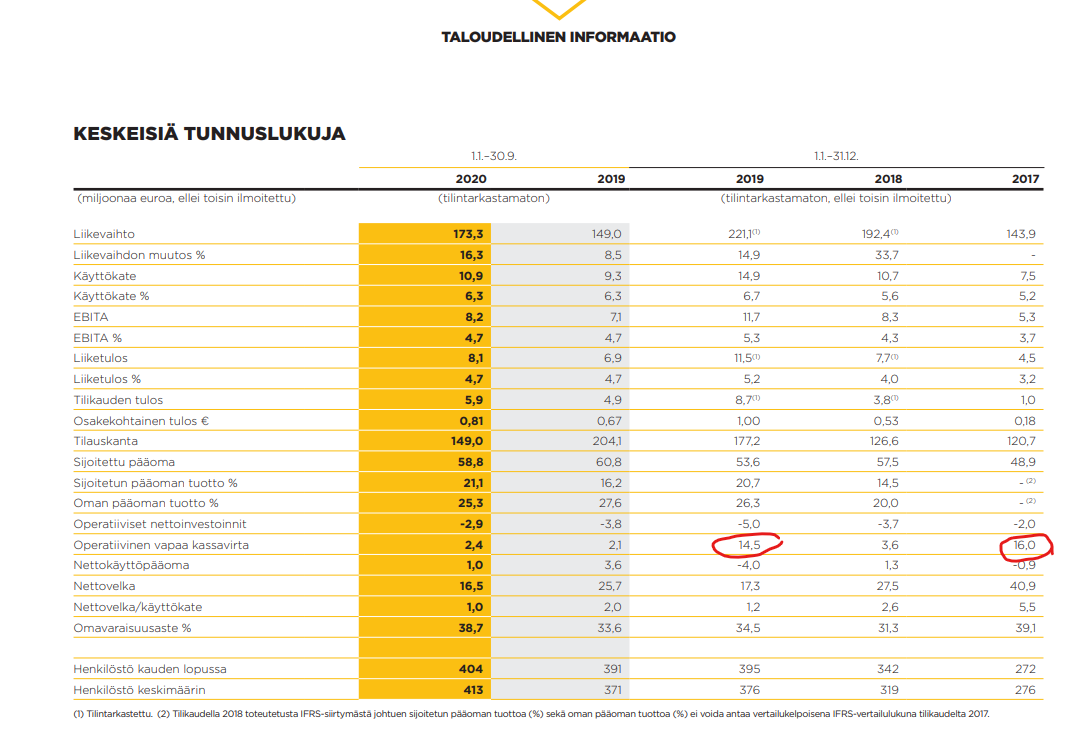
Here are a couple of the most important figures picked from Kreate’s marketing brochure. The high return on equity (ROE) immediately stands out. Over 20% in 2018-2019 is indeed an impressive result. Despite this, when we also know from the listing prospectus that as a result of the IPO, the number of shares can increase to a maximum of 8,980,985 shares, or approx. 8.981 million shares (meaning MCAP increases to a maximum of 73.644 MEUR), the P/E calculated with 2019 earnings would be <8.5. What?! For a company making >20% ROE, that sounds really strange. In addition to these, the revenue growth is good to note from the brochure (this is important information later when we examine the DCF):
Well, let’s now look a bit deeper into this P/E, ROE, and revenue growth.
Let’s first dig out Kreate’s financial targets. Here they are:
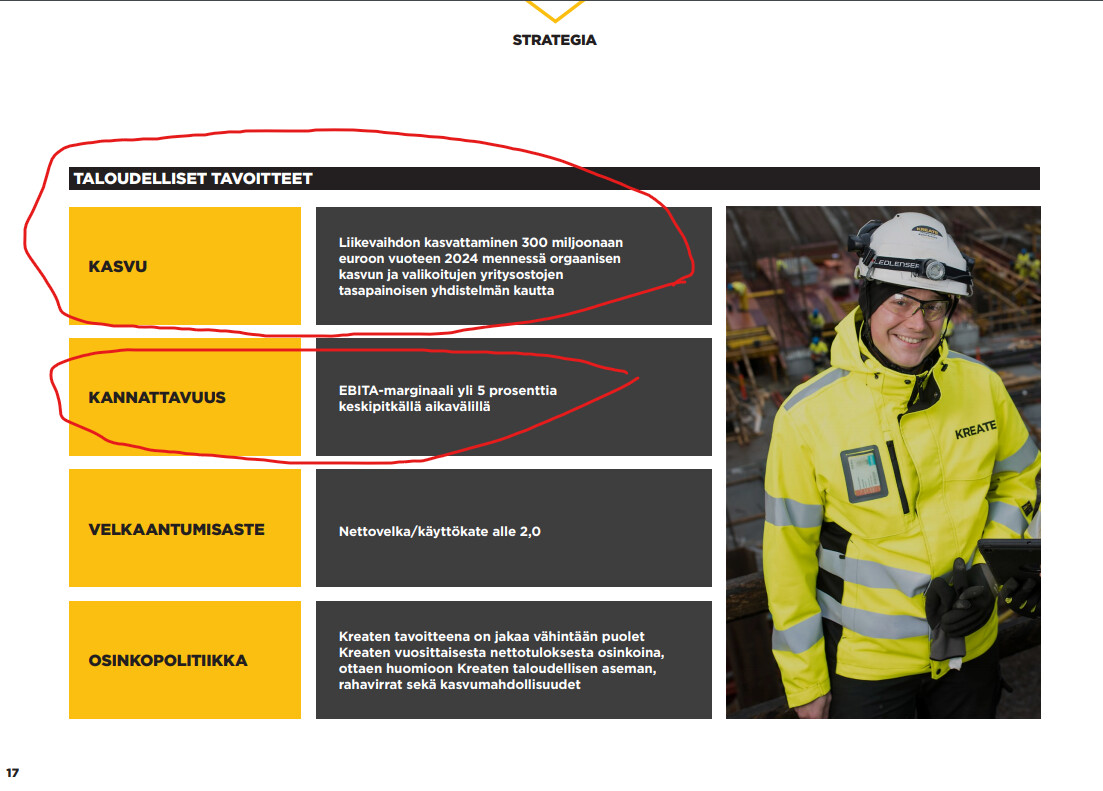
I circled the two most significant ones for myself. That is, aiming for 300 MEUR revenue and a 5% EBITA margin by 2024. I had circled the amount of amortizations (A) from 2019 as an example, which was a mere 200 TEUR. In 2018, this amount was 500 TEUR for comparison. Through that EBITA margin target, it’s easy to get a kind of range for EBIT, now that we’re moving on to the DCF calculation. And here comes the result of last week’s hard work:
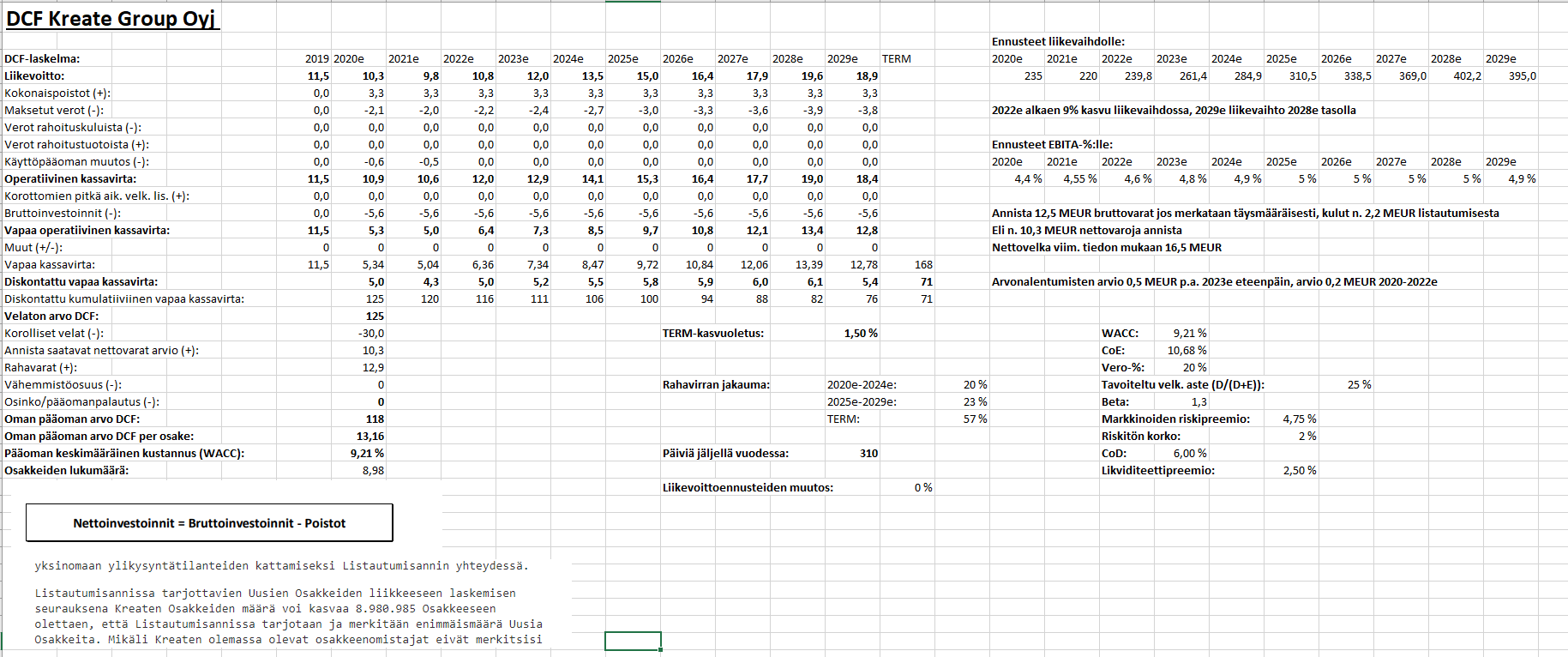
If and when you read the model carefully, I believe all essential information is provided in the model. Don’t mind the 2019 row, it has no effect on the model, and I didn’t bother to fill in the numbers
 Key points of the model:
- In this model, Kreate will only achieve its financial targets in 2025, meaning this model does not assume financial targets will be met immediately in 2024. I have estimated the annual impairments to be 0.5 MEUR from 2022 onwards, and 0.2 MEUR for 2020-2022 - this way, the model can determine EBIT using the EBITA margin. I believe the estimated impairments are at a reasonable level, especially considering other parameters.
- For WACC, I have somewhat benchmarked a reasonable result against Inderes’ model for Consti, a somewhat comparable company (whose MCAP at the time of writing is approx. 100 MEUR vs. Kreate’s future approx. 74 MEUR), which has a WACC of 8.8% in @Olli_Koponen’s model. In more detailed justifications, a liquidity premium of 2.5% is justifiable based on the company’s size and assumed trading volume. The cost of debt (CoD) is high, but I wanted to be cautious with it given the current interest rate environment, and set it at six percent. For comparison, Consti’s cost of debt in @Olli_Koponen’s model is 4.5%, so I have clearly increased that value. A very important target gearing ratio ((D/(D+E)) can be obtained directly from Kreate’s interim report by only considering interest-bearing debt in the numerator, i.e.,
- Beta has been reasonably estimated for such a company. Not too precise, otherwise it becomes hair-splitting. The tax rate of 20% is self-evident, and the risk-free rate is consistent with Inderes’ models. After all these justifications, I finally decided to use a WACC of approximately 9.2%, which is 0.4% higher than, for example, Consti’s comparable WACC.
- TERM growth is 1.5%, which is the same as in @Olli_Koponen’s model for Consti, and I see no reason to use anything else. For the terminal value, I trimmed the last forecast year’s cash flow by a little over 0.5 MEUR (by trimming revenue), thereby reducing the exposure of terminal cash flows somewhat. The EBITA margin in the terminal period is below the company’s own targets, at 4.9%.
- The company’s depreciations and gross investments are assumed to be constant over the years - more precise modeling of these would most likely lead to large errors (over time). Net investments are therefore estimated at 2.3 MEUR annually. The change in working capital, on the other hand, is estimated to be zero from 2022 onwards, and before that, working capital will see additions of 1.1 MEUR, bringing the final stable working capital level to approximately -2.9 MEUR. I confirmed with the CFO in the webcast by asking that the line item should not be large annually, and in fact, the CFO, at least according to their own words, was very satisfied with the current working capital situation. In practice, the working capital change line provides a safety margin, even if the estimate of net investments over time is too small, because cash flow is generally very strong for builders precisely due to working capital changes (in other words, working capital goes more negative annually as working capital management becomes more efficient).
- In this case, all taxes have been calculated using the formula income tax * operating profit, and taxes on financial expenses and income have been left as zero lines. This is a simplification from a practical point of view, but from what I was able to examine in income statements from previous years, it’s not far off.
- After all these lines, it’s good to note that both operating cash flow and free operating cash flow do not show any terribly high figures! If we look at Kreate’s marketing brochure, we find free operating cash flow figures of over 14 MEUR for 2017 and 2019, and these are already realized figures! In my DCF, over 14 MEUR of operating cash flow only starts to be generated in 2024

- Finally, cash and interest-bearing debt are taken directly from Kreate’s interim report on Kreate’s website, and it’s good to add that in this model, Kreate’s revenue is assumed to grow by only 9% annually during 2022-2028! Kreate has already guided that 2021 will be an interim year for revenue, and this has been taken into account in the DCF. If you compare this revenue growth to Kreate’s already realized figures (see above), I believe these figures are already very conservative, even though this is a long-term forecast
- And now finally, this DCF has arrived at an equity value of approximately 13 euros per share. This means roughly a 60% upside to the IPO price according to this DCF. Taking into account the certain built-in caution in the forecasts of this DCF, Kreate’s historically very high return on equity, and very cheap multiples, I decided to subscribe for the largest sum I have ever moved in this IPO. In Bilot’s institutional offering, I subscribed for 100 TEUR, now I have increased this subscription by 1.5 times to 150 TEUR. It’s good to remind at the end that even though this IPO will surely be heavily oversubscribed on the retail side, for example, Bilot’s offering was heavily oversubscribed on the retail side (18.3 times), but everyone still received 50 shares + 7.2% of the excess. I myself roughly hope for an allocation of this kind, meaning I expect to receive Kreate shares worth approximately 10 TEUR from the IPO. If Kreate’s share opens low enough when trading begins, I might buy more shares, but I’ll have to see what the allocation ultimately is. I am fundamentally looking for a trade in this case, as the largest undervaluation is likely to be closed, but I do not rule out the possibility of holding the line for longer!

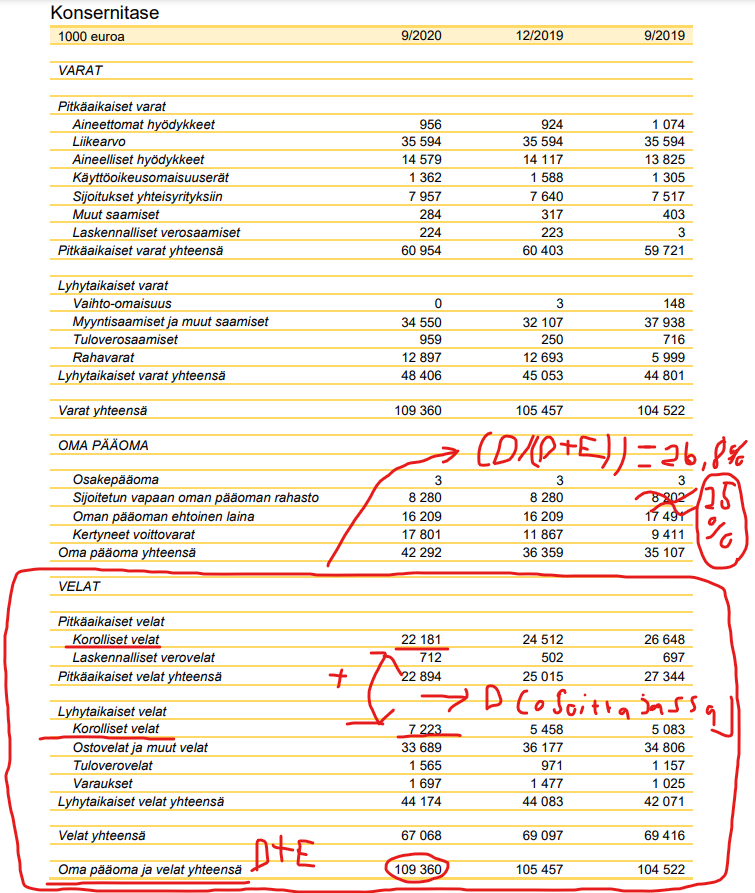
Whew. That was quite a walkthrough. Hope you enjoyed it. Feel free to ask questions, and I’ll try my best to answer them if any come up! 
PS: @Hurde In Bilot’s offering, I actually received fewer shares from the institutional offering than I would have through the retail offering, so that can happen too 
E: Finally, the obligatory disclaimer: nothing I write in this post should be interpreted as an investment recommendation or any kind of investment advice, as I do not have the licenses for such activities I will try to present my own as well-reasoned opinions as possible.
279 Likes
Thanks Johannes for writing this up here!
I also recommend others to read @Johannes_Sippola’s post carefully.
17 Likes
{“content”:“Would it be a good idea to model the balance sheet in a different way so that profitability is not automatically assumed to improve with growth? In recent years, it seems to have reached about the return on capital of a good engineering firm?”,“target_locale”:“en”}
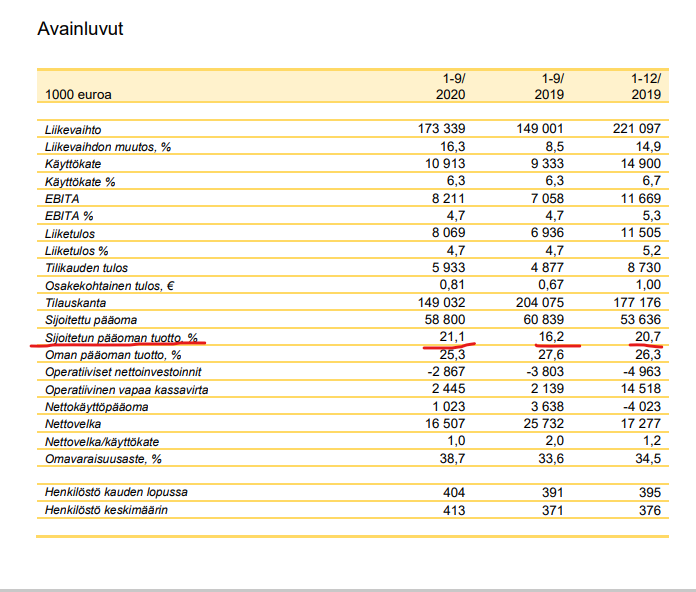
In this case, we actually ended up with an automatic solution where we model only the components required for DCF calculations, mainly through the income statement. The intention here is not to assume that profitability improves due to growth, but rather that profitability improves over time to where the company estimates it can be in the medium term, according to its financial targets. In the terminal value, the company doesn’t even reach its target EBITA margin in this calculation. In this case, modeling the balance sheet would likely significantly increase the risk of errors, because more exact balance sheet modeling without a standardized model is challenging, especially since I have intentionally avoided more detailed balance sheet modeling in connection with these DCF models. The company’s EBITA-% was already, for example, 5.3% in 2019, clearly above the medium-term target.
Kreate’s return on capital has also historically been strong, if you look at Kreate’s interim report.
9 Likes
Great analysis, Johannes, thanks!  I’d be interested to hear your general assessment of Kreate, or how you view the risks “behind the numbers”?
With a DCF model, the valuation, as you said, looks like “this can’t be real.” Your model includes somewhat conservative assumptions, but on the other hand, it leads to a rather optimistic outcome: Kreate achieves its revenue and profitability targets, but a year late. Above all, I’m a bit suspicious that a share sale-heavy IPO is being done with such cheap-looking multiples by a private equity firm. Intera has owned Kreate since 2014, which is already a long ownership period for a private equity investor. What do they know more than us when they want to bring a long-term ownership to the stock exchange now with a cheap-looking valuation? The charity option can surely be immediately ruled out
Intera’s track record with companies brought to the stock exchange in recent years has not been good at all. Recent IPOs (Consti, Silmäasema, Kamux) have, in hindsight, been priced quite high. Of course, perhaps lessons have been learned from this now?
Generally, for this (as well as other project business/construction industry companies), one can easily draw a scenario where profitability, based on rather small margins, deteriorates significantly if even a few larger projects run into difficulties. Of course, one should initially trust the company’s own guidance, which states that the profitability of the order book is “at a normal level.” In addition to the existing order book, other projects are needed rather quickly, and in public tenders where the lowest price usually wins, there is a big risk of pricing an offer too tightly, etc. At the moment, the order book is only 111 million. Is the profitability of the order book to be agreed upon from now on still “at a normal level”? If not, the promise of the current “normal profitability” for the order book will not carry far.
So I’m not saying that Kreate couldn’t be a good or even excellent investment at the IPO price. I just want to remind everyone, amidst all this excitement, that sellers also know how to do DCF calculations to perfection They certainly wouldn’t voluntarily offer such an IPO discount, so some parameters in the seller’s calculations are quite different or at least contain too much significant uncertainty?
46 Likes
The analysis sounds good! If it’s okay to challenge a bit, a few questions: How much weight do you give to the aforementioned numbers and forecasts? I mean, with those, you can assess the risk related to performance very well, but what about the risks related to the industry and its growth if the numbers lose their foundation? And what about management-related risks, and especially in Kreaten’s industry, political risk? Having done somewhat similar analyses myself, I’ve noticed that a more effective approach is to start with the industry and its related risks, then assess management and competition in the market where the company operates, and only then see if the numbers have the prerequisites to materialize. As such, in this case, they clearly do, but as someone mentioned here, the seller’s side certainly has the numbers broken down at least as well as the buyer’s side. It’s cool that someone bothers to put in some effort and not just mark it to dump within the first hour  This won’t work if every marker thinks the same

9 Likes
Infrastructure builder Kreate lists at an attractive price – leading to oversubscription of the offering
3 Likes
This thread is quickly getting flooded with technical questions related to IPOs.
I created a separate thread for them here (the thread is for all IPO companies) Suuri IPO / kaupankäynnin ketju: tekniset kysymykset - Osakkeet - Inderes forum
60 Likes
Cheers, thanks for this.
I was just thinking that one option could be to sketch out the balance sheet, even if it’s just the necessary assets through asset turnovers from revenue, then just equity = assets - liabilities. You’d get a sense of how much wiggle room there is.
Another option could be to use a capex & working capital adjustment in the DCF as a percentage of revenue; otherwise, with these, profitability tends to improve unnoticed as the size grows. Of course, this is often possible, but not all industries necessarily always get an automatic scale advantage.
(edit: just tidied up my tracks a bit to keep this nice forum neat)
edit 2: In a good model, I think the income statement would be modeled, and then alongside it, the balance sheet, perhaps through asset turnovers or similar, and from that, different ratios would be calculated, so it would be easy to check that everything remains realistic. This way, you often also realize you understand the business better and see where value creation actually happens versus competitors, and you can find those sustainable competitive advantages etc. from the operational side.
1 Like
Yeah, it’s good to remember that with this construction company, anything can happen.
A bad contract can haunt you for 10 years…
2 Likes
Kreate apparently does a lot of substation groundwork for Fingrid (perhaps also earthworks for transmission lines, I don’t know). And new substations are popping up like mushrooms after rain with the wind power boom (and perhaps energy storage in the future). Hard to say how significant it is for the results 