Investing in the Chinese stock market

My faith is starting to waver in everything except China and socialism, so I’m tempted to next pour my savings into the Chinese stock market. BYD Company can be bought through Mandatum Trader from either the Shenzhen or Hong Kong stock exchanges. I already discussed the topic with AI, and it suggested that trading in Hong Kong is generally more straightforward, cheaper, and less susceptible to, for example, political risks for Westerners. However, it seems that, contrary to Grok’s assessment, BYD can be bought slightly cheaper on the mainland Chinese side than in Hong Kong, and it appears that the costs are actually higher in Hong Kong.

Is there any expertise, knowledge, and experience available? Is one of the exchanges a worse idea, will there be laborious clarification issues, e.g., with the tax authorities, will dividends reach their destination without double taxation, etc.? I haven’t invested in anything in China before, other than food and beer.

1 Like

I’m now answering myself, as no other answers came, as perhaps someone else is interested in the topic. I opened a small position on the Shenzhen Stock Exchange in China this morning, and before placing the order, I compared the Hong Kong Stock Exchange and the Shenzhen Stock Exchange based on the conditions shown by Mandatum Trader, using BYD Company Ltd. as an example stock.

Here are the general conditions for the Shenzhen Stock Exchange: lot size 100 shares (although I don’t know if it has practical significance, as the minimum trade size is still stated as 1 share), the price of one lot comes to approximately 4900 euros at BYD’s current price. The order must be a limit order, and an accepted order cannot be changed. Trading hours are Finnish time, 2 x 2 hours per day, from 4:30-6:30 and 8:00-10:00.

IMG_7614

Costs are presented here such that the stock is first bought, then sold at the same price and with the same exchange rate, in which case the combined buying and selling costs are 0.71%.

IMG_7615

Then to the Hong Kong Stock Exchange. There, trading is reportedly done in lots, meaning the minimum order size is 500 shares, and the euro price of one lot at BYD’s current price is approximately 26200 euros. The order can be of a type other than a limit order, and the exchange’s opening hours are longer, 4:30-7:00 and 8:00-11:00 Finnish time.

IMG_7616

Using a similar formula as for the Shenzhen Stock Exchange, the combined buying and selling costs are 0.95%, and here the Hong Kong stamp duty is also payable.

IMG_7617

As a result of this comparison, I ended up buying BYD from the Shenzhen Stock Exchange; the lot size was a significant factor, and it also had an impact that for some reason the stock is currently significantly more expensive in Hong Kong, 52.4 euros, while on the Shenzhen Stock Exchange the price is 49.1 euros, meaning the stock is 7% more expensive in Hong Kong.

Whether it’s worth buying BYD is a completely different matter; don’t do as I do, but do as you see fit. My reasons for buying BYD are that it is a company with potential in many respects to ride the wave of technological development to significant growth from its current state, it has diversified production in its own hands, and the P/E ratio of 26 is low given these factors. There is probably its own thread about the company here, where one can analyze in more detail what is true and probable and what is not, etc. I would, of course, gladly read other people’s views besides my own, which are quite close to selection methods based on a dart-throwing monkey compared to real analyses.

6 Likes

In Hong Kong, the board lot size varies by company and is determined by the company itself (however, a minimum of 10 and a maximum of 10,000).

A few examples:

  • Tencent board lot 100, at current prices the lot is 5800€
  • CK Hutchison Holdings board lot 500, at current prices the lot is 2500€
  • Hang Seng Bank board lot 100, at current prices the lot is 1240€
  • Xiaomi board lot 200, at current prices the lot is 1230€

They are planning possible changes to this at some point:

2 Likes

In Hong Kong, no withholding tax is levied on dividends at all.

In mainland China, withholding taxes are levied, and the percentage depends on various factors.

The applicable taxation is based on the company’s tax domicile, and there are often various solutions or arrangements, but 59% of companies listed on the Hong Kong stock exchange are domiciled in the Cayman Islands, 17% in Bermuda, 14% in mainland China, and 8% in Hong Kong. The rest are miscellaneous.

(Webb-site is a page maintained by investor David Webb, where a wealth of data related to the HK stock exchange is available.)

1 Like

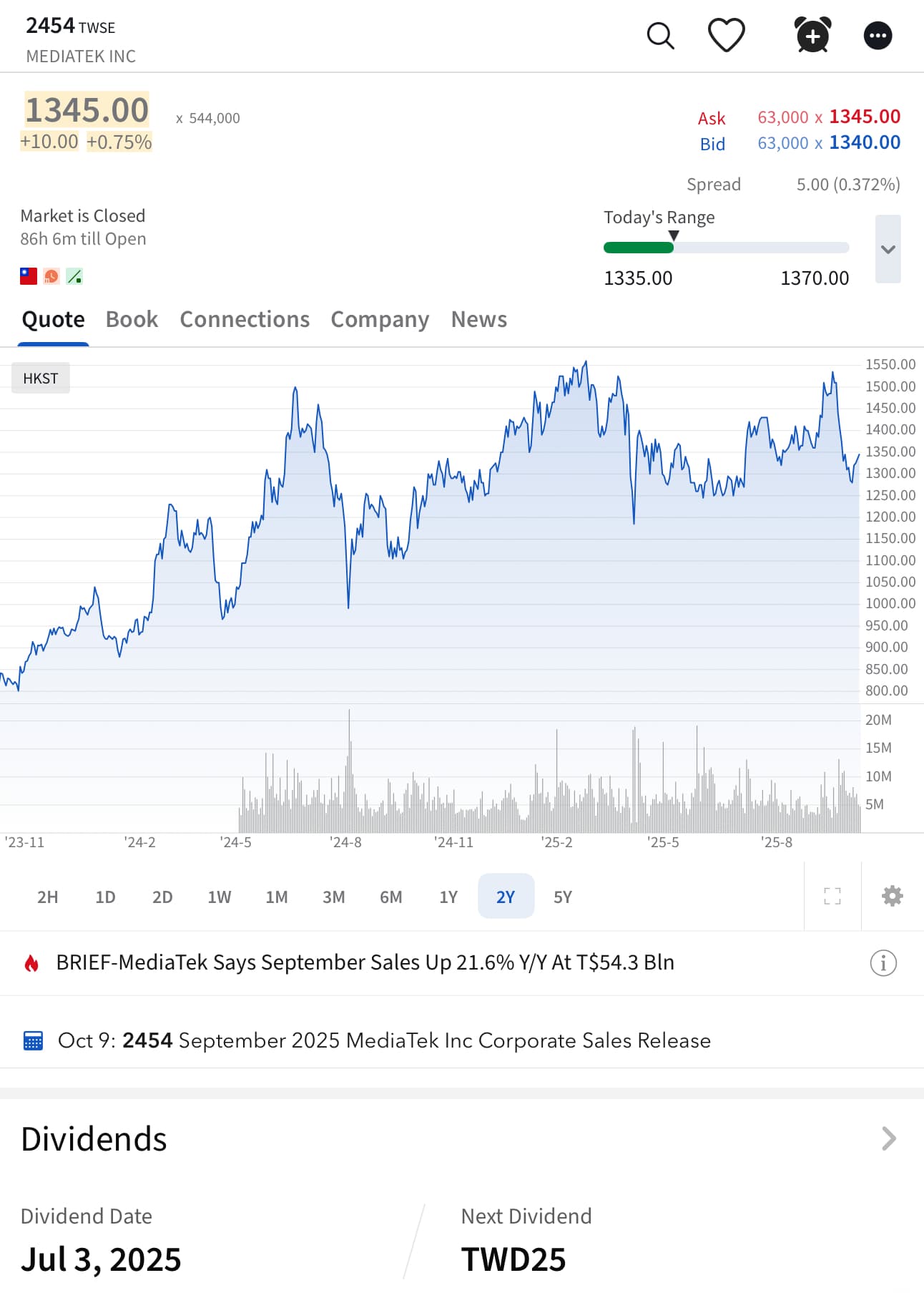
Let’s also ask now, in addition to the People’s Republic of China, about the Republic of China, i.e., Taiwan. I opened a user account and an investment account with Interactive Brokers to buy and own Taiwanese stocks, as I couldn’t find them on Nordnet, Mandatum, or Degiro. I haven’t deposited a single penny into my IB account yet, let alone bought any stocks, but if I were to buy Taiwanese stocks from there now, what would be the dividend taxation practice? Does anyone have practical experience? You can also share general experiences with IB if you have used it.