KH Group - a turnaround company after restructuring?

Good news. A small reprieve has been granted.

KH Group: Indoor Group Updated Its Financing Agreement

KH Group’s subsidiary, Indoor Group, has updated its agreement with the financier. According to the updated agreement, the financier will not call in the loans if certain conditions are met. The validity period of the agreement has been extended until August 31, 2025.

The parties have negotiated the terms of Indoor Group’s financing validity for the duration of the sales process. Uncertainty is associated with Indoor Group’s financial position, as the company did not meet the covenant conditions as of September 30, 2024. The financier has the right to call in the loans upon the expiration of the agreement, which may affect the conditions for Indoor Group’s continued operations. Indoor Group’s financial situation does not have an immediate impact on the group’s ongoing operations, as the group companies are separately financed.

14 Likes

The furniture industry isn’t quite that easy. Everything has to be in place for sales to happen: marketplace, supplier relationships, salespeople, software, brands, and consumer trust. Competitors don’t have the space (or the resources) to expand their own collections with proper Asko/Sotka brand corners; the whole thing would have to be based on industry expertise and the profits brought by a better future - which would then turn debts into profits over time. There are no quick wins available.

What interests buyers most from that Indoor listing are brands known in the domestic market, although the need to update perceptions has clearly been noticeable for a longer time.

Regarding the software, what’s interesting are the potential benefits, when verifiable; so far, it has strongly focused on the cost side, with over a year having passed since its implementation.

Domestic operators have very little collection-specific differentiation compared to competitors (Ikea, Jysk). Asko factory products have also been marketed by competitors (Vepsäläinen), others?

It is hoped that the cost-effectiveness of the change negotiations will be a real benefit already in Q2, not a drop in service quality.
Service quality is so far an almost untapped competitive advantage; online services have been highlighted, but has any development occurred?
Ikea’s expertise in self-service is practically almost impossible to challenge.
Without dipping into the consumer’s wallet, the outcome of moving funds is predictable.

1 Like

I did a little detective work at Asko. I happened to get a really nice salesperson, so while asking for offers, I also inquired about things that were on my mind. I don’t own KH-Group myself.

  • What has been the feeling about combining Asko and Sotka stores?

The biggest impact, surprisingly, has been that there are significantly fewer staff members present in total. Apparently, when it’s a bit busier than usual on a weekend, unfortunately, they don’t always get to help customers as well as they would like.

They also saw it as a challenge that if you’re used to being a salesperson at Sotka, it’s considerably harder to jump to the Asko side because the product selection is wider and the customer base is in a way more demanding. Serving in the other direction is much easier. For me, these answers were pretty much what I expected. From a customer’s perspective, it’s a bit “odd” that the same salespeople serve in two different stores whose target groups are quite different.

  • Has this new ERP made things easier from the salespeople’s perspective?

To put it nicely, the ERP didn’t receive very glowing feedback. Making offers is reportedly much clunkier and slower than with the old system. Apparently, the system sometimes also shows ghost balances in the online store. For example, there might be a display product in the store that is not for sale, but the online store might still show inventory. Then it’s nice to tell a customer who has come to the store that the product isn’t for sale here. Unfortunately, this didn’t surprise me much either…

Of course, these weren’t consensus views, but I thought I’d share them here in case anyone is interested.

25 Likes

However, it should be noted that the old DOS-based ERP was no longer an option. Although old programs are easy for the salesperson to use, they limit the chain’s development.

I don’t know if choosing the new ERP was the best possible option, but something had to be done anyway. And when software that has been in use for 30 years is renewed, it’s clear that things will be slower and clunkier for old users at first.

The most important question, did you buy anything during your visit? If sales work and customers buy, then the salespeople’s self-esteem and morale will rise, and small issues will fix themselves as if by magic..

2 Likes

Yes, I can openly admit that I didn’t know what the old ERP was based on, and I absolutely agree that there’s always some stiffness at the beginning with a new system (though it’s probably been in use for many years now) when one has been accustomed to using the old one for years.

No money was invested in the business at this point. We are moving, so there is indeed a need to replace some furniture. I’m not deep enough in the numbers to know how realistic the risk of bankruptcy would be in the short term. It would be a bit more unpleasant to put several thousands into custom-ordered products only to find that the money is gone and the products don’t appear.

1 Like

Well, the new operational control system hasn’t really been used for many years🙂 It’s been in use for about a year.

And perhaps it won’t be used at all. A really bad investment mistake. Changing an ERP system is no small matter, and this might become one of those example cases where a major failure almost brings down or completely brings down the entire company.

1 Like

Yes, it is used, but likely by some other party. Rarely do those ERP systems completely fail at once. I have also been testing them to some extent myself. And I’m not entirely convinced that this company’s problems are solely due to ERP, but rather the general economic situation. A few chains have, however, taken market share. I do believe in a recovery when the economic situation for low-wage sectors improves, if it improves.

If one considers Sotka’s target audience, not necessarily many middle-income earners or those earning more visit it. In my opinion, the target audience has been young people and those earning less.

We’ll see if that has any effect now that the shops have been merged. We must hope that the housing market picks up and things start to normalize.

KH Group: Indoor continues to improve profitability – the company initiates change negotiations

3 Likes

This might lean more towards my personal experiences, but a short comment should be allowed here. Around Christmas, I went browsing in Asko. The salespeople had plenty of time to chat, and I ended up ordering something small. While they were printing papers, I asked if they had a new system, how it had been working, etc. The salesperson replied that the old one was old-fashioned, but it was functional nonetheless. They didn’t directly criticize the new one, but I gathered from their comments that there had been problems.

I don’t know if it’s related to the new system’s functionality or not, but the goods still haven’t arrived after almost half a year of waiting. A few months ago, I went to inquire, and the order reportedly showed up as ‘ok’ in the system, but no further information about its progress was visible. If it works this poorly for others too, it’s no wonder they’re not getting money in the till.

12 Likes

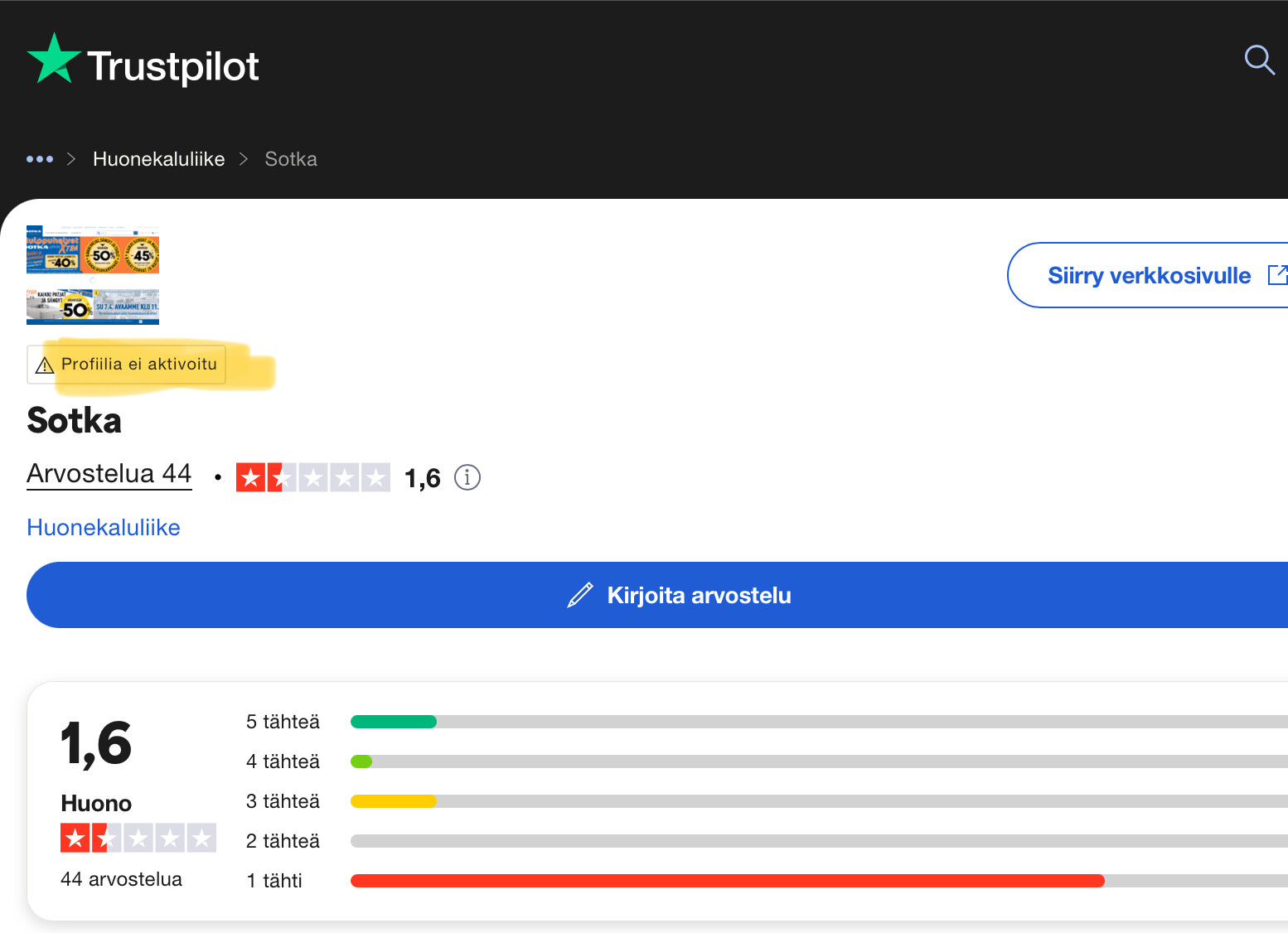
Yeah. It looks like you might not be the only one. Try googling Sotka reviews. Trustpilot reviews came up first. Absolutely terrible stuff. I don’t remember ever seeing such bad ones ever. The last 10 reviews are one star and everyone has the same problem. No one would dare to buy anything from there. Surely these can’t all be from ERP. Things are much more messed up there than I thought.

2
3
4
5

7 Likes

I did google it, and this came up. Sotka kokemuksia: asiakkaat kertovat | Sotka
It seems to be an excellent store.

  • Good quality on a student budget
  • Laura Rantanen: “Sotka is reliable”
  • Laine: “Sotka beat other options in service and price”

Trustpilot is a company whose business is based on bad reviews. And people who have had a bad experience are more likely to express their opinion than those who have had a good/neutral experience. So I wouldn’t give those reviews any more value than Make’s opinion at Esson baari (Esson bar). And there were only a few reviews this year; if the rest of the customers are at least somewhat satisfied, then Indoor is performing really well.

3 Likes

Trustpilot sells that as a service. And I bet Indoor pays for it.

It’s true that people are more likely to criticize than praise. But it gives the impression that the whole house is in disarray.

Of course, it would be surprising if Sotka’s website said that the service is terrible, and we don’t know where your items are going… I also have this and that on my homepage… but I don’t add complaints there, even if they come in. They just need to be handled.

ERP (Enterprise Resource Planning) system changes are always a risk, and one would think that at that level, certain things would be written into the contract. I’ve been involved in several such changes. It never goes perfectly the first time, but when the contracts are in order, the service provider will fix problems 24/7… if it’s written in there who is responsible.

2 Likes

It doesn’t pay because the profile hasn’t been activated.

IMG_0566

2 Likes

There’s a lot of speculation online about Trustpilot’s operating model, and admittedly, companies that receive bad ratings often come to light in its context.

For example, this Reddit thread compiles some good critical perspectives:

https://www.reddit.com/r/Scams/s/QBbr3aIlbZ

If its operating model were sometimes to target entities with image problems, Finnish sofa retailers would certainly be an attractive target. :smiley:

2 Likes

ERP risks are always divided into the operation of the program itself and the correctness of the data entered by the user.

For example, if a product is coded incorrectly or incompletely - or there are errors in inventory balances - the order will not be processed correctly even if the program functions correctly at that point. This easily leads to additional waiting times for the customer and frustrates the salesperson, who can do nothing about it.

1 Like

Here are Thomas’s comments regarding Indoor’s change negotiations.

1 Like

Consumers are becoming more active in retail based on Nordea’s card data. This certainly won’t hurt Indoor:

image

11 Likes

When the bank committed to Indoor’s sales process and the financing agreement was renewed until August 31st, it can be concluded that there was no quick sale after all. It probably wasn’t expected either.

The new change negotiations and the communication about them were, correspondingly, surprising. Why wasn’t this communicated, prepared for, and backgrounded in the Q1 release? This additional need for -2M€ in savings was probably not suddenly noticed a week after the previous release. Or is Indoor now being led by a bank that dictates the next quarter’s personnel budget in its covenant review? The bank certainly knows how to manage this company’s costs, but based on KH Group’s board’s history of competence and Indoor’s own operational management’s track record, it makes one wonder who currently has the competence to challenge and create consumer market competitiveness for Indoor, better margins (continuous “ALL beds -60% and ALL patio furniture -50%” indicate a severe lack of competence in sales and margin management), and growing sales? If increasing a company’s competitiveness and value means initiating change negotiations, then corporate leadership is an easy job.

The reason why I believe it would have been good to hear about these additional reductions during the earnings release is related to KH Group’s capability to sell Indoor (and get the best possible return on its investment). My question and concern is: when was the last time you heard strategic-level guidelines for improving Indoor’s sales and competitiveness (=sales value)? All significant policies over the past year have practically only been related to saving Indoor’s costs (operating model reform, store consolidations, staff reductions, ERP, etc.)? By what means will Indoor succeed in competition; in which customer segment, with what kind of service promise, with what kind of store network and store experience, with what kind of procurement machinery or with what kind of logistical network will the continuous drop in market share cease?

A couple of years ago, sales were at 190M€, the operating model reform started last summer at 166 M€ levels, at this rate, sales will soon reach 150M€, and the risk increases that the old savings program will again not be enough to bring the planned profitability.

In summary, and respectfully provocatively: Dear KH Group board, now take your (and the bank’s) eyes off just the costs. Put the literature of Porter, Barney, Teece, Mintzberg, and Rumelt on your nightstand. Quickly focus on Indoor’s strategy and developing it to a level where competitiveness is found and market shares are won. After that, Indoor itself can trade with good figures. If there is no desire/ability/investment/commitment for this, is it worth taking the risk of a continuous spiral of contraction and additional capitalization?

According to Nordea, hardware + home goods, in particular, already grew by double digits in April. Nikulainen seemed to convey different sentiments about March-April sales?
image

11 Likes