So what’s the problem there? Who among private investors does any precise fair value determination, when that’s pure guesswork anyway. You can analyze a company without doing any original numerical valuation.
Tell me then, from your own perspective, what was your fair value for F-Secure when you bought it at 2.7 euros and sold it at 2.9 euros. Yet, when you bought it, you justified the purchase with Inderes’ valuation, which was close to four. You still haven’t justified what made you sell so cheaply right before the negative news
What do you think this looks like? Open your eyes there!
Edit: So far, the biggest mistakes (in euros) have been, for example, Pantaflix, Verkkokauppa.fi. However, I’m patient with these; I won’t sell at a loss until I see “where we end up.” So, these are in the red by a four-digit number of euros.
Edit2: Since my investment strategy has also been criticized here, let me state that there’s a section “Mr. Market is my servant, not my master. The market offers opportunities for trading,” and with this, I also refer to a bit of trading. 80-90% of the portfolio has indeed been acquired and held for at least a 1-3 year horizon, but I also sometimes aim to make a purchase based purely on undervaluation. F-Secure seemed like such a case, but I had a change of heart regarding my purchase, for example, after watching Taaleri’s video on value investing. That gave me an impetus to reconsider, and by LUCK, I disengaged in time with a small profit. (Yes, this was a change of mind caused by my own deficiency. However, it was worth changing my mind as the odds heavily leaned on growth expectations.) The position in F-Secure was not large, only an amount equivalent to my current monthly investment sum.
Edit3: Here are the worst portfolio losses in percentages, in order: Nordic Mining / Pantaflix / Verkkis
However, this highlighted exactly what is typical at the moment and also for the Inderes phenomenon. A purchase is first justified based on Inderes’ analysis, and then the view can be changed after watching a video, presumably about investment strategy. This means purely bouncing around after other people’s views. It would be different if some new perspective on the investment had emerged, but here, based on one practically insignificant video, the stance on the company is changed, and the outcome of the analysis is discarded.
Short positions can be an interesting option, but then investment decisions should not be made based on any analysis. Goals and tools must be proportional to each other, not just splashing around and basing views only on some individual analysis or video.
Yeah. My own actions were a bit of a mess, I’ve recognized that. The other reason for the sale was, as I’ve already mentioned… I’ve bought more defensive stocks at good prices. (One valid reason to sell a stock can be to exchange it for a better one)
The case of Next Games, the target was raised to €2 <— €1.2, and then the estimated required funding amount was halved to €10 million <— from €20 million. Okay, the case is not the easiest, but an analyst’s estimates shouldn’t fluctuate that much with the lemming mass and tax sales. Now, we’d need a bit of courage to do better analysis. The technical implementation is good, but a bold grasp of the overall picture is missing, and uncertainty is reflected in the analysis’s mood-dependent fluctuations.
The target price is now a bit what it is. It aims to predict what the share price will be in 12 months. If the share price is under pressure due to external factors and this is expected to be reflected in the price even a year from now, then this external pressure must be taken into account when determining the target price.
Fair value, on the other hand, would better describe the analyst’s view of the company. It would not contain as many variable and speculative components. It would almost be more sensible to look at fair value rather than the target price. Alternatively, both could be announced.
According to Sauli, analysis failures in small companies are apparently not as significant as failures in large companies. Nokia’s success apparently offsets many smaller failures, because the absolute value hasn’t been destroyed as much. The logic is a bit strange, though. So, analyses of large companies are apparently more valuable than those of smaller companies.
Elsewhere, it’s stated how the added value of analysis is greatest precisely for smaller companies, as they are outside the radar of many analysts. Now, however, analysis failures are downplayed by saying that Nokia has been able to create much more absolute value for investors than the losses in small companies. If analyses are done with the same quality, then the value of each analysis should be the same.
Another slightly strange observation in the video was that Inderes examines its success in absolute terms, not relative to an index. With this calculation method, everyone can bring added value by being constantly positive on stocks. The prerequisite, then, is that stocks rise more often than they fall in the future. The comparison should definitely be relative to some index or similar. A mere absolute metric is poor here.
The target price was only a side issue in this Next Games example, and the point was mainly about estimating the need for financing. In fact, in this case, I don’t believe it was a lack of understanding, but rather a desire to play it safe again. I personally miss analyses where the analyst dares to deviate from the mainstream if they see some things differently than the market and dare to take a stance on the matter. In my opinion, such a uniformly flat analysis that follows the share price simply does not offer investors added value, even though the technical execution is at a good level.
I agree with this. Almost every Inderes analyst says that their estimates are very conservative. That is, they make estimates but try to include a large margin of safety. Shouldn’t the goal of analysis be precisely to estimate what will be realized?
This same issue was repeated, for example, in those unsuccessful analyses that Sauli also referred to in the video I mentioned earlier. If the estimates are conservative and still go very badly wrong, it is justified to ask whether the analyst was aware of what was really happening. The same applies in the other direction. Why give a cautious estimate if the goal is to try to be right?
Now, when success is also evaluated absolutely, cautious positive estimates should guarantee that the direction is more often right than wrong, because in a bull market, everything has gone up. The absolute direction has therefore been correct in development. A conservative estimate also gives an opportunity to justify in a bear market that one was more right than many others.
It should also be noted that Sauli emphasized in the video that the success of the analysis is evaluated by comparing target prices to the share price. This gives the impression that the most significant thing in the analysis is precisely the target price. However, I would see that what investors get out of the content of the analysis is more significant. That is, bringing out the opportunities and risks associated with the company. Every informed investor can then make their own decisions based on the analysis about whether it is sensible to invest and what weight to give to each aspect when determining the company’s value. The target price, in my opinion, is quite a side issue, and success in setting it can vary significantly if there is strong movement in the market.
The essential thing is that the analyst is able to highlight the factors that specifically affect the share price. The future development of some factors can have so much randomness that the development path is difficult to grasp. If an analyst can clearly point out a risk, and if it materializes, the share price is well below the target price, I would see the analysis as successful rather than unsuccessful.
Based on the analysis, one should be able to create an expected value for the price in the future, and sometimes it goes wrong and sometimes it is right. The essential thing is whether the value analysis finds the components that affect the price and whether they have been given the correct risk factors. If there are no significant shortcomings in these and the value of the investment decreases, it does not make the analysis bad. Randomness has merely changed the outcome so that the estimate was not successful.
Well-written, and I can easily agree with these same views. This, in my opinion, is what’s most important: what you can get out of the analysis. Not so much what the target price is and how it was reached. For example, in the case of QT, I had been considering selling my holdings for a long time when I thought it was becoming overpriced. However, after Mikael’s analysis and interviews, my mind changed, and I found completely new perspectives, even though I thought I was already quite well-versed in the company. Similarly, in the other direction, Sauli’s analyses of Verkkokauppa (Online Store) haven’t really been affected by changes in the share price or target price; instead, they’ve remained confident in their own view of the company. This, in turn, gives confidence to an amateur investor like me when you see that experienced professionals also dare to defend these same views on the company that I have, even if the markets are a bit disagreed. I’ll stop these compliments here so Verneri doesn’t completely tear his pants off, as I don’t remember being allowed to write anything positive in this thread.
Uncle Masse once had a thread called “The Unspoken Mr. Index,” but it didn’t really loosen the tongues of the pros. I guess it was because beating Mr. Index is just so damn hard for all of us. That’s why “investing is entertainment…” (I won’t say more, because Masse’s disciples already know the rest of the chorus by heart
Yeah, you shouldn’t just trust someone else’s opinion without thinking things through yourself. Verkkokauppa.com is really something, Sauli is definitely in love with Verkkis. Verkkis is a cemented stock; one man owns half of it, and only 10-15% of the shares are traded.
I still think Verkkis is expensive. Why is it allowed a P/E of 20? Is it just because it might grow someday?
Verkkis has indeed been quite the serial disappointment.
Inderes’s statement about the removal of the earnings warning risk for Verkkis, which proudly sits at the top of the morning review’s TOP3 list, is the icing on this cake.
Could it be said that Mr. Market was once again quite right in keeping the valuation at a more reasonable level than, for example, a year ago?
Now, take the CEO to a televised inquisition and dig out all the reasons why the results are lagging – and, above all, whether this will be the new normal going forward.
We’ve been very positive about Verkkis for quite some time, even though the stock price has steadily declined. I wonder when we’ll give up on this and admit that it went wrong. The worst part is that time after time, Verkkis’s development is misjudged. Sauli must have a pretty high threshold for changing his view to negative, because he’s hyped this so much. Unless there’s some clear reason to base a change of view on. Unless there’s really something here that the market doesn’t see, but the market can’t be wrong indefinitely either.
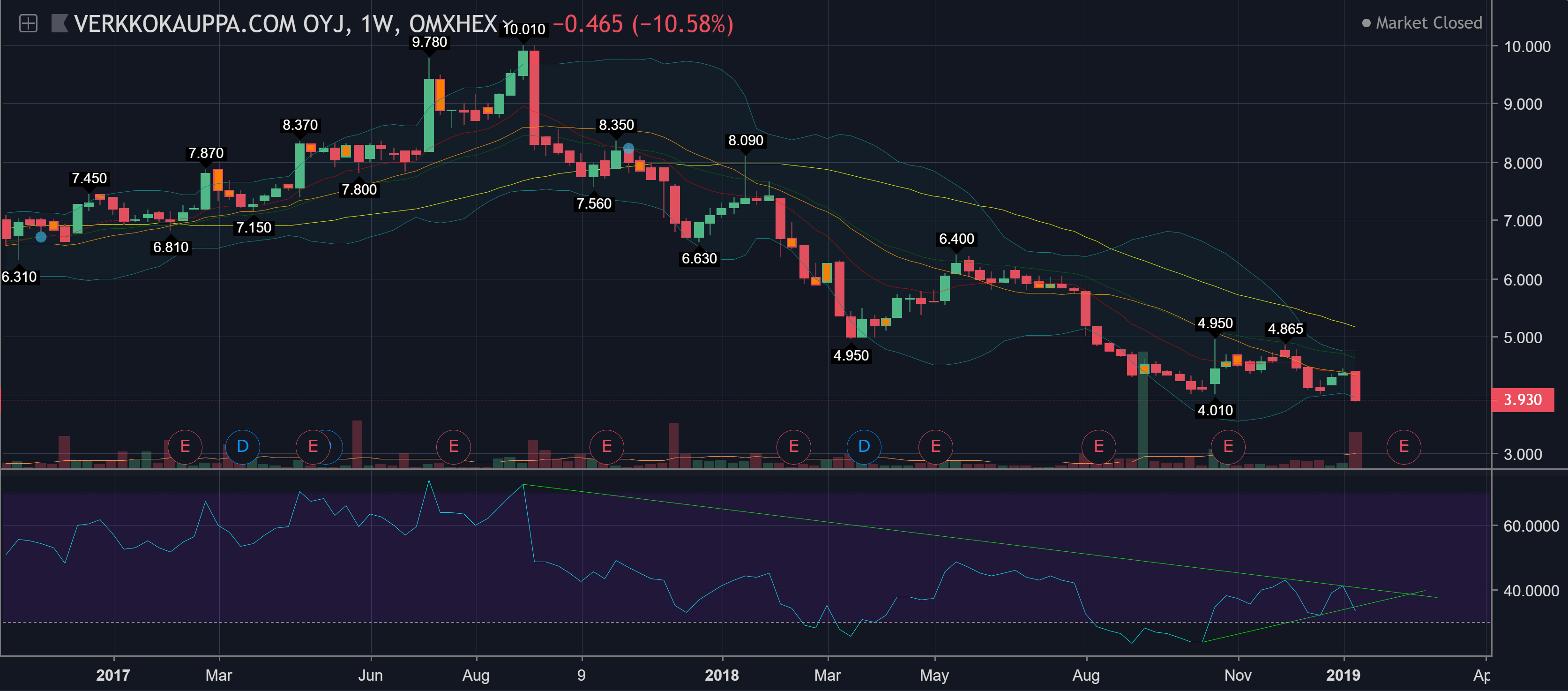
From a TA perspective, Finland’s Amazon, Verkkokauppa, is very clear when viewed weekly.
a textbook falling knife that cannot break its bearish trend but continuously makes lower lows
such small attempts at a rally occur with such low volume that the rally ends in “panic selling”
The RSI indicator pretty well tells what has happened, what is happening, and what should happen for the direction to change (in terms of price action)
From a fundamental perspective, Verkkokauppa has transformed along the way from a specialized store selling electronics (computers and their components) into a general merchant, and Amazon’s entry into the Nordics will finally kill any attempts at a rally.
Verkkokauppa is not a discount store, so they cannot compete on price
currently, as there are no significant competitors in Finland, product availability and brick-and-mortar stores have been sufficient until now
However, Finland has Gigantti, Power, XXL, etc., which are eating into Verkkokauppa’s sales
The Amazon concept should have been implemented a long time ago; then, it might have been able to survive here for longer. IMO.
Copied from OP’s page, an interview with successful investor Ilkka Parviainen:
The stock market often appears difficult and challenging to the inexperienced, but Parviainen makes it sound incredibly simple. His own investment strategy is borrowed from Kim Lindström, who has a long career in the financial and securities industries.
– In my portfolio of 25 stocks, I use a key figure strategy that includes the P/E ratio, P/B ratio, and dividend yields. I add up these figures and score the company accordingly. One is the best and 25 is the worst. I invest in the top third of stocks.
I think it’s a good strategy and especially suitable for long-term investors who are not in too much of a hurry. The downside is that (rapidly) growing, non-dividend-paying, and especially popular success stories that cannot be acquired cheaply are left out of the equation. So, they should be evaluated with different metrics.
I primarily use a similar strategy myself, supplemented with selected growth stocks. I recommend it for beginners as well. Sometimes stock prices stagnate, but in the long run, it generally yields good results. Patience is usually (not always) a virtue.
I would also add forward P/E, estimated revenue growth, and dividend growth to the mix. Then you’d have a pretty good set of data.
Of course, it’s also worth looking into the business operations and the credibility of management’s stories
This could be thrown into the Investment Strategy thread? This thread is dedicated to Inderes’ botched analyses and ranting about them
P.S. With that strategy, he seemed to have gotten an index-matching return, as emerged earlier from Salkunrakentaja’s article. The road to the stars isn’t that simple, but overall, with strict saving and investing in an index, one should get good results in the long run.
Interpretation: When Masse gets into the index regardless of how much own analysis he does, then the uncle leaves Parviainen tactics to their own devices. By closely following the index and with his own gut feeling, good things will come, and Masse’s time will mainly be spent on all sorts of enjoyable nonsense. Masse’s disciples thank him.