I wonder if any tabloid has run a headline today along the lines of “Nalle left Sampo, stock in a -6% plunge,” and of course without mentioning the stock going ex-dividend.
5 Likes
Well then, Friday .. haven’t really felt like doing much on the investing front, unless you count watching the Wahlroos interview. Well, I’ve thought about and crunched some numbers for Lapwall, and updated a few calculations for existing holdings. Somehow summer mode is already on.
What I have had the energy to spend time on is, of course, funny pictures found on the internet 

Have a great weekend everyone 
14 Likes
In Japan, it’s also convenient to take advantage of liver metabolism arbitrage, as some business ideas don’t take into account the alcohol tolerance of gaijins. We were once at a karaoke place that cost 20e/h per person (which we haggled down to 17e/h). The deal included endless free drinks from a fairly comprehensive list of beers, cocktails, and highballs. In hindsight, it could be said that we fell into a value trap.
23 Likes
Käärijä will likely receive quite decent compensation through Spotify alone. The article does not have a paywall.
If the figures from the calculator published on the Ditto Music website are to be believed, 40 million streams would bring in $174,800 in royalties, or approximately €162,083.
17 Likes
Thanks!
In Osaka now. From here, it’s easy to make shorter trips to Kyoto, Himeji, or Nara.
Of course, with the Shinkansen high-speed train, you’re pretty much anywhere in no time.
Maximum speed of 320 km/h in passenger service.
Previously I’ve visited Tokyo, where 2 weeks were spent practically exploring just one district (Shinjuku)  .
I really like both cities. There’s just a slightly different big-city feel to it when you can’t see the end of the city with the naked eye when looking out from a tower.
Even though I have 20/20 (outward) vision 
If you appreciate good food, Japan is an excellent destination.
Right after Singapore, it’s top 2 on my own list.
You should set aside plenty of time for Japan because there is so much to see and do.
20 Likes
Yeah, those streaming royalties are relatively small and are further split among the creative team, especially considering that a band like Tehosekotin could earn €100k from a single gig.
According to one report, that streaming money hasn’t appeared in Käärijä’s account yet, and Eurovision itself hasn’t paid anything yet. It’s damn good exposure for an artist who wasn’t known to anyone yet. He noted that now he should hire a manager and go on tour.
But money like that doesn’t come easily. Tehosekotin (Teharit) also worked a hell of a lot for negligible compensation just to make a comeback after years.
Oh, the times!
Now he just needs to capitalize on all the publicity and new connections. Things have been looking pretty good.
7 Likes
It really shows the impossibility of streaming for artists. If an album sold 40 million copies back in the day, it was the millionaire club and a world tour. Compared to that, 162k minus taxes is in a bit of a different league 
5 Likes
You can’t really compare streaming to buying an album. It should be compared to radio airplay and the royalties derived from it.
Or do you remember how just twenty years ago, albums were selling billions of copies?
9 Likes
Selling records used to require a lot of work too. Nowadays, a song can go viral quite easily, and Spotify is just one channel that will be paying Käärijä.
The threshold for listening to a song on Spotify is significantly lower than for buying a record. In the old days, piracy and recording songs were also common. The artist got nothing.
Nowadays, you can get visibility for free as well. You don’t always have to buy it.
Gigs also seem to pay a bit better these days than before. At least ticket prices have gone up. Of course, not everyone can do a “Tehosekottimet”.
Spotify’s genius lay in shifting the power of physical distribution to the control of playlists. At the same time, a huge amount of costs were eliminated from the journey between the recording booth and the bargain bins at Anttila.
Opinions vary on how much of the efficiency gains in music consumption costs actually trickled down to the creators. 
If you teach a child brand communication, they might soon become a more successful musician than they would by playing the guitar.
1 Like
It’s quite interesting to hear all kinds of opinions on the forum. I would love to hear more of your thoughts as well and, if I may ask, if you could explain your investment strategy somewhere—specifically, how you plan to potentially benefit from a bear market?
It’s hard to compare it to radio airplay either. Radio airplay can have an infinite number of listeners. The compensation per listener is lower than on Spotify.
Spotify is criticized for low payouts, but it should be understood that on Spotify, that same pot is divided among many more artists because the plays are distributed differently. If you get on a radio playlist and play 5x a day all year round, that adds up to quite a lot of listens.
I would argue that it leveled the relationship between the consumer and the provider, making it easier to create value for the listener. Making piracy unnecessary.
If we think about the evolution of our own time, and how paying for music was avoided:
- borrowing a cassette from the library and recording it
- recording from the radio or television
- buying pirate CDs from the Mustamäe market (Mustamäentori)
- copying songs from CDs yourself
- the long evolution of downloading songs via torrents for personal use
- avoiding the TV license fee (funding for the public broadcaster)
- switching radio channels when commercials come on
Modern era:
- you pay a monthly fee and at no point do you own the song for your personal use
- every time you listen to a song, it generates something for the artist
This is really the interesting part—how consumers have adapted to it because it is priced reasonably and its accessibility has been made easy —> customer value has been created.
Every time you want to listen to a specific song, you pay for it in some way. It is no longer in your “eternal” use. You can’t sell it forward, and its value cannot increase over time.
This would never have been possible without:
- The digital revolution
- Devices
- Faster internet connections
- Legislation regarding piracy
- International agreements on these matters
- Obligations regarding broadband subscriptions
- Monitoring and sanctions
9 Likes
Piracy has always been a customer service issue. If pirates offered better service and superior value for money, it ate into the demand for legal providers. Spotify is the one providing better service in the music industry, and its value for money is OK.
Similarly, in the era before Steam, the PC had already been declared a dead platform not worth releasing games for because everything was being pirated. Then a way to publish, distribute, and sell games emerged that allowed content to be offered before every pirate had it, and the value for money was OK—especially when accounting for sales campaigns. There was also much less hassle to deal with, particularly as the pace of game patching accelerated, which requires extra effort with pirated versions. And suddenly, the PC transformed from a “dead platform” into a massive cash cow for game developers…
Any entity crying about piracy in their industry can only look in the mirror and start thinking about how to provide content to customers faster, more flexibly, and with better value for money.
33 Likes
Record labels and distributors used to hold significant power over the allocation of music revenues, specifically through record sales and distribution. Now, the curator of a popular playlist is the kingmaker.
Another new phenomenon in music is putting capital to work. Of course, this isn’t limited to Spotify or streaming.
The acquisition of publishing rights and the interpolation of old song snippets—generating returns with copyrights held on the balance sheet—is a phenomenon you can hear just by turning on a station like NRJ.
Old melodies and elements from years past are recycled in new songs, where the performer doesn’t need to be paid as much as the one who originally created the familiar hit hook.
Music monetization is undergoing a revolution.
Edit: As @Jarnis’s message highlighted, piracy was a major problem specifically for physical distribution.
1 Like
…where the problem was often that when a song was fresh, you couldn’t even get the record from the store yet because the manufacturing and distribution of the discs caused delays and releases were by no means simultaneous worldwide, partly due to ancient organizational structures, and there was no functional digital commerce. The options were to try and catch the song from the radio, or then sail to the Pirate Bay. iTunes was, in its own way, the first step and likely remains a significant channel. Spotify then moved music listening into the modern era, where you pay a monthly fee for a massive library and don’t have to deliberate over every single release whether you’d bother to pay for it or not.
4 Likes
So you mean that whereas before the intellectual property rights owners called the shots, now it’s those who own the customers.
There has indeed been some speculation that because the number of streaming services has grown so much, there is no longer just one place where money accumulates. It is typical and likely for a technology’s lifecycle that a new way to listen to music or watch movies will soon emerge from somewhere.
The intellectual property rights holders certainly seem dissatisfied. Ideally, even Spotify would rather feed the listener its own AI-generated content and podcasts, for which no royalties need to be paid.
4 Likes
Vague memories from the 90s and the turn of the millennium that money was also a currency that counted, in addition to the wait time. But Apple and piracy probably shared the cake more than they fought over it.
2 Likes
Before iTunes, the options were “late-arriving plastic discs that still had to be ripped separately to listen on a computer or an MP3 player” and “the pirate bay.” If you didn’t want to mess around with discs and already had an MP3 player, options were scarce. Music companies literally wouldn’t take your money unless you agreed to the discs.
iTunes + iPod was such a strong combo for music consumers that they were willing to pay a premium for it because everything just worked without any fiddling or hassle.
5 Likes
Remote work day at the cottage, as the kids have no school today. My own studies ended on Tuesday and I’ve now completed my entrepreneurship degree. No complaints about the scenery. Not even a sluggish day on the stock market is stressing me out
Serving as a sleeping pad is a 6x6x6m  “hammock”
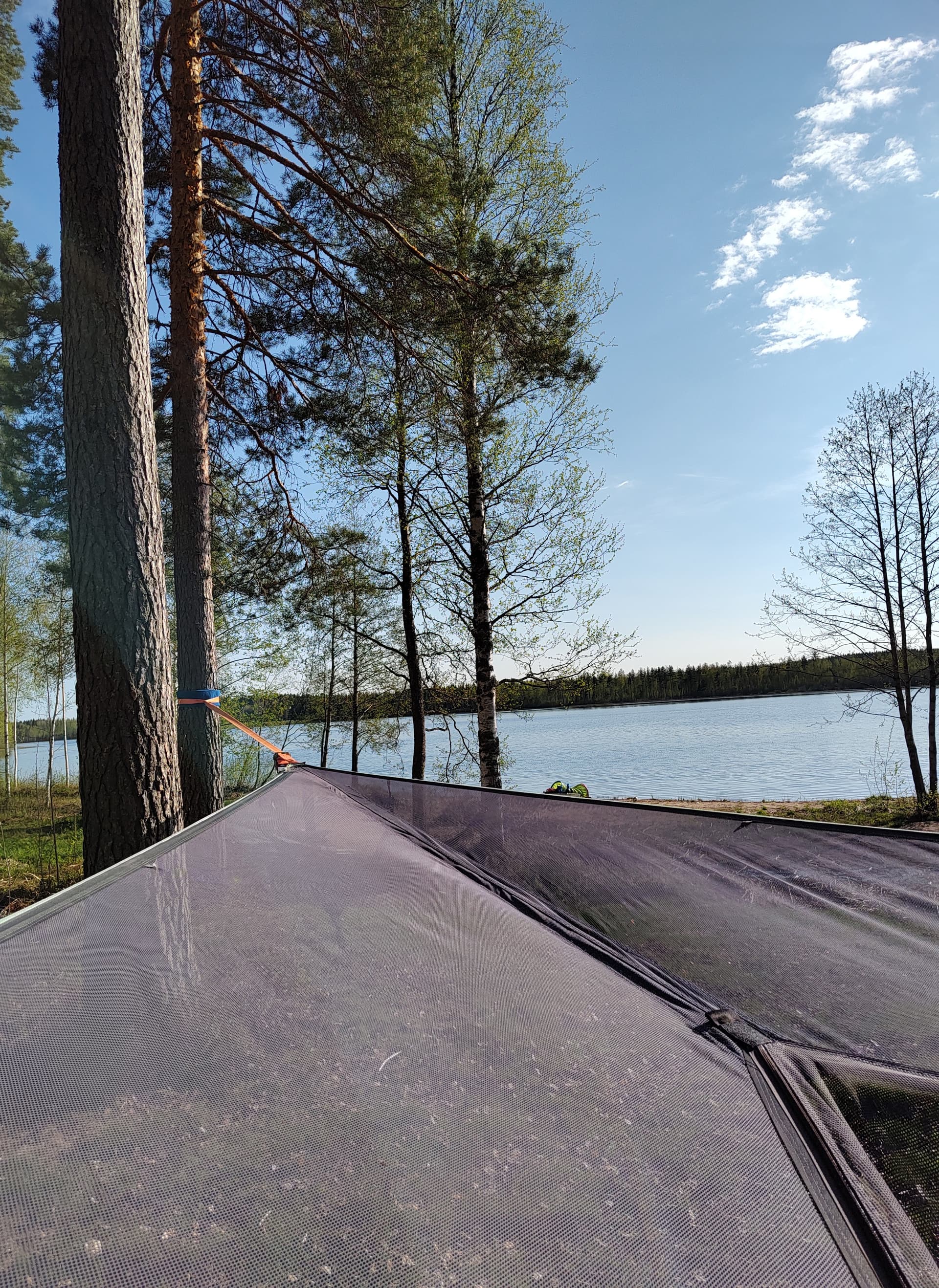
Have a great weekend everyone!
40 Likes