
Brian has an interesting tweet about stock holding periods 
This is largely explained by the frequently suggested idea of investor short-termism, but it is worth noting that it is also driven by companies’ advanced capabilities to scale their operations through new business models, access to financing, and subcontractor networks, as well as the (assumed) increased efficiency of price discovery, lower trading costs, a larger number of retail investors, the explosion in the number of listed companies, and the ease of trading.
In the 50s, factories were built on-site from red bricks, it took a decade to bring a new factory into operation, and they had to be built separately on every continent. Financing was primarily provided by operating cash flow. There wasn’t much room for disruption to happen in a quarter or a year that would cause a stock’s expected return to fluctuate as rapidly as it does today.
Here is an article about Renny Harlin’s movies, where all the films are listed with a short summary. I wasn’t familiar with all of the movies beforehand, which is why the article was quite interesting.
This really shakes me to the core, one of the greats of my whole youth. Popeda and Pate, we always went to a gig whenever there was a chance, we’d have some drinks and have a great time. The 80s were the golden era for Popeda gigs here in Ostrobothnia, a big hand and goodbye, this makes me sad.
An invention has been discovered that would surely find its way into every Finnish household. This would make even the most die-hard vaccine skeptic reconsider. Waiting for commercialization. 
A beer-based vaccine has been developed in the United States — virologist Chris Buck brewed beer capable of protecting against diseases
He managed to integrate virus-like particles into yeast, helping the body fight infections.
He and his family tasted the “foamy shot,” and the results were striking: after drinking five liters of the beer, their bodies really did produce antibodies that could help fight illness.
Now he’s considering how to make beer-vaccines for other diseases as well.
https://x.com/nexta_tv/status/2004315215005909100?s=20
Would it also help with the seasonal flu?
Thank you Wolt!
Only now does Juurikki understand that the desire to help the less fortunate by offering them even odd jobs can become this wonderfully expensive. 
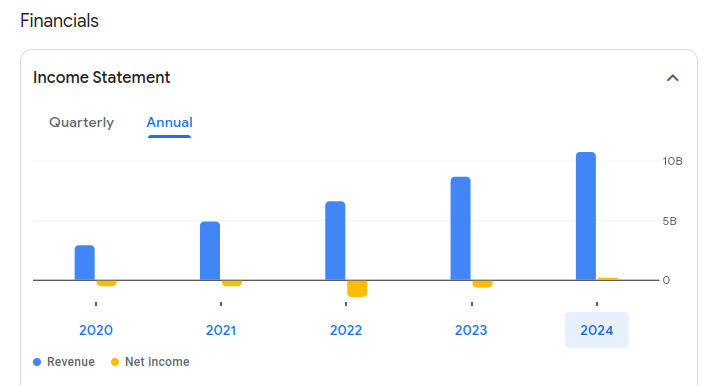
IS: “In 2024, Wolt Finland’s revenue was 139.9 million euros, but the operating result sank to a loss of 640.8 million euros. The loss for the financial year was 625.3 million euros.”
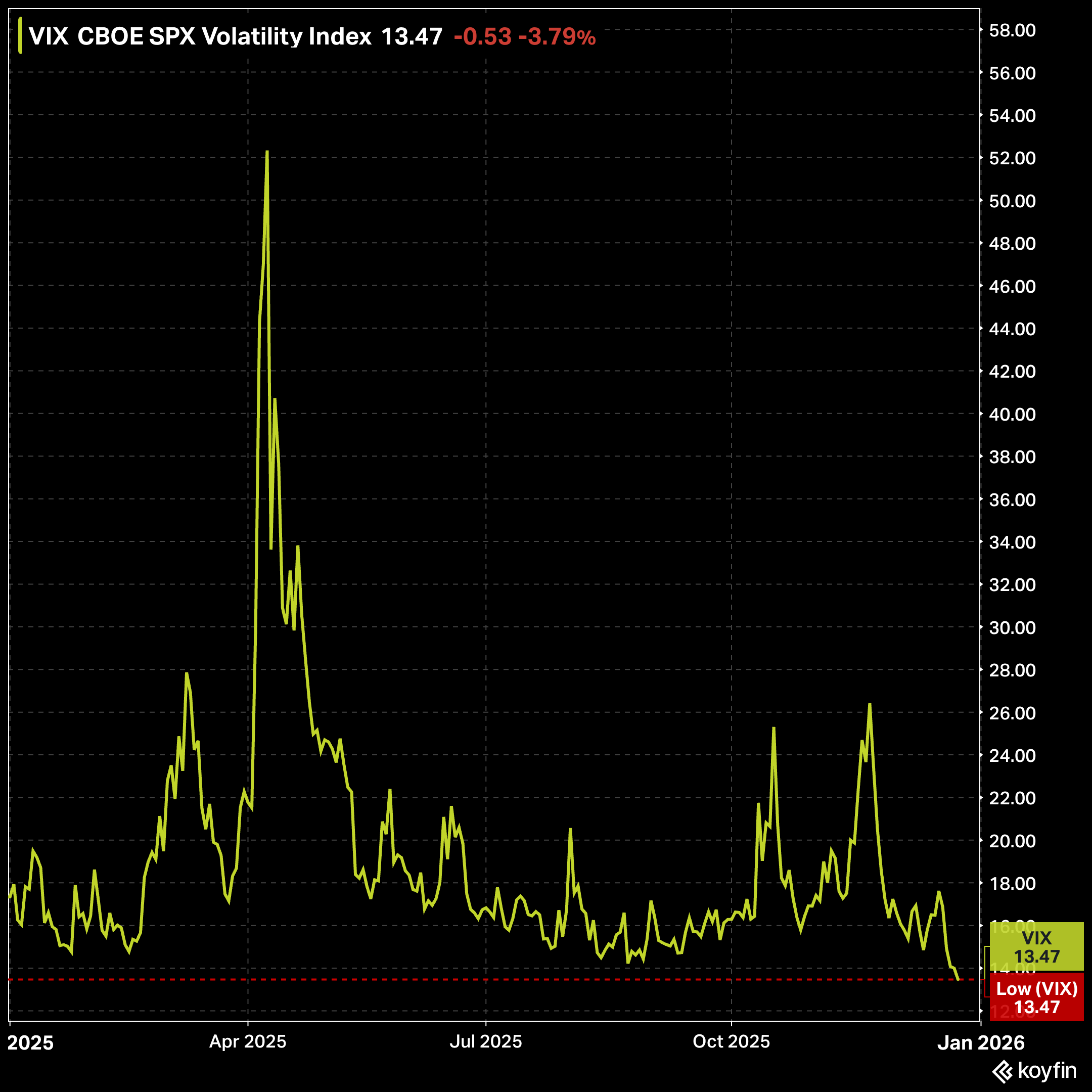
From the tweet below regarding the VIX, one could perhaps think that the markets are now exceptionally calm and confident. But is there already too much confidence in the air? 
Rest in peace, Pate/Pauli.
Back in our youth, we had a tradition of belting out “Tapparan mies” informally at Midsummer parties during karaoke.
One time, the host of the party happened to have a night shift at a hotel in Oulu on Midsummer, so a couple of friends and I decided to keep the tradition alive.
Around last call, we headed to the hotel lobby to cheer him up and rock out to “Mää ja Tapparan mies” with air guitars. As the volume of the chorus went up, Pate Mustajärvi himself stepped out of the hotel elevator.
We finished the chorus with total dedication; Pate gave us a quick compliment along with some brief applause. We went our separate ways toward our next adventures in high spirits.
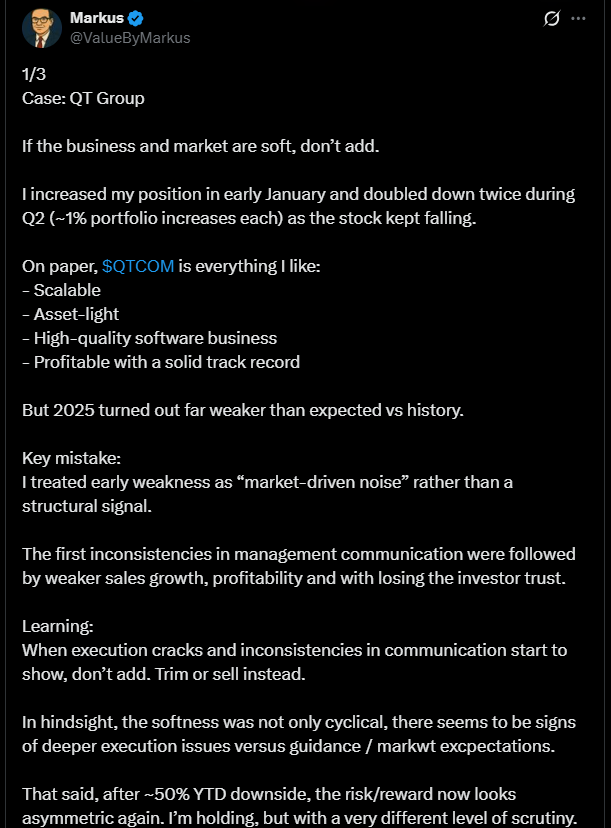
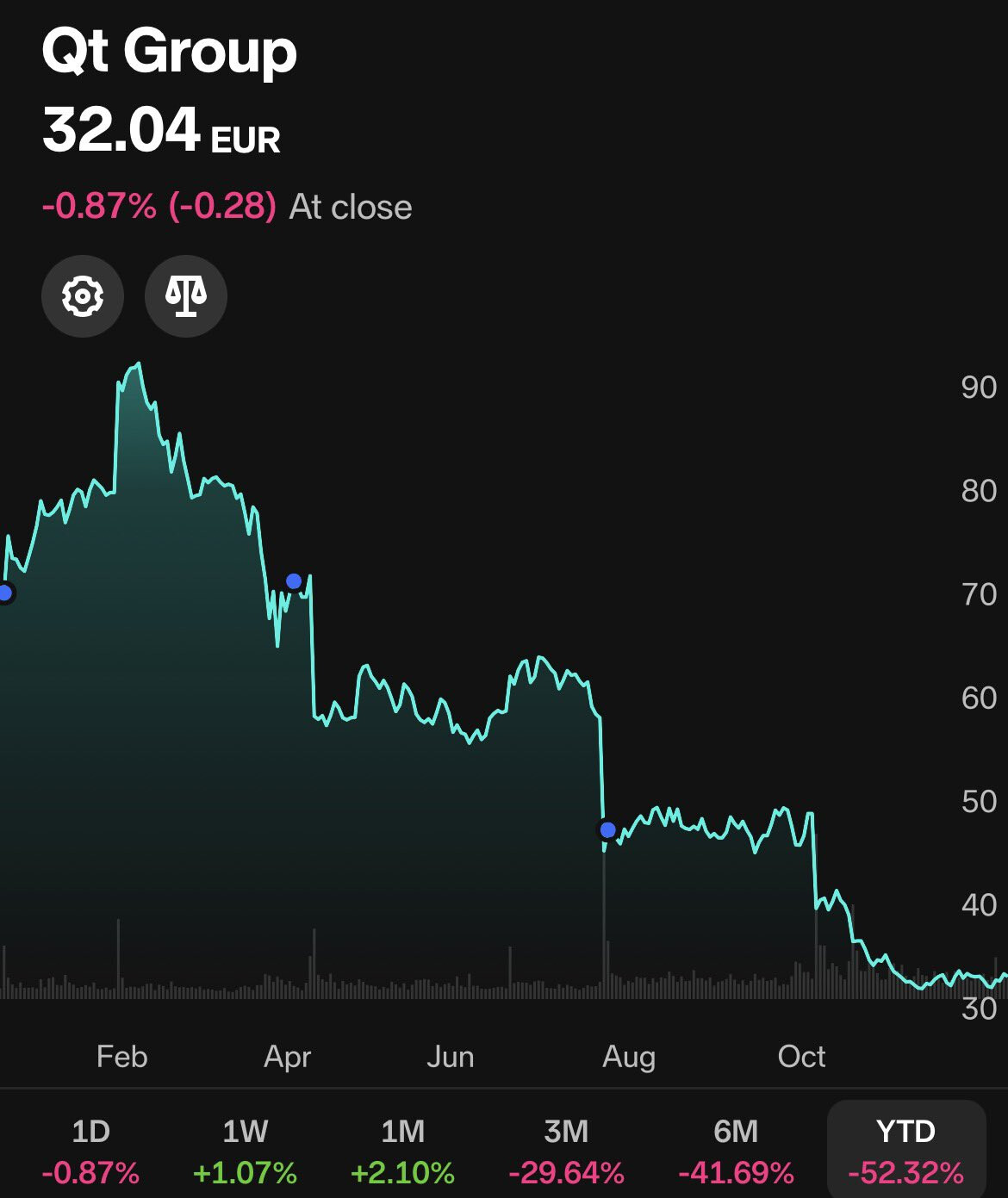
Here are Markus’s highlights from this year
In Wolt’s case, the absolute figures are completely insane. A couple of years’ worth of losses correspond to the costs of the first phase of the West Railway (one-hour train). In a couple of years, an amount of money has been burned on food deliveries that the state and municipalities don’t seem to be able to afford.
Now that there has been over a billion in losses in two years, it feels like the scale of the matter isn’t quite understood. Where are the other Finnish companies that make hundreds of millions in losses year after year? It’s absurd business, but I guess this is that “platform economy” or some other new economy that I don’t understand. 
Is there some trick here where money flows out of the country to the parent company (DoorDash), resulting in losses here in Finland (high corporate taxation) while profits are generated in some other country with a lower tax rate? Or is this just one of those modern firms where investor money is burned to grow the user base and the pool of couriers?
Furthermore, it remains unclear how this can ever make money. Most users are extremely price-sensitive. If a 15-euro meal gets a five-euro delivery fee on top, we’re already at the limit of whether people are willing to pay. And I don’t really understand how that five euros covers the costs, let alone generates a profit. There isn’t even a glimmer of hope that it could be, say, doubled; nobody is going to pay a tenner for hauling 15 euros worth of food.
I’ve “abused” this a bit myself through Wolt+ when the weather has been such that you don’t feel like sticking your nose out, and this makes the whole thing even weirder mathematically. 8 euros a month makes deliveries free, assuming the place you want is in the program and close enough. 8 euros covers the delivery costs of at most two orders. I understand the logic behind monthly subscription systems – you hope a huge number of people subscribe and then forget the subscription is running even if they don’t use the service, but if you actually use the service – say, order 2-3 times a week – you get 8-12 deliveries a month, leaving the firm with less than a euro per delivery. Yeah, Wolt also takes a cut of the meal price itself from the restaurant, but there isn’t much to be taken from there either if we’re talking about a 15-20 euro meal.
Maybe this is all some kind of new mathematics.
I understand the system working much better when Wolt carries purchases from, for example, Verkkokauppa.com. In these cases, the delivery fee is a tenner, which likely already offers a bit of profit per delivery, especially if Wolt also gets some commission from Verkkokauppa for the purchase itself; and when you order a gadget worth several hundred euros, a tenner is completely irrelevant and often cheaper than equivalent shipping. However, the delivery distance in these cases is often longer, which probably eats into the margin since couriers, as I understand it, are paid based on the distance.
Well, the show goes on for now. If the shop is bust in a few years, then we’ll know the math didn’t work and the investors’ money ran out. If the journey continues, then we just didn’t know how to calculate how this business works
Wolt’s parent company DoorDash turned a profit for the first time last year (full-year net profit of $123 million).
So the chart doesn’t include this year yet, but a total profit of $722 million has been generated in Q1-Q3. Revenue is expected to grow by approx. 25% this year.
Edit: To my understanding, that revenue for Wolt Enterprises Oy does not include Wolt’s entire international revenue, which is included within those DoorDash numbers. Wolt has group management, global support functions, etc. in Finland, meaning a lot of expenses, but most of the revenue comes from other countries.
The distribution of tax liability between the parent company and subsidiaries located in different countries is always interesting. I believe a certain American apple company managed to avoid paying taxes entirely for a few years by exploiting the tax laws of different countries to create a double-irish-dutch-sandwich.
An ordinary Juurikki just doesn’t understand how this system could work globally under current Finnish legislation. Or was it just about showing a profit somewhere to ensure continued funding, or something?
The Double Irish Dutch Sandwich: End of a Tax Evasion Strategy - Conversable Economist The Double Irish Dutch Sandwich: End of a Tax Evasion Strategy - Conversable Economist
“I’m sure the international tax lawyers around the world are strategizing new tax evasion strategies even as I write these words.”
Edit: link updated, sandwitch → sandwich
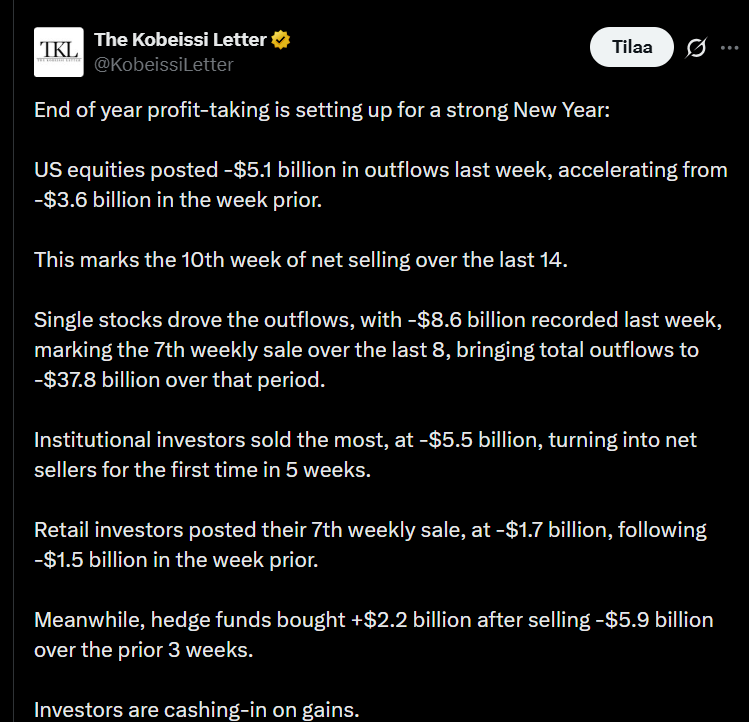
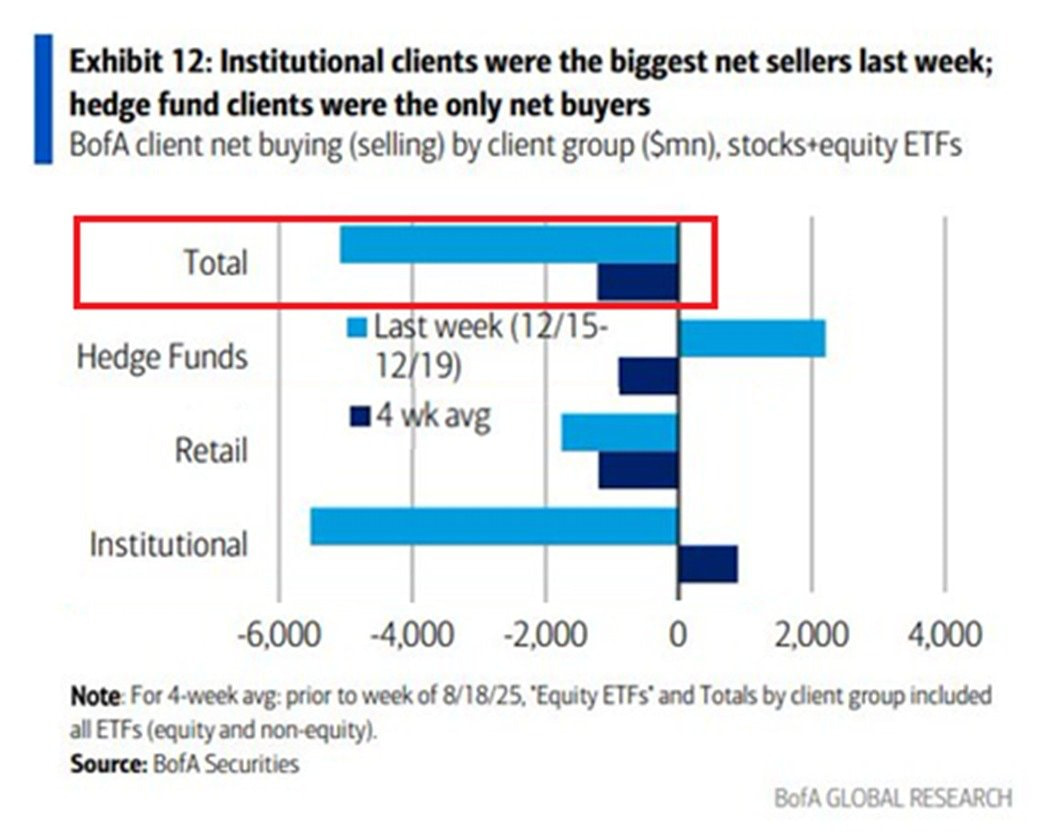
The tweet states that year-end profit-taking is clearly visible, meaning money is flowing out of stocks—especially certain individual stocks.
Institutional and retail investors in particular are selling, while hedge funds are cautiously returning to the buy side.
Wolt first takes about a 30% commission from the restaurant on the price of the food, after which an approximately 5.6% “service fee” is added, and finally, they charge for delivery based on the distance. With Wolt+, you get discounts on delivery, but at the same time, loyal customers are locked in with a monthly fee.
One must also remember that not all orders are these 15-euro single orders. Every day, orders for 10–20 pizzas/burgers arrive at our office, where Wolt’s share is 50–100 euros and the driver’s share is around five euros.
Wolt stated years ago, even before the latest price increases, that they could operate profitably in a new city within the first year. The organization itself isn’t particularly expensive, after all.
Almanakka has once again written a new post about Charlie Munger and his thoughts.
Legendary investor and Warren Buffett’s long-time business partner Charlie Munger (1924–2023) was known not only for his investment success but also for his profound understanding of the workings of the human mind. Perhaps his most famous speech, The Psychology of Human Misjudgment, lists 25 psychological tendencies that often lead our decision-making astray. While many of these biases—such as envy or herd behavior—are almost exclusively harmful, one tendency stands out as potentially beneficial: the Curiosity Tendency.
Munger noted in his speech that mammals have an innate tendency toward curiosity, but in humans, this trait has developed to a level all its own. But what does this mean in practice, and how can we harness it for our benefit without it leading us astray?
Cybersecurity software for boomers.
The antivirus subscription for the digital devices of my elderly and completely “tech-clueless” parents is about to expire, and it’s time to renew. What would you recommend?
Their use of digital devices is limited to online banking, news sites (like Ilta-Sanomat), and email. Even though both have been using laptops, phones, and tablets for almost 30 years now, their understanding of information technology is on par with the average pig’s understanding of silver spoons.
F-Secure offers antivirus (including scam protection) for €110/year, which is perhaps a bit too expensive. Any experiences with cheaper alternatives?
Yes, for that kind of basic use, I think Windows Defender is enough, and a separate paid antivirus isn’t necessary. It’s already built into Windows.