OP bonuses can continue to be used to pay service fees and insurance premiums. As a new use, owner-customers can now, for example, invest bonuses in funds.
One factor behind the reform is a change in the taxation practice of OP bonuses, which will come into force at the beginning of 2026. OP bonuses will be subject to capital gains tax starting from the beginning of 2026.
– Whereas previously we paid customers a bonus of 0.25 percent, next year we will pay 0.4 percent bonus. With this solution, the impact of capital gains tax can be compensated, and the increase is actually slightly larger than the impact of withholding tax, says Ritakallio.
The bonus accumulation for customers after capital gains tax withholding will be 0.28 percent, instead of the previous 0.25 percent, Ritakallio states.
I’ll continue here. It’s quite a good benefit and beats the old Nordea Premium card in every way, so I immediately submitted an application, and once approved, I can give up Premium.
If bonuses can be invested in a fund in the future, shouldn’t they also be able to be withdrawn, like in the good old days? Now that they are taxable anyway, that should be possible, right? It’s another matter if OP wants to go for this. Of course, there might also be competitive reasons behind it.
In the future, you can get bonuses as cash if you want:
You can get bonuses as cash by transferring them from the bonus account to the current account.
The CEO’s sabbatical shouldn’t be too noticeable in an organization like Inderes, with decentralized decision-making and a flat hierarchy. But I’ve noticed that no one has started the dishwashers anymore and clean coffee cups are threatening to run out.
Oh no, yeah, I know! That’s really unfortunate, it’s happened to me too. Unfortunately, it’s not for my department to handle, but could you please create a ticket about it?
Laugh, love & all that jazz!
Andre, Service Desk.
I can’t bring myself to be too worried. In such a self-organizing organization, there will surely be that person who takes responsibility,

It’s really been one of those work weeks again, that I could come work for you as a coffee maker, even if with the title of CEO.
Coffee had been brewed there by the agile organization, but the dishwasher is naturally impossible without a 6-month training program and a certificate.
The CEO must have said, “you can call if anything important comes up,” so at this point, there’s nothing else to do but pick up the phone.
Thanks for sharing, but that seems to be AI-generated nonsense, as indicated by the warning label.
I listened to it for a moment, and that “significantly” is indeed an understatement. That’s just nonsense. 

Buffett doesn’t predict crashes or bull markets. Nor does he look at dividends.
Yeah, it only took about five seconds to recognize it as AI. Of course, that nonsense doesn’t rule out the possibility of a 40% crash. =P
I wonder if @Verneri_Pulkkinen will soon be found as an AI version on YouTube with some joyful message, e.g., about Finland’s strong economic growth 
Olli Koponen has clearly transitioned in his career from an Inderes analyst to an Inderes critic


In any case, it’s nice to hear Olli’s thoughts on the market even after his analyst career 
It would be worth investing my money into those 3% best special ones, and not, for example, into an Index, where you also get those 97% bad ones. It’s a shame that I don’t know what those 3% are.
On the other hand, it’s worth remembering that an S&P 500 index, for example, doesn’t contain just any random companies, but only less than 1% of the world’s listed companies and ~10% of US-listed companies. A very large portion of all over 50,000 current listed companies in the world (not to mention tens of thousands of former listed companies) are various penny stocks and hopeless cases. If returns are viewed divided by the number of companies, in the denominator of the calculation, every Aerotyne International, Lehto Group, or Pallas Air is as significant as Microsoft or Berkshire Hathaway.
A quantum coder fetching data via API from another provider’s API. At the same time, of course, also developing and running this guy’s trading algorithms with a few percent slice of the profits. I don’t remember when my “bullshit filter” would have alarmed so badly.
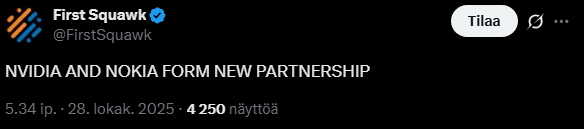
What the hell is happening here in Helsinki. Good luck to Nokia owners
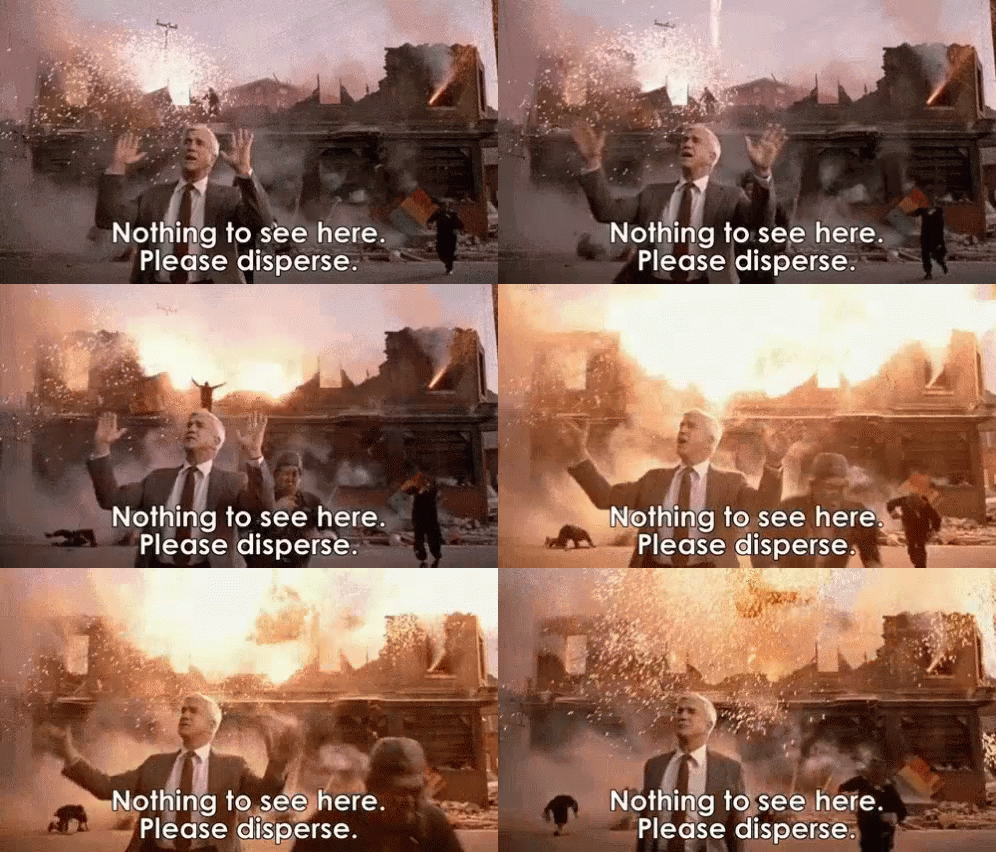
Hell, why can’t Nvidia invest in my crappy small-cap stocks.
T: I sold my own Nokias at 3-year lows in 2023.