IDEXX pops up now and then across various threads on the forum, but no dedicated thread has been opened for this companion animal healthcare company, so let’s remedy the situation. The opening post might ramble a bit and may not be as concise as one might wish, since this has simultaneously served as my own research into the company, and I’ve ended up investigating things in various ways as a result. I’m not a veterinarian or any other kind of industry expert, so I don’t know IDEXX’s products and services any more deeply than what I’ve managed to discover and comprehend by reading their website, reports, and other articles. I hope the text doesn’t contain too many factual errors, but if there are any, I certainly hope they get pointed out.
IDEXX offers diagnostic solutions for small animals, livestock, poultry, dairy, and human medicine, as well as water testing. Most of the company’s focus is on the veterinary side. In its own words, the company’s purpose is to help pets lead longer and fuller lives by giving veterinarians the tools and technology to get the answers they need.

Business Segments
IDEXX divides its business into three segments (plus “Other”):
Companion Animal Group (CAG): CAG provides products and services for companion animal diagnostics as well as practice management systems for veterinary clinics. This segment generated $3,352M in revenue last year, making it by far IDEXX’s largest segment (91.5% of the total). In fact, the rest are currently fairly insignificant in size, and I don’t intend to focus on them much further. The EBIT margin in 2023 was 30.2%.
Water quality products: Within this business, IDEXX provides testing solutions for detecting and testing various microbiological parameters. The main products are the Colilert and Colisure tests, used to detect fecal contamination in water. IDEXX’s tests are used to ensure safe drinking water for up to 2.5 billion people, utilized by water utilities and various laboratories that regularly test drinking water quality. Additionally, the tests are used to check water used in beverage and pharmaceutical production processes, bottled water, wastewater, and private well water, among others. This business generated $168M in revenue last year, with an EBIT margin of 44.2%.
Livestock, Poultry and Dairy (LPD): Tests, services, and instruments for monitoring livestock health and ensuring dairy quality control. Livestock-related tests include those for bovine viral diarrhea, respiratory diseases, and African swine fever. On the dairy side, they offer rapid tests to detect antibiotic residues in milk. Revenue last year was $121M, and the EBIT margin was 8.2%.
Other: Human medical solutions. Revenue last year was $18M, with an EBIT margin of 0.4%.
Below, the intention is to focus more closely on CAG. In its reporting, IDEXX further breaks down this business line as follows (in parentheses: 2023 revenue and share of total CAG revenue):
CAG Diagnostics capital – instruments ($137M / ~4%)
Diagnostic products for veterinary clinics, for example for analyzing blood, urine, and hematology. Blood and urine analyzers assess the concentrations of certain enzymes and other components, helping to monitor the animal’s progress and assist in making a diagnosis. Below is an illustrative picture of a chemistry analyzer.

CAG Diagnostics recurring revenue ($2,935M / ~88%)
- IDEXX VetLab consumables ($1,188M / ~35%)
Blood and urine analyzers and their associated processes use various disposable or short-life supplies during analysis, such as reagent kits, test strips, sample tubes, filters, etc. These consumables generate the vast majority of IDEXX’s “VetLab consumables” revenue. In other words, a continually expanding installed instrument base generates one-off revenue from product sales and recurring revenue from consumables. - Rapid assay products ($344M / ~10%)
Single-use rapid tests that can be used standalone or in conjunction with certain analyzers. - Reference laboratory diagnostic and consulting services ($1,278M / 38%)
Alongside consumables, reference lab services form the other major pillar. IDEXX provides laboratory services to veterinary clinics, which ship samples to IDEXX; IDEXX can usually deliver test results the same day or the day after receiving the samples. IDEXX’s laboratories can naturally perform all the tests carried out in veterinary clinics, plus a range of more specialized tests. There are around 80 labs in total, with just over 50 located in the US. - CAG Diagnostics services and accessories ($124M / ~4%)
Services and accessories related to the installed instrument base.
Veterinary software, services and diagnostic imaging systems ($279M / ~8%)
- Recurring revenue ($214M / ~6%)
- Systems and hardware ($64M / ~2%)
Veterinary Software and Services & Diagnostic Imaging Systems includes clinic practice management software through which veterinarians manage their core processes: patient records, scheduling, client communication, billing, and inventory management—standard ERP stuff. Standouts include the cloud-based ezyVet and IDEXX Neo; as I understand it, the former offers everything imaginable for larger clinics, while the latter is a more stripped-down version for smaller practices. Diagnostic Imaging systems, on the other hand, provides X-ray/radiology solutions.
Financial Figures
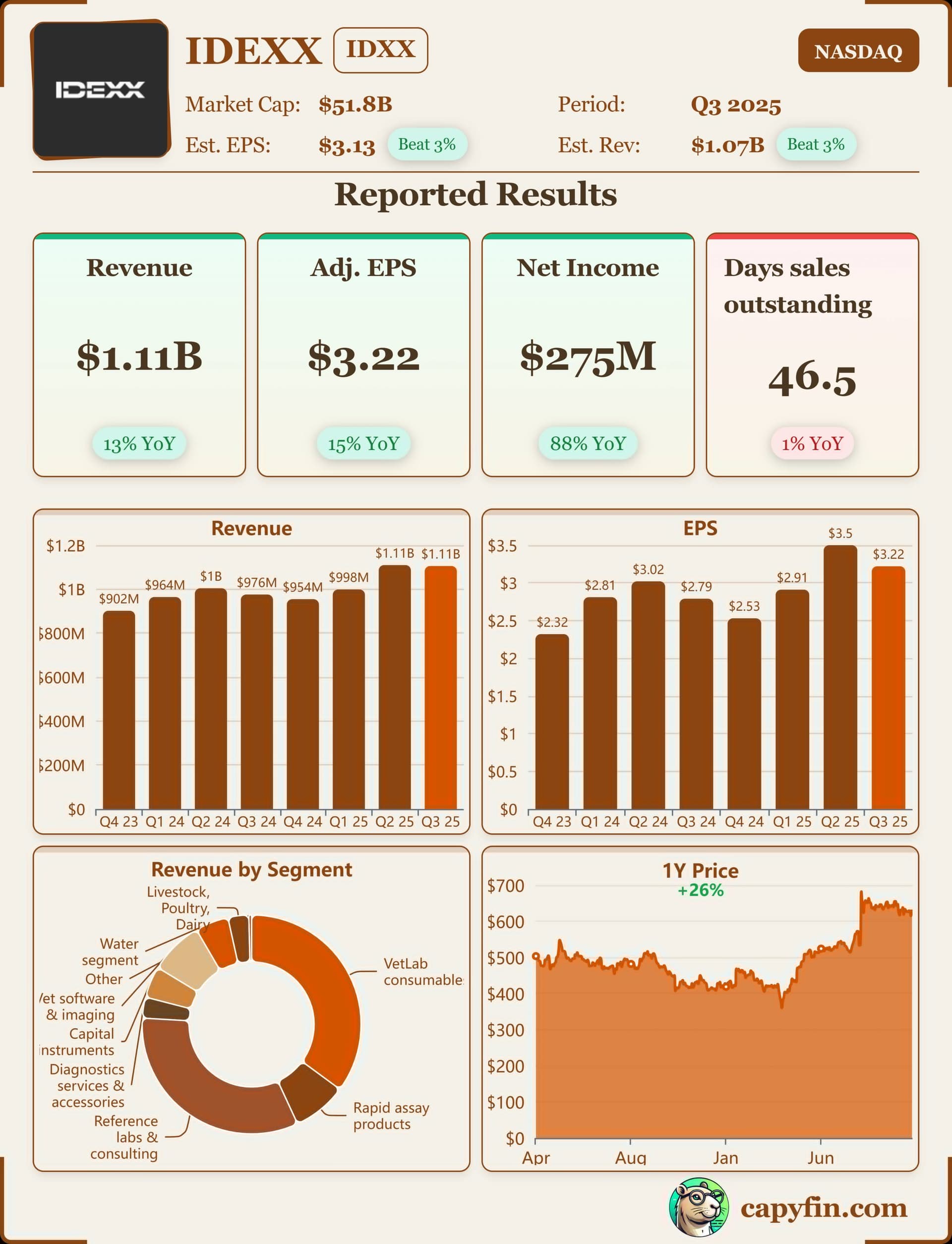
The revenue history is remarkably serene; few companies see sales climb year after year with such consistency. From 2010 through Q2 2024, TTM revenue has grown at 8.8% annually. EPS hasn’t grown quite as smoothly, but its annual growth over the same period is even more impressive at 15.9%.


The installed instrument base has grown in recent years, generating both one-off and recurring revenue.

In 2023, approximately 65% of IDEXX’s revenue came from the US, with the remainder from international markets. Whether this indicates that there’s still plenty of growth runway worldwide or that expanding outside the US isn’t quite so easy is up for debate. Tellingly, after the US, the second-largest individual market is Canada (with Germany pretty much neck and neck), accounting for only ~4% of IDEXX’s revenue. International growth has been slower over both the last three years and the last 10 years:
Year: US growth % vs. International growth %
2023: 9.5% vs. 7.6%
2022: 8.5% vs. 5.5%
2021: 16.9% vs. 15.5%
Below is a summary of the three main regions, their revenue in 2013 and 2023, and annual growth over that timeframe:
Americas: $899M → $2,625M = 11.3% CAGR
Europe, Middle East and Africa: $326M → $716M = 8.2% CAGR
Asia Pacific Region: $151M → $319M = 7.8% CAGR
One might prefer it to be the other way around, because at the current pace, the significance of the US market will only become more pronounced.
A few other highlights from the financial figures: GM% ~60% and EBIT% ~30%. The business is capital-light; over the past five years, depreciation as a share of operating cash flow (assuming depreciation roughly equals maintenance capex) has averaged 16%, and free cash flow generation has averaged 17% of revenue. The company carries relatively little debt (Debt/EBITDA = 0.82), and return on invested capital is around 30%. Based on the numbers, the company appears to possess strong competitive advantages. Free cash flow is partially reinvested back into the business, but most is returned to shareholders through share buybacks. The company has never paid a dividend. According to the annual report, buyback amounts depend on other capital expenditure needs, share price levels, and interest rates. Who knows what management’s own view of fair value is. One has to be cautious with buybacks now that the valuation is fairly elevated. Buybacks also offset dilution from share-based incentive programs, which accounted for 1.6% of revenue in 2023.
Market
IDEXX’s business is supported by a growing and aging pet population. Furthermore, pets are living longer on average, and owners’ expectations for the care their pets receive are rising. The strengthening human-animal bond certainly plays a big role here; according to IDEXX, a significant portion of pet owners are willing to cut back on their own personal expenses rather than on costs related to their pet’s health.
In the company’s view, there is still plenty of market share up for grabs in the future. The image below is from IDEXX’s 2024 Investor Day. Of course, one should always take this Investor Day hype with a grain of salt, but I do believe the market will continue to grow at a healthy clip. With birth rates declining, at least across developed countries, we will likely see a steady increase in pet owners going forward (my own guess), and more resources will be invested in their well-being.

At the Investor Day, there was also an interesting slide showing how the volume of blood tests relative to vet visits has increased over the last ~15 years, and how diagnostics has been the fastest-growing revenue stream for veterinary clinics.


Strategy
I found it a bit difficult to pin down a concise summary of the strategy, but as I understand it, the core pillars are as follows:
Innovation: IDEXX invests heavily in R&D to advance both existing and new diagnostic platforms. A prime example is lymphoma screening, set for commercial launch in 2025. IDEXX aims to anticipate market needs and engineer intuitive, straightforward solutions for them.
Customer Focus: Driving customer productivity, engagement, education, and sharing domain expertise. Through partnership and engagement, the goal is to forge enduring, mutually beneficial relationships.
Purposeful Integration: Integrating diagnostic solutions, data, and software to simplify and streamline workflows.
Geographic Expansion: As mentioned, there should be significant growth opportunities, assuming IDEXX holds competitive advantages in technology, turnaround times, and its overall ability to help clients grow their practices.
Management Team
The management team includes several members who stepped into their current roles this year, but on the other hand, many have a long tenure at IDEXX. It seems IDEXX has succeeded well in developing executive talent from within, which is always positive. Additionally, several executives have significant share ownership in the company. Naturally, I don’t know what portion of their total net worth their IDEXX holdings represent, but the CEO’s large stake in particular inspires confidence that management’s interests are aligned with shareholders. I couldn’t find ownership data for every executive.
| Position | Name | Started in role / at IDEXX | IDEXX shares owned |
|---|---|---|---|
| CEO | Jay Mazelsky | 2019 / 2012 | 81,733 |
| CFO | Brian P. McKeon | 2014 / 2014 | 30,932 |
| General Counsel and Corporate Secretary | Sharon E. Underberg | 2021 / 2019 | 5,112 |
| CTO | Martin Smith | 2021 / 2021 | 510 |
| General Manager, Point of Care Diagnostics and Telemedicine | Mike Erickson | 2024 / 2011 | 10,657 |
| Strategy, Sector Development, and Global Operations | Tina Hunt | 2023 / 2006 | ? |
| CHRO | Michael P. Johnson | 2024 / 2022 | 183 |
| General Manager, Reference Laboratories and Information Technology | Michael Lane | 2020 / 1997 | 6,443 |
| General Manager, Veterinary Software and Services, Corporate Accounts and Customer Experience | Michael Schreck | 2024 / 2020 | 913 |
| CRO | George J. Fennell | 2024 / 2011 | 6,920 |
| Commercial Finance and Sales Operations | Jeffery D. Chadbourne | 2024 / 2011 | ? |
| Corporate and CAG Finance | Andrew Emerson | 2024 / 2015 | ? |
| Global Operations | John Hart | 2017 / 2008 | ? |
| CIO | Ken Grady | 2016 / 2014 | ? |
| General Manager, Reference Laboratories | Dan Janson | 2020 / 2016 | ? |
| Research and Development | Murthy Yerramilli | 2020 / 1997 | ? |
Competitors
In companion animal diagnostics, IDEXX competes primarily against the following companies and their subsidiaries. Unfortunately, Mars is not a publicly traded company, making comparisons somewhat tricky (e.g., regarding revenue). However, Antech (with its subsidiaries) and Zoetis appear to be the main competitors on a global scale. Outside North America, the market is presumably more fragmented.
- Mars Inc.: Beyond chocolate bars, this company competes fiercely in pet food and pet health; under the Mars Petcare division, you’ll find a few of IDEXX’s primary competitors. As I understand it, most of Petcare’s revenue comes from pet food (?), while diagnostics’ exact share remains a bit unclear.
- Antech Diagnostics: In 2017, Mars acquired Antech Diagnostics, which according to its website boasts the largest reference laboratory network in North America, with over 70 laboratories across the US (compared to IDEXX’s 50+). In Europe, Antech has over 20 labs, with 2 in the UK and 2 in Asia. The scale of Antech’s laboratory operations is further illustrated by the following:
- Over 17,000 customers globally, operating across more than 1,000 cities (IDEXX states that its 80+ labs serve over 50,000 veterinary clinics, meaning IDEXX’s labs are significantly larger on average despite fewer locations?)
- An average of 50,000 samples analyzed per day
- Heska: In 2023, Mars acquired Heska, which focuses on point-of-care diagnostic instruments in the very same market segment as IDEXX. On Antech’s website, this portfolio is promoted as the “Most comprehensive in‑clinic diagnostics portfolio on the market.”
- Asia Veterinary Diagnostics: Offers diagnostic solutions primarily in Hong Kong and Singapore, with recent expansions into Malaysia and the rest of Southeast Asia.
- Scil: A German diagnostic instrument company operating in Germany, France, Italy, Spain, and Malaysia.
- Antech Diagnostics: In 2017, Mars acquired Antech Diagnostics, which according to its website boasts the largest reference laboratory network in North America, with over 70 laboratories across the US (compared to IDEXX’s 50+). In Europe, Antech has over 20 labs, with 2 in the UK and 2 in Asia. The scale of Antech’s laboratory operations is further illustrated by the following:
Mars also owns many other brands directly and through subsidiaries, though I can’t speak to their significance.
- Zoetis: Zoetis’s main source of revenue lies elsewhere, rather than in IDEXX’s core domain. Zoetis draws the bulk of its revenue from parasiticides, vaccines, dermatology products, etc. Animal diagnostics accounts for only 4% of its revenue, but given its larger overall scale, that still amounts to $376M. It competes with IDEXX at least through its subsidiary, Abaxis Inc.
- Fujifilm Holdings Corporation: The primary focus of Fujifilm’s Healthcare segment is human diagnostics, but it also offers veterinary solutions.
- Arkray: A Japanese company offering urine analyzers and rapid tests.
- BioNote: A pure-play animal health diagnostics company. Seems to operate exclusively in the US.
- Samsung Electronics
- Mindray
A Seeking Alpha article from a few years ago states that IDEXX held a 60%+ market share in veterinary diagnostic instruments, Zoetis (via Abaxis) 30%, and Heska 6–9%. On the reference lab side, IDEXX and Antech Diagnostics effectively form a duopoly in the US market.
In water, livestock, and dairy testing, IDEXX competes with both small niche players and multi-billion-dollar corporations. On the software side, the largest competitor is Covetrus, alongside a wide array of smaller, specialized players.
Competitive Advantages
According to IDEXX, key factors in diagnostic products include testing speed, diagnostic accuracy, product quality, breadth of the portfolio, integratable technologies, pricing, and access to medical consultation. Pretty self-evident stuff.
Switching Costs: According to the Seeking Alpha article cited above, IDEXX analyzers can only run IDEXX’s proprietary consumables (referring primarily to reagent kits). Once a customer adopts IDEXX analyzers, recurring revenue scales through consumables, and that dynamic only really changes if the clinic eventually switches out the equipment for a competitor’s. Keep in mind that instrument sales themselves are far less significant to IDEXX than consumables sales. I would assume IDEXX’s competitors enjoy the same dynamic. Switching costs also manifest clearly on the software side.
Patents: IDEXX holds key patents in areas including:
- “Catalyst consumables”, where patents began expiring in 2020 and run through 2035. The Catalyst family represents IDEXX’s most comprehensive installed base, so consumables tied to it are likely massive revenue drivers; these patents should protect against third-party alternatives.
- “Catalyst instruments”, with patents starting to expire in 2026 and running through 2032.
- Reagents and methods for detecting pancreatic lipase in dogs. Patent expires in 2026.
- Reagents and methods for testing renal function, with patents starting to expire in 2029 and running through 2037.
Cost Advantage: IDEXX and Antech Diagnostics operate the most extensive reference lab networks globally, giving them a distinct cost advantage stemming from economies of scale, particularly in the United States.
Barriers to Entry: Patents, decades of R&D, peer-reviewed studies backing product precision and reliability, brand equity, and accumulated domain knowledge combined with client trust create formidable barriers to entry—or at least barriers to succeeding in the space.
In the charts below, IDEXX highlights that clinics partnering with them grow faster than peers. The sample size appears robust enough for statistical analysis, but does it meet the criteria for a random sample, and more importantly, does it reflect correlation or causation? The NPS charts shared by IDEXX are also flattering, though they lack scale axes. So I’d take these charts with a grain of salt, but IDEXX clearly believes their competitive advantages are reflected in these outcomes.


Risks
A growing market offering attractive returns on capital naturally invites competition, and this dynamic is unlikely to ease going forward. Consolidation among both competitors and clients could pressure margins due to weakening pricing power. The veterinary clinic landscape is consolidating rapidly, with competitor Mars Petcare being a major driver (whose brands include Mars Veterinary Health, Banfield Pet Hospital, BluePearl, and VCA). Clinics snapped up by Mars will presumably transition toward using Mars-owned lab services (Antech) and diagnostic instruments (Heska, Asia Veterinary Diagnostics, Scil, etc.). How will IDEXX counter this, and what is the long-term impact on its operations?
And how might the regulatory framework evolve? Granted, the veterinary sector faces a lighter burden than human pharma. However, the most prominent risk is likely whether IDEXX can sustain product and service innovation to ensure they add differentiated value and stay ahead of the pack. A technological lead is often the flimsiest possible moat. Then again, IDEXX is backed by its sheer scale; few competitors have the balance sheet to match its R&D budget.
For this year, IDEXX recorded a $62M one-time litigation charge related to an ongoing legal dispute. This involves a contract dispute alleging that the company underpaid royalties between 2004 and 2017 under an expired patent licensing agreement. IDEXX had originally accrued $27.5M, but increased the provision by $61.5M, bringing total exposure to $89M. I am not familiar with the background beyond this; whether this is the only pending litigation remains to be seen.
Valuation
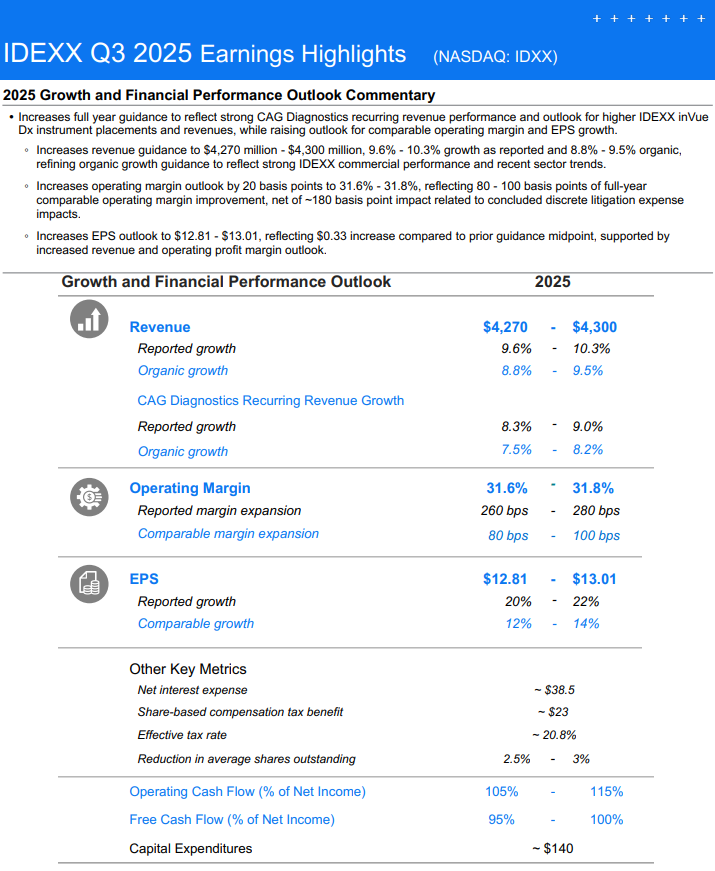
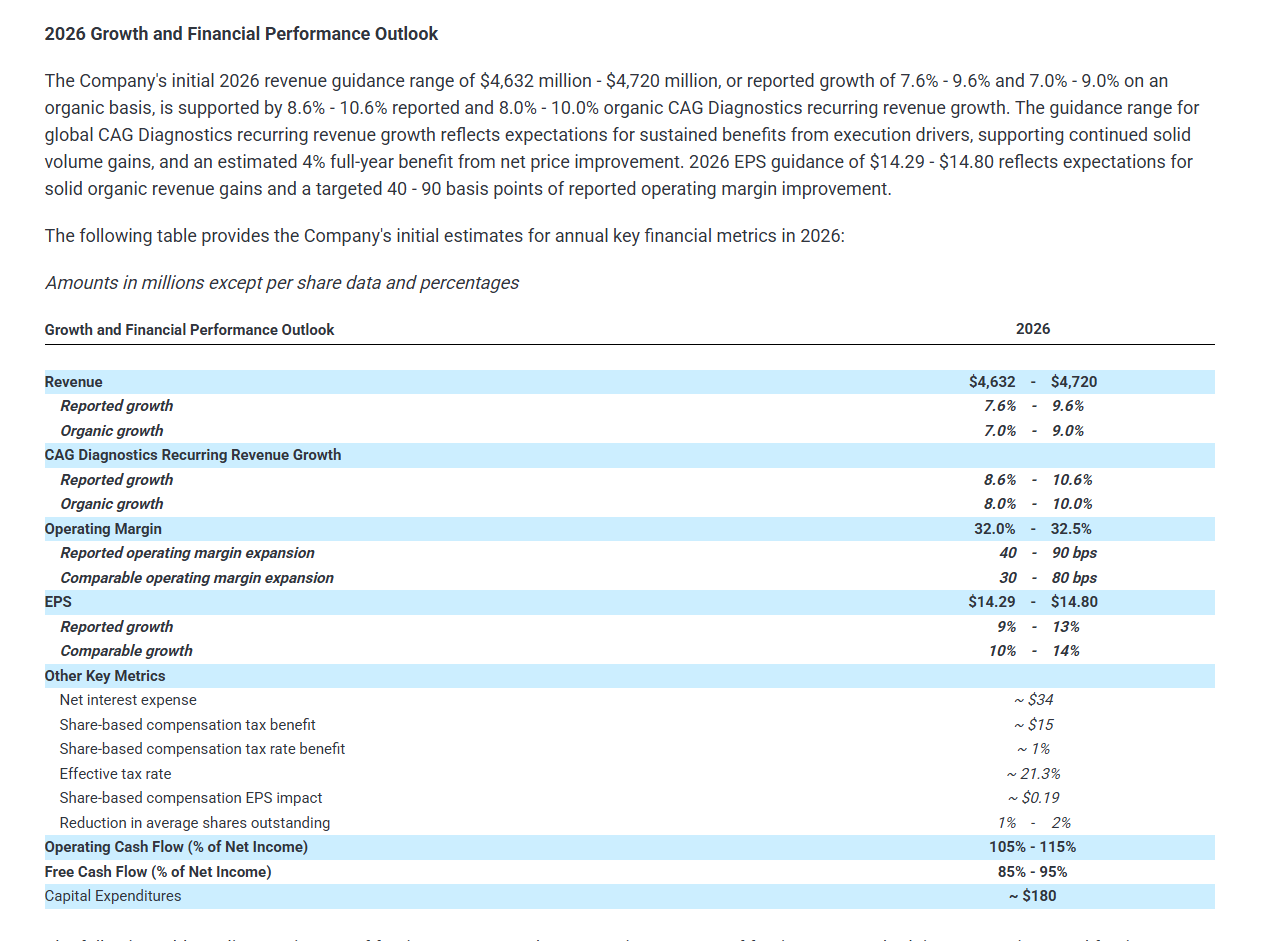
Currently, TTM P/E and P/FCF are hovering around 45, which means a lot of future growth is already baked into the price. Below are consensus estimates for the next few years from Stock Analysis.

The P/E multiple began an aggressive expansion around 2014 and has stayed elevated for the past seven years, meaning buying opportunities at a 30x P/E may be a thing of the past unless the business suffers a major operational deterioration. Relative to the past five years, the stock could even be deemed cheap or reasonably priced. Delivering double-digit annual shareholder returns from here would certainly require exceptional growth to persist.

One reason for multiple expansion is, of course, the steady margin expansion IDEXX manages to generate, implying significant pricing/bargaining power over clients and/or suppliers, along with some degree of operating leverage.

Questions
To wrap things up, here is a stream of consciousness in the form of open questions:
What are other forum members’ thoughts on IDEXX? Personally, I don’t typically care much about the ESG/ethical angle of an investment, yet IDEXX still gives me a warm feeling—despite being a massive corporation—simply because its products advance animal welfare.
How durable are IDEXX’s competitive moats? What are your views on market growth, and specifically on IDEXX’s ability to accelerate international expansion? Will the big players continue acquiring smaller ones at an accelerating pace? The consolidation trend across veterinary practices is a particularly fascinating aspect to follow.
What operational metrics do you track most closely for IDEXX? What risks should keep an investor up at night? Does anyone here currently hold IDEXX in their portfolio? Can it still beat the S&P 500 over the long run or deliver double-digit annual returns, or has the valuation simply stretched too far?
I suspect there might be a few veterinarians on the forum as well, so I’d love to hear whether you’re familiar with IDEXX’s solutions and your impressions of IDEXX—either standalone or relative to the competition.
I have to say in closing: writing this up was a blast, and I learned an enormous amount about a company I’ve been watching for several months. I hope this sparks some lively discussion on the board!
 En tiedä, miten paljon tämä video antaa paljon yhtiötä seuranneelle, mutta itselleni tämä oli ihan ok video, kun yhtiö ei ole sillä tavalla tuttu.