Financial sector as an investment

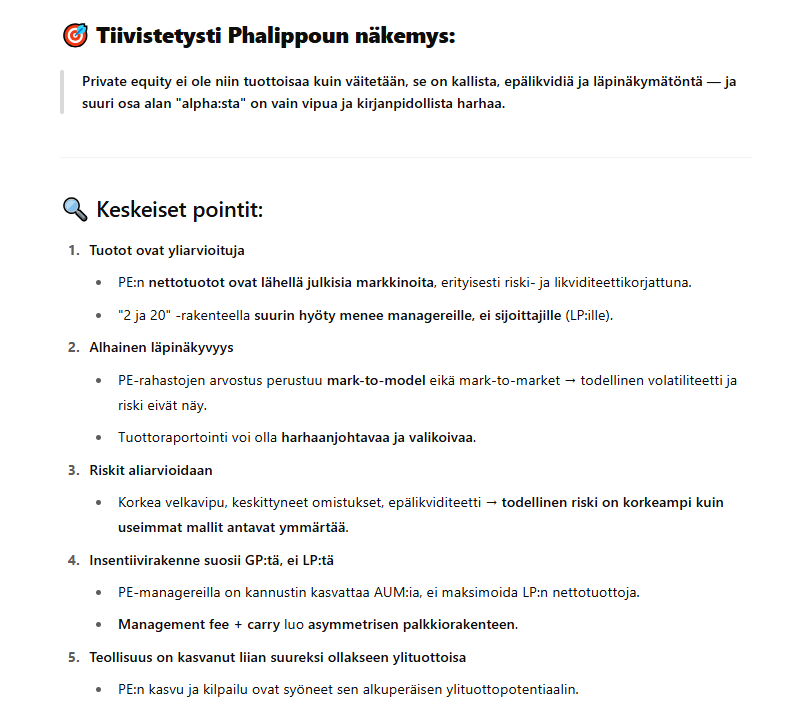
Video recommendation for the weekend! Oxford professor Ludovic Phalippou is probably the world’s toughest Private Equity critic. I myself read/listened to a lot of his materials during my sabbatical, and this also increased my own skepticism towards the entire industry.

Here’s a short ChatGPT summary of his views:
image

If PE and its problems interest you, then this 42-min video is really good: https://www.youtube.com/watch?v=YJNczVewjTI

For sports fans, a little teaser: around the 25-min mark, it discusses what kind of owners PE firms are for sports clubs (this has been a growing trend in recent years) and whether sports clubs can be good investments :soccer: :football: :ice_hockey:

35 Likes

S-Pankki is the first fund management company to provide information on redemption developments for H2’24. S-Pankki’s fund redemption calendar does not follow the typical rhythm (1.4/1.7/1.10/1.1), but for example, the current redemption period in question is: 30.8.2024-28.2.2025. What’s interesting here is that S-Pankki Asunto is the first to report how the intensified media coverage in early this year has affected redemptions (the worst period was January-February this year).

According to S-Pankki, redemptions totaling approximately EUR 50 million were submitted, which is somewhat more than in previous redemption windows (~EUR 40 million). Although the number of redemptions has increased from before, no major surge in redemptions has been observed, which is positive for the industry. I note that S-Pankki also employs a method in the fund that I find highly questionable, namely that redemptions always lapse to the extent that they are not paid immediately.

Redemption restriction means that a redemption order given by a unit holder lapses to the extent that the amount to be redeemed exceeds 3,000 euros. Lapsed redemption orders do not automatically transfer to the next redemption window; instead, the unit holder must, if desired, submit a new redemption order for the fund’s redemption window ending on August 29, 2025, before 4:00 PM.

I have not personally seen a similar method used by others. Considering that customers are mainly private individuals, there is a clear risk that the customer may not remember/understand to make a new redemption, especially within the correct redemption window. For the manager, this is of course a good thing, as redemption pressure eases, but in my opinion, it’s a rather questionable method. It remains to be seen whether this practice will become widespread in the industry. I hope not, but I wouldn’t be surprised if other players also saw the “brilliance” of this reset from a manager’s perspective.

Here is the full press release:
https://www.s-pankki.fi/fi/tiedotteet/2025/s-pankki-asunto-erikoissijoitusrahaston-lunastuksia-rajoitetaan-osuudenomistajien-ja-rahaston-etujen-turvaamiseksi2/

31 Likes

When will we ever see equity funds where the fund manager determines the fair value of shares other than at market prices and refuses redemptions as long as the value is below it?

12 Likes

This might not be entirely comparable, however. Real estate is simply not a liquid asset like a stock or a bond; there is no unambiguous market price.

If it were mandatory, without any consideration, to always record the value absolutely at the price someone is genuinely willing to buy the property in question, it would be quite easy to end up in a situation where the portfolio’s value is zero when the market crashes. And often there wouldn’t even be that zero price, as there simply wouldn’t be any buyers at any price. In addition, real estate usually has a debt component, and in a crisis situation, the only buyers (if any) are opportunistic vultures. It’s hard to see how it would genuinely be in the investor’s interest for funds not to publish any price or for redemptions to be carried out at a zero price.

It always comes back to this: an illiquid asset simply doesn’t become liquid, no matter what kind of structure is built around it. And the investor must understand this when making an investment.

3 Likes

Agreed, if it’s a real crisis (corona, financial crisis, etc.). However, if the fund was set up 18 months ago, is it a crisis or a normal market situation after the zero-interest rate craze? If for 18 months you say that the market price is wrong and you only sell when the price is right, then when does this turn into speculation with the client’s money?

Indeed, transactions are being made there, as Kojamo’s PE transaction shows. The fact is that real estate funds significantly slow down market recovery. This is because all buyers know that a lot of properties will be coming up for sale at some point.

I also want to emphasize the often-forgotten fact here that for managers, playing for time is a very smart strategy in many situations. Clients can cancel redemptions, and the longer time passes, the higher the probability of redemptions being canceled.

21 Likes

Indeed. Temporarily, it may well be that there is no price, or that the price is unrealistically low due to a crisis, but in the long run, that is no longer an explanation; the facts should be acknowledged. Still, even in a good market, it’s difficult to say what the “correct market price” is for an individual property. If a neighboring property was sold for price X, does that tell us anything about the one we own?

By the way, there seems to be a difference in the speed of price reaction between Finland and other Nordic countries, probably more broadly. In Finland, appraisers reportedly typically record values (both up and down) more slowly, only after data from completed transactions becomes available. And if no transactions are made during a crisis, then…

Elsewhere, appraisers are more inclined to also consider calculated values, even if no transactions are made. And on the other hand, there might be more transactions when the market is deeper.

3 Likes

If necessary, markets will find a price for anything traded. For tulips, internet portals, useless radio frequencies, virtual currencies… But is this market price always or even generally the only and so-called “correct” price, as the majority of writers on this forum believe?

From an economic theoretical perspective, the only “correct” price is future cash flows discounted to the present. And yes, calculating it is almost always impossible. But that doesn’t change the fact that it is good and profitable to strive for it in various valuation situations.

There isn’t one universal market. There are numerous different markets, with different phenomena and market mechanisms. All markets also have noise and stress, which can make price formation in the markets very absurd.

Typical phenomena in real estate markets include construction costs, buildings are not typically subject to speculative or short-term trading, trading usually requires separate financing, transaction prices are high, and properties also have end-uses such as residential use…

It is, I would say, simplistic to believe and assume that even real estate markets and listed stock markets are anywhere near identical. That price formation and trading in real estate markets should function like in listed stock markets. A property should be able to be sold or bought every second at the so-called market price. And when real estate markets operate at a slower pace and with different boundary conditions, the real estate market would therefore be somehow less suitable or worse than the listed stock market. And wrong.

After a market disruption, real estate markets follow their own course. Trading volume and prices are determined within the laws of real estate markets. After major interest rate shocks, etc., the stabilization of real estate markets and the increase in trading volumes have, to my understanding, usually taken years. At least as long as there is significant movement in interest rates, one can hardly speak of a stable real estate market where price formation would be easy and straightforward.
4 Likes

It is good to distinguish between a temporary short-term situation and a situation where people’s money is held by someone else for years without access to the funds, and they even have to pay for that pleasure.

1 Like

In my opinion, the situation where the money is tied up indefinitely is a much better option than realizing it at a terrible price or losing it entirely. Your frustration with this issue has certainly become very clear, so my sympathy is probably in order. However, you can comfort yourself with the fact that nothing has been lost; we are just waiting for better times. :slight_smile:

I believe that those who eventually buy them will certainly have the patience to wait for financial supervision or some court to determine that it’s no longer a “temporary” situation, and then they’ll go for cheap.

So now the inevitable is just being delayed completely unnecessarily, and it’s not being done with the customers’ best interests in mind.

1 Like

Less liquid investments (Samla Hotels, Samla Asunnot, Samla Business Premises II) received a valuation update, with the write-down of Hotel Maria…

Samla Capital writes down the holdings and investments of the funds it manages, related to The Hotel Maria located in Kruununhaka, Helsinki. The hotel was completed in summer 2024 and has been chosen numerous times among the world’s best new hotels. Samla Capital is no longer involved in the operational activities of the hotel or the real estate company.

In addition to Samla Hotels Ky, the write-downs of Samla Capital’s funds affected the alternative funds named Samla Asunnot Ky and Samla Toimitilat II Ky, which were the original owners of the real estate development project.

“The write-downs are being made now so that any impairment of investments related to a potential sale of the hotel will no longer affect the funds’ financial results at a later stage. Regardless of the hotel’s future, we are focused on ensuring the profitable business operations of our residential and business premises funds with other properties in their portfolios,” says Samppa Lajunen, CEO of Samla Capital.

Following the write-downs, the value of Samla Asunnot Ky halves from its year-end valuation level to just under 60 percent of the original invested capital. The value of Samla Toimitilat II Ky halves from its year-end valuation to approximately 30 percent of the original invested capital.

“Samla Capital’s funds have suffered from The Hotel Maria’s business starting weaker than expected. As a result of the COVID-19 pandemic and the war in Ukraine, both the tourism and real estate markets have suffered severely. Arrangements made during the project aimed to protect the capital of fund investors in difficult circumstances,” Lajunen states.

Samla Asunnot acquired a residential development project in line with its investment strategy in 2020 in Kruununhaka, Helsinki. The development strategy was changed the following year by a decision of the fund’s investment committee, according to which Samla Asunnot Ky’s direct ownership was converted into a loan investment through the Samla Hotels Ky fund.

“The arrangement was implemented because the hotel property was no longer a residential investment. By decision of the investment committee, Samla Hotels purchased Samla Asunnot’s ownership stake at a market price determined by a third party. A loan investment is more flexible and has a better repayment order than direct ownership,” Lajunen explains.

The market value (GAV) of the funds managed by Samla Capital is 166 million euros after the write-downs.

6 Likes

Is there still anyone who intends to invest in Lajunen’s funds? Significant write-downs in the funds where most clients have their investments. At the same time, trust in Lajunen was lost, and the result might be the end of Samla Capital’s entire story due to one poor decision. Hardly anyone expected that the value of the Toimitilat (Premises) fund is now 30% of the original capital.

7 Likes

Kassun and Salen’s comments have provided an overview of domestic asset managers, particularly regarding their profitability. :slight_smile:

In this review, we have examined the development of profitability for domestic asset managers for the peak year 2021 and the year 2024. Overall, the profitability levels of domestic asset managers have held up very well, and 2024 profitabilities do not significantly deviate from 2021 levels, even though the market situation is undeniably much weaker. The biggest explanatory factor is the growth in assets under management, and all companies’ assets under management have grown since 2021.

We have examined the profitability of the companies’ asset management businesses and have also included group expenses in our calculations. We excluded Aktia and Mandatum from the review, as all necessary data points for their asset management businesses are not available.

1 Like

Good analysis from Sauli and Kasper. Quite a few asset managers rely on real estate sector investments, but open-ended funds unfortunately have their limitations, as we have seen in recent years. The predominantly Swedish listed sector manages to efficiently secure new financing through both equity and debt solutions, and thus can acquire more properties at attractive long-term yield levels. The question is, how can the domestic asset management sector compete with this (if it can at all)? I don’t see a very strong position for domestic listed asset management companies… Will the domestic open-ended fund sector recover from its slump for many years? Another question is related to this fundraising theme: how do domestic companies fare in fundraising if their track record is relatively thin or mediocre? If we compare, for example, CIBUS’s rapid financing solutions (directed share issue/short bond in the 80-100MEUR range), very few companies can raise capital as flexibly…

Evli has set this up

The Evli Private Equity Co-Investment I Fund makes direct minority investments in unlisted companies in Europe and the United States together with leading international private equity firms. A co-investment fund in international unlisted equities with its own specialized team is the first of its kind among Finnish asset management companies.

8 Likes

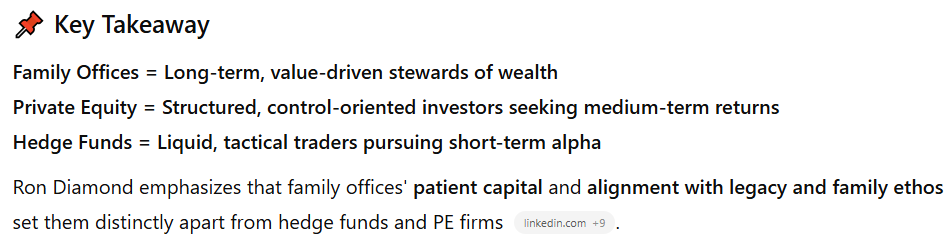
Interesting talk about family offices and their investment world.
https://www.youtube.com/watch?v=J5qxKPBDRqs
ChatGPT summary:

image

1 Like

I wrote a slightly more extensive overview of the happenings in the asset management sector :phone: Even though stock markets are rallying at ATHs, the sentiments are expectant and quite cautious. New sales of alternatives are a challenge across the sector, but on the traditional side, interest-rate products are selling particularly well.

Also, interest in corporate acquisitions seems to be higher behind the scenes than in years :wedding:

The full review :arrow_right: Varainhoitajien alkuvuoden kehityksessä isoja yhtiökohtaisia eroja - Inderes

23 Likes

Samla Capital’s infamous Hotel Maria is becoming a Waldorf Astoria.

It’s clear that this sales operation did not go well for those who invested in Samla’s funds :see_no_evil: Because running such funds for the wealthy is a trust business, it’s impossible to see a bright future for the funds.

20 Likes

Did the publicly reported figures of a good -40% and about -70% relative to the funds’ initial values materialize with the deal, or did they change further?
It’s great, however, that a buyer was found. Hopefully, there’s enough demand. Off-topic for this thread, but what size positions did you have, superg, in these? Just asking out of curiosity, no sarcasm intended :slightly_smiling_face:

I have on several occasions (e.g., in a tagged post) criticized real estate funds’ slowness to realize assets and rely on the hope of a swift market turnaround being just around the corner.

In this KL article, eQ’s portfolio manager articulates the matter exactly as I see it:

”Trading volume is still at a low level, but perhaps we see that this is now the new normal and we must live and operate within it.”

In my opinion, it is clear that by simply looking at the buyers, we can see that the market is not returning to its previous state. Real estate funds were big buyers in the previous cycle; now they will be net sellers for a long time. Pension companies are more on the selling side than the buying side after the pension reform. The housing investment boom for private individuals will have to wait until the next generation. Who will bring us the high volume that all funds are waiting for like the rising moon?

P.S. eQ has realized assets very briskly, which is a clear exception compared to other players in the field.

21 Likes