I broke it down in plain English (for myself as well) to see how Faron’s development pipeline is finally progressing promisingly along several routes. This time focusing on the key points and near-term outlook for BEXAR.
The markets for soft tissue sarcoma and HR-MDS can be comparable in magnitude, (Faron’s R&D and Soft Tissue Sarcoma Market Size, Share & 2031 Growth Trends Report ) meaning the results achievable there are not insignificant. Another similarity is that neither indication has seen a breakthrough in a couple of decades, so the unmet need is high.
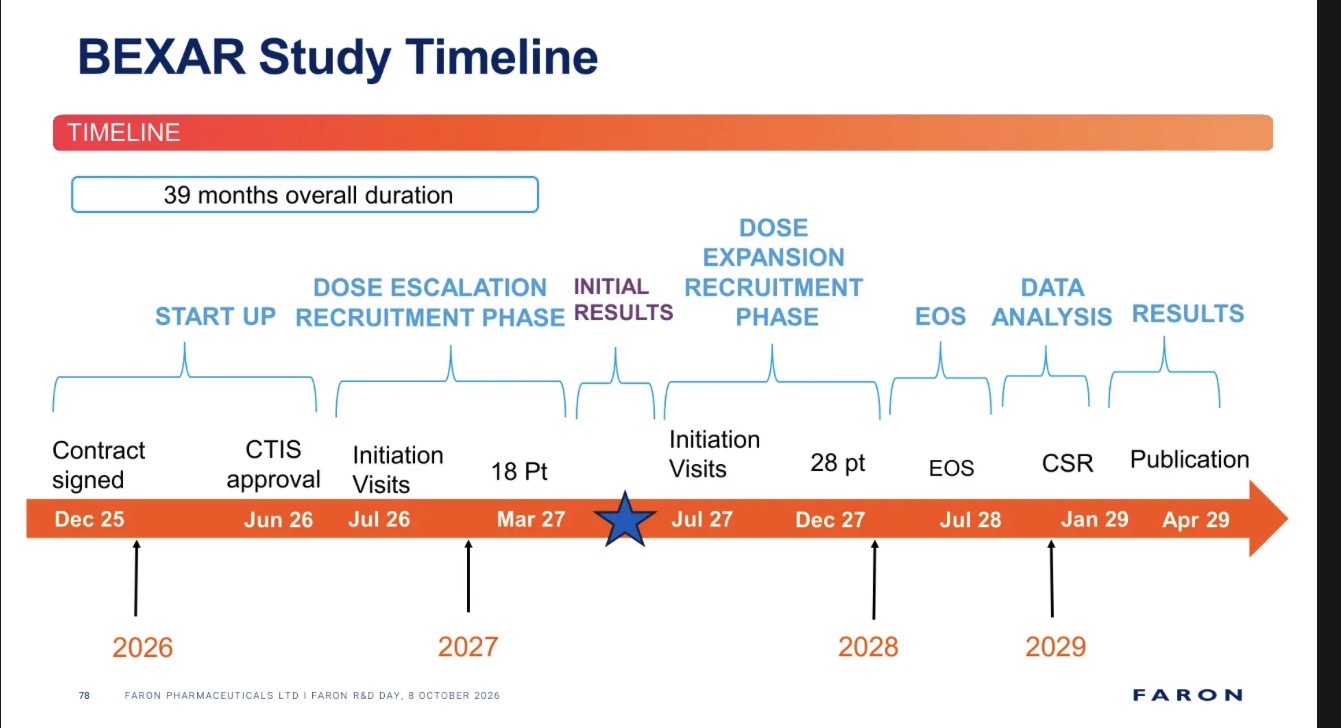
Bex is administered at three different dose levels: 1, 3, and 6 mg/kg during the escalation phase across a total of 18 patients. According to Dr. Serrano, preliminary results are expected in April–May 2027. According to him, Bex’s tolerability is excellent, and they have already dared to escalate the dose to 3 mg/kg, so at least the study did not stall right away due to toxicity. What the maximum tolerated dose will be will become clear in the spring. Safety is therefore the first thing for investors to watch, now that the trial is underway.
The secondary endpoint in Phase 1b is PFS. PFS stands for Progression-Free Survival, meaning it ends at disease progression or death. Specifically, achieving it at the 6-month mark for each patient.
Dr. Serrano:
“If progression-free survival (PFS) is prolonged from 6–8 months to about 12 months (a full year), it is a remarkable achievement for patients whose disease progresses rapidly.”
First-line overall response rates (ORR) are typically 10–15%. According to Serrano, a 25% response rate in Phase 1b would be good. Such results have been achieved with doublet chemotherapy, but its severe adverse effects are a problem, and it did not prolong overall survival. PFS did, however, increase from 4.6 months by 2.8 months in Phase 3.
In Phase 1b, the primary endpoint consists of dose-limiting toxicities and adverse events. Consequently, parameters such as blood counts are monitored in patients. Doxorubicin causes bone marrow suppression, drops blood cell counts, and thereby causes adverse events. Faron’s observations of Bex’s bone-marrow-supporting function will now be tested in solid tumors in addition to the trials in MDS patients. Maija also had laboratory evidence of treating chemotherapy-induced bone marrow suppression with Bex in mice, which Serrano also presented, but the market for treating chemotherapy side effects in healthy mice is rather small. (/s)
What can be expected in the spring? The most important thing is that adverse effects do not prevent progression to the expansion phase, where the two best Bex doses will be administered. If results arrive in April–May, the first patients will have received Bex already 8–9 months earlier, so it remains to be seen for how many patients the 6-month PFS rate can be evaluated preliminarily. We would, of course, need that 12-month PFS evidence, but that won’t happen until late 2027 at the earliest. For the majority of the expansion cohort, it will be in 2028.
In randomized Phase 2 (provided preliminary successes are seen in Phase 1b), PFS will instead be the primary endpoint and thus an essential question for the investment case. As usual, the company’s valuation is driven by phase transition probabilities, market size, and the time value of money discounted into the future. Let’s see what multipliers @Antti_Siltanen uses to outline these in the upcoming report.
Serrano stated that PFS is acceptable for regulatory purposes in sarcomas. Even though BEXAR is an IIT (investigator-initiated trial) and they are responsible for reports and academic disclosures, that does not override Faron’s obligation to issue a stock exchange release should compelling new information emerge and reach Faron. The publication date on the timeline always comes later than the results themselves.
Phase 2 has a pretty decent patient count; if PFS and OS turn out to be significantly better, there would even be cause to discuss preliminary marketing authorization. Naturally, a more global Phase 3 would be required to proceed, and it seems unlikely that Faron would finance that either. And those results would be years away. Someone else could fund it following the same logic as the hope that BEXERA will also be funded based on randomized Phase 2 evidence. Time will tell.