Elisa - In the wake of 5G?

The biggest problem is precisely that, even though Elisa has been a consistent performer for years, this can no longer be relied upon. Competition is intensifying on the consumer side, prices can no longer be raised, and it has already been seen that prices must be lowered if they want to retain their customers. The result will inevitably decrease, but I suspect that something we don’t yet know is also brewing in the background. Perhaps the company lost a major public tender on the corporate side, or the Huawei ban is a bigger problem than expected?

The company has notoriously continuously streamlined its operations, meaning it has practically laid off people annually, but done so on such a small scale that it doesn’t make headlines, but something has changed now. The company has already held 11 change negotiations this year, in addition to this larger layoff. Such a large measure indicates that not everything is in order.

The scale of the change negotiations came as a surprise to [chief shop steward] Kivistö also because Elisa has already held 11 smaller change negotiations this year.

9 Likes

Telia has indeed been improving its performance all the time.

Elisa’s several layoffs and other reputational damages have weakened its performance. How much of this can be attributed to the new CEO? Manner started on 1.3.2024 and a lot has happened since then. During Mattila’s time, my trust in the company was higher.

12 Likes

I’m quoting this old message of mine, and last spring, the chairman of the board also changed, as did one other long-term member. After Mattila’s long tenure, there is a great danger that the successor is not as competent and brings their own ways of working, Elisa’s workplace culture was highly praised during Mattila’s term, what is the situation now, as change negotiations are constantly being held. At least customer service representatives are now forced to push even unwilling customers into one-year fixed-term contracts, whereas two-year contracts were popular before. It’s really difficult to assess now whether the competitive situation has truly changed radically immediately after Mattila’s departure, or whether the new broom and its team have brought undesirable traits into Elisa’s leadership culture, and what is the new chairman of the board’s competence to intervene in matters, having only been in the position for a short time!?

11 Likes

One option is probably also paying dividends partly with cheap debt. Not sustainable in the long run, but probably not a problem for Elisa in individual years.

I myself sold my Elisa shares soon after I had to temporarily switch from the joint network to Elisa’s customer and was surprised how poor Elisa’s coverage was in a few places compared to the Joint Network.

Now the share price has come down so much that it could be acceptable for my portfolio even if the dividend were cut slightly.

9 Likes

Thanks, that’s an important addition. I was indeed thinking about the possibility of a loan, but I wrote about the matter too narrowly, only mentioning balance sheet unwinding.

4 Likes

https://www.inderes.fi/releases/elisa-oyj-elisa-ilmoitus-johtohenkiloiden-liiketoimista-kristian-pullola

The CFO bought the dip.

45 Likes

Elisa’s spearhead in the software business is the radio network analytics/optimization software offered to other operators. As I understand it, a truly competitive product/service. They have invested significantly in this, on their own scale, and if successful, it should scale nicely.

I was left wondering what would happen to this business if Nvidia also built a similar cooperation with Ericsson as it has with Nokia…?

10 Likes

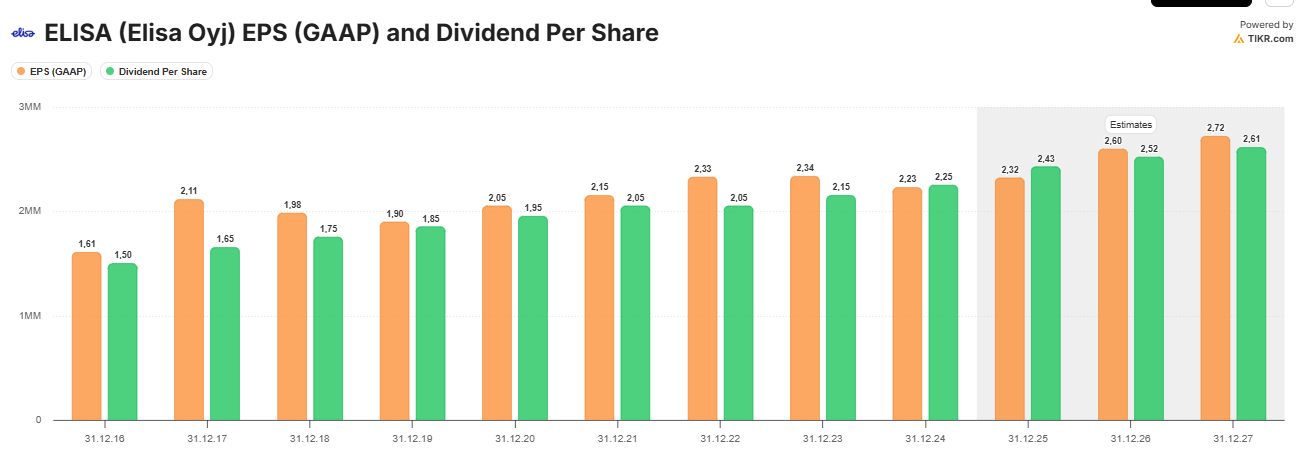
The market indeed seems to be pricing in a dividend cut. The dividend payout ratio has already been over 100%, which is not healthy.

I have been considering adding more, but I would like a bit more safety margin. I don’t expect Elisa to grow much.

2 Likes

This spring it was indeed slightly over 100%, when EPS was 2.34 and the dividend 2.35, I hadn’t even remembered that. That is undeniably an unhealthy situation and makes one wonder with even greater reason why the dividend was raised so much for this year, when less would have been enough to continue the streak of increases. But previously the payout ratio has been slightly lower, and it will continue to be so according to Inderes’ forecasts. On the other hand, the stock price has fallen so low that the dividend yield percentage is already quite high in absolute terms, even if the dividend were to stagnate or even slightly decrease in the coming years. I myself am holding onto my Elisa ownership (approx. 3% of the portfolio) with peace of mind.

2 Likes

For at least ten years, Elisa has distributed almost all of its profit as dividends. Normally, this would be concerning, but Elisa manages to do this without getting heavily indebted. What is Elisa’s secret?

9 Likes

Elisa reduced its investments in Q3. If it continues the same, it will be able to distribute a larger dividend than its earnings without taking on additional debt.

Competition still seems quite fierce. I would estimate that the current price level in the consumer segment will reduce Elisa’s EBITDA by approximately 1% (\~6M€) over the next 12 months per month of intensifying competition. The benefit of the co-determination negotiations could thus melt away in just over half a year if one assumes they have no significant adverse effects.

7 Likes

A couple of news items today, unfortunately this one seems to be behind a paywall: Telia pakkosiirtää asiakkaita 5g-liittymiin – laskut kasvavat | HS.fi

A couple of quotes can probably be taken:

Telecom operator Telia is automatically changing the 4G subscriptions of tens of thousands of its customers to more expensive 5G subscriptions.

Telia has informed its customers that it is discontinuing its Telia Rajaton 4G 200 M subscription and upgrading it to similar 5G subscriptions. This particular subscription has been one of Telia’s most popular subscriptions, with well over a hundred thousand customers.

The change began in January of the current year, and it is expected to continue into next year as fixed-term subscription agreements expire or campaign periods, referred to as promotional price periods for indefinite-term agreements, come to an end.

According to the HS article, the promotional price for the subscription would increase from 24 euros to 30 euros, and the Finnish Competition and Consumer Authority has not yet taken a stance on such a significant price increase in fixed-term contracts.

And the final comment from the Consumer Union’s lawyer: “When a fixed-term contract ends, the easiest thing to do is to see what other operators offer,” says Niemi.

So competition is indeed fierce, and it has been short-lived joy for those who switched to Telia hoping for lower prices, meaning there might be some returning customers to Elisa.

Another news item from Kauppalehti, the announcement came shortly after the stock exchange closed. In the closing auction, a significant number of shares changed hands for 0.14 euros cheaper than at the end of normal trading. Perhaps @Joni_Gronqvist can say whether these terms are good or bad compared to Elisa’s previous loan portfolio; it has always been said that Elisa gets loans exceptionally cheaply: Elisa Oyj: Elisa korottaa 200 miljoonalla eurolla vuonna 2030 erääntyvää joukkovelkakirjalainaa | Kauppalehti

The issue yield of the EUR 200 million bond tap is the interest rate swap reference rate of 2.380% + 0.68%. The fixed annual coupon rate of the bond is 2.875% and the issue price is 99.228.

Yes, probably so @AES, I’ll quote one more part from that Hesari article, meaning that the increased price of 30 euros is also a promotional price, the list price would be 35 euros: “The normal monthly price according to his subscription’s price list remains unchanged at about 35 euros. It will come into effect after the 12-month promotional price period.”

16 Likes

That Telia thing is actually a pretty standard practice in the industry. For example, Elisa does something like this a lot:

  1. The customer buys a 100MB unlimited subscription for a year for 14.90€/month
  2. The list price for the product is approximately 29.90€/month
  3. The terms and conditions state at the time of purchase that after the offer period, the price will rise to the list price, i.e., 29.90€/month
  4. However, when there is about 1 month left of the offer period, Elisa sends a text message to the customer: “Hi, we noticed that the offer period for your subscription is ending. No worries, we can offer you a 100MB subscription for a year for 19.90€/month. Just reply to this message with ‘k’. We’ll handle the update for you.”
  5. Depending on the customer’s segmentation, this new price could be, for example, 17.90€ for a price-sensitive family with multiple subscriptions, or 24.90€ for an older customer, for instance.
  6. So Elisa wins 5€/month here, and the customer thinks they win too. 10€/month and they don’t shop around for their subscription.
  7. I estimate there are around 50,000 of these “expiring” subscriptions per month. From that, you can calculate how important this process is for Elisa’s business – making some assumption about how many would shop around after a 100% price increase.
  8. What Telia did was exactly the same thing. The only difference seemed to be (without knowing the details) that Telia also improved the customer’s service to a 5G subscription at the same time, which is usually desirable in customers’ opinion?
11 Likes

Regarding this Telia subscription price, I would comment that a street canvasser just offered a 300M 5G subscription for €17.99/month. So the price is unlikely to rise for consumers unless Elisa and DNA join in the price increases. Of course, if one doesn’t shop around for their subscription, the price will surely rise after the offer period, whether 4G or 5G is in use.

6 Likes

Regarding the smart battery business, I cannot say if it is yet very significant for Elisa.

The battery has a high one-time cost including installation: Elisa mentions its prices starting from 6300 EUR + installation (2000) = 8300€, but this likely has a low gross margin. On the other hand, the emergence of a continuous reserve market for Elisa could become quite high once there is more customer volume, as customers apparently have some kind of lock-in to Elisa when acquiring that battery system. However, Elisa’s core business is running subscription-based operations, so in that sense, it fits well into the portfolio.

Subscription prices have indeed been at that level for 3-4 months in new sales for Elisa as well, and no change is visible. 4G seems to be available for close to ten euros per month. Competition has thus tightened back to the level of 2016-2019 subscription prices. This will certainly hurt Elisa significantly, both through declining ARPU and due to increased high sales and marketing costs. Currently, all operators are selling more subscriptions because customers have more incentives to switch. Also, the aforementioned so-called ‘ending period process’ is under pressure - operators, including Elisa, have more pressure to keep price increases more moderate, which again leads to slower ARPU growth.

3 Likes

Topi Manner in Kauppalehti’s Talousaamu at approx. 8m 40s mark. “Competition is fierce because the economic situation is challenging and the market is not growing. Strategy changes…”

12 Likes

Morgan Stanley: 58 → 43€ & Equal Weight

The brokerage sees limited catalysts for significant upside. The combination of sustained pricing pressure, intense competition (including new entrants and possible further MVNOs), high churn, and only modest cost‑cutting potential compared to peers, suggests a muted growth trajectory for Elisa in the near to mid term.

https://www.investing.com/news/stock-market-news/morgan-stanley-downgrades-elisa-cuts-pt-amid-slowing-mobile-growth-rising-churn-4381095

11 Likes

I’m not entirely sure what prices you are referring to. Based on the discussion forum below, for example, with the prices you mentioned, you can probably get any subscription, and a 4G subscription is very often close to ten euros for the first year with any operator.

Operator Campaigns | Page 486 | Matkapuhelinfoorumi - The Most Popular Mobile Phone Forum

Here I’m wondering if it’s even possible that new sales prices would suddenly jump up by about 8 euros overnight with all operators (which would be the level we were at before the heated competition in the autumn).

I’m afraid there’s a possibility that Elisa’s share price of 37-38 euros might also be too high.

5 Likes

And I can’t really call Elisa’s stock expensive, as I’ve bought a few shares myself again. But let’s just say that two years ago, grabbing the stock at a price of 40 euros felt like a greater opportunity than buying it at today’s price.

If the stock’s return relies solely on a 6% dividend yield, and even that is generated by the company distributing practically all its earnings, I don’t know if that return can be considered very large.

As for subscriptions, list prices are list prices. Consumers have widely learned that it’s worth comparing subscription prices regularly, so the prices return to the level of a couple of years ago, and additionally, a few days’ grocery bill can be covered with a bonus gift card. But if subscription offers are now clearly better and the bonuses more generous than ever in recent years, it should make shareholders think.

I do believe that at some point, the competition will calm down a bit again, as overly fierce competition is not in any operator’s interest. But the longer consumers are offered those cheap subscriptions for the next year, the more it will show on the bottom line. And as the previous writer noted, there’s a high hurdle to get, say, an additional 8 euros in monthly billing after a fixed term without the consumer comparing their subscription again.

5 Likes

Follow an irresponsible, amateur-level stream of narrative, so continuing to read this message is not recommended under any circumstances.

Certainly, at the bulk level of the subscription business, there will be pressure on results in the coming years (not just 2026), as competition has become fiercely brutal during 2025. This is, of course, to the benefit of consumers, but pricing is possibly returning closer to a decade ago – without accounting for inflation. This is by no means an idyllic situation for the business, as money wasn’t raked in like Nvidia or the weight-loss drug business even before.

Consequently, efficiency in all its forms plays a massive role so that the bulk business doesn’t end up at a loss. Finnish operators have indeed adhered to this discipline well; they haven’t rested on their laurels. I would argue that Telia, DNA, and Elisa have survived such storms, technological changes, and competitive bidding from each other that only exceptionally high-quality companies could have made it through.

The only bigger question for me in the bulk business is how good satellite connectivity will ultimately become. As I understand it, in Europe, mainly Vodafone is among the first to invest in satellite ventures. Can a sufficiently stable connection come solely via satellites in the future, or will satellites + base stations start cooperating? But this development curve is likely a decade away in any case.

Additional services (cybersecurity, mobile ID, etc.) are probably what can differentiate operators from at least virtual competitors in the coming years, and the margin on additional services is likely better. This can partly make up for the loss in the core business, but probably not entirely.

However, new virtual operators cannot build a sufficiently extensive customer service network due to their cost structure, and thus “legacy” operators may continue to maintain a slightly higher price level. After all, Moi, for example, has been on the market for a long time offering cheaper subscriptions, and legacy operators have survived that quite well. In principle, both a super cheap operator and a slightly more expensive comprehensive mobile company can operate and survive simultaneously in the market.

The fiber optic market is expected to be a buyer’s market, and it will be interesting to see which fiber optic company ultimately ends up with which operator.

The value of base station infrastructure itself should primarily rise as even new virtual operators lease existing ones. A new operator will never build a new nationwide base station network in Finland.

And of course, Elisa also has other initiatives regarding software development around the world (which I admit I’m not sufficiently familiar with). However, even in Finland, 100 “AI experts” were hired earlier this year, and it will be interesting to see what they achieve in the coming years. To my understanding, other Finnish operators have not invested in AI on the same scale but are adopting it more calmly and conservatively.

Then there’s that one potential dark horse, the home battery reserve, which could be a massive thing if successful.

Good things have mainly been heard about that experiment, based on hearsay; Elisa has a reputation as a reliable operator. The home battery market is very much in its infancy, but already, some rogue players are dropping out of the game in the early stages. As battery prices fall, Elisa should also be able to offer batteries on better terms than currently.

And when the operation is large enough, in Finland’s “lucky electricity” situation, a well-distributed, nationwide energy storage system might rise to incalculable value – even if the price of electricity itself doesn’t rise. Nuclear power plants, however, take a decade or two to complete, and that is a golden age for reliable reserve balancing. Thanks to the combination of “lucky electricity” and stable electricity demand. (I genuinely support solar and wind power, but Finland is becoming too dependent on them to claim to be truly independent in the electricity market during winter frosts. But that’s another story.)

Of course, the China risk must also be highlighted in the home battery business. Oh, for crying out loud, why can’t Europe find its own independent battery expertise on a large scale?

In a way, I think about Elisa similarly to Kesko regarding the grocery trade. The mobile side will remain a relatively stable cash cow in the future, on which other initiatives can be built, from which the potential real growth will come. In Finland, however, the physical number of relevant subscriptions cannot grow no matter how much statistics are manipulated; instead, existing customers will jump from one company to another in pursuit of offers (or whatever random annoyance).

I have mainly watched from the sidelines as Elisa’s valuations exceeded €45 earlier this year. Now I have finally been able to start building my own portfolio little by little. The intention is to potentially raise it to one of the larger holdings over time, but without haste. Therefore, I would favorably accept an even longer-term drop in the share price without the overall story changing significantly. But then we shall see.
22 Likes