These covenants change quarterly and are always at their tightest at the end of Q4.
4 Likes
Here are Tommi’s quick comments on the result. 
Duell’s Q3 report revenue clearly exceeded our expectations, driven by stronger-than-expected sales in the Nordic countries. This also led to a beat at the adjusted operating profit level. Expected challenges in the French subsidiary continued to weigh on the overall performance, but the Nordic market region drove the entire Group’s revenue into growth. Net debt at the end of the quarter was higher than our expectations, but leverage metrics are supported by a better-than-expected adjusted EBITDA level. The tight balance sheet position is eased by a better working capital structure compared to the comparison period, which provides the foundation for better cash flow in Q4’26 compared to the previous year. Overall, we believe the report leans toward the positive side due to the earnings beat.
1 Like
I just woke up and here are my quick first impressions; as I was opening this thread and Nordnet, I realized I could make a video about this.
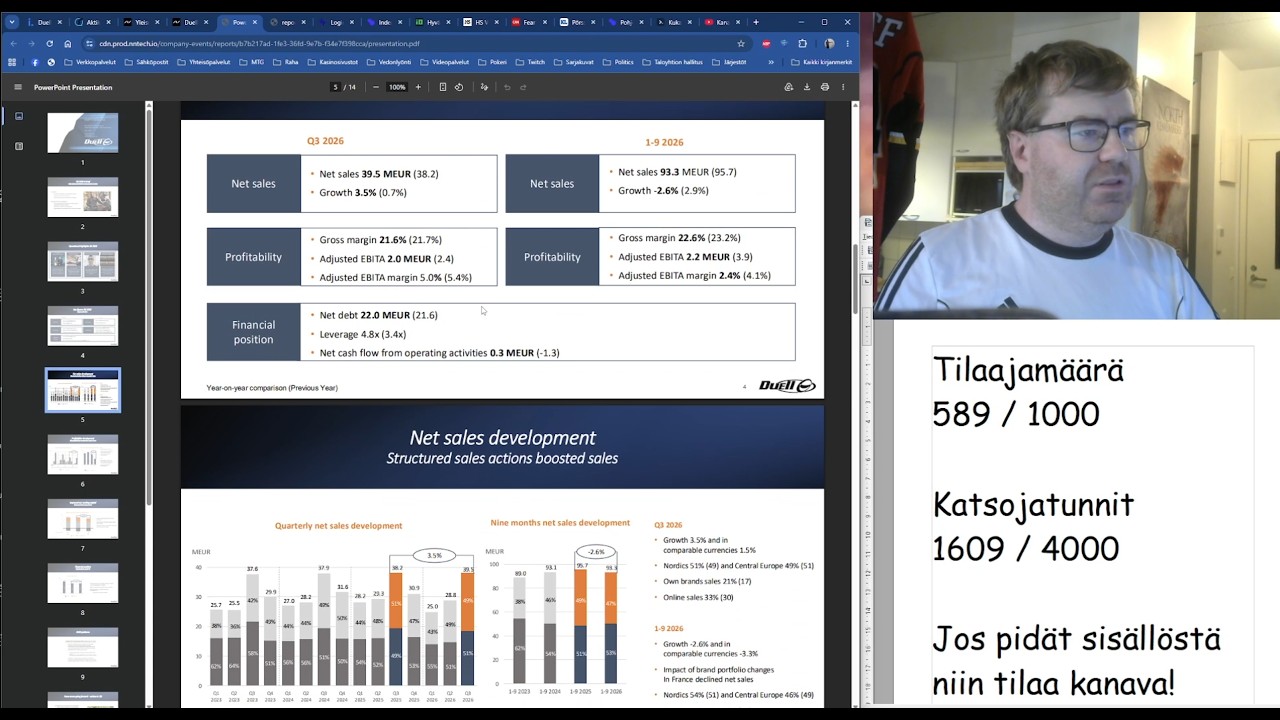
This was totally off the cuff and I just woke up, so content warning for even more “homemade” material than usual, featuring a few days’ worth of stubble 
5 Likes
On valuation and net debt:
Total current liabilities €21,593,000
Total non-current liabilities €21,050,000
Total liabilities = €42,643,000 
Total current receivables €25,459,000
Cash and bank balances €2,301,000
Total liquid assets = €27,760,000 
Actual net debt totals €14,883,000, and against this debt, there is inventory totaling €44,550,000. This results in a difference of ~€30 million in assets against the current market capitalization of €10.98 million. 
I reiterate my view: the stock remains blatantly undervalued, and anyone babbling about a “tight balance sheet position” with these figures still doesn’t know what they are talking about and is simply flat-out wrong. 
EDIT: To clarify for those who don’t yet understand, that inventory is on the balance sheet at Duell’s own purchase prices. Once you add the sales margin on top, its value is much higher than that €44.5 million, improving those figures even further.
6 Likes
Tommi interviewed CEO Tomi Virtanen regarding the Q3 results
Topics:
(00:00) Introduction
(00:18) Development in different market areas
(04:20) Focus areas
(06:14) Turnaround of the French subsidiary
(10:00) Working capital management
(14:28) Guidance remains unchanged
(19:59) Expectations for next year
4 Likes
Here is the company report from Tommi following Duell’s Q3 results
Duell’s Q3 results exceeded our forecasts, as the company achieved growth in the Nordics and Rest of Europe withstood the headwinds in France better than we expected. We raised our forecasts for the coming years, and the satisfactory results relative to the conditions, combined with what appears to be cautious guidance, strengthened our confidence in a gradual earnings turnaround. However, the recent clear share price rise has eaten into the short-term upside, and the tight financial position keeps the risk level elevated as the covenant “acid test” coincides with the end of the financial year. We raise our target price to EUR 2.40 (prev. EUR 2.00) following the forecast hikes and a moderately lower return requirement, but repeat our Reduce recommendation.
Quote from the report:
The share value according to our discounted cash flow (DCF) model is EUR 2.5, which is above the current share price (EUR 2.20). We moderately lowered the return requirement (WACC 11.4%, previously 12.2%) reflecting the gradual easing of balance sheet risk as inventories are reduced and covenant terms are met. The low market capitalization and high debt keep the valuation picture sensitive to changes in earnings levels and financial position. A financing solution affecting the number of shares would, of course, have a negative impact on the model’s value.
1 Like
There isn’t an immediate liquidity crisis there, but if customers are slow to pay or the business runs at a loss, €2M in cash isn’t much. The covenants have already been discussed here.
The company needs to keep EBITA growing, in which case there is a lot of potential. If that doesn’t happen, they’ll be walking on a knife’s edge.
3 Likes
If the CEO getting fired and a profit warning are just the sound of things cracking, then I hope I’m not on this train if it really starts to crash. 
2 Likes
I personally don’t see the CEO getting the boot after a profit warning and a 70% drop in the share price as a negative development, so I’m happy to be on board if the shake-up is positive too
Thanks @Tommi_Saarinen again for the high-quality analysis. I’m on the same page, although I personally see the expected return as good even if they had to take on even more expensive financing.
Based on the comments, I’m expecting an even weaker revenue trend from the rest of Europe. The wording regarding France suggested that there won’t be much revenue and that losses will likely accumulate. The scale of the French operations is puzzling. Last year, the problems in France already had a -€4 million impact on revenue, weighted towards the fourth quarter, and now the company is expecting a big drop on top of that. Total annual revenue has been around €200 million, weighted towards Q3 and Q4, so what revenue is even left there? Just scraps, or perhaps the talk and the figures don’t quite align.
The severe heatwave in France and Europe will likely have a negative impact on sales. In France, the overall sentiment is also quite weak in general. This is a second factor as to why I think we will end up with weak revenue for the rest of Europe.
But once we get past this Q4 and if there is money to prepare for the next financial year, it will be interesting to see what can be achieved again. Especially if we get plenty of snow this winter for a change. Well, we’ll see about those things then.
3 Likes
Duell still has absolutely no need to take on any additional financing with these figures.
“If there is money to prepare for the next financial year” — it’s not an “if”; there will be more than enough money following the strong Q4 cash flow.
Regarding the Inderes report: “Following the share price increase, the valuation is no longer exceptionally low.”
If the company is valued, including debt, at less than 1/3 of its assets and generates ~25% of its market cap in operating profit per year according to your own forecast in a weak market, I would like to know what you consider low?
Or alternatively, show me one company on the Helsinki Stock Exchange that is valued at lower specs.
1 Like
What kind of calculation and numbers are you basing it on that Duell will meet its covenants at the end of Q4? Last fiscal year, the Q4 covenant was a net debt of max 3x adjusted EBITDA.
If the covenants are not met, the lender has the right to terminate the loans, meaning that if the bank wants, Duell must pay down the debt to the required level or refinance the entire company. Where would that necessary money come from? I would be happy to be wrong about this, but according to my math, there is a clear risk here that matters are in the bank’s hands, not Duell’s.
Could you present the calculations and assumptions to the rest of us?
Of course, it is still possible that the bank will look the other way in exchange for extra financing costs.
2 Likes